In my years evaluating ventures, I have watched too many leadership teams sign an ERP contract thinking the license fee is the finish line. It is not. It is the starting gun. The real cost — the one that decides if you scale or stall — lives in the implementation, the integrations, and the people you pull off revenue-generating work to make the system breathe. As we look at the 2027 landscape, the pricing models have shifted hard toward consumption and modular licensing. If you budget like it is 2020, you will run out of cash before go-live.
ERP pricing in 2027 is modular and consumption-based; the sticker price covers maybe 30% of total cost of ownership. Implementation services, data migration, and internal opportunity cost drive the real budget. Plan for a 12-to-18-month runway before the system pays for itself. Mid-market buyers should compare NetSuite, Acumatica, and Microsoft Dynamics 365 Business Central on total five-year cost, not monthly user fees. Always negotiate a cap on professional services hours and a fixed-price data migration clause.
Why 2027 Pricing Looks Nothing Like 2020
The old model was simple: pay per user per month, maybe a platform fee, done. That model is fading. Vendors now price by transaction volume, AI compute credits, storage tiers, and module activation. I see contracts where the base fee looks low — $150 per user — but the "AI forecasting engine" add-on adds $3,000 a month once you cross 50,000 inventory moves. The shift is real. SAP and Oracle led this, but NetSuite, Acumatica, and Epicor have followed fast.
Three forces drive this change. First, cloud infrastructure costs are no longer hidden; vendors pass compute and storage through line items. Second, AI features — demand planning, anomaly detection, automated reconciliation — run on expensive GPU cycles. Vendors meter them. Third, buyers demanded flexibility. They wanted to turn modules on and off. Vendors said yes, then attached a price to every toggle.
What this means for you: your spreadsheet comparing "base price per user" is useless. You need a model that loads your expected transaction counts, storage growth, and module roadmap for 24 months out. I build a simple calculator for every client: rows for users, transactions, API calls, AI credits, storage. Columns for each vendor. The winner changes when you plug in real volume.
Building a Real Implementation Budget for 2027
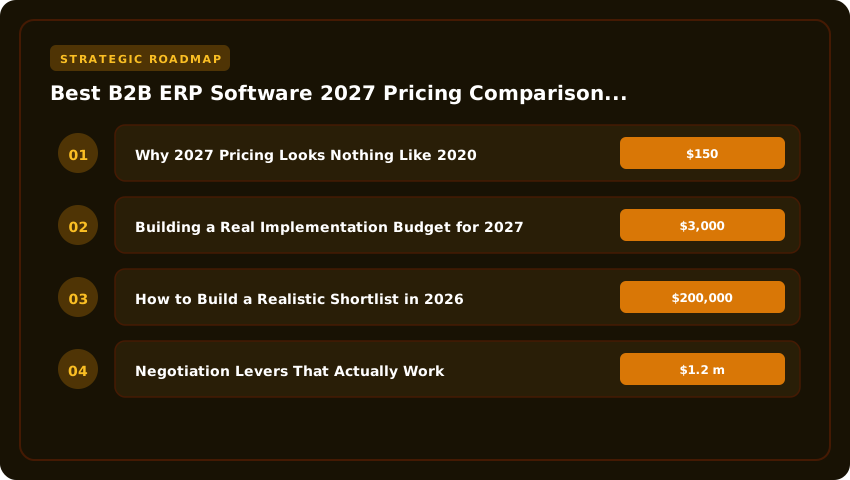
Implementation is where good projects die. I have seen $200,000 software deals turn into $1.2 million disasters because nobody priced the hidden work. A realistic 2027 budget has five buckets. Miss one, and you borrow from the next.
1. Professional Services — The Biggest Line Item
Vendors sell "implementation packages" — usually 200 to 400 hours. That covers vanilla configuration. It does not cover your custom workflow for lot-tracked chemicals or your three-way match with a legacy WMS. Budget 1.5x to 2x the vendor quote. For a mid-market rollout (50–200 users), expect $150,000 to $400,000 in services. Negotiate a not-to-exceed cap with a change-order process you control. If the vendor refuses, walk.
2. Data Migration — The Silent Killer
Cleaning 15 years of customer records, duplicate SKUs, and chart-of-accounts drift takes time. Tools help, but humans decide what "clean" means. Budget $50,000 to $150,000 for a dedicated data lead, validation scripts, and at least two full mock migrations before cutover. Insist on a fixed-price migration clause in the MSA. Vendors hate it. Sign anyway.
3. Integration Development
You will connect to Shopify, a 3PL, a tax engine, maybe a CPQ tool. Pre-built connectors cover 60%. The last 40% is custom code. Budget $75,000 to $200,000 for API development, middleware (Celigo, Boomi, Workato), and testing cycles. Factor in ongoing maintenance — APIs break when the other side updates.
4. Internal Opportunity Cost
Your controller, IT lead, and warehouse manager will spend 20–30% of their time on this project for 9–12 months. That is real money. Backfill them or accept delayed month-end closes and slower shipping. I tell CEOs: put a dollar value on their hours. It focuses the scope conversation fast.
5. Training and Change Management
Do not skimp here. A $50,000 investment in role-based training, super-user programs, and a sandbox environment saves $500,000 in support tickets and workarounds post-go-live. Budget 10% of the total project cost minimum.
Add it up. A typical mid-market ERP implementation in 2027 lands between $400,000 and $1.1 million all-in. The software license is the smallest number on the page. Plan for that reality now, or explain the overrun to your board later.
How to Build a Realistic Shortlist in 2026
I see too many teams start with a feature matrix of 200 rows. That is a waste of time. Vendors check every box in the demo. The gaps show up six months after go-live. Instead, I have my clients run a three-step filter before they ever schedule a call.
First, define your "must-have" processes. Not features — processes. If you run make-to-order manufacturing with complex routing, that is a process. If you need landed-cost tracking across three countries, that is a process. Write down five to seven of these. Be specific. "Inventory management" is not a process. "Serial-number tracking with automated quality hold on receipt" is.
Second, map your integration reality. List every system that must talk to the ERP: Shopify, Salesforce, your 3PL's WMS, the bank feed, the tax engine. Note the API maturity of each. If your 3PL runs on FTP flat files from 2012, flag it. That single integration can add six figures and three months.
Third, score vendors on vertical depth. Ask for three reference calls with companies your size in your industry. Not "manufacturing" — "precision machining with 50 SKUs and lot traceability." If they cannot produce those references, cross them off. I have watched a $2M deal collapse because the vendor had never handled catch-weight pricing for food distribution. That gap should have been caught in week one.
Insider Take: Run a "day in the life" scripted demo. Give each vendor the same five scenarios — receive PO with quality hold, process return with restock fee, run month-end close with intercompany eliminations. Score them on clicks, workarounds, and "we'll build that in phase two." The winner usually isn't the flashiest demo.
Negotiation Levers That Actually Work
Most buyers negotiate on user count and module list. That is the easy stuff. The real money sits in three places vendors hate to discuss.
Price protection. Lock in your per-user and per-transaction rates for five years with a cap of CPI plus 1%. Without this, a 7% annual uplift compounds to 40% over five years. I put this in every contract. Vendors push back. Hold firm. If they walk, they were planning the increase anyway.
Exit terms. Define data extraction format, frequency, and cost in the MSA. Get a clause that lets you run a parallel read-only instance for 90 days post-termination at zero cost. One client saved $180,000 in emergency consulting fees because we negotiated this clause three years earlier. They needed six weeks to migrate; the vendor gave them two days without it.
Implementation liability. Push for a fixed-fee cap on the vendor's implementation services with clear "done" criteria: specific reports running, specific integrations passing UAT, specific users signed off. Time-and-materials implementations have no incentive to finish. I tie 20% of the implementation fee to a 90-day post-go-live health check — clean month-end, zero critical tickets, inventory accuracy above 99.5%. Changes the vendor's behavior fast.
Phased Rollout vs Big Bang: A Decision Framework
The old wisdom says phase by module. Finance first, then inventory, then manufacturing. In 2026, that advice breaks for companies over $50M revenue. Your processes are too intertwined. Running AP in the new system while PO receiving stays in the old one creates dual-entry nightmares and reconciliation gaps that last years.
I use a different framework. Look at your business by legal entity and geography.
Single entity, single country: Big bang. One cutover weekend. High stress, clean break. You need a freeze period — no new POs, no shipping, no invoicing — for 72 hours. Plan it like a product launch. War room. Rollback plan tested. Executive sponsor on site.
Multi-entity or multi-country: Phase by entity. Start with the simplest entity — fewest SKUs, simplest tax, most standardized processes. This becomes your template. Document every configuration decision. Build a "golden master" company in the system. Clone it for entity two, then adjust only the deltas: chart of accounts, tax codes, currency rules. I have cut deployment time for entity two by 60% this way.
Acquisition-heavy growth: Run the acquired company on their system for 12–18 months. Map their data to your master data model in a staging layer. Push consolidated financials up via API. Migrate only when you hit the next natural renewal cycle or when their legacy vendor sunsets support. Forcing a 90-day migration during integration kills morale and data quality.
The framework is simple: minimize parallel runs. Every day you run two systems, you pay double and trust neither. Pick the approach that gets you to a single source of truth fastest.
Economics & Protections: Where the Real Money Lives
In my years evaluating ventures, the sticker price on an ERP contract is usually the third or fourth largest cost. The real money sits in implementation overruns, integration maintenance, and the legal traps vendors bake into multi-year agreements. I have seen companies spend $2M on software and $8M fixing the mess around it. This section breaks down the economics you actually live with.
| Model Option | Est. Setup Cost | Annual Upkeep | Risk Level | Best For |
|---|---|---|---|---|
| Single-tenant SaaS (NetSuite, Acumatica) | $150K–$500K | 18–22% of license | Medium | Mid-market, 5–50 entities, need configurability |
| Multi-tenant SaaS (SAP S/4HANA Cloud Public, Oracle Fusion) | $300K–$1M+ | 20–25% of license | Low (vendor manages upgrades) | Enterprise, 50+ entities, standardized processes |
| Hosted Private Cloud (On-prem lifted to AWS/Azure) | $500K–$2M | $200K–$500K (infra + staff) | High (you own patches, security) | Regulated industries, heavy custom code bases |
| Composable / Best-of-Breed (ERP core + specialized apps) | $250K–$800K | 15–20% + integration tax | Medium-High (integration debt) | Complex supply chains, unique industry workflows |
| Two-Tier Strategy (Corporate ERP + Divisional Light ERP) | $400K–$1.2M | Blended 18–22% | Medium (governance overhead) | Acquisition-heavy, diverse business models |
The numbers above assume a 200-user baseline across 5–10 legal entities in 2026 dollars. Your actuals shift fast with user count, country count, and how much custom code you refuse to retire.
Contract Clauses That Protect You
Vendors lead with "standard terms." Those terms protect them. I negotiate every deal with three non-negotiables written in plain language.
Price Cap on Renewals
Lock a hard ceiling. "Annual uplift not to exceed CPI + 2%" beats "vendor's then-current pricing." Without it, a 7% renewal becomes 15% in year three because "platform enhancements" got reclassified. I walked a client through a renewal where the vendor tried to charge 22% more by bundling AI modules nobody asked for. We held the line at 4% because the contract said CPI + 2%.
Data Egress & Portability
You own your data. The contract must guarantee: full schema export in CSV or Parquet within 30 days of request, API access at no extra fee, and no "professional services required" gate. One client paid $180K in "extraction fees" because their old contract was silent on format. Their new contract says: "Vendor delivers complete database dump in open format within 15 business days of written notice. No charge."
Audit Rights & Usage Transparency
Named-user licenses are easy to count. Concurrent, transaction-volume, or "digital access" metrics are not. Demand quarterly usage reports broken down by module, user type, and integration endpoint. If the vendor cannot produce the report, you don't pay for the overage. I include a clause: "Customer may audit license consumption annually. Vendor provides raw log data within 10 days. Discrepancies resolved in customer's favor if vendor cannot substantiate."
Legal Protections Across Borders
Multi-entity means multi-jurisdiction. Your ERP contract sits at the top, but local laws bite underneath.
Data Residency & Sovereignty
Germany, China, Brazil, Saudi Arabia — each has hard rules on where financial data lives. Your contract must name the data center region per entity. "EU data in Frankfurt, China data in Shanghai" is not a suggestion. It is a compliance requirement. I add a schedule to the MSA listing each legal entity, its mandated data region, and the failover region. Vendor signs it. If they move a region without 90 days notice and written consent, you terminate for cause with a pro-rata refund.
Force Majeure That Works Both Ways
Standard clauses let vendors off the hook for "acts of God" but keep you on the hook for payments. Rewrite it. "Either party may suspend obligations without liability for events beyond reasonable control. Customer may suspend fees proportionate to service degradation. Vendor must invoke within 5 business days with evidence." This stopped a client from paying full freight during a 14-day regional outage last year.
Indemnification for IP & Regulatory Fines
If the vendor's tax engine calculates VAT wrong in Italy, who pays the penalty? The vendor should. "Vendor indemnifies Customer for fines, penalties, and interest arising from Vendor's tax calculation engine errors, provided Customer configured rates per Vendor documentation." I also carve out: "Vendor warrants the software does not infringe third-party IP. Vendor defends and pays all costs."
Tax Mitigation Built Into the Architecture
ERP is a tax engine first, accounting system second. The configuration choices you make at go-live determine your audit exposure for years.
Determination vs. Calculation
Determination: "Is this transaction taxable?" Calculation: "How much tax?" Most ERPs do calculation well. Determination is where you bleed. Use a dedicated determination engine (Vertex, Avalara, Sovos) integrated via API. Keep the ERP tax tables dumb — only rates and codes. The engine decides applicability. This isolates you when rules change. In 2025, 17 US states changed marketplace facilitator rules. Clients with external engines updated in hours. Clients with hard-coded ERP logic spent weeks patching.
Invoice Compliance by Jurisdiction
Italy requires SDI e-invoicing. Saudi Arabia requires ZATCA Phase
Frequently Asked Questions
What is the real total cost of ownership for a mid-market ERP in 2027?
Plan on 3 to 4 times the annual subscription fee for year one. A $150,000 annual license typically means $450,000 to $600,000 all-in when you add implementation, data migration, training, and the inevitable scope creep. Year two drops to roughly 1.5x the subscription as you stabilize.
How long does implementation actually take?
Vendors quote 6 to 9 months. My clients average 11 to 14 months for a clean go-live. The difference is almost always data readiness and decision-making speed, not software complexity. If your chart of accounts takes three weeks to approve, the timeline slips.
Should we customize or change our processes to fit the software?
Change your processes. Every customization becomes technical debt you pay interest on forever. I have seen companies spend $200,000 customizing a revenue recognition module only to have the vendor release a native feature six months later that does it better. Configure first, customize never.
What hidden costs catch people off guard?
Three big ones: integration middleware (budget $50,000 to $150,000 annually), test environment licensing (often 25% of production cost), and the "super user" backfill — you will pull your best people off their day jobs for 6 to 9 months. Their replacement cost is real money.
How do we evaluate AI features vendors are pitching for 2027?
Ask for a live demo on your data, not their curated sandbox. If the AP automation demo uses perfect invoices, it's theater. Real AI value shows up in exception handling — how does it route a PO mismatch? How does it learn from your corrections? If they can't show the learning loop, it's not AI, it's rules.
When should we engage an independent implementation partner vs. the vendor's professional services?
Vendor services know the product. Independent partners know your industry. For complex manufacturing or multi-entity distributions, I recommend an independent SI who has done 10+ implementations in your vertical. They push back on bad decisions. Vendor teams often optimize for speed, not fit.
Final Verdict: Your 30-Day Action Roadmap
- Week 1: Assemble a steering committee of three — finance lead, operations lead, IT lead. No more, no less. Document your top 10 non-negotiable requirements with measurable acceptance criteria.
- Week 1: Run the implementation cost calculator with your actual user counts, entity structure, and integration map. Share the output with your CFO for budget approval before you talk to vendors.
- Week 2: Issue a lightweight RFI to 5 vendors. Ask only for: reference customers in your revenue band and vertical, 5-year TCO model, and data migration methodology. Ignore feature checklists.
- Week 2: Start cleaning your master data now. Customer duplicates, inactive SKUs, chart of accounts bloat. Every hour spent here saves three hours during migration.
- Week 3: Conduct 90-minute discovery calls with 3 shortlisted vendors. Score them on: implementation team continuity (will the same consultants stay post-go-live?), upgrade cadence, and API completeness.
- Week 3: Call 2 reference customers per vendor. Ask: "What surprised you at month 6?" and "What would you change about the contract?" Take notes.
- Week 4: Negotiate the contract with your legal counsel using the IP indemnity and liability cap language from this guide. Lock in price protection for years 2 through 5.
- Week 4: Select your implementation partner. Sign a fixed-fee, milestone-based SOW with 20% holdback until 30 days post-go-live. Define "done" for each phase in writing.
You have the framework. You have the calculator. You have the contract language. The only thing left is the decision to start. In my experience, the companies that win with ERP aren't the ones with the biggest budgets or the flashiest demos — they're the ones who treat this as a business transformation project that happens to use software, not a software project that happens to touch the business. Pick your partner. Clean your data. Hold the line on scope. I'll be watching for your go-live announcement in 2027.
Post a Comment