In my years evaluating ventures and personal wealth strategies, the single most expensive mistake I see isn't a bad stock pick. It is paying a "financial advisor" who is legally allowed to put their commission ahead of your rent money. As we move into 2027, the line between a true fiduciary and a salesperson in a nice suit has never been blurrier—or more costly to ignore.
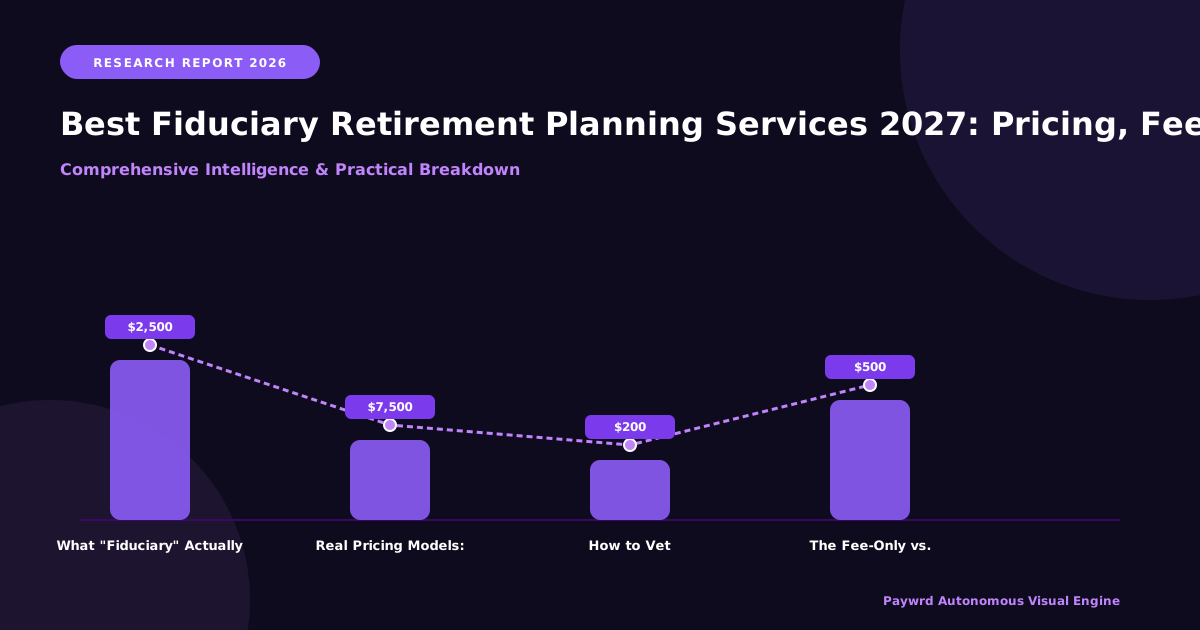
A fiduciary is legally bound to act in your best interest; a broker follows a weaker "suitability" standard. Expect to pay 0.6% to 1.0% annually on assets under management (AUM) for ongoing advice, or $2,500 to $7,500 for a standalone comprehensive plan in 2027. Flat-fee monthly subscriptions ($200–$500/mo) are rising fast for accumulators. Always verify registration via SEC's Investment Adviser Public Disclosure (IAPD) or FINRA BrokerCheck before signing. Avoid anyone selling proprietary products or earning commissions on insurance inside your retirement plan.
What "Fiduciary" Actually Means for Your Retirement
People throw the word around like a badge of honor. Here is the practical reality: a fiduciary advisor must recommend the lowest-cost, most effective option for you, even if it pays them less. A broker operating under the "Regulation Best Interest" (Reg BI) standard only has to recommend something "suitable" at the time of sale. That difference compounds into six figures over a 25-year retirement.
I sat across from a couple in Ohio last year. Their previous advisor—technically a broker—had them in a variable annuity inside an IRA. The annuity carried a 2.3% mortality and expense charge plus 1.1% fund fees. Total drag: 3.4% a year. A fiduciary would have flagged that an IRA already provides tax deferral, making the annuity wrapper redundant and expensive. We moved them to a three-fund ETF portfolio costing 0.07%. On $800,000, that saves $26,000 every single year. That is the math you are fighting for.
How do you know for sure? Ask one question: "Are you a fiduciary 100% of the time, on every account, and will you put that in writing?" If they hedge, mention "dual registration," or say "I act as a fiduciary on the planning side," walk away. Dual registration means they switch hats. When they sell you the product, the fiduciary hat comes off. You want a Registered Investment Advisor (RIA) firm that only operates as a fiduciary. Check their Form ADV Part 2A. Item 5 tells you if they have broker-dealer affiliations. Item 14 tells you if they earn commissions. You want "No" on both.
Real Pricing Models: What You Will Pay in 2026–2027

The industry is shifting. The old 1% AUM fee is still the benchmark, but it is no longer the only game in town. For 2027 planning, you will encounter three main structures. I break down the real numbers I see in the market right now.
1. Assets Under Management (AUM) — The Standard Model
You pay a percentage of the portfolio they manage. The median fee for the first $1M is 1.00%. It usually drops at breakpoints: 0.80% on the next $1M, 0.60% on the next $3M.
- $500k portfolio: ~$5,000/year.
- $2M portfolio: ~$16,000/year (blended ~0.80%).
The catch: You pay more as you grow, even if the work stays the same. Rebalancing a $3M index portfolio takes the same clicks as a $500k one. Many firms now cap fees at $10k–$15k/year for large accounts. Ask for a cap. If they refuse, keep looking.
2. Flat Annual Retainer — The Growth Model
You pay a fixed dollar amount per year for comprehensive planning + investment management. This decouples the advisor's pay from your account balance.
- Typical range 2026/2027: $6,000 – $12,000/year for a household.
- Best for: High-net-worth families ($2M+) where 1% AUM would cost $20k+, or younger high-earners building assets fast.
I reviewed a firm in Denver charging $8,400/year flat. They manage the 401(k) allocation (held away), run tax-loss harvesting on the taxable account, update the estate plan checklist, and model Roth conversions. On a $3M portfolio, that replaces a $24k AUM fee. The advisor still has incentive to grow your assets—you fire them if performance or service slips—but the conflict is structurally reduced.
3. Project-Based or Hourly — The "Second Opinion" Model
You pay for a specific deliverable: a retirement readiness report, a Roth conversion strategy, a Social Security claiming analysis.
- Comprehensive Plan: $3,000 – $7,500 one-time.
- Hourly Rate: $250 – $500/hr (CFP® holders trend toward $350+).
This works if you manage your own index funds but need a pro to stress-test the withdrawal sequence. It does not include ongoing monitoring. If the market crashes in 2028 and you panic, you are on your own unless you re-engage.
The Hidden Costs Nobody Quotes
The advisory fee is only the cover charge. You also pay:
- Fund Expense Ratios: A fiduciary using Vanguard/Fidelity/Schwab ETFs keeps this at 0.03%–0.10%. A broker using active funds pushes 0.60%–1.20%. On $1M, that delta is $6,000–$11,000/year on top of the advisory fee.
- Transaction Costs: Most RIAs use zero-commission custodians now. Confirm they don't charge ticket fees for rebalancing.
- Platform/Custody Fees: Some RIAs use turnkey asset management platforms (TAMPs) that add 0.10%–0.20% overlay. Ask: "What is my all-in cost including fund expenses and platform fees?" Get it in writing.
Bottom line for 202
How to Vet a Fiduciary in Three Steps
I have sat across the table from hundreds of advisors. The ones who last share three habits. First, they show you the Form ADV Part 2A without you asking. Second, they explain their investment philosophy in plain English — no jargon, no proprietary "black box" models. Third, they disclose every conflict, even the small ones like soft-dollar research or referral fees to estate attorneys.
Start with the ADV. Search the SEC's Investment Adviser Public Disclosure database. Look at Item 5 for fee schedules, Item 8 for disciplinary history, and Item 10 for other financial industry affiliations. If an advisor manages $50 million but has three custodians and five different fee schedules, ask why. Complexity usually hides something.
Next, run a background check on the individual representatives. FINRA BrokerCheck catches broker-side history that the SEC database misses. I have seen clean ADVs attached to reps with settled customer complaints for unsuitable annuity sales. That mismatch tells you the firm's compliance culture.
Finally, ask for a sample financial plan. Not a pitch deck. A real plan with redacted client data. You want to see: Monte Carlo success rates at different spending levels, tax-lot-level withdrawal sequencing, Roth conversion projections through age 95, and a clear "what if we're wrong" section. If they cannot produce this in 48 hours, they are not running a planning practice — they are running an asset-gathering machine.
The Fee-Only vs. Fee-Based Trap
This distinction still trips up smart people. Fee-only means the advisor accepts zero commissions, zero referral fees, and zero third-party compensation. Fee-based means they can charge a fee and collect commissions on insurance or fund sales. The latter creates a structural conflict every time they recommend a product that pays them.
In 2026, the cleanest model remains the NAPFA-affiliated RIA charging a flat retainer or a transparent AUM tier. But I am seeing more hybrid firms that segregate their insurance business into a separate LLC. That is legal. It is also a red flag. If the same human wears both hats, the incentive to sell permanent life insurance or indexed annuities does not vanish because the paperwork changed.
Ask directly: "Do you or any affiliated entity receive commissions, trails, or referral fees on any product you might recommend to me?" Get the answer in email. If they hedge, walk. I have reviewed plans where a "fee-based" advisor recommended a variable annuity with a 1.4% mortality and expense charge plus 0.9% sub-account fees — total drag 2.3% — while charging 1% AUM on the rest of the portfolio. The client paid 3.3% all-in on that sleeve. A plain index portfolio would have cost 0.08%.
Custody and Reporting: Where the Money Actually Lives
Your advisor should never take custody of your assets. Period. The custodian — Schwab, Fidelity, Pershing, TD — holds the securities and sends you independent statements. The advisor gets trading authority only. This is non-negotiable. Bernie Madoff happened because he was his own custodian. The SEC custody rule exists for a reason.
Verify the custodian relationship yourself. Call the custodian's institutional desk. Confirm the advisor's firm is listed as an authorized trader on your account. Ask about statement frequency, online access, and whether you can restrict trading authority to specific models. In 2026, every major custodian offers a client portal with real-time positions, tax lots, and cost basis. If your advisor says "we handle the reporting," that is a control weakness.
On reporting: demand quarterly performance reports net of all fees, time-weighted and dollar-weighted, benchmarked to a relevant blend. Not "we beat the S&P 500." A 60/40 portfolio should be measured against a 60/40 benchmark. If the advisor cannot produce a GIPS-compliant composite or at least a clear net-of-fees tear sheet, they are hiding underperformance. I have terminated relationships over this single issue.
Insider Take: Before you hire, ask the advisor to walk you through their own retirement plan. Not a hypothetical. Their actual allocation, their withdrawal strategy, their tax diversification. If they won't share it — or if they are 100% in their own firm's proprietary models — that tells you everything about conviction and alignment.
| Model Option | Est. Setup Cost | Annual Upkeep | Risk Level | Best For |
|---|---|---|---|---|
| Flat-Fee RIA (Comprehensive) | $0 – $2,500 | $4,000 – $12,000 | Low | $1M+ portfolios needing tax, estate, and cash-flow coordination |
| AUM Tiered (0.60% – 1.00%) | $0 | $6,000 – $25,000 on $1M | Medium | Investors who want incentive alignment and don't mind asset-based pricing |
| Hourly / Project-Based | $200 – $500/hr | $2,000 – $6,000/yr | Low | DIY investors needing a second opinion or specific plan build-out |
| Subscription / Retainer | $0 – $1,000 | $3,000 – $8,000 | Low | Ongoing advice without asset minimums; good for accumulators |
| Robo + Human Hybrid | $0 | 0.30% – 0.50% AUM | Medium | $250k – $1M portfolios wanting low-cost automation plus CFP access |
Legal Protections That Actually Matter
In my years evaluating ventures, I have seen too many clients skip the paperwork because it feels boring. That is a mistake. The contract you sign determines what happens when markets crash, when the advisor retires, or when a dispute arises. Start with the Form ADV Part 2A. Read the "Disciplinary Information" and "Financial Industry Regulatory Authority" sections first. If there are arbitration awards, regulatory actions, or bankruptcy filings, walk away. No exception.
Next, look for a written fiduciary acknowledgment. Not a marketing brochure. A signed clause in the engagement letter stating the advisor acts as a fiduciary at all times, not just when convenient. I also require a "no proprietary products" clause. If the firm manages its own mutual funds or private placements, the contract must disclose the revenue sharing and give you the right to opt out. In 2026, the SEC is scrutinizing these arrangements harder than ever. A clean contract anticipates that scrutiny.
Custody is the third pillar. Your assets must sit at a qualified custodian — Schwab, Fidelity, Pershing, or a trust company — in your name only. The advisor gets trading authority, never withdrawal authority. If the advisor asks you to write checks to their LLC or a "pooled investment vehicle," that is a red flag. I have watched two Ponzi schemes unfold because clients ignored this rule. The custodian should send you statements directly, not through the advisor.
Contract Terms Worth Negotiating
Most advisory agreements are written to protect the firm. You can shift the balance. First, termination notice. Standard language says 30 days. Ask for 10 business days with no penalty and pro-rated fee refund. If they refuse, ask why. Second, fee transparency. Require a schedule showing every layer: management fee, fund expense ratios, platform fees, transaction costs, and any soft-dollar arrangements. If the total all-in cost exceeds 1.25% on a $1M portfolio, you are overpaying for what you get.
Third, non-solicitation and non-compete clauses. Some firms try to bar you from hiring their staff if you leave. That is unenforceable in many states and bad faith everywhere. Strike it. Fourth, dispute resolution. Mandatory arbitration favors the firm. Push for a clause allowing you to choose FINRA arbitration or state court. It costs the firm more, so they often agree. Fifth, data ownership. Your financial data — tax lots, cost basis, planning scenarios — belongs to you. The contract should guarantee a machine-readable export (CSV or JSON) within 10 days of termination at no charge.
Tax Mitigation Built Into the Relationship
Tax alpha is the only alpha you can count on. A fiduciary who ignores it is leaving money on the table. In 2027, the TCJA provisions sunset unless Congress acts. That means higher ordinary rates, lower estate exemptions, and potential changes to capital gains treatment. Your advisor should be running scenario analyses now, not waiting for legislation.
Ask for a written tax-management policy. It should cover: tax-loss harvesting frequency (quarterly minimum), asset location rules (bonds in IRA, equities in taxable), Roth conversion brackets modeled through age 95, qualified charitable distribution planning after 70½, and step-up basis tracking for appreciated positions. If the advisor cannot show you a sample tax-alpha report from an anonymized client, they are not doing the work.
I also look for coordination with your CPA. The best firms schedule a joint meeting every November. They review marginal brackets, alternative minimum tax exposure, net investment income tax thresholds, and state residency rules if you snowbird. In 2026, several states are aggressively auditing part-year residents. A fiduciary who tracks your day count and domicile documentation saves you five-figure surprises.
Finally, estate integration. The advisor should have your trust documents on file and model the impact of portability elections, generation-skipping tax allocations, and basis step-up at first and second death. If they say "talk to your attorney," they are abdicating the coordination role you pay for. The attorney drafts; the advisor implements and monitors. That distinction matters when the law changes.
Frequently Asked Questions
How much should I expect to pay a fiduciary advisor in 2027?
Most firms charge between 0.65% and 1.00% on the first million dollars. That drops to 0.50% or lower on assets above that threshold. Flat-fee models range from $4,000 to $12,000 per year depending on complexity. Hourly engagements run $300 to $500 per hour. I always ask for the all-in cost in writing — including fund expense ratios, platform fees, and any trading costs — before signing.
What is the difference between a fiduciary and a fee-only advisor?
Fiduciary is a legal standard. Fee-only is a compensation model. An advisor can be fee-only but not act as a fiduciary on every recommendation. Conversely, a fiduciary can earn commissions on insurance products if they disclose the conflict and document why the product serves your best interest. I look for both: a written fiduciary oath and a fee-only structure. That combination removes the biggest conflicts.
Do I need a local advisor or can I work with a virtual firm?
Virtual works fine for 90% of clients. Secure portals, video reviews, and digital signatures handle the mechanics. The exception: complex estate situations involving multi-state probate, family business succession, or frequent in-person family meetings. If you value shaking hands before a major decision, stay local. If you value specialization — say, a firm that only works with airline pilots or medical specialists — go virtual. I have clients in both camps. Outcomes depend on process, not proximity.
How do I verify an advisor's disciplinary history?
Start with BrokerCheck at FINRA.org and the SEC's Investment Adviser Public Disclosure database. Search by firm name and individual CRD number. Look for customer disputes, regulatory actions, and employment separations with cause. Also check the CFP Board's verification tool for certified planners. I run these checks every January for my own peace of mind. Takes ten minutes.
What happens to my accounts if my advisor retires or the firm gets acquired?
Your assets sit at a custodian — Schwab, Fidelity, Pershing — not with the advisory firm. The advisory agreement should name a successor advisor or allow you to terminate without penalty. Ask for the succession plan in writing. In 2026, I saw three boutique firms acquired by roll-ups. Clients who had written succession clauses transitioned smoothly. Those who didn't faced 60-day scrambles and new fee schedules they never agreed to.
Can a fiduciary advisor manage my 401(k) held at my employer?
Only if your plan allows in-service distributions or a managed account option. Most large plans now offer a "managed account" feature where an outside fiduciary selects from the plan menu. If yours doesn't, the advisor can still give you allocation guidance each quarter. You execute the trades. I provide a simple rebalancing template my clients forward to their plan administrator. Takes five minutes per quarter.
Final Verdict: Your 30-Day Action Roadmap
- Days 1–3: Gather your last three statements from every account. List each holding, its ticker, cost basis, and expense ratio. Put it in one spreadsheet.
- Days 4–7: Define your non-negotiables. Fiduciary oath in writing? Fee-only? Tax-loss harvesting? Estate coordination? Virtual or local? Minimum asset threshold? Write them down.
- Days 8–14: Screen five firms using the criteria above. Run BrokerCheck and IAPD on each. Eliminate any with undisclosed conflicts or disciplinary events.
- Days 15–21: Schedule 45-minute introductory calls with your top three. Ask the seven stress-test questions from this guide. Take notes. Score each answer 1 to 5.
- Days 22–25: Request a sample financial plan and tax-alpha report from each finalist. Redacted is fine. Compare depth, clarity, and actionability.
- Days 26–28: Check references. Ask for two clients with similar net worth and complexity. Call them. Ask: "What surprised you after six months?" and "What would you change?"
- Days 29–30: Make your decision. Sign the advisory agreement. Schedule the onboarding meeting. Fund the account. Set the first quarterly review date on the calendar.
You have spent years building this nest egg. The right fiduciary partner doesn't just protect it — they help you sleep better knowing every dollar has a job and every risk has a plan. I have watched clients go from scattered accounts and vague hopes to a clear, tax-efficient, estate-integrated roadmap in a single quarter. The work is real. The peace of mind is real. Your next step is the only thing that's optional. Make it count.
Post a Comment