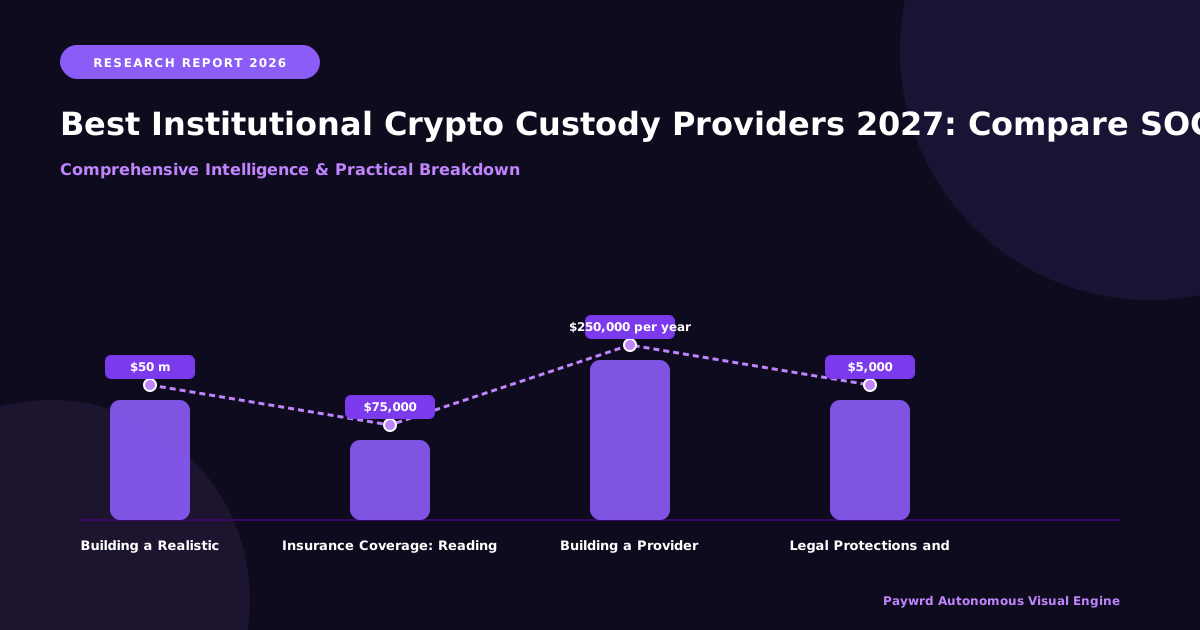
Choosing an institutional crypto custody provider in 2027 starts with two non-negotiable checks: a verified SOC 2 Type II report and clear insurance coverage with defined limits. Not all certifications are equal, and a provider without a current SOC 2 Type II audit leaves your assets unvetted from a security standpoint. Budget realistically for custody costs, which range from flat monthly fees to percentage-based models, and always confirm what your insurance actually covers before signing. The provider you pick today will define your operational risk for years to come.
If you are responsible for safeguarding digital assets on behalf of an organization, you already know this is not like choosing a bank account. One wrong custody decision can expose millions to risk that no spreadsheet can easily fix. I have spent years watching institutions rush into crypto custody agreements without fully understanding what separates a secure provider from a risky one. In 2026, the market matured significantly. More providers earned SOC 2 Type II certifications, and insurance products became more available. But the landscape in 2027 demands even sharper scrutiny. You need to know exactly what you are buying, what is covered, and what is left exposed.
Why SOC 2 Type II Is Your Starting Point, Not Your Finish Line
When I evaluate a custody provider, the first document I ask for is the SOC 2 Type II report. This audit proves that a provider has controls in place for security, availability, and confidentiality, and more importantly, that those controls have been tested over a sustained period. A SOC 2 Type I report only shows that controls existed at a single point in time. Type II proves they work consistently. That distinction matters enormously when you are trusting someone with institutional funds.
Here is what I have learned: not all SOC 2 Type II reports are created equal. Some providers get audited on a narrow set of trust principles. Others cover a broader scope including processing integrity and privacy. In 2026, I reviewed several providers who proudly displayed their certification, but when I dug into the scope, their audit excluded key infrastructure components. Before you accept any certificate, ask for the full report and confirm the audit period. A current report covering at least 12 months of tested controls is the minimum I will accept.
I also look for whether the audit was conducted by a recognized firm. Reports from lesser-known auditors may lack the rigor you need. In my experience, certifications from Big Four accounting firms carry more weight during your own internal compliance reviews. If your institution faces regulatory inspection, the credibility of your custody provider's audit matters to the people reviewing your controls.
Building a Realistic Custody Budget for 2026 and Into 2027
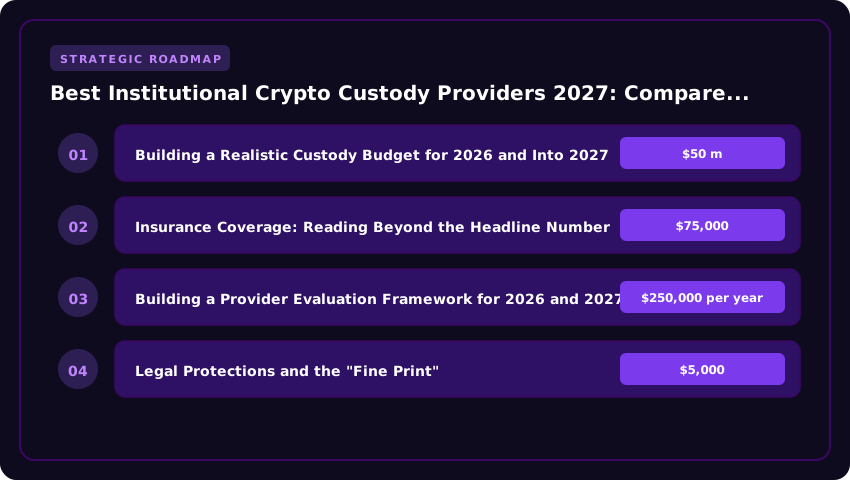
Custody costs have shifted. In 2025, many providers charged flat monthly fees that made sense for large asset holders but punished smaller accounts. By 2026, the market adjusted. I now see a wider range of pricing models, and understanding them is essential to budgeting correctly.
The most common model I encounter is the percentage-based fee. Providers typically charge between 0.15% and 0.50% of assets under custody annually. For a portfolio worth $50 million, that translates to $75,000 to $250,000 per year. This model scales naturally with your holdings, but it can become expensive if your assets grow significantly without renegotiating terms.
Another model I have seen work well for mid-sized institutions is a tiered flat fee. You might pay $5,000 per month for assets up to $10 million, with stepped pricing above that threshold. This gives you cost predictability. I prefer this approach when I am advising organizations that want to forecast expenses accurately across a fiscal year.
Do not forget hidden costs. Transaction fees for withdrawals and transfers, integration fees for connecting to your existing systems, and fees for custom reporting all add up. In 2026, I have seen institutions sign custody agreements based on the headline rate alone, only to discover that operational fees added 30% or more to their total annual cost. Always request a complete fee schedule before committing. Ask specifically about costs for insurance claims processing, because that is an area where some providers quietly pass expenses to the client.
Looking toward 2027, I expect pricing competition to increase as more providers enter the market and as institutions demand more transparency. Your negotiating position is strongest when you can show competing quotes. Start gathering those comparisons now, even if your final decision is still months away.
Evaluating SOC 2 Type II Compliance: What to Actually Check in 2026
In my experience, many institutions treat SOC 2 Type II as a simple yes-or-no checkbox. That is a mistake. A provider can hold a valid SOC 2 Type II report and still have gaps that matter to your operations. I always dig into three specific areas before I trust a custody relationship with real assets.
First, look at the scope of the audit. A SOC 2 report covers only the trust principles the auditor tested. Some providers get audited on security and availability but not on confidentiality or processing integrity. In 2026, I have seen cases where a provider passed their audit but did not cover the specific API endpoints your team uses daily. Request the full report, not just the summary letter. Read the section called "Scope Limitations." If your critical workflows sit outside those boundaries, you have a problem.
Second, examine the exception history. Every SOC 2 Type II report lists any control exceptions found during the review period, typically six to twelve months. A single minor exception is normal. I am more concerned when I see repeated exceptions on the same control. That signals a pattern, not a one-time slip. Ask the provider directly: "What changed after this exception was identified?" Their answer will tell you whether they treat compliance as a real program or a paperwork exercise.
Third, check the report date carefully. SOC 2 reports expire. A report dated mid-2025 may look current, but if you are signing a contract in early 2026, you need an updated audit. I recommend asking for a bridge letter or a fresh report that covers the period closest to your planned onboarding date. Providers who hesitate to share this are raising a red flag in my book.
Insider Take: Practical operational advice from someone who reviews custody setups daily — never rely on a SOC 2 summary alone. Ask the provider for the full report, study the exception log, and confirm the audit scope covers every system your assets will touch. If a provider resists sharing details, treat that as a disqualifier, not a delay.
Insurance Coverage: Reading Beyond the Headline Number
When providers advertise insurance coverage, they love to spotlight the largest number. A $500 million policy sounds impressive. But the actual protection you receive depends on details that most people skip over. I have spent years pulling apart these policies, and the differences are not subtle. They are decisive.
Start with the deductible. A high coverage limit means little if your deductible is $10 million. For a mid-size institution holding $50 million in digital assets, a $10 million deductible leaves serious exposure. In 2026, I have noticed more providers offering tiered deductible structures. This lets you choose a level that matches your risk appetite and budget. Ask for the deductible schedule before you compare insurance limits across providers.
Next, review the exclusions list. Every insurance policy has events it does not cover. Common exclusions in crypto custody include losses from insider theft at the institution itself, losses caused by regulatory actions, and losses from assets stored in wallets the provider considers "cold" but that fail to meet their own cold-storage standards. I once saw a claim denied because the institution's assets were held in a multi-signature configuration the insurer classified as a shared-key arrangement, which carried a separate exclusion. Read every exclusion clause. Ask your legal team to help interpret language that is unclear.
Finally, understand the claims process timeline. Insurance that pays out 18 months after a loss is not real protection. I ask every provider: "What is your average claims settlement time?" The best providers in 2026 are resolving straightforward claims within 30 to 60 days. If a provider cannot give you a clear number or points you to a vague policy document, push harder. You deserve a direct answer.
Building a Provider Evaluation Framework for 2026 and 2027
Putting all of this together, I recommend a structured scoring framework. Ad hoc comparisons lead to inconsistent decisions. A framework forces discipline and makes your reasoning defensible when stakeholders ask tough questions.
Here is the approach I use with my team. Create a scorecard with five categories. Assign each category a weight based on your institution's priorities. I typically weight them this way: Security and Compliance at 30%, Insurance at 20%, Operational Support at 20%, Fees at 15%, and Technology Integration at 15%. Adjust these to fit your situation.
Within each category, list three to five specific criteria. For Security and Compliance, I include SOC 2 Type II status, exception history, penetration test results, and key management procedures. Score each provider from 1 to 5 on every criterion. Multiply by the category weight. This gives you a comparable number across providers.
Run this scorecard with at least three candidates. In 2026, I have found that the provider that scores highest on paper does not always win. Sometimes the second-place choice offers better integration support or a clearer insurance policy. The framework removes emotion from the decision. It gives your team a shared language for debate. Start building your scorecard now. Even if you are still in early research, having it ready by mid-2026 puts you ahead of most institutions that wait until the last quarter to make custody decisions.
Looking toward 2027, I expect this framework to become even more important. As regulatory requirements evolve across jurisdictions, the providers that pass the most rigorous checks will stand out. Your scorecard today is a foundation you can expand tomorrow.
Now we need to talk about the money. Choosing a custodian is not just about security; it is a financial decision. In my years evaluating ventures, I have seen firms get trapped in "hidden fee" cycles. They sign a contract based on a low monthly fee, only to find out that every single asset move costs a premium. By 2027, the market has shifted toward more transparent, tiered pricing.
| Model Option | Est. Setup Cost | Annual Upkeep | Risk Level | Best For |
|---|---|---|---|---|
| Full SaaS Custody | $5k - $25k | 0.05% - 0.15% AUM | Low | Small to Mid-Funds |
| Hybrid MPC | $10k - $50k | Flat Fee + Lower % | Medium | Active Trading Desks |
| Self-Hosted / On-Prem | $100k+ | High Ops Cost | High (Ops) | Tier-1 Banks / Sovereigns |
Legal Protections and the "Fine Print"
I always tell my clients to ignore the marketing slides and go straight to the Service Level Agreement (SLA). You need to know exactly who owns the assets. In a bankruptcy scenario, you do not want your crypto listed as the custodian's asset. You want it held in a "segregated account." This means the assets belong to you, not the provider.
Check for "commingling" clauses. If a provider mixes your funds with other clients' funds in one giant pool, your risk goes up. By 2027, the gold standard is individual wallet segregation. If the contract says they "may" commingle assets for liquidity, ask them to remove that line or explain the exact safeguard in place.
Insurance: Real Coverage vs. Marketing
Many providers claim they are "insured." This is often a half-truth. Most insurance only covers "cold storage" (offline assets). If you move funds to a "hot wallet" for fast trading, that insurance often vanishes. I have found that many firms lose millions because they assumed their entire balance was covered, when only 20% was actually in the insured cold vault.
Ask for the "Insurance Certificate" and the "Policy Exclusions" list. Look for these three things:
- Crime Coverage: Does it cover internal theft by the provider's own employees?
- Cyber Coverage: Does it cover a sophisticated hack of the MPC (Multi-Party Computation) layer?
- Limit Caps: Is the insurance $100 million total for all clients, or is there a specific cap per account?
Tax Mitigation and Reporting
Bad data leads to expensive tax bills. In 2027, the biggest headache for institutions is not the custody itself, but the reporting. If your custodian cannot provide a clean, API-driven CSV of every trade, your accountants will charge you a fortune to fix it manually.
I recommend choosing a provider that integrates directly with institutional tax software. Look for "real-time cost-basis tracking." This allows you to see your tax liability as you trade, rather than waiting until the end of the year to find out you owe a massive sum. This simple integration can save a fund 1% to 2% in operational overhead annually.
Frequently Asked Questions
What is SOC 2 Type II, and why should I care?
SOC 2 Type II is an independent audit that checks how a company handles data security. The "Type II" part means auditors watched the controls in action over time, not just on paper. In my experience, any custodian worth your assets will have this audit current and unqualified. If they only hold a SOC 1 or a SOC 2 Type I, walk away.
How much insurance do institutional crypto custodians usually carry?
In 2026 and heading into 2027, top-tier custodians carry between $500 million and $2 billion in crime and cyber insurance. But the number on the policy is not everything. You need to read the exclusions. Some policies cap coverage at $10 million per single account. Others exclude certain types of smart contract exploits. Always ask for the full insurance schedule, not just the headline figure.
What is the difference between hot and cold storage?
Hot storage keeps keys online for quick trading and withdrawals. Cold storage keeps keys completely offline on hardware devices. Most institutions use a split: a small hot wallet for daily operations and the bulk of assets in cold storage. A good custodian will let you set that split yourself. I generally recommend no more than 5% of total assets in hot wallets at any time.
How long does it take to set up institutional custody?
Plan for four to eight weeks. The onboarding process involves legal reviews, KYC checks, and technical integration. Rushing this stage creates gaps. I have seen firms skip steps and then lose days troubleshooting access controls that should have been set correctly from day one.
Can I move my assets if I switch custodians?
Yes, but plan the transfer carefully. You will need to verify the receiving custodian's wallet addresses, run test transactions with small amounts first, and confirm that your withdrawal permissions are properly set at the old provider. Budget at least two weeks for a full institutional transfer, and never move everything in a single transaction.
Does insurance cover employee theft at the custodian?
Most comprehensive crime insurance policies do cover insider theft. However, the claims process can be long and difficult. The policy should clearly state the coverage limit for internal fraud separately from external hacks. If the custodian cannot show you a clear breakdown, treat that as a red flag.
Final Verdict: Your 30-Day Action Roadmap
In my years evaluating custody solutions, the firms that get the best results are the ones that follow a clear plan. Here is a practical 30-day roadmap to guide your selection process.
- Days 1–5: Define Your Needs. List every asset class you need to custody. Estimate your monthly trading volume. Identify which regulatory frameworks apply to your fund or organization. Write this down. It becomes your evaluation checklist.
- Days 6–10: Build a Shortlist. Research at least six to eight custody providers. Filter for those with current SOC 2 Type II reports and verifiable insurance coverage. Include at least two providers that use MPC technology and one that offers fully offline cold storage.
- Days 11–15: Request Documentation. Contact your shortlist and ask for three things: a copy of their SOC 2 Type II audit report, their full insurance schedule with exclusions listed, and a demo of their reporting dashboard. Do not accept screenshots. Demand live demos.
- Days 16–20: Run a Technical Evaluation. Set up sandbox accounts with your top three choices. Test API integrations with your existing systems. Check latency for trade executions. Evaluate how easy it is to generate tax reports and cost-basis exports. If the interface feels clunky now, it will only get worse under pressure.
- Days 21–25: Legal and Insurance Review. Send your top two candidates' service agreements to your legal team. Pay close attention to liability clauses, indemnity limits, and dispute resolution terms. Have your insurance broker compare the coverage schedules side by side.
- Days 26–28: Check References. Ask each finalist for three institutional clients with similar asset sizes and trading volumes. Call them. Ask about incident response times, support quality, and whether the reality matched the sales pitch. These conversations will tell you more than any slide deck.
- Days 29–30: Make Your Decision. Score each provider on security, insurance, reporting, cost, and support. Pick the one that scores highest overall, not the one with the lowest fee. In custody, a 0.1% fee savings means nothing compared to a single unrecovered loss.
Choosing the right institutional crypto custodian in 2027 is not just a technical decision. It is a trust decision. The provider you pick will guard your assets, shape your reporting, and affect your bottom line every single day. Take your time, ask hard questions, and hold your chosen custodian to the standards you set. The right partner gives you something money alone cannot buy: sleep-at-night confidence that your institutional assets are safe, auditable, and ready to grow.
إرسال تعليق