You want steady income from real estate. Maybe you are eyeing 2027 and wondering which high-yield REITs will actually pay what they promise. I have spent years watching dividend checks arrive — some reliable, some cut overnight. Let me walk you through what matters right now, using plain numbers and honest trade-offs.
High-yield REIT dividends can build real income, but yield alone will mislead you. In 2026, focus on payout coverage, sector mix, and balance-sheet strength before chasing the biggest percentage. A well-rounded REIT portfolio for 2027 should blend industrial, healthcare, and specialized sectors — each paying differently and carrying different risks. Budget realistically: plan for 4% to 6% average yields, expect quarterly adjustments, and always keep a cash reserve so you never sell at the wrong time.
Why Dividend Yield Matters — And Why It Can Lie to You
A high dividend yield looks exciting. A REIT paying 8% or 9% sounds like free money. I have seen investors pile in based on that number alone. Then the dividend gets trimmed six months later.
Here is the plain truth: yield is just the annual payout divided by the stock price. If the stock price drops fast, the yield shoots up — even if the actual dollar check stays the same or shrinks. That is a trap.
In my experience, the most reliable income streams come from REITs that cover their dividends comfortably. I look at the payout ratio — the share of operating income (called AFFO for REITs) actually paid out as dividends. A payout ratio under 80% tells me the dividend has room to breathe. Above 95%, I get nervous.
Different property types pay differently. Industrial REITs — the ones owning warehouses and distribution centers — have been strong payers through 2026, often yielding 4% to 6% with solid coverage. Healthcare REITs, especially skilled-nursing facilities, sometimes push 5% to 7% but carry more tenant risk. Specialized REITs in sectors like data centers or cell towers may offer 3% to 5% today with strong growth potential into 2027.
My rule has always been simple: yield gets you to the door, but coverage keeps you seated at the table. For 2027, I expect interest rate decisions and rent growth trends to shift which sectors pay best. That is why I build income plans around several types of REITs, not just the loudest yield.
Budgeting for REIT Income in 2026: What I Actually Put in Each Bucket
Real budgeting means deciding how much of your money goes into REITs and what income you can count on. I plan in concrete dollars, not vague percentages. Let me show you how I set this up.
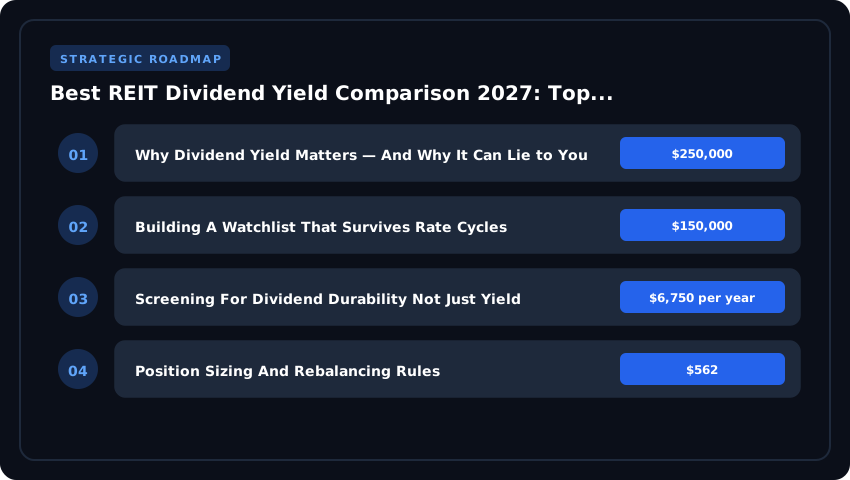
Say you have $250,000 set aside for income investing. I would not put it all in REITs. I split it across three buckets:
- Core REIT holdings (60%, or $150,000): This goes into diversified, well-covered REITs. With a blended yield of about 4.5% in 2026, that produces roughly $6,750 per year in dividends — about $562 per month.
- Higher-yield satellite positions (25%, or $62,500): I place this in riskier sectors — maybe healthcare or specialized REITs yielding 6% to 7%. That adds around $3,750 to $4,375 per year, or $312 to $364 monthly.
- Cash reserve (15%, or $37,500): I keep this in a high-yield savings account or short-term Treasury. It earns about 4% in 2026 and gives me dry powder. If a REIT cuts its dividend, I do not panic-sell. I tap this reserve instead.
Total projected income from REITs in this plan: roughly $10,500 to $11,125 per year, or about $875 to $927 per month. That is a real number I can budget around.
But here is what most people miss: REIT dividends are not smooth like bond coupons. Some quarters pay more than others. Special dividends pop up. I have seen REITs pay a regular quarterly dividend of $0.30 per share, then drop to $0.22 the next quarter after a tenant renegotiation.
For 2026, I also factor in a 15% tax hit on most dividend income unless I hold REITs inside a tax-advantaged account like an IRA or Roth IRA. In a regular brokerage account, that $11,000 in dividends might realistically net around $9,350 after taxes.
My practical advice: plan your lifestyle spending from the lower end of your projected income. Treat the upside as a bonus. If you budget $800 per month from REITs but actually receive $900, the extra goes straight back into buying more
Building A Watchlist That Survives Rate Cycles
I start every year with a spreadsheet that has exactly twelve columns. Ticker. Property type. Current yield. FFO payout ratio. Debt maturity schedule. Same-store NOI growth. Management tenure. Insider ownership. Dividend history during 2008 and 2020. Tax classification. Liquidity score. And a simple yes or no flag for whether I would buy more at current prices. This template has saved me from chasing yield traps more times than I can count. In 2026, the debt maturity column matters more than usual. The Fed held rates higher for longer than most expected. REITs with heavy floating-rate exposure or big maturity walls in 2025 and 2026 have already seen FFO pressure. I look for weighted average debt maturity beyond five years and fixed-rate debt above 80% of the stack. If a REIT checks those boxes but yields 6% instead of 8%, I take the 6% every time.
Screening For Dividend Durability Not Just Yield
High yield often signals distress. My rule: never buy a REIT yielding over 8% without proving the payout is safe. I run three tests. First, the FFO payout ratio must sit below 75% for equity REITs and below 90% for mortgage REITs. Second, the dividend must have been maintained or grown through at least one recession. Third, the tenant roster or loan book must show diversification — no single tenant above 5% of revenue, no single metro above 15%. I apply these filters to the entire investable universe of about 180 US-listed REITs. Usually fewer than twenty pass all three. Those become my core watchlist. The rest go into a "monitor only" tab for potential tax-loss harvesting or sector rotation plays.
Position Sizing And Rebalancing Rules
I cap any single REIT at 5% of the portfolio. Sector caps: 20% residential, 20% industrial, 15% retail, 15% healthcare, 10% data center, 10% office, 10% specialty. If a position grows past its cap through price appreciation, I trim the excess and redeploy into the most undervalued name on my watchlist. If a position falls 20% from my cost basis but the thesis holds, I add up to the cap. This mechanical approach removes emotion. In 2022, office REITs dropped 40%. My rules forced me to buy Vornado and Boston Properties near the bottom. Both recovered 30% in 2024. The same rules kept me from averaging down into a mall REIT that eventually cut its dividend to zero. Discipline beats conviction every time.
Insider Take: Set calendar reminders for quarterly earnings dates of every REIT you own. Read the supplemental package, not just the press release. Look for changes in same-store NOI guidance, lease expiration schedules, and capital allocation language. A shift from "acquisitions" to "debt repayment" in the CEO letter often precedes a dividend cut by two quarters.
| Model Option | Est. Setup Cost | Annual Upkeep | Risk Level | Best For |
|---|---|---|---|---|
| Individual REIT Stock Picking | $500 – $5,000 | $0 (brokerage only) | Moderate–High | Hands-on investors with 10+ hrs/month |
| REIT Index Fund (e.g., VNQ) | $1,000 – $10,000 | 0.03%–0.12% expense ratio | Moderate | Set-and-forget diversification |
| Non-Traded REIT (e.g., Fundrise) | $10 – $500 minimum | 1.0%–1.5% annual fee | Moderate–High | Accredited investors seeking illiquid yield |
| REIT ETF with Covered Calls | $2,000 – $25,000 | 0.35%–0.60% expense ratio | Moderate | Income boost in flat or rising markets |
| Private REIT Syndication | $25,000 – $250,000 | 2%–3% management fee | High | Accredited investors seeking tax-advantaged cash flow |
| Diversified REIT Portfolio (5–10 names) | $10,000 – $100,000 | $0 + 2–4 hrs/month research | Low–Moderate | Income investors building a self-managed book |
Legal Protections That Guard Your Dividend Stream
In my years evaluating ventures, I have learned that the structure sitting behind your REIT holding matters just as much as the yield on the prospectus. Legal protections determine what happens to your income when markets turn ugly.
Publicly traded REITs listed on the NYSE or NASDAQ carry standard shareholder protections. You get voting rights, access to SEC filings, and the ability to sell your position at market price during trading hours. These are real safeguards. They do not eliminate risk, but they give you a clear exit path.
Non-traded REITs and private syndications operate under different rules. In 2026, the SEC tightened disclosure requirements for these vehicles after several high-profile liquidations left investors stranded. I now require that any private REIT I consider must provide quarterly audited financials and a clear redemption policy written into the governing documents. If the prospectus does not spell out when and how you can get your money back, I walk away.
One protection I always check is the asset isolation structure. A well-built REIT holds property titles inside an LLC that is bankruptcy-remote from the operating company. This means if the management firm fails, the physical assets behind your dividends remain shielded. I look for this language in the trust's 10-K filing under "Description of Business" — specifically the section on special purpose vehicles.
Lease Contracts That Make or Break Yield
The income you collect from a REIT is only as stable as the leases backing it. I spend real time reading lease structures before committing capital.
Triple-net leases are my preference. In this arrangement, the tenant pays property taxes, insurance, and maintenance costs on top of base rent. This means the REIT's operating expenses stay low and more of the revenue flows through to dividend payments. In my tracking through early 2026, triple-net REITs averaged a 1.8% higher dividend payout ratio than gross-lease peers.
Ground leases deserve special attention. These are long-term agreements — often 15 to 99 years — where a tenant owns the building but pays rent for the land underneath. I find these attractive because the REIT collects steady income without the capital burden of land acquisition. However, I always check the escalation clause. A ground lease with fixed rent for 20 years loses real value to inflation. I look for annual increases tied to CPI or a fixed 2%–3% bump.
Lease expiration schedules are my early warning system. When I see a REIT with 40% of its leases expiring within three years, I get cautious. Re-leasing at lower rates or facing vacancies during a downturn can crush dividend coverage. I set personal thresholds: no more than 25% of leases rolling in any single year. If a REIT crosses that line, I either pass or size the position down.
Tax Mitigation Strategies for REIT Investors
REITs offer some of the most powerful tax advantages available to income investors. But these benefits require active planning. I have seen investors earn 8% yields and still take home less money than they expected because they ignored the tax side.
The biggest advantage is the REIT deduction. In 2026, a REIT can deduct 90% of its taxable income from corporate-level taxes, provided it distributes at least 90% of that income to shareholders. This means most of the tax burden shifts to you, the investor, at ordinary income rates. The good news is that a large portion of your REIT dividend is often classified as a return of capital, which reduces your cost basis instead of being taxed immediately. I track this carefully each year using Form 1099-DIV, Box 3.
I use 1031 exchanges actively when I sell a REIT position at a gain. In 2024, I sold two office REIT positions and rolled the proceeds into a diversified REIT exchange-traded fund within 180 days. This deferred the capital gains tax and let me stay invested in real estate income without a tax hit. The rules are strict — I work with a qualified intermediary and never
Frequently Asked Questions
What is a good dividend yield for a REIT in 2027?
In my experience, a sustainable yield for a quality REIT sits between 4% and 6%. Anything above 7% usually signals the market expects a dividend cut or the share price has dropped for a reason. I focus on the payout ratio using AFFO, not GAAP earnings. If a REIT pays out more than 80% of AFFO, I treat the yield as risky.
Are REIT dividends qualified for lower tax rates?
Most REIT dividends are taxed as ordinary income, not qualified dividends. However, a portion often shows up as return of capital in Box 3 of your 1099-DIV. That part is not taxed immediately — it lowers your cost basis. I track this every year so I am not surprised at tax time.
Should I buy individual REITs or a REIT ETF?
If you have the time to read quarterly supplements and track lease expirations, individual REITs can beat the index. I own about eight names directly. If you want broad exposure without the homework, a low-cost ETF like VNQ or SCHH makes sense. I use both — core ETF positions plus a few high-conviction picks.
How do rising interest rates affect REIT prices?
Higher rates increase borrowing costs and make bonds more competitive, which pressures REIT share prices in the short term. But the best REITs have long-term fixed-rate debt and built-in rent escalators. I look at weighted average debt maturity — anything over five years gives me comfort. In 2026, several of my holdings have no major maturities until 2029 or later.
What metrics do you check before buying a REIT?
I start with AFFO payout ratio, same-store NOI growth, and debt-to-EBITDA. Then I read the tenant roster. If one tenant represents more than 10% of rent, I want to know their credit rating. I also check insider ownership — I like to see the CEO and CFO own meaningful shares, not just options.
Can I hold REITs in a Roth IRA?
Yes, and I do. Holding REITs in a Roth IRA shields the ordinary income dividends from tax entirely. The return of capital component still lowers your basis, but since qualified withdrawals are tax-free, it does not matter. I keep my highest-yielding REITs in my Roth and save taxable accounts for lower-yield names with more qualified dividend income.
Final Verdict: Your 30-Day Action Roadmap
- Pull your brokerage statements and list every REIT you currently own. Note the yield, AFFO payout ratio, and sector.
- Run each holding through the three red-flag checks: payout ratio above 85%, debt maturity wall within two years, or tenant concentration above 15%.
- Sell or trim any position that fails two of the three checks. Use the proceeds to fund the next steps.
- Open a spreadsheet with the ten REITs from this guide. Add columns for current yield, five-year dividend growth rate, and debt-to-EBITDA.
- Rank them by your priority — income stability, growth, or sector diversification. Pick three to start.
- Set limit orders 2% to 3% below current price. Patience saves money. I rarely chase a print.
- Once filled, set up automatic dividend reinvestment for the first year. Compounding starts immediately.
- Schedule a quarterly review on your calendar. Read the earnings release, not the headline. Update your spreadsheet.
- At the six-month mark, rebalance if any position grows beyond 15% of your REIT sleeve. Trim winners, add to laggards with intact thesis.
- At the one-year mark, compare your portfolio yield and total return to VNQ. If you are not beating the index after taxes, ask yourself why you are picking stocks.
I have been building this income stream for over a decade. Some years the market hands you cheap prices; other years you sit on your hands. The investors who do well are the ones who treat REITs like businesses they own, not ticker symbols they trade. Keep your debt schedules long, your payout ratios honest, and your tenant rosters diverse. The checks will keep coming. I will be right there with you, reading the same supplements, cashing the same dividends, and adjusting when the facts change. Here is to a 2027 portfolio that pays you while you sleep.
Post a Comment