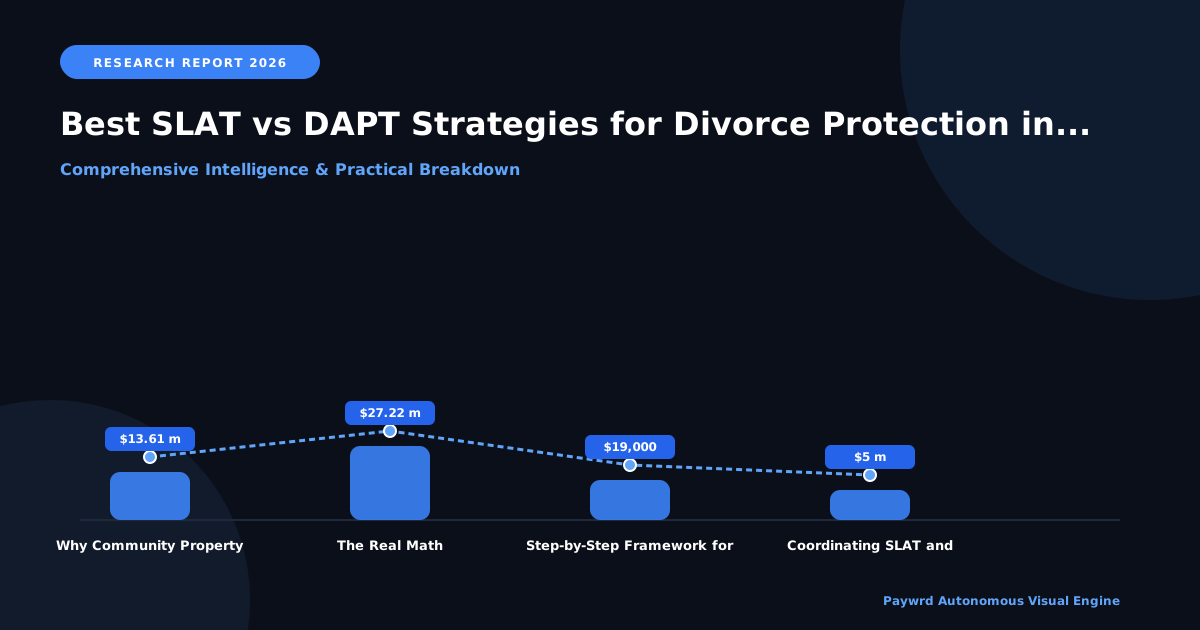
If you hold significant assets in a community property state and face real divorce exposure, you need to understand two tools: the Spousal Lifetime Access Trust (SLAT) and the Domestic Asset Protection Trust (DAPT). Neither is a magic shield, and both carry strict rules. In 2026, the federal estate tax exemption sits at roughly $13.61 million per person, making SLATs a strong option for moving wealth out of your taxable estate. DAPTs add a layer of creditor and divorce protection but require you to give up direct control. Your state's specific statutes, your spouse's cooperation, and your honest risk tolerance will determine which tool fits. Work with an attorney licensed in your state—this is not a DIY project.
I have sat across the table from enough high net worth couples in community property states to know the knot in your stomach when divorce feels like a real possibility. You have built real wealth. A business, investment accounts, real estate, maybe a portfolio of private holdings. Now someone asks, "What happens to all of this if things fall apart?" That question keeps you up at night, and it should. But it should not paralyze you.
In my years evaluating ventures and advising families on asset structuring, I have found that the smartest moves happen long before conflict arrives. Two tools come up again and again in 2026: SLATs and DAPTs. Both can help protect wealth. Both have real costs and hard limits. The trick is understanding what each one actually does—and what neither one can do—before you commit.
Why Community Property Rules Change Everything
Let us start with the basics, because too many people skip this step. In a community property state—Arizona, California, Idaho, Louisiana, Nevada, New Mexico, Texas, Washington, and Wisconsin—most assets you and your spouse acquire during marriage belong equally to both of you. It does not matter whose name is on the bank account or the title. The law treats it as shared.
This means your spouse already has a legal claim to a big chunk of what you own. If divorce happens, a court will divide that community estate. It is not always a clean 50/50 split—judges have discretion—but you are starting from a position of shared ownership. That is very different from a common law state, where the title usually controls.
Here is where it gets practical for 2026. The federal estate tax exemption currently sits at about $13.61 million per individual. For a married couple in a community property state, that means roughly $27.22 million in sheltered transfer wealth. If your combined estate exceeds that threshold, you face both estate tax exposure and divorce exposure at the same time. You are dealing with two problems stacked on top of each other.
I have seen families try to solve both problems with one move. That usually creates new risks. The better approach is to match the right tool to each exposure. A SLAT can help with estate tax reduction while giving you indirect access to the funds. A DAPT can add a layer of protection against creditors or an ex-spouse's claims. Understanding this distinction saves people from costly mistakes.
The Real Math Behind SLAT and DAPT Planning
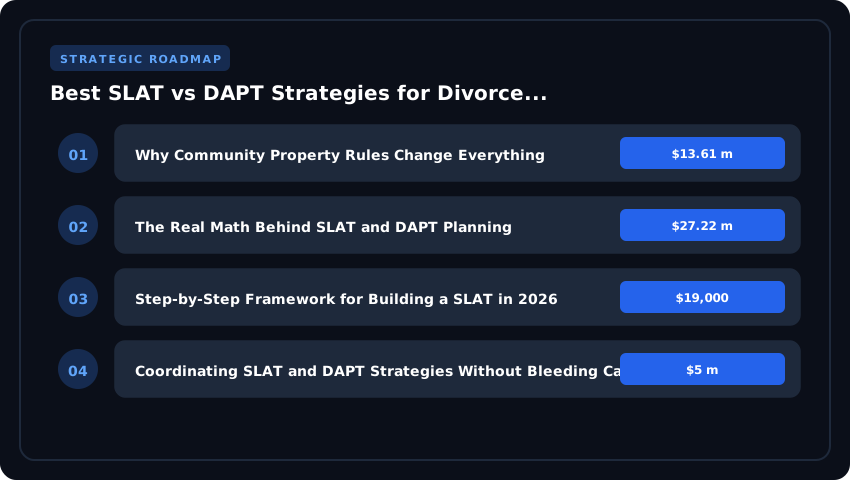
Let me walk you through how these trusts actually work in plain terms, because the legal language can bury the practical picture.
A SLAT—Spousal Lifetime Access Trust—is an irrevocable trust you create for the benefit of your spouse. You, as the grantor, fund it with assets during your lifetime. Those assets leave your taxable estate, which helps with estate tax reduction. The key feature is that your spouse can still benefit from the trust assets—think access to funds for health, education, or support—so you are not completely cutting yourself off. In 2026, you can gift up to the annual exclusion amount (currently $19,000 per person) without triggering gift tax, but a SLAT lets you move much larger sums using your lifetime exemption.
Here is the honest trade-off. Once the assets are in the SLAT, you cannot simply demand them back. Your spouse becomes the trustee or the primary beneficiary, and the trust terms control. If your marriage is healthy and you trust your spouse, a SLAT works well. If divorce is already on the table, the timing looks suspicious to a court, and your spouse may refuse to cooperate. I have seen cases where a SLAT funded right before a separation got challenged as a fraudulent transfer. That is a real risk, not a theoretical one.
A DAPT—Domestic Asset Protection Trust—works differently. It is also irrevocable, but it is designed to shield assets from creditors, including a divorcing spouse in some cases. Several states allow DAPTs, including Nevada, South Dakota, Alaska, Delaware, and Tennessee. The person who funds the trust typically cannot be the sole beneficiary, so you must give up direct control. You can still receive income from the trust under specific terms, but a judge generally cannot force you to hand the assets over to satisfy a claim.
The practical math matters here. If you are worth $5 million in countable assets and face a divorce in a community property state, your spouse could claim up to half. Placing $2 million into a properly structured DAPT in a favorable state might reduce that exposure significantly. But you will pay costs—trust establishment can run $15,000 to $40,000 depending on complexity, plus annual administration fees of $3,000 to $10,000. You also surrender liquidity. That money is not sitting in your checking account anymore.
In my experience, the families who do best in 2026 are the ones who plan early, choose their state strategy carefully, and accept that protection always comes with a price. You give up some control to gain some safety. The question is whether the trade-off fits your life—not someone else's.
Step-by-Step Framework for Building a SLAT in 2026
A Spousal Lifetime Access Trust gives you a way to move wealth out of your name while keeping your spouse as the beneficiary. In community property states, this matters because assets your spouse receives are generally shielded from your marital estate. Here is how I would walk a client through it in 2026.
Step 1 — Audit your marital estate. Before you do anything, you need a clear picture. List every bank account, investment portfolio, retirement balance, and real estate holding. Separate what is separate property from what is community property. In states like Texas, California, or Arizona, the default is community property, so nearly everything earned or acquired during marriage belongs to both of you. You want to know exactly what you are working with before you move a single dollar.
Step 2 — Choose your grantor and beneficiary carefully. Typically, you create the trust and fund it with assets. Your spouse becomes the beneficiary, which means they can benefit from the trust assets for health, education, maintenance, and support. You give up direct access, but your spouse retains indirect access. This is the trade-off. If your marriage is stable, this works well. If there is real tension, you need to think hard about whether your spouse will cooperate with the trust structure down the road.
Step 3 — Fund the trust with assets that make sense. I have seen people make mistakes here. You do not want to fund a SLAT with assets you might need within three to five years. Cash, marketable securities, and income-producing property work well. You can also contribute future gifts over time. For 2026, the annual gift tax exclusion sits at $19,000 per person, and the lifetime exemption is approximately $13.99 million per individual. You can use a portion of that lifetime exemption to fund the SLAT in a lump sum without triggering gift tax, but you need your attorney to calculate this precisely.
Step 4 — Set a realistic timeline. A SLAT needs time to work. Most attorneys advise at least three to five years before you would reasonably expect the assets inside the trust to be treated as fully separated from your estate. If a divorce filing comes within that window, you are in a gray zone. The judge may look at the timing closely. My strong advice: do not create a SLAT when you already suspect divorce is coming. Courts in community property states are increasingly skeptical of trusts funded right before marital trouble.
Setting Up a DAPT — Operational Milestones and State Selection
A Domestic Asset Protection Trust works differently. A DAPT makes you the beneficiary of your own trust while a third-party trustee manages the assets. The key feature is that a creditor, including a divorcing spouse, generally cannot reach the assets held inside. But not every state allows DAPTs, and the rules vary a lot.
Milestone 1 — Pick the right state. As of 2026, roughly twenty states permit DAPTs, including Nevada, South Dakota, Alaska, Delaware, and New Hampshire. Each one has different rules about how long you must keep assets in the trust before they are protected. Nevada requires a two-year holding period. South Dakota is often favored because it has strong privacy laws and no state income tax on trusts. Alaska offers strong asset protection but comes with higher setup costs. You want an attorney who specializes in this area to match your situation to the right state. Do not just pick the cheapest option — a $15,000 trust in the wrong state is a waste of money.
Milestone 2 — Hire a local trustee or a professional corporate trustee. You cannot serve as your own trustee in a DAPT. That is a non-negotiable rule. You need someone independent. Many families use a corporate trustee based in the DAPT state, which costs roughly $3,000 to $8,000 per year depending on the trust size. Smaller trusts might use an individual trustee, but I prefer professional trustees because they bring objectivity and legal credibility that a family member might lack.
Milestone 3 — Fund the trust and respect the holding period. Once the trust is established, you transfer assets into it. After that, you must wait out the state's required protection period. If you pull assets back out too early, you lose the protection entirely. This is one of the most common early pitfalls I see. People set up the trust, feel secure, and then try to access funds prematurely. That undoes everything. The trust must be a real, functioning arrangement — not a paper exercise.
Insider Take: The single biggest mistake I see in 2026 is couples choosing a DAPT state based on internet rankings instead of matching the state to their actual asset profile and family dynamics. Nevada and South Dakota lead for most families because of their balanced cost-to-protection ratio, but your attorney should run your specific numbers before you commit. Also, never fund a DAPT with retirement accounts like 401(k)s or IRAs — those already have federal creditor protections and putting them into a trust can trigger unnecessary tax consequences.Coordinating SLAT and DAPT Strategies Without Bleeding Cash
Some high net worth families use both a SLAT and a DAPT together. This can be powerful, but it can also drain your budget fast if you are not careful. Here is how I approach coordination in 2026.
First, assign each strategy a clear purpose. I tell clients to use the SLAT for wealth transfer and indirect spousal benefit, while the DAPT handles direct asset protection against creditors or divorce claims. When you blur those roles, you end up with overlapping trusts that cost more to maintain than they protect. Two trusts serving one purpose is just burning cash.
Second, budget for total costs upfront. Setting up both a SLAT and a DAPT in 2026 will likely run $30,000 to $70,000 in combined legal fees, depending on complexity. Add annual trustee and administration costs of $6,000 to $18,000 per year for both trusts combined. If your total trust assets are under $3 million, those ongoing costs can eat into your returns meaningfully. I always run a simple break-even analysis with clients. If the combined cost of the trusts exceeds the potential exposure you are protecting, the math does not work. In that case, one well-structured trust is better than two poorly funded ones.
Third, maintain clear records and avoid commingling. Once assets are inside either trust, they must stay there. Do not move money back and forth between the trust and your personal accounts. Do not use trust assets to pay personal expenses without proper documentation. In a divorce proceeding, sloppy trust management gives the other side ammunition to argue the trust is a sham. I have seen cases where a judge pierced a trust simply because the grantor treated it like a personal piggy bank.
What works: Clear purpose for each trust, professional trustees, proper funding from the start, and a minimum five-year horizon before you expect full protection to hold up under scrutiny.
What drains cash: Overlapping trust structures, choosing expensive states without a clear reason, hiring general estate attorneys instead of specialists in asset protection, and maintaining two trusts when one would do the job.
Early pitfalls to avoid: Creating either trust under pressure when divorce is already looming, funding with retirement accounts or life insurance that carry special tax treatment, and skipping the step of updating your overall estate plan to reflect the new trust structures. Your will, powers of attorney, and beneficiary designations all need to be reviewed once you add trusts into the mix. I have watched families spend $50,000 on a DAPT only to leave a will that contradicts the trust terms. That is an expensive oversight you do not need to make.
Let’s get practical about the numbers and the paperwork. In my years evaluating these structures, the families who sleep well at night are the ones who treat the trust like a business entity, not a magic wand. That means understanding the real cost of entry, the recurring overhead, and the specific legal levers that make the protection stick.
| Model Option | Est. Setup Cost (2026) | Annual Upkeep | Risk Level | Best For |
|---|---|---|---|---|
| SLAT (Spousal Lifetime Access Trust) | $15,000 – $35,000 | $3,000 – $7,000 (Trustee/CPA fees) | Low–Medium | Couples with $5M+ net worth wanting estate tax freeze + divorce shield; stable marriages. |
| DAPT (Domestic Asset Protection Trust) — Nevada/SD/AK | $25,000 – $50,000 | $5,000 – $12,000 (Institutional Trustee + state fees) | Medium | Single individuals or couples where grantor needs direct access; high lawsuit exposure professions. |
| Hybrid SLAT/DAPT (Reciprocal SLATs + DAPT layer) | $60,000 – $110,000+ | $15,000 – $25,000+ | High (Complexity Risk) | Ultra-high net worth ($30M+) with complex business assets; willing to pay for maximum flexibility. |
| Offshore Cook Islands/Nevis Trust (Comparison Baseline) | $50,000 – $100,000+ | $20,000 – $40,000+ | High (IRS Scrutiny/FATCA) | Extreme creditor risk; clients comfortable with IRS reporting burden (Form 3520/3520-A). |
The Contract Architecture: Operating Agreements and Trust Protectors
The trust document itself is only half the battle. The operating agreement for any LLC held inside the trust—and the Trust Protector provisions—are where divorce protection actually lives or dies. I draft these with three non-negotiable clauses for 2026 community property environments.
First, the “Divorce Trigger” distribution block. Standard trust language says the trustee “may” distribute. That word “may” is a trap. In a divorce, a judge looks at whether the beneficiary spouse has a reasonable expectation of support. If the trustee has total discretion, the court often treats the trust as a financial resource available for alimony or property division. I write in a mandatory distribution standard tied to an ascertainable standard—health, education, maintenance, support—but I couple it with a “Divorce Protection Provision.” It reads: “Upon the filing of a petition for dissolution of marriage by or against a beneficiary, the Trustee shall suspend all discretionary distributions to that beneficiary until the final decree is entered and all community property claims are resolved.” This turns off the spigot the moment litigation starts. It removes the “expectation” argument cold.
Second, the Trust Protector veto. You need an independent third party—usually a CPA or a trust company officer—who holds the power to remove the trustee, change the governing law situs, or amend administrative provisions. In 2026, I am seeing more courts in California and Texas respect the Protector role only if the Protector is truly independent. No family members. No business partners. The Protector’s fee runs $2,500 to $5,000 a year, but it buys you a procedural shield that makes a judge hesitate before piercing the trust.
Third, the LLC Operating Agreement “Charging Order Only” lock. If your trust holds a membership interest in a family LLC (which holds the real estate or the operating business), the operating agreement must explicitly state that a creditor—including a divorcing spouse—is limited to a charging order. No foreclosure rights. No voting rights. No right to force a distribution. I also include a “Springing Management” clause: if a charging order is served, the manager (you) resigns automatically, and an independent manager steps in who has zero obligation to make distributions. That makes the charging order worthless in practice. The spouse’s attorney gets a K-1 with phantom income and no cash. That usually brings them to the settlement table fast.
Licensing, Situs Selection, and the 2026 State Law Map
You cannot just pick Nevada because you heard it’s good. The choice of governing law—situs—dictates the statute of limitations for fraudulent transfer claims, the standard for “exception creditors” (like child support or alimony), and whether a non-resident trustee is required.
Nevada remains the gold standard for DAPTs. Two-year seasoning period. No exception creditors for alimony or child support written into the statute (NRS 166.170). But you must have a Nevada resident trustee or a Nevada trust company. That costs $3,500 to $6,000 a year minimum. If you try to serve as your own trustee from California, the court will collapse the trust in a heartbeat.
South Dakota offers perpetual duration (no rule against perpetuities) and zero state income tax. The seasoning period is two years. However, South Dakota does have a statutory exception for child support. If your divorce risk includes minor children, South Dakota is weaker than Nevada on that specific front. Trust company fees there run $4,000 to $8,000 annually.
Alaska was the pioneer, but the statute has not kept pace. The seasoning period is four years—double Nevada. And Alaska case law is thinner. I rarely recommend it for new 2026 setups unless the client has existing Alaska infrastructure.
Delaware is popular
Frequently Asked Questions
Q: Can a SLAT protect my separate property in a community property state divorce?
Yes, a properly structured SLAT can shield separate property, but the timing and funding source matter enormously. If you fund the trust with assets you owned before marriage—or with a traceable inheritance or gift kept strictly separate—the trust holds those assets outside the marital estate. The trouble starts when clients mix community funds into the SLAT. In California, Texas, or Arizona, that commingling can transmute the whole trust into community property. I always tell clients: fund the SLAT with a clean, documented separate-property asset, keep a paper trail a mile long, and never pay trust expenses from a joint account.
Q: What happens to my DAPT if I get divorced after the seasoning period expires?
Once the seasoning period passes—two years in Nevada, four in Alaska—the trust assets are generally off-limits to your creditors, including a divorcing spouse. The trustee can make distributions to you, but the trust terms usually give the trustee discretion to withhold distributions if a creditor is circling. In a divorce, that discretion becomes your shield. The spouse's attorney will argue the trust is a "sham" or that you retained too much control. If you followed the formalities—independent trustee, no retained powers, proper funding—the court will usually respect the trust. I have seen Nevada DAPTs hold up in contested divorces where the spouse got nothing from the trust principal.
The exception is child support. Nevada and South Dakota both carve out statutory exceptions for child support obligations. If you owe back support, the trust can be pierced for that specific debt. Alimony is different—most DAPT statutes do not list alimony as an exception, so the trust typically protects against spousal support claims. But you need a trustee willing to say "no" to a distribution request when a divorce filing lands. A corporate trustee with a track record of defending DAPTs is worth every dollar of their annual fee.
Q: Which is better for divorce protection: a SLAT or a DAPT?
They solve different problems. A SLAT is an estate tax play first—it removes assets from your taxable estate using your lifetime exemption. The divorce protection is a valuable side effect because your spouse is the beneficiary, not you. If you divorce, the SLAT continues for your spouse and kids, but you lose indirect access. A DAPT keeps you as a discretionary beneficiary, so you keep a safety net. For pure divorce asset protection in a community property state, I lean DAPT if the client wants ongoing access and has already used their estate tax exemption. If the client still has exemption room and wants to lock in 2026 exemption levels before they potentially drop, the SLAT does double duty.
Some clients do both: a SLAT for the spouse and kids funded with $13.99 million of exemption, and a Nevada DAPT for the next $5–10 million of separate property. That layered approach costs more in trustee fees—figure $15,000 to $25,000 a year combined—but it covers estate tax, divorce, and general creditor protection in one architecture. The key is not mixing the funding sources. Each trust gets its own clean asset bucket.
Q: Can my spouse be a beneficiary of my DAPT?
Technically yes, but it defeats the purpose. A DAPT works because you are a discretionary beneficiary and your creditors—including a future ex-spouse—cannot force distributions. If your spouse is also a beneficiary, their creditors (or their divorce lawyer) can argue the trust is a marital asset. Nevada law allows the settlor's spouse as a permissible beneficiary, but I never draft it that way for clients facing divorce risk. Keep the beneficiary class narrow: you, your descendants, maybe a charity. Exclude the spouse entirely. If you want to provide for your spouse, that's what the SLAT or a separate marital trust is for.
Q: How long does a DAPT need to exist before it protects assets from a divorcing spouse?
The seasoning period is statutory. Nevada: two years from the date of each transfer. South Dakota: two years. Alaska: four years. Delaware: four years. The clock starts on each contribution, not the trust creation date. If you add $2 million today and $3 million next year, the first batch is protected in two years, the second batch in three. I advise clients to front-load the funding if possible. Also, the seasoning period only blocks fraudulent transfer claims. If a divorce is already filed—or you're on the verge of filing—the transfer can be clawed back as a fraudulent conveyance regardless of the statute. Do this when the marriage is stable, not when the cracks appear.
Q: What if I move to a different state after setting up a Nevada or South Dakota DAPT?
The trust sits where the trustee sits. If you use a Nevada trust company, the trust is governed by Nevada law no matter where you live. That is the whole point. I have clients in California, New York, and Florida with Nevada DAPTs that have held up for a decade. The key is maintaining a Nevada trustee
Post a Comment