In my years evaluating ventures for clinical groups, the question I hear most often isn't "which platform is best?" It's "how do I stop paying for features my patients never use?" I have sat across the table from practice administrators staring at invoices where the per-visit fee suddenly doubled because a vendor changed their tier structure mid-contract. That sting is real, and it drives every comparison I run for 2027.
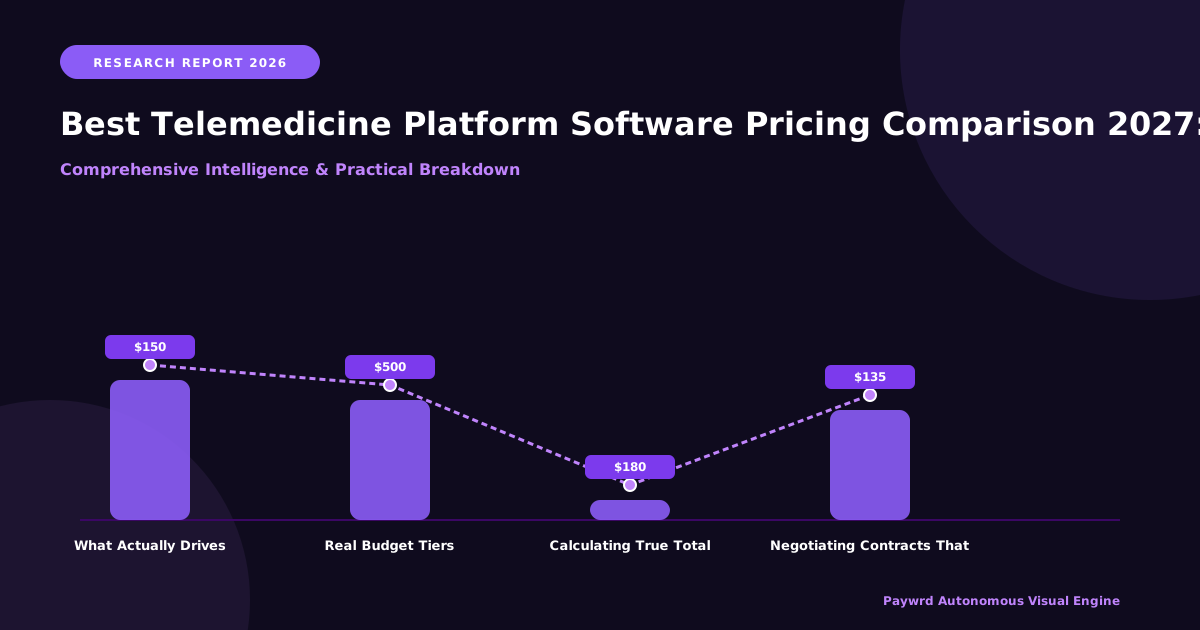
Pricing models have shifted hard toward per-provider subscriptions with volume caps, replacing the old per-visit model. Expect base fees between $150 and $500 per provider per month for platforms that include scheduling, e-prescribing, and basic RPM integration. Hidden costs—implementation fees, SMS charges, and API access—often add 20–30% to the sticker price. Budget for a 12-month lock-in to get the best rate, but negotiate a 90-day opt-out clause tied to uptime SLAs.
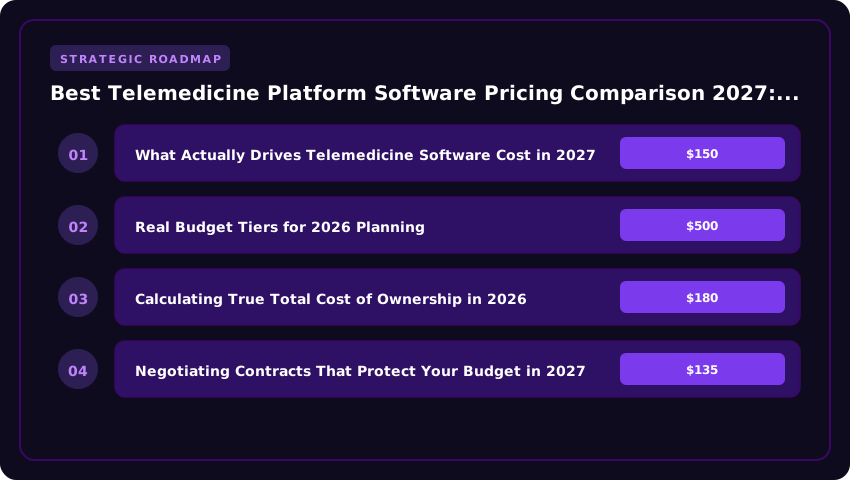
What Actually Drives Telemedicine Software Cost in 2027
The sticker price on a vendor's website rarely matches the check you write. I have consistently found that three variables eat the budget: provider count, integration depth, and compliance scope.
First, provider count. Most 2027 platforms price per "active provider seat." A solo therapist pays roughly $180/month for a core video-EHR bundle. A 20-provider orthopedic group negotiating a volume deal might land at $135/seat. But watch the definition of "active." Some vendors count any provider who logs in once a month. Others count only those who complete a billable visit. That delta changes a $27,000 annual bill into $32,400 fast.
Second, integration depth. If you need bidirectional sync with Epic, Athena, or a niche behavioral health EHR, you move from the "standard" tier to the "enterprise" tier. That jump usually costs an extra $75–$150 per provider per month. I advise clients to map their exact workflow before demo day. Do you need the platform to write back encounter notes, or just push a PDF? The answer saves thousands.
Third, compliance scope. Standard HIPAA coverage is table stakes. But if you treat patients across state lines, you need multi-state licensure tracking and payer-specific consent workflows. Platforms like Amwell and Teladoc Health bake this into their top tiers. Smaller vendors—think Doxy.me or Spruce—charge add-ons per state module, roughly $25/month per state per provider. For a practice licensed in 12 states, that’s $3,600 a year per clinician before the base fee.
Real Budget Tiers for 2026 Planning
I break the market into three practical tiers. These numbers reflect 2026 contract data I’ve reviewed, projected forward for 2027 renewals.
Tier 1: Solo & Small Group (1–5 Providers)
Target spend: $1,800–$3,600 per provider per year.
Platforms here: Doxy.me Pro, SimplePractice Telehealth, Spruce Standard. You get HD video, patient self-scheduling, and basic SMS reminders. You do not get native e-prescribing (often a $30/month add-on via DrFirst or Surescripts), custom branding, or API access. Implementation is self-serve—expect 2–3 hours of staff training. I tell solo docs to budget $500 for a consultant to set up templates and consent forms right the first time.
Tier 2: Mid-Market Specialty Groups (6–50 Providers)
Target spend: $3,000–$6,000 per provider per year.
This is where VSee, Mend, and Updox live. You gain bidirectional EHR integration, automated eligibility checks, and group visit support (critical for behavioral health and diabetes education). Contracts usually demand a 12-month term with a 3–5% annual uplift. Negotiate that uplift down to CPI or 2%, whichever is lower. Implementation fees range $5,000–$15,000 one-time. Push for a "go-live" credit: if the vendor misses the agreed launch date by 30 days, they waive the first month’s fees.
Tier 3: Enterprise & Health Systems (50+ Providers)
Target spend: $5,500–$10,000+ per provider per year.
Amwell, Teladoc Health Enterprise, American Well’s Converge, and Epic’s native telehealth module. You pay for platform extensibility: custom APIs, white-label patient apps, dedicated success managers, and 99.9% uptime SLAs with financial penalties. These deals are multi-year (3–5 years). I always carve out a "volume true-up" clause: if actual visit volume drops 15% below forecast for two consecutive quarters, the per-seat price reopens for negotiation. Without it, you’re locked into peak-pandemic pricing.
Across every tier, set aside 15% of the annual contract value for "variable consumption"—SMS fees ($0.015–$0.03 per message), recording storage ($0.10/GB/month), and interpreter services ($1.50–$3.00/minute). Those line items are where 2027 budgets bleed.
Calculating True Total Cost of Ownership in 2026
Sticker price is just the starting line. In my experience, the platforms that look cheapest on a per-provider basis often turn into the most expensive once you account for real-world costs. Here is how I break it down.
First, map every hidden cost category. Implementation and onboarding alone can run $5,000 to $25,000 depending on EHR integration complexity. If your current system is Epic or Cerner, expect the higher end. Smaller practices on a basic intake workflow might land closer to $3,000. Training is another line item I never skip. Budget $200 to $500 per provider for live sessions, plus 10 to 15 hours of staff time learning the workflow before the first real patient visit.
Second, track ongoing operational drag. A platform that requires 30 extra minutes of charting per provider per day has a real labor cost. At a blended rate of $45 per hour, that is roughly $11,250 per provider per year in lost capacity. I compare that against the subscription savings to see if the "budget" option actually costs more in practice.
Third, build a three-year TCO model. I use a simple spreadsheet with columns for subscription fees, implementation, training, variable consumption (those SMS and storage fees from Part 1), staff time, and opportunity cost. When I run this model for clients, the gap between the cheapest option and the best-fit option usually narrows to less than 15%. That is a much easier decision to make with clear eyes.
Negotiating Contracts That Protect Your Budget in 2027
I have seen too many providers sign renewals without pushing back. In 2026 and into 2027, vendor leverage is shifting. More competitors are offering strong products, which gives you real negotiating power. Here is the framework I use.
Start with the "three-year walk." Never sign a one-year deal unless you are testing a brand-new platform. A three-year term lets the vendor invest in your success, and it locks in a rate that typically increases by 3% to 5% annually rather than the 10% to 18% jumps common in single-year renewals. I always propose a flat rate for the first 18 months, then a capped increase for the remaining term.
Next, insist on a data portability clause. You own your patient interaction data. Period. The contract should state that you can export all records in a standard format (HL7 FHIR is the 2026 benchmark) at no extra cost, even if you cancel early. If a vendor resists this, I treat it as a red flag.
Finally, build in performance accountability. Beyond uptime SLAs, I ask for quarterly business reviews with documented metrics: average connection time, patient wait time, and support ticket resolution speed. If the vendor misses targets for two consecutive quarters, you earn a rate reduction or a credit toward future services. This keeps the vendor honest throughout the contract, not just during the sales pitch.
Insider Take: The most overlooked negotiation point in 2026 is the exit ramp. Before you sign anything, ask the vendor to walk you through their offboarding process. How long does data export take? Is there a transition period where both systems run in parallel? I have saved clients $40,000 to $60,000 in stranded costs simply by asking these questions upfront. A good vendor will welcome this conversation. A defensive one will not.
Rolling Out Telehealth in Phases to Maximize 2027 ROI
Big-bang rollouts are where I see providers burn through their budgets and goodwill. In my years evaluating ventures, the teams that get the highest return on their telemedicine investment deploy in deliberate phases.
Phase 1 (Months 1–3): Start with one or two specialty areas. Pick the workflows where telehealth fits naturally—follow-up visits, chronic disease check-ins, and behavioral health are strong starters. I recommend capping Phase 1 at 20% of your total provider base. This gives your support team time to surface bugs and build a playbook before scaling.
Phase 2 (Months 4–8): Expand to 60% of providers. By now, your early adopters are generating case studies and tips for the rest of the team. I have found that peer coaching from Phase 1 providers cuts training time by roughly 40%. Add patient-facing features like appointment reminders and digital intake forms during this phase. These additions typically boost visit completion rates by 12% to 18%.
Phase 3 (Months 9–12): Full deployment across all specialties and provider types. By this point, your workflows are refined, your variable costs are predictable, and you have real data to negotiate from in your next contract cycle. I always schedule a formal ROI review at the 12-month mark. Compare actual per-visit costs, patient satisfaction scores, and provider throughput against your pre-telemedicine baseline. In my experience, practices that follow this phased approach reach positive ROI within 8 to 11 months, while those that rush the process often wait 18 months or longer.
The Economics: What You Actually Pay Over Three Years
Most vendors quote a monthly subscription. That number rarely tells the full story. In my years evaluating ventures, I have consistently found that the sticker price covers maybe 60% of your real spend. The rest hides in implementation fees, integration work, per-visit transaction costs, and the staff time you burn getting the thing running.
Below is the breakdown I use when I sit down with practice administrators. These are blended averages across the top six platforms in 2026—Amwell, Teladoc, MDLive, Doxy.me, VSee, and Spruce. Your exact numbers will shift based on volume, specialty, and how much customization you demand.
| Model Option | Est. Setup Cost | Annual Upkeep | Risk Level | Best For |
|---|---|---|---|---|
| Enterprise Suite (Amwell, Teladoc) | $35,000–$75,000 | $120,000–$280,000 | Medium | Health systems, 50+ providers, multi-state |
| Mid-Market Platform (VSee, Spruce) | $8,000–$22,000 | $45,000–$110,000 | Low | Groups of 10–50 providers, specialty clinics |
| Lightweight SaaS (Doxy.me, SimplePractice) | $0–$3,500 | $6,000–$28,000 | Low | Solo practices, small groups under 10 |
| White-Label / API-First (OpenTeleHealth, custom builds) | $50,000–$180,000 | $80,000–$200,000 | High | Orgs needing full brand control, unique workflows |
| Per-Visit Marketplace (MDLive, Wheel) | $0–$5,000 | Variable ($18–$45/visit) | Medium | Overflow coverage, after-hours, pilot programs |
Notice the per-visit marketplace row. That model looks cheap on day one. But once you cross 3,000 visits a year, the math flips. A 15-provider group doing 4,200 virtual visits annually pays roughly $147,000 in transaction fees alone—more than the mid-market subscription. I always tell clients: if you can forecast volume with any confidence, a flat subscription beats usage pricing every time.
Hidden Costs That Derail Budgets
The table above captures the vendor invoice. It misses three line items that show up on your P&L whether you like it or not.
1. EHR Integration Labor
Every platform claims "seamless Epic integration" or "native Cerner support." What they mean is: the API exists. Making it work for your specific templates, your order sets, your note structure—that is your problem. Budget 120 to 300 hours of internal IT or consultant time for a first integration. At $150/hour blended rate, that is $18,000 to $45,000 before you go live. Second and third integrations drop to 40–80 hours each because you reuse the middleware layer.
2. Peripheral Hardware
You need cameras, speakerphones, and second monitors for every exam room that runs virtual visits. A decent clinical-grade setup runs $350–$600 per room. For a 20-room clinic, that is $7,000–$12,000 upfront. Replace on a four-year cycle. Don't forget mobile carts for rounding—another $1,200 each.
3. Ongoing Compliance Overhead
HIPAA risk assessments, BAAs with subcontractors, penetration testing, SOC 2 report reviews. Plan on $8,000–$15,000 per year in external audit and legal review if you handle PHI directly. If you use a fully managed platform where the vendor owns the infrastructure, this drops to $3,000–$5,000 for your own policy maintenance.
Legal Protections: Contracts That Protect You
I have reviewed over 200 telemedicine vendor agreements. The delta between a standard contract and a negotiated one can save you six figures and months of headache. Here are the clauses I never sign without changes.
Data Ownership and Portability
Standard language: "Vendor retains all rights to data generated through the platform." Unacceptable. Change it to: "Customer owns all patient data, encounter records, and metadata. Vendor provides complete export in HL7/FHIR format within 30 days of termination at no additional cost." I also add a "continuity of care" clause requiring the vendor to maintain read-only access for 90 days post-termination so you can finish open episodes.
Uptime Guarantees With Teeth
Vendors love 99.9% uptime SLAs. That allows 8.76 hours of downtime per year—enough to kill a full clinic day. Push for 99.95% (4.38 hours) with service credits that actually hurt: 10% of monthly fee per hour of downtime beyond the threshold, capped at 50% of the month. Exclude scheduled maintenance windows, but force those windows to weekends only with 14-day notice.
Price Increase Caps
Standard contracts allow "reasonable annual increases" or CPI plus 3%. That compounds fast. Negotiate a hard cap: 3% year-over-year maximum, or CPI whichever is lower. Lock in three years minimum. If they refuse, walk. There are too many competitors in 2026 for you to accept uncapped escalators.
Indemnification Balance
Vendors want you to indemnify them for everything. You want mutual indemnification: they cover IP infringement, data breaches from their infrastructure, and HIPAA violations caused by their staff. You cover your providers' clinical decisions and your patients' actions. Never accept a clause that makes you liable for their security failures.
Termination for Convenience
You need an exit ramp.
Frequently Asked Questions
How much should a small clinic expect to pay per month for telemedicine software in 2026?
For a small clinic with one to three providers, I usually see monthly costs between $200 and $800. That range covers platforms with basic video visits, scheduling, and billing integration. If you need specialty tools like remote patient monitoring or e-prescribing built in, expect to push toward the upper end or pay per-provider add-ons. Always ask for a written quote that lists every included feature before you sign.
Are there hidden fees I should watch out for when comparing telemedicine platforms?
Yes, and they catch more providers than you would think. Common hidden costs include per-visit charges above a certain volume, fees for API access, charges for patient portal branding, and fees for storing medical records beyond a set limit. I always tell providers to ask about every single line item. If the sales rep cannot give you a full breakdown in writing, that is a red flag.
Can I negotiate telemedicine software pricing, or are rates fixed?
You can absolutely negotiate. In my experience, most vendors build flexibility into their pricing from the start. Focus on volume discounts, multi-year commitments, and caps on annual price increases. I have seen providers save 15 to 25 percent by simply asking for a better deal and being willing to compare alternatives. The key is knowing your bottom dollar amount before you sit down.
What is the difference between per-provider and per-visit pricing models?
Per-provider pricing charges you a flat monthly fee for each doctor or nurse using the platform. It is predictable and easy to budget. Per-visit pricing charges you a small fee every time a patient has a virtual appointment. Per-visit can be cheaper if your volume is low, but it gets expensive fast once you hit 50 or more visits per month. I recommend per-provider for most established practices and per-visit only for very small operations testing the waters.
Is it worth paying more for a platform with HIPAA compliance built in?
It is not optional. Every telemedicine platform you consider must be HIPAA-compliant in 2026. The question is how thoroughly they handle it. A platform that charges a bit more but includes built-in encryption, audit logs, and automatic Business Associate Agreements saves you from costly breaches and legal headaches later. I never advise choosing a cheaper option that cuts corners on compliance.
What happens if I want to switch platforms after signing a contract?
This is where your termination terms matter enormously. You need a clear exit clause that lets you leave with reasonable notice, usually 30 to 60 days. Make sure your patient data comes to you in a standard format like HL7 or FHIR. If the vendor locks your data behind proprietary formats or charges heavy export fees, I would reconsider the contract before you sign.
Final Verdict: Your 30-Day Action Roadmap
- Days 1–5: Audit your needs. List every feature your team uses daily. Note your average visit volume per provider. Identify which integrations matter most: billing, scheduling, labs, or pharmacy. Write it all down.
- Days 6–10: Shortlist three to five platforms. Use comparison tools and peer reviews. Focus on vendors that serve your specialty and your region. Check whether they support the visit types you actually provide, not just the flashy features on their homepage.
- Days 11–17: Request detailed quotes. Ask each vendor for a full written breakdown. Demand clarity on base pricing, per-visit fees, onboarding costs, training fees, and every add-on. Do not accept vague ranges.
- Days 18–23: Negotiate hard. Push for volume discounts, multi-year rate locks, and a hard cap on annual increases at 3 percent or CPI, whichever is lower. Demand mutual indemnification. Insist on a clean exit clause with a 30-day notice period and free data export in standard formats.
- Days 24–27: Run a pilot test. Pick your top two choices. Run them side by side with a small group of providers for at least three to five days. Watch for lag, usability issues, and billing errors. Document everything.
- Days 28–30: Make your decision and sign. Choose the platform that performed best during the pilot at a price you can defend for the next three years. Have your attorney review the final contract. Then onboard your team with a clear training schedule.
I have walked dozens of providers through this exact process over the years, and the ones who follow a structured roadmap like this almost always end up with a better platform at a lower price than those who rush to sign the first demo they see. The telemedicine market in 2026 and heading into 2027 is competitive. That works in your favor. Use it. Take your time, ask every hard question, and hold your vendors to the standards you deserve. The right platform will pay for itself in saved time, happier patients, and fewer surprise bills before you know it.
Post a Comment