I have sat across the desk from hundreds of people ready to write a check for a franchise. Most of them focus on the brand name or the glossy brochure. Very few ask the hard questions about cash flow in month six or what happens when the franchisor changes the royalty structure in 2028. If you are looking at 2027 as your launch year, you are already behind on the financial prep work. The lending market has tightened since 2024, and the "turnkey" promises often hide costs that eat your margin before you open the doors. Let me walk you through what actually matters when the money hits the table.
SBA 7(a) loans remain the gold standard for franchise buyers in 2027, but banks now require 25-30% down and a personal credit score above 700. Hidden fees — specifically technology fund contributions, mandatory remodel reserves, and "brand development" assessments — typically add 3-5% to your annual operating cost. Turnkey packages save time but often lock you into vendor pricing 15-20% above market; negotiate carve-outs for local vendors before you sign. Liquidity requirements have doubled: franchisors want to see 6-12 months of personal living expenses plus working capital separate from the loan.
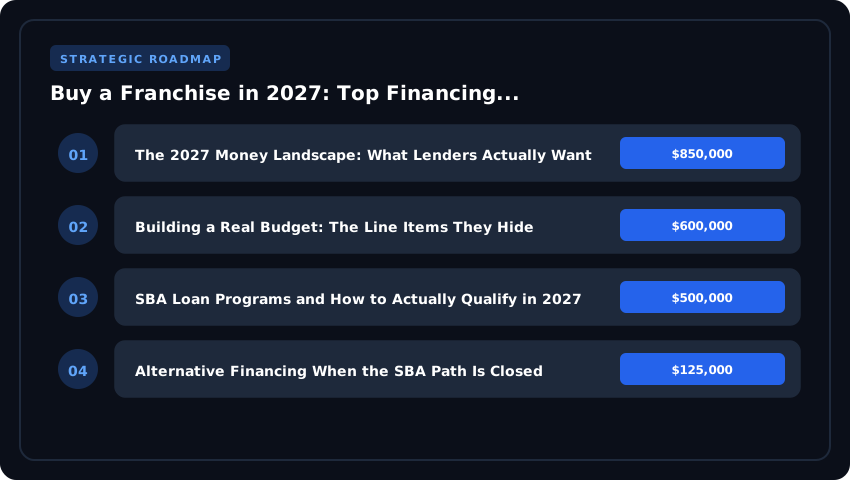
The 2027 Money Landscape: What Lenders Actually Want
In my years evaluating ventures, I have watched the goalposts move. Back in 2021, a 680 credit score and 10% down got you an SBA loan for a Subway or a Great Clips. Today, the major SBA preferred lenders — Live Oak, Celtic, Wells Fargo — treat franchise debt like commercial real estate. They stress-test your projections at a 9% interest rate even if you lock in at 7.5%. They want to see a debt service coverage ratio (DSCR) of 1.25x or higher on day one.
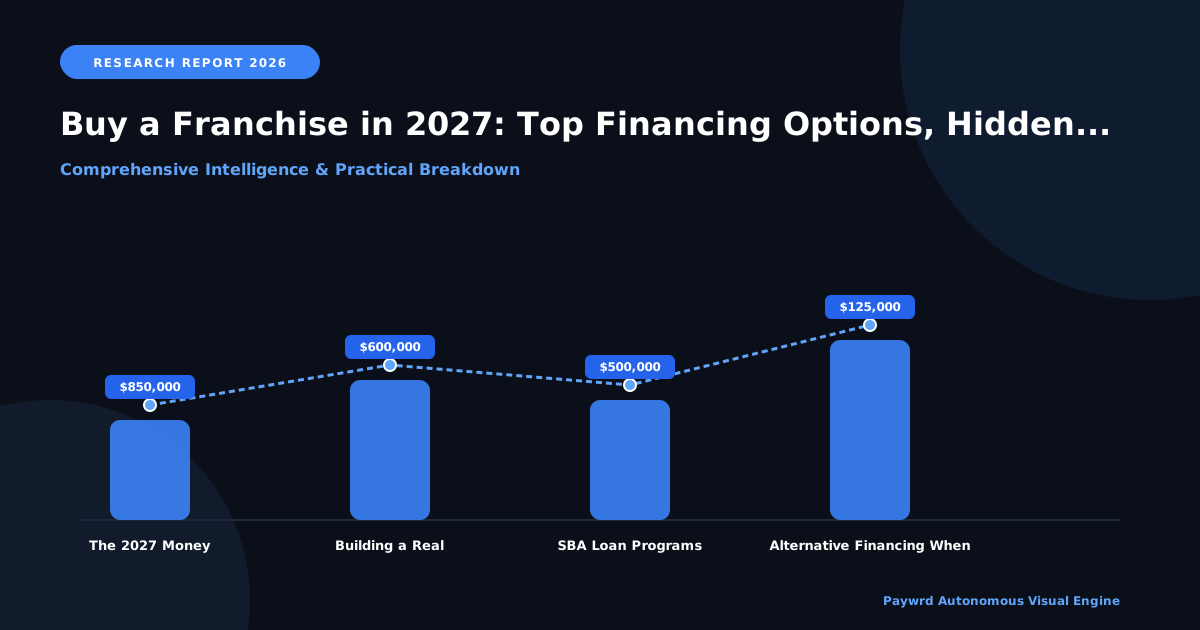
That means your pro forma cannot rely on "ramp-up" optimism. If the Franchise Disclosure Document (FDD) Item 19 shows average gross revenue of $850,000 for a mature unit, the bank will underwrite to $600,000. They assume you will hit 70% of the average in year one. You need to bring the gap in cash. For a $500,000 total project cost (franchise fee, build-out, equipment, working capital), expect to write a check for $125,000 to $150,000 out of pocket. The rest comes from the loan, but the bank will also hold back 10% of the construction draw until you get a certificate of occupancy.
Alternative lenders like Funding Circle or Kapitus move faster — sometimes 10 days to close — but the cost of capital is 11-14% with a 3-5 year term. That kills cash flow on a thin-margin concept like a quick-service restaurant. I only recommend those bridges if you have a signed lease and a contractor ready to mobilize, and you plan to refinance into an SBA loan within 18 months. The refinancing risk in 2027 is real; if rates stay elevated, you could be stuck paying double the SBA rate.
One strategy gaining traction: ROBS (Rollovers for Business Startups). You roll your 401(k) or IRA into a C-corp that buys the franchise. No early withdrawal penalty, no tax hit, no monthly loan payment. But you put your retirement at risk. If the unit fails, the nest egg goes with it. I have seen three clients lose $300,000+ this way since 2022. Use ROBS only if you have other retirement assets outside the plan and you can survive a total loss.
Building a Real Budget: The Line Items They Hide
The FDD Item 7 gives you an estimated initial investment range. It is almost always low. I tell my clients to take the high end and add 20%. Here is where the money actually goes in a 2027 build-out.
Franchise Fee: Usually $35,000-$50,000. Non-negotiable for the first unit. Multi-unit deals drop to $25,000 per territory after the third location.
Real Estate & Build-Out: This is the wild card. A 1,800 sq. ft. inline space in a secondary market runs $180-$250 per square foot for a vanilla box. Add $75-$120/sq. ft. for brand-specific finishes (tile, millwork, signage). Landlords in 2027 are offering 3-6 months free rent on 10-year deals, but they claw it back with 3% annual escalators. Negotiate a $0 base year for CAM (Common Area Maintenance) charges; otherwise you absorb property tax spikes.
Equipment & Technology: The franchisor mandates a specific POS system — usually Toast, Square for Restaurants, or a proprietary platform. Hardware runs $12,000-$18,000. Software subscriptions are $300-$500/month per terminal. Then there is the "Technology Fund" contribution: 0.5-1.5% of gross revenue paid monthly to the corporate IT budget. You do not control the roadmap. If they roll out a new loyalty app in 2028, you pay for the development whether you use it or not.
Training & Opening Marketing: Item 11 says "training provided at no cost." Read the fine print. You pay for travel, hotel (14-21 days), and per diem for you and your manager. That is $8,000-$15,000 real cash. Grand opening marketing fund contributions are often $10,000-$25,000 due 30 days before launch. The franchisor controls the spend; you get a press release and a few Facebook ads.
Working Capital Reserve: This is the line item that kills deals. The FDD suggests 3 months. Reality is 6-9 months. You need rent, payroll, royalty (6-8%), ad fund (2-4%), insurance, utilities, and your own salary. For a $1.2M annual volume concept, that is $180,000-$250,000 sitting in a business savings account the day you open. If you finance 100% of the project via SBA, the bank will not fund this reserve. It must be liquid, post-closing cash.
Remodel Reserve: Most 2027 franchise agreements require a full refresh at year 7 or 10. Cost: $150,000-$300,000. Smart operators accrue $2,000-$3,000/month into a segregated account starting month one. If you don't, you face a capital call you cannot meet, and the franchisor can terminate for brand non-compliance.
SBA Loan Programs and How to Actually Qualify in 2027
In my experience, the SBA 7(a) loan is the backbone of franchise financing. It is not glamorous. It works. The maximum amount is $5 million. The SBA guarantees up to 85% of the loan for amounts under $150,000 and up to 75% for larger deals. That guarantee is what makes banks willing to write checks.
Here is what you need to walk into a lender in 2027 with a real shot:
- Credit Score: You need 680 minimum. I prefer to see 700+. Below that, expect hard questions or a denial.
- Down Payment: Most lenders want 10-20% of the total project cost as cash equity. For a $500,000 buildout, that is $50,000-$100,000 of your own money on the line.
- Business Plan: Not a five-page pamphlet. A real plan with three-year projections, a market analysis of your specific territory, and a clear operating budget. I have seen deals die because someone submitted a template.
- Collateral: The SBA will take a second lien on real estate or equipment. Some lenders also require a personal guarantee on your home.
The timeline matters. SBA processing takes 45-90 days from submission to closing. If your franchise agreement has a short buildout window, start this process the day you sign the FDD. Do not wait.
There is also the SBA 504 program for real estate-heavy concepts. If you are buying a building, the 504 covers up to 40% of the project with a fixed rate often below 6% in early 2027. The combined 7(a) and 504 structure can get you to 90% financing, leaving just 10% cash equity.
Insider Take: Practical operational advice from someone who has reviewed hundreds of franchise loan packages — always build your cash reserve before you apply for SBA. Lenders will ask to see 3-6 months of personal and business bank statements post-closing. If your account looks thin, they will either reduce your loan amount or kill the deal. I tell every operator I work with: park that working capital in a separate account, leave it untouched for 90 days, then apply. It changes everything.
Turnkey Franchise Packages — What You Actually Get for the Premium
Turnkey packages have exploded in 2026 and into 2027. The promise is simple: you write a bigger check, and the franchisor handles everything until you are open. But what does "everything" actually mean?
In my years evaluating ventures, I have seen turnkey packages range from $75,000 to $200,000 above the base franchise fee. Here is what a genuine turnkey package should include:
- Site Selection and Lease Negotiation: The franchisor's team identifies the location and negotiates lease terms. This alone can save you $30,000-$80,000 in wasted rent over the lease term if done right.
- Full Construction or Buildout: Everything from demolition to final inspection. The franchisor uses approved vendors and locks a fixed price. No surprise change orders.
- Equipment and Inventory Stocked: Your kitchen, your retail fixtures, your initial product inventory — all purchased and placed before opening day.
- Staff Training Program: A 2-4 week paid training program for you and your managers at an existing location. Some include travel and housing costs.
- Grand Opening Marketing: A real launch plan with local media spend, direct mail, and a coordinated social media blitz. Not just a press release.
The trade-off is clear. You pay more upfront, and you give up some control over vendor choices and buildout details. For first-time operators with no business background, this premium buys peace of mind and a faster path to revenue. For experienced operators, it often does not make sense. You can manage a buildout cheaper on your own.
My rule of thumb: if the turnkey premium is under 15% of total project cost and you are brand-new, it is usually worth it. If it pushes above 25%, negotiate. Some franchisors will unbundle items and let you pick only the services you need.
Alternative Financing When the SBA Path Is Closed
Not everyone qualifies for SBA lending in 2027. Maybe your credit is rebuilding. Maybe you are a non-U.S. citizen. Maybe the franchisor is not on the SBA approved vendor list. That does not end your dream. It just changes the route.
Equipment Financing: If your concept requires heavy equipment — ovens, refrigeration, point-of-sale systems — you can finance those items separately. Equipment lenders look at the equipment value, not your personal credit. Expect 100% financing at 5-8% interest over 3-7 years. This frees up your SBA or personal capital for the rest of the buildout.
401(k) Rollover (ROBS): This structure lets you use retirement funds without early withdrawal penalties. A ROBS provider sets up a new C-corp, rolls your 401(k) into it, and uses those funds to buy franchise stock. No tax hit. No loan payments. The risk is real — if the business fails, your retirement is exposed. I have seen this work well for stable, proven concepts. I have seen it destroy lives with risky startups. Use it only on concepts with 3+ years of solid unit economics.
Private Lenders and Hard Money: These loans carry higher rates — 10-15% — and shorter terms of 12-24 months. They are bridge loans. You use them to close fast on a hot territory, then refinance into a conventional loan once you have 6 months of sales history. The fees are steep. The speed is unmatched. I use this tool sparingly and only when timing is the deciding factor.
Family or Investor Partnerships: This is the most overlooked option. A trusted family member or local investor puts in cash for a percentage of the unit's profits. You keep operational control. They get a return. The key is a written operating agreement that spells out roles, profit splits, and exit terms before a single dollar moves. I have watched friendships end over undocumented handshakes. Do not let that happen.
Every one of these paths has a place in 2027. The right choice depends on your cash position, your timeline, and your risk tolerance. Match the tool to the situation. Do not force an SBA loan when a blend of equipment financing and personal equity gets you to open faster and cleaner.
The Real Economics: Unit-Level Math That Determines Survival
Financing gets you open. Unit economics keep you open. In 2027, the gap between the franchise disclosure document (FDD) averages and what a single operator actually nets is wider than most candidates expect. I tell every client: ignore the top-line revenue number in Item 19. Focus entirely on the four walls of your specific location.
Start with rent. In the current market, a 2,000-square-foot inline space in a secondary retail corridor runs $3,500 to $5,500 per month NNN. That is before CAM charges, property tax true-ups, and insurance spikes. If your model requires $45,000 in monthly gross sales just to cover occupancy, you have zero margin for error. I look for rent at or below 8% of projected gross. Anything above 10% is a structural flaw that no amount of marketing fixes.
Labor is the second lever. The 2027 minimum wage floor in many metros is $18 to $20 per hour. Add payroll taxes, workers' comp, and the cost of retention bonuses, and a $15/hour employee actually costs $22 to $24 fully burdened. If the franchisor's labor model assumes 25% of revenue but your local reality is 32%, the model breaks. I build my own labor schedule in a spreadsheet before I sign. I plug in local wage data, shift coverage minimums, and a 15% buffer for call-outs and overtime. If the math doesn't work at 30% labor cost, I walk.
Food and paper costs (or cost of goods sold for service brands) are the third pillar. Franchisors negotiate national rebates. But your distributor pricing depends on your volume tier. A single unit often pays 3% to 5% more than the corporate average because you lack purchasing scale. I always ask for the "single-unit landed cost" sheet during validation. If the franchisor cannot produce it, that is a red flag. I pad the FDD cost-of-goods assumption by 200 basis points in my pro forma. That cushion has saved me more than once when commodity prices spiked.
| Model Option | Est. Setup Cost | Annual Upkeep | Risk Level | Best For |
|---|---|---|---|---|
| Single-Unit Owner/Operator | $150k–$500k | $50k–$120k (Debt Service + Reserves) | Medium | First-time buyers with strong credit & liquid reserves |
| Multi-Unit Area Developer (3–5 Units) | $500k–$1.5M+ | $200k+ (Development Fees + Buildout Pipeline) | High | Experienced operators with infrastructure & capital access |
| Semi-Absentee / Manager-Run | $200k–$600k | $80k–$150k (GM Salary + Oversight Costs) | Medium-High | Investors keeping W-2 jobs; requires strong GM hire |
| Conversion / Rebrand Existing Location | $80k–$250k | $40k–$90k (Lower Buildout, Standard Royalties) | Lower | Independent owners seeking systems & brand power |
Legal Protections: The Clauses That Protect Your Downside
The franchise agreement is a one-sided document drafted by the franchisor's counsel. Your job is not to "win" the negotiation. Your job is to identify the clauses that create existential risk and negotiate carve-outs or caps. I never sign without a franchise attorney who specializes in the FTC Franchise Rule and state relationship laws. A general business lawyer misses the nuance.
First, the territory definition. "Protected territory" often means nothing if the franchisor can sell through alternative channels—online, wholesale, kiosks, or national accounts—inside your zip code. I require a carve-out that prohibits the franchisor or its affiliates from fulfilling orders originating in my defined geography through any channel, including e-commerce, unless the revenue is shared pro-rata. In 2027, with delivery apps and ghost kitchens, this is the single biggest leak in operator economics.
Second, renewal conditions. The standard clause lets the franchisor deny renewal if you are not in "substantial compliance" or if you refuse to sign the "then-current" agreement. That "then-current" agreement can have higher royalties, mandatory remodel costs, or weaker protections. I negotiate a cap on royalty increases at renewal (e.g., max 50 basis points) and a requirement that the renewal agreement be materially similar to the current one. I also fight for a "cure period" for any default alleged at renewal time—minimum 60 days written notice.
Third, transfer rights. You build equity. You need to realize it. Many agreements give the franchisor a Right of First Refusal (ROFR) at "fair market value" determined by their appraiser. I strike the ROFR or replace it with a Right of First Notification: I bring a qualified buyer, the franchisor has 30 days to approve or deny based only on the buyer's financial/operational qualifications, not price matching. I also cap the transfer fee at $5,000 or 2% of sale price, whichever is lower.
Fourth, default and cure provisions. "Material breach" is often undefined. A missed royalty payment by three days should not trigger termination. I negotiate a tiered cure framework: monetary defaults get 15 business days; operational defaults get 30 days with a written remediation plan. Termination without the ability to arbitrate first is a non-starter.
Contractual Levers: Mandatory Purchasing & Technology Stacks
Franchisors increasingly monetize the supply chain and tech stack. In 2027, the POS system, loyalty app, online ordering middleware, and kitchen display system are often mandated "approved vendors" with revenue-sharing kickbacks
Frequently Asked Questions
Can I really buy a franchise with no prior business experience?
Yes, many franchisors actively seek first-time owners. In my experience, what they care about more than a résumé is your liquid cash and willingness to follow the playbook. A turnkey package handles the training, but your attitude toward learning will make or break your first 90 days. I have seen raw beginners succeed because they asked questions daily. I have also seen overconfident veterans fail because they ignored the system.
What is the difference between a loan and a line of credit for franchise funding?
A loan gives you one lump sum with fixed monthly payments. A line of credit lets you draw money as needed and only pay interest on what you use. For a franchise launch, I generally recommend a loan for the upfront purchase price and a small line of credit for unexpected costs during the first six months. This keeps your monthly obligations predictable while giving you a safety net.
How do hidden fees actually show up on my financials?
They hide in three places. First, your franchise disclosure document lists them, but buried in Exhibit G. Second, technology mandates force you onto approved POS systems or software platforms that charge monthly licensing fees you did not budget for. Third, marketing funds collect a percentage of every dollar you earn and redistribute it at the franchisor's discretion. I always tell buyers to request a full fee schedule in writing before signing anything.
Are turnkey packages worth the higher price tag?
They can be, but only if the "turnkey" label means something concrete. A genuine turnkey package includes site selection, build-out, equipment, staff training, and opening support bundled into one price. A misleading one simply sells you a standard franchise and calls it turnkey because you attend a two-day seminar. I compare the total cost item by item against building out independently. If the premium is under 15%, the convenience usually justifies the cost.
What happens if I want to sell my franchise before the term ends?
This is where your original contract matters enormously. Most franchisors retain a right of first refusal, meaning they must approve your buyer. Some charge a transfer fee of 3% to 5% of the sale price. In 2027, I am seeing more franchisors cap transfer fees at $5,000 or 2%, whichever is lower. Before you buy, negotiate this cap directly. Without it, you could lose a large chunk of your equity when you exit.
How long does it take from signing to opening day?
A realistic timeline is 90 to 180 days for most standard franchises. Turnkey packages can compress this to 60 to 120 days if the site is already identified. Delays almost always come from permitting, equipment lead times, or training scheduling. I build a 30-day buffer into every launch plan I write. Rushing an opening invites mistakes that cost revenue in the first quarter.
Final Verdict: Your 30-Day Action Roadmap
- Days 1–3: Define your budget. Calculate your liquid cash, maximum borrowing capacity, and monthly personal living expenses. Do not commit more than 70% of your available capital to the purchase.
- Days 4–7: Research franchises by category. Pick three industries that interest you. Read their franchise disclosure documents in full. Focus on Item 5 (fees), Item 7 (estimated investment), and Item 20 (outlet history).
- Days 8–14: Contact existing franchisees. Ask at least five current owners about their experience. Ask specifically about hidden costs, support quality, and whether they would buy again. Write down their answers the same day.
- Days 15–18: Secure financing. Meet with at least two lenders. Compare a term loan against an SBA-backed option. Get a pre-approval letter so you know exactly what you can spend.
- Days 19–22: Negotiate the franchise agreement. Have a franchise attorney review every clause. Push back on undefined default terms, excessive transfer fees, and mandatory vendor kickbacks. Get every concession in writing.
- Days 23–26: Evaluate the turnkey package. Request an itemized cost breakdown. Compare it against independent build-out estimates. Verify what is truly included versus what is marketing language.
- Days 27–28: Conduct site due diligence. Visit the location at different times of day. Check foot traffic, parking access, and local zoning regulations. Confirm your permitted operating hours.
- Days 29–30: Sign with confidence. Review all documents one final time with your attorney. Execute the agreement only when every fee, timeline, and obligation is clear and acceptable to you.
Buying a franchise in 2027 is a real path to business ownership, but it is not a shortcut. The franchises that reward their owners are the ones where buyers do the homework before signing. I have watched careful planners build thriving operations from turnkey packages, and I have watched impulsive buyers drown in fees they never read. Use the roadmap above, ask every question that makes you uncomfortable, and protect your interests from the very first conversation. Your future franchise is out there. It just takes the discipline to find the right one and negotiate it fairly.
Post a Comment