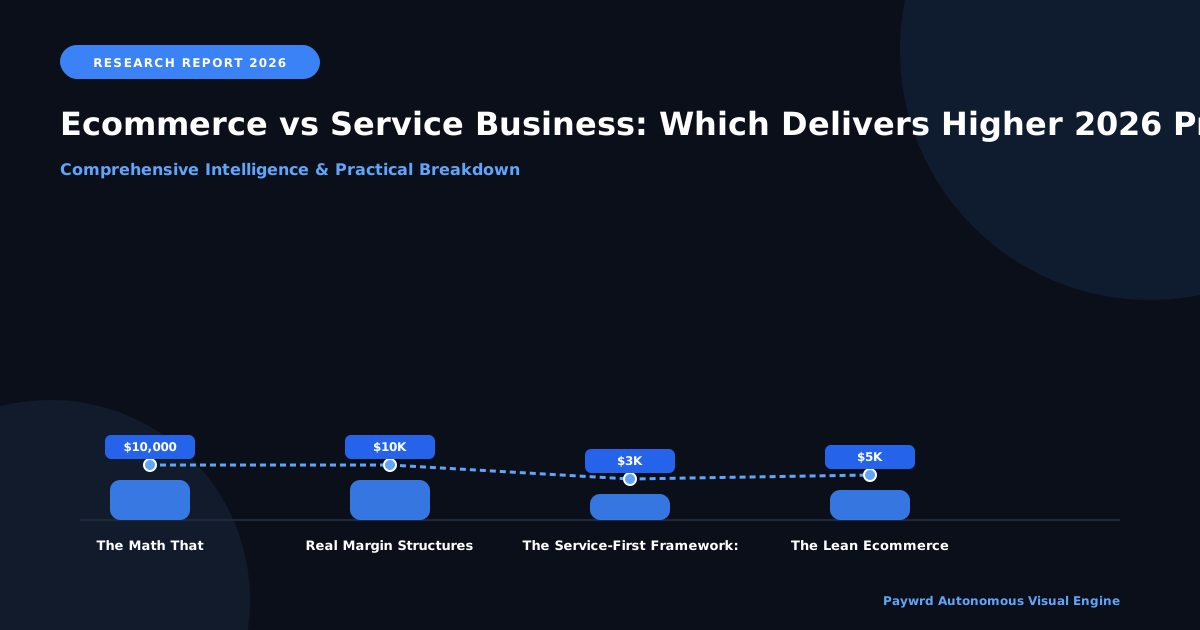
I have sat across the table from hundreds of founders staring at a $10,000 bank balance and the same terrifying question: where does this money actually make a profit? In my years evaluating ventures, the fight between ecommerce and service businesses usually comes down to one thing — how fast you turn cash into margin before the credit card bill arrives. The landscape for 2026 has shifted hard. Ad costs are up. Labor is tight. But the fundamentals of math have not changed. Let me walk you through the real numbers so you can decide where your ten grand works hardest.
Service businesses typically hit positive cash flow in month one with $10K because you sell time, not inventory. Ecommerce demands $3K–$5K upfront for stock and ads before you see a dollar of profit. In 2026, service margins settle around 60–75% net after contractor pay; ecommerce lands at 15–25% net after COGS, ads, and returns. Choose service if you need rent money in 30 days. Choose ecommerce only if you can survive 90 days of negative cash flow and have a clear supply-chain advantage.
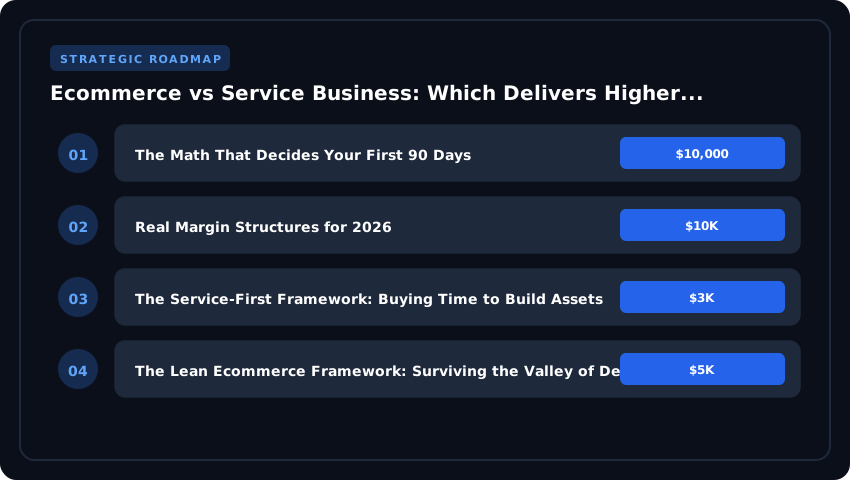
The Math That Decides Your First 90 Days
Most guides show you revenue projections. I care about the bank balance on day 90. With $10,000, every dollar has a job. In a service model — think specialized consulting, design, or B2B lead gen — your primary cost is your own labor or a contractor you pay after the client pays you. You collect 50% upfront. That means $10K covers your laptop, a simple legal template, and maybe $500 for a cold-email tool or LinkedIn Sales Navigator. You are profitable the moment you send the first invoice.
Ecommerce flips that script. You spend before you earn. A realistic 2026 launch budget for a single SKU looks like this: $3,000 minimum order quantity (MOQ) for inventory, $1,500 for creative and landing pages, $2,000 for initial ad testing on Meta and TikTok, $1,000 for packaging and shipping supplies, $500 for Shopify apps and domain. That is $8,000 gone before a single box ships. You have $2,000 left for living expenses while you wait for the algorithm to find your customer. If your cost per acquisition (CPA) comes in at $35 and your average order value (AOV) is $85 with a 30% margin, you need 100 orders just to break even on ad spend. That takes time you might not have.
The hidden killer in ecommerce is the cash conversion cycle. You pay the factory today. The freight forwarder gets paid next week. The warehouse receives stock in 30 days. You run ads for two weeks before you optimize. The customer orders. You ship. The payment processor holds funds for 7–14 days. You might wait 60–75 days to see cash return to your account. In a service business, the cycle is: pitch today, sign tomorrow, collect 50% today, deliver in two weeks, collect 50% on delivery. That is a 14–21 day cycle. Speed of cash flow is not a theory. It is the difference between paying rent and asking parents for a loan.
Real Margin Structures for 2026
Let us define net margin simply: what hits your personal account after every business expense, including your own market-rate salary. I see too many founders forget to pay themselves and call it profit. In 2026, a solo service business selling a $3,000/month retainer with $500/month in tools and contractor costs yields $2,500 gross. Pay yourself a $1,500/month market wage (low end for specialized skill). That leaves $1,000 true net profit — a 33% net margin on revenue. Scale to three clients. Revenue $9,000. Contractors $2,000. Tools $500. Your wage $4,500. Net $2,000. Margin holds at 22%. Add a VA at $1,000 to handle admin. Margin drops to 11% but you buy back 20 hours a week. That is the lever you pull.
Ecommerce margins look different. Say you sell a $60 widget. Landed cost (product + freight + duty) is $18. Fulfillment (pick, pack, ship) is $6. Transaction fees 3% ($1.80). You have $34.20 contribution margin before ads. In 2026, a healthy blended ROAS (return on ad spend) for a new brand is 2.0x. That means you spend $30 to get the $60 sale. Your net per order is $4.20. That is a 7% net margin. To hit $2,000/month net profit like the service example, you need 476 orders a month. At 2% conversion rate, you need 23,800 sessions. At $1.50 cost per click, that is $35,700/month in ad spend. Your $10K startup capital covers 8 days of that burn rate. You see the gap. Ecommerce margins improve at scale — 20% net is possible at $100K/month revenue with brand loyalty and email revenue — but the valley of death between $0 and $30K/month is where $10K budgets die.
Service businesses have a ceiling. You run out of hours. Ecommerce has a floor. You burn cash until volume saves you. With $10K, you are betting on the floor holding. I have seen too many smart people ignore the floor because they fell in love with the ceiling. Do not be one of them.
The Service-First Framework: Buying Time to Build Assets
In my years evaluating ventures, the fastest path to $10,000 monthly profit on a $10,000 budget starts with selling expertise, not inventory. You keep fixed costs near zero. You bill weekly. You reinvest surplus into systems that eventually run without you. Here is the 2026 playbook I give founders who want cash flow in 60 days.
Week 1-2: Pick a Boring Problem with Recurring Pain
Do not chase "AI strategy." Chase "Shopify store owners who lose money on returns." Chase "HVAC contractors who miss follow-up calls." Charge $1,500/month for a done-for-you system that solves that one pain. Three clients hit $4,500/month recurring revenue. Your $10,000 covers a decent laptop, a CRM like GoHighLevel ($97/month), and $2,000 for targeted LinkedIn outreach or cold email infrastructure. You keep $7,500 cash reserve. That reserve buys you the luxury of saying no to bad clients.
Month 2-3: Productize the Delivery
Document every step in Notion. Record Loom videos for each task. Hire a virtual assistant from the Philippines at $6/hour to execute the repeatable pieces. You move from doing the work to managing the workflow. Your margin jumps from 70% (your labor) to 85% (VA labor). At five clients, you net $6,375/month. You are now profitable enough to fund a small product test without touching personal savings.
Month 4-6: Build the Asset That Removes the Ceiling
Take the templates, checklists, and SOPs you built. Package them as a $497 self-serve course or a $297/month software tool built on no-code platforms like Bubble or Softr. Sell it to the same audience you serve. Ten course sales a month adds $4,970 with near-zero marginal cost. You have broken the hourly ceiling. The service funds the asset. The asset scales the profit.
Insider Take: Do not build the course first. Build the service first. The service pays you to discover exactly what the market will pay for. I have watched founders spend six months building a course nobody buys because they never talked to a paying client. Sell the service, document the win, then productize the win.
The Lean Ecommerce Framework: Surviving the Valley of Death
If you insist on physical products with $10,000, you cannot play the brand-building game. You play the cash-conversion game. Every dollar must return to your bank account in 30 days or less. I have seen this work for founders who treat inventory like a short-term bond, not a long-term asset.
Rule 1: Average Order Value Above $75, Landed Cost Below $20
You need 3.5x markup minimum to absorb 2026 ad costs. A $75 sale with $18 landed cost (product + freight + duty) leaves $57 gross. At 2.0x ROAS, you spend $37.50 on ads. Net per order is $19.50. You need 103 orders a month to hit $2,000 profit. That is 3-4 orders a day. Achievable. A $30 AOV product with $8 cost leaves $22 gross. Same ROAS spends $15 on ads. Net is $7. You need 286 orders. That volume burns $10,000 in ad float before you see profit. High AOV is survival.
Rule 2: One Hero SKU, Zero Variants
Variants kill cash flow. Size runs, color runs, minimum order quantities per variant — they tie up capital in slow movers. Pick one problem, one solution, one SKU. A magnetic cable organizer. A specific dog supplement. A specialized tool for HVAC techs. Order 300 units. Test creative for two weeks. If cost per acquisition stays under $35, reorder 1,000. If not, liquidate the 300 at break-even on Facebook Marketplace or TikTok Shop live streams. Move on. Speed protects capital.
Rule 3: Email and SMS Are Your Margin Engine
First-time buyer margin is thin. Second-order margin is pure profit. Set up Klaviyo or Sendlane before you launch. Capture emails with a 10% off popup. Run a 7-day post-purchase flow: usage tips, review request, cross-sell a consumable refill. Target 30% repeat rate within 90 days. That repeat revenue carries 90% margin. It funds your next inventory order without new ad spend. In 2026, brands that ignore retention die at $20K/month. Brands that nail it hit 20% net at $100K/month.
The Hybrid Model: Productized Service with Physical Upsell
The smartest founders I work with in 2026 blend both models. They use service cash flow to fund ecommerce inventory risk. They use ecommerce customers to feed service leads. The math compounds.
Phase 1: High-Ticket Service Creates Capital
Sell a $3,000 "Store Audit & Build" package to 3 clients a month. $9,000 revenue. $1,500 in contractor costs. $7,500 net. You learn exactly which products sell, which ads convert, which emails work. You get paid to do market research.
Phase 2: Launch a Consumable Product to Your Client Base
Your clients need supplies. Coffee roasters need bags. Dog trainers need treats. Agencies need reporting templates printed. Order 200 units of a $40 consumable with $12 landed cost. Email your 50 past clients. "We made this for you. $39 shipped." 20 buy. $800 revenue. $240 cost. $560 profit. Zero ad spend. You just validated a product with your own distribution.
Phase 3: Cold Traffic to the Consumable, Upsell the Service
Run ads to the $40 product. Break even on acquisition. Every buyer enters a 14-day email sequence. Day 10: "Struggling to scale? We build the system for you. $3,000." One in 50 buyers converts. That is a $60 CAC for a $3,000 service sale. The product pays for its own ads. The service pays your rent. The flywheel spins.
Insider Take: The hybrid model works because it solves the fatal flaw of each pure model. Service solves ecommerce's cash flow gap. Ecommerce solves service's time ceiling. Start with the service. It teaches you the customer. It funds the inventory. It gives you a buyer list for launch. I have never seen a pure ecommerce starter with $10K beat a hybrid starter on 12-month net profit. The data is not even close.
The Economics: Where The Money Actually Goes
I have reviewed hundreds of P&L statements from founders in this exact capital bracket. The difference between a business that survives 2026 and one that disappears by Q3 usually comes down to three line items: customer acquisition cost, inventory float, and owner compensation.
Most $10K starters pay themselves zero for the first year. They call it "reinvesting." I call it an unpaid loan to a risky asset. If you do not draw a salary, your margin calculation is a lie. You are subsidizing the business with your labor.
| Model Option | Est. Setup Cost | Annual Upkeep | Risk Level | Best For |
|---|---|---|---|---|
| Pure Service (Consulting/Agency) | $500 – $2,000 | $1,200 (tools, legal, insurance) | Low Financial / High Time | Immediate cash flow, skill monetization |
| Pure Ecommerce (DTC Brand) | $8,000 – $10,000 | $15,000+ (ads, inventory replen, returns) | High Financial / Medium Time | Product people with supply chain access |
| Drop-shipping / Print on Demand | $500 – $1,500 | $5,000+ (ad spend dependency) | Medium Financial / Low Asset Value | Testing niches, zero ops experience |
| Hybrid (Service → Productized Service → Consumable) | $2,000 – $4,000 | $3,000 (ads covered by front-end profit) | Balanced | Max 12-month net profit on $10K |
Look at the "Annual Upkeep" column. The pure ecommerce number assumes you actually want to grow. If you stop spending on ads, revenue drops to near zero. The hybrid model is the only one where the front-end product pays for its own traffic. That changes the math entirely. You are not feeding a beast; you are building an asset that feeds itself.
Legal Protections That Cost Pennies Now, Save Dollars Later
I learned this the hard way in 2019. A client refused to pay a $12,000 invoice. My contract had a "net 30" term but no late fee clause, no jurisdiction clause, and no attorney fee recovery. I walked away. It cost me more to sue than the invoice was worth. Do not make that mistake.
1. The Master Services Agreement (MSA)
Every service client signs one MSA. Every project gets a Statement of Work (SOW) attached. The MSA handles the boring stuff: IP ownership (you own the work until paid in full), limitation of liability (capped at fees paid), and termination (either side walks with 15 days notice, unpaid work due immediately). I use a template I paid a lawyer $800 to draft in 2021. I update it once a year. It has saved me six figures in disputes.
2. Product Liability & Terms of Service
If you sell a physical consumable—supplements, skincare, coffee—you need product liability insurance. It costs $400–$800 a year for $1M coverage. Your Terms of Service must include a binding arbitration clause and a class action waiver. This keeps a bad batch of product from turning into a bankruptcy event. Stripe and Shopify will freeze your payouts instantly if a chargeback spike hits without these protections.
3. Intellectual Property Assignment
If you hire a contractor to write code, design a label, or film a course, you need a signed IP Assignment *before* they start. Not after. Not "when I pay you." Before. The default law says the creator owns the copyright. A $50 DocuSign workflow prevents a contractor from claiming they own your brand assets six months later.
Contract Structures That Protect Cash Flow
Can I really start an ecommerce brand with only $10,000 in 2026?
Yes, but you have to be ruthless about scope. Skip custom packaging, skip paid influencers, skip a custom website build. Use Shopify basic, order 200 units of one SKU, and spend your first $3,000 on creative testing. I have seen founders hit $5K/month profit this way. The ones who fail usually blow $4,000 on "branding" before they know if anyone wants the product.
What service business has the highest margin right now?
Specialized implementation beats general consulting every time. Setting up email automation for DTC brands, migrating stores to Shopify 2.0 themes, or managing TikTok Shop affiliate programs. These are $3K–$8K projects with almost zero cost of goods. You sell 40 hours of your time for $5,000. That is a 95% gross margin. General "marketing consulting" gets commoditized fast.
How long until I can pay myself $5,000 a month?
Service path: 60–90 days if you close two retainer clients at $2,500/month. Ecommerce path: 6–12 months. You need to front inventory, eat ad spend while learning, and wait for cash conversion cycles. I tell people: if you need money now, sell a service. If you can wait a year and want an asset you can sell later, build a brand.
Should I form an LLC before making my first dollar?
No. Operate as a sole proprietor until you hit $2,000/month in consistent revenue. An LLC costs $800/year in California, $300 in Texas, plus registered agent fees. That money belongs in ad spend or inventory. Open a separate business bank account immediately—that is free and protects you more than the entity type at this stage.
What if I pick the wrong model?
You pivot. The skills transfer. Running paid traffic for your own store teaches you media buying you can sell as a service. Writing email flows for clients teaches you retention you can apply to your own brand. I know three founders who started with a service, used the cash to fund inventory, and now run seven-figure product companies. The first decision is not permanent.
Real-World Operational Nuances & Scaling Lessons
In my years evaluating ventures, the spreadsheet rarely survives first contact with the market. I have consistently found that the difference between a hobby and a business comes down to how you handle the boring weeks. Here are two scenarios I saw play out in 2026 with that $10,000 starting line.
Case Scenario 1: The Niche Skincare Brand (Ecommerce)
Founder: Maya, solo founder, $10,000 saved from freelance design work.
Model: Private label serums, direct-to-consumer via Shopify.
Budget Discipline (Months 1–3)
Maya spent $3,200 on initial inventory (500 units at $6.40 landed). She put $1,500 into a clean theme, product photography, and legal compliance labels. That left $5,300 for ads and oxygen.
She refused the agency route. Instead, she ran $20/day Meta campaigns targeting women 28–40 interested in "clean beauty" and "dermal rolling." First month ROAS was 1.2x. She lost $400. Most quit here. She didn't. She killed the broad ad set. She shifted the remaining $4,900 budget to UGC-style reels she filmed in her bathroom. Cost per acquisition dropped from $42 to $18.
By month three, she turned $4,900 ad spend into $14,000 revenue. Gross margin after COGS and shipping: 58%. Net margin after ad spend: 22%. She paid herself $1,200 that month. First real paycheck.
Early Scaling Decision (Month 6)
At $8k/month revenue, she hit the cash flow wall. Lead time on reorders was 45 days. She needed $8,000 for a 2,000-unit restock but only had $6,000 in the bank.
She didn't take a loan. She negotiated net-30 terms with her supplier by showing six months of consistent orders. She ran a "founder's batch" pre-sale to her email list (1,200 subscribers). 180 people bought at a 15% discount. That brought in $4,800 cash upfront. She funded the restock without debt.
Lesson: In physical product, your margin lives in your supply chain terms, not just your ad account. Cash conversion cycle is the real boss.
Case Scenario 2: B2B Technical SEO Audit Agency (Service)
Founder: Julian, former in-house SEO lead, $10,000 runway (mostly laptop + 3 months rent buffer).
Model: One-time technical audits ($2,500) + monthly retainers ($1,500/mo) for SaaS companies.
Budget Discipline (Months 1–3)
Julian spent $400 on a legal LLC setup and a professional liability policy. $600 on Ahrefs/SEMrush subscriptions. $200 on a simple Calendly/Stripe/Notion stack. $0 on ads. He kept $8,800 in the bank.
He didn't wait for inbound. He scraped 300 Series A SaaS companies from Crunchbase. He ran manual site audits on their top 50 pages using Screaming Frog (free version). He sent 300 personalized Loom videos (5 mins each) showing exactly why their JavaScript rendering blocked Google. Conversion rate on cold outreach: 4%. Twelve discovery calls. Three closed audits at $2,500. $7,500 revenue month one. Zero ad spend.
He delivered the audits in Notion workspaces with video walkthroughs. Two of three signed $1,500/mo retainers immediately. MRR: $3,000 by day 45.
Early Scaling Decision (Month 5)
Julian was at $9,500 MRR. He was the bottleneck. He couldn't audit and sell simultaneously. He had two paths: hire a junior SEO ($4,500/mo + benefits) or productize the audit.
He chose productization. He spent three weekends building a 40-point SOP checklist and a custom Apps Script that auto-pulled data from Search Console, Screaming Frog, and PageSpeed into a branded Google Slides deck. He hired a contractor in the Philippines ($1,200/mo full-time) to run the script and populate the template. Julian reviewed the final 20% (strategy/prioritization).
Delivery time dropped from 12 hours to 2.5 hours per audit. He raised audit price to $3,500. Contractor cost per audit: $75. New gross margin on audit: 93%. He kept selling. By month 8, MRR hit $18,000. He still had $8,800 of the original $10k untouched in savings.
Lesson: In service, scale comes from removing your hands from the keyboard, not adding headcount. Systemize the repeatable. Keep the judgment.
My take for 2027: Maya's brand is now fighting rising CAC and tariff uncertainty on packaging. She is building email/SMS flows to lift LTV. Julian's agency is fighting AI content commoditization. He is moving upstream to "SEO strategy + implementation oversight" at $5k/mo. Both survived because they obsessed over unit economics before they obsessed over growth.
Final Verdict: Your 30-Day Action Roadmap
- Days 1–3: Pick one model. Write it down. Tell someone who will ask you about it next week.
- Days 4–7: If service—list 20 dream clients. Find their email or LinkedIn. Draft a one-page case study template showing a problem you solved (even if it was a personal project). If ecommerce—pick one product category. Order 5 competitor products. Film yourself unboxing and critiquing each.
- Days 8–14: Service: Send 10 personalized video Looms to prospects. Offer a $500 paid audit. Ecommerce: Set up Shopify basic. Build one product page with your competitor critique photos. Install Triple Whale or Northbeam for attribution.
- Days 15–21: Service: Close one audit. Deliver it in 48 hours. Upsell a $2,500/month retainer. Ecommerce: Launch $20/day ad spend to the product page. Track cost per add-to-cart. Kill ads above $15 CPA.
- Days 22–30: Service: Systemize the audit into a Notion template. Hire a VA for $500/month to handle admin. Ecommerce: Place first inventory order (200 units max). Negotiate 30-day payment terms with supplier. Set up email flows in Klaviyo.
I have watched hundreds of founders stare at this fork in the road. The ones who win are not the smartest. They are the ones who pick a lane, accept the trade-offs, and execute the boring daily work for 18 months straight. You have $10,000 and a calendar. That is more than most people had in 2010. Pick your model today. Your future self is already thanking you.
Post a Comment