In my years evaluating franchise deals, the number one question I get isn't about the brand or the territory. It is always about the money. Specifically, how to pay for it without putting your house on the line or drowning in payments before you open the doors. Heading into 2027, the lending landscape has shifted. Interest rates have settled higher than we saw in 2021, and banks are pickier about cash flow projections. You need a clear map before you sign anything.
SBA 7(a) loans remain the gold standard for rates and terms in 2027, but approval takes 60 to 90 days and requires a 10 to 20 percent cash injection. Alternative lenders fund in days, not months, but annual percentage rates often sit between 15 and 30 percent. Total cost of capital matters more than the monthly payment; a lower rate with high fees can cost more than a higher rate with no origination fee. Franchisor relationships with preferred lenders can shave weeks off the process and sometimes waive packaging fees. Liquidity reserves of three to six months operating expenses are now non-negotiable for most credit committees.
The 2027 Financing Landscape: What Changed Since 2024
If you last looked at franchise funding three years ago, the rules have moved. The Federal Reserve held rates steady through late 2025 and early 2026. That means prime rate sits around 7.5 to 8 percent. SBA 7(a) loans price off prime plus a spread, so you are looking at 10.5 to 11.5 percent fixed for 10 years on a typical deal. That is not cheap money, but it is predictable money.
Banks tightened credit boxes in 2025. They want to see two years of personal tax returns, a personal credit score above 680, and a business plan that shows debt service coverage ratio (DSCR) of 1.25x or better. I see strong operators get declined because their projection assumes 20 percent year-one growth. Lenders in 2027 stress-test at flat revenue. If the numbers don't work at zero growth, they pass.
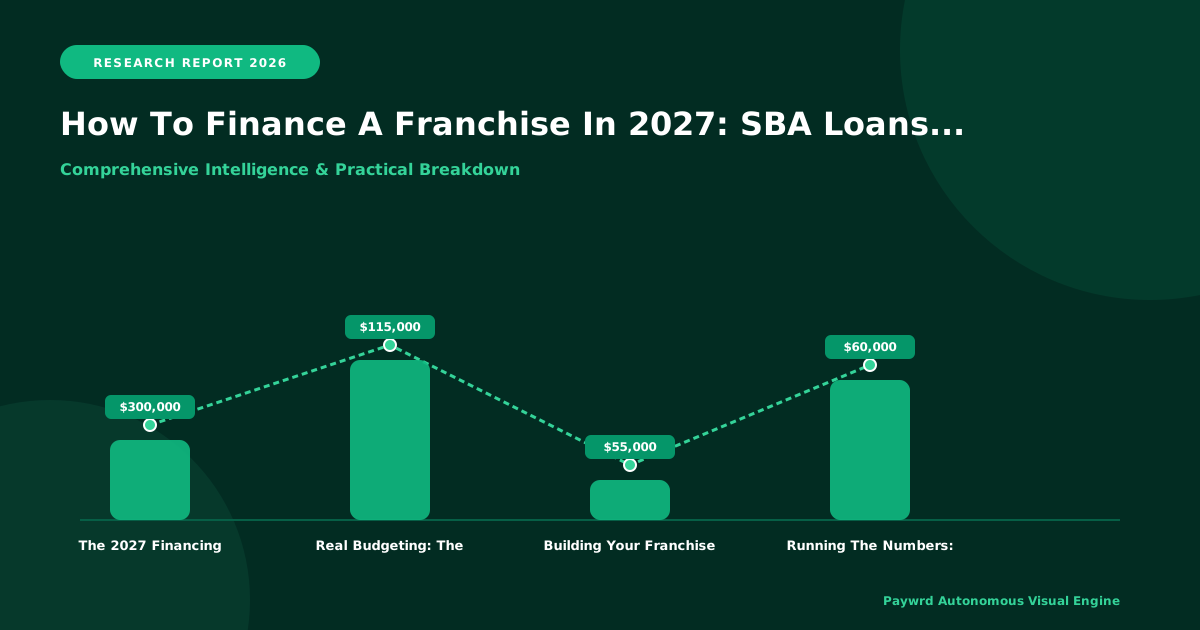
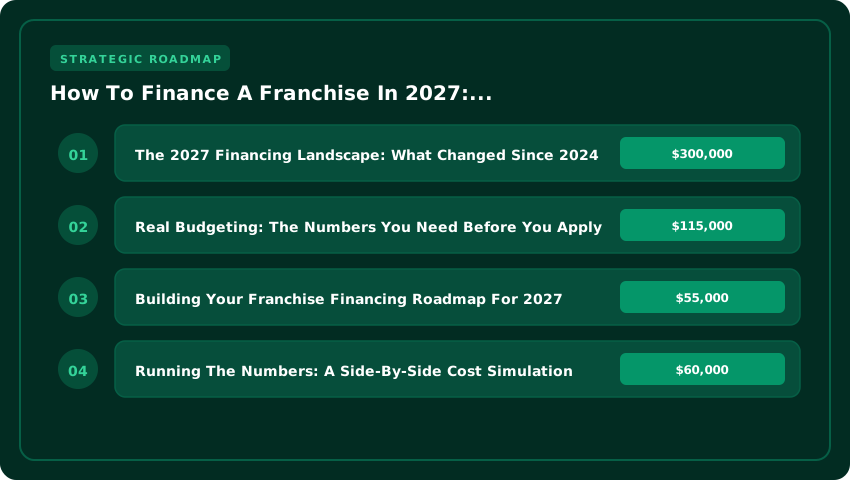
Alternative lenders — online platforms, credit unions with franchise programs, and specialty finance companies — filled the gap. They use technology to underwrite in 48 hours. They look at bank statements, not just tax returns. The trade-off is cost. A $300,000 equipment loan from an alt lender at 22 percent APR with a 3 percent origination fee costs roughly $115,000 in total interest and fees over five years. The same loan through an SBA 7(a) at 11 percent costs about $55,000 total. That $60,000 difference buys a lot of working capital.
One shift I watch closely: franchisors are building their own lending arms. Brands in fitness, quick-service, and home services now offer in-house financing for 30 to 50 percent of the total investment. Rates sit between SBA and alternative money, usually 12 to 14 percent. The advantage is speed and alignment. The franchisor wants you open and paying royalties. Their credit committee understands the model because they built it.
Real Budgeting: The Numbers You Need Before You Apply
Stop guessing at the total investment. The Franchise Disclosure Document (FDD) Item 7 gives you a range. Use the high end. Add 10 percent for overruns. That is your target loan amount. Here is the breakdown I use with every client in 2027.
Cash Injection Requirements
SBA requires a minimum 10 percent equity injection for loans under $500,000 and 20 percent above that. The cash must be seasoned — sitting in your account for 60 days — or sourced from a documented gift with a gift letter. Retirement rollovers (ROBS) count, but they trigger IRS scrutiny. I had a client in 2025 whose ROBS structure delayed closing by 45 days because the custodian flagged a prohibited transaction. Plan for that timeline.
Working Capital Reserve
This is the line item most first-timers skip. You need three months of rent, payroll, utilities, and marketing in a separate account the day you open. For a $500,000 build-out, that reserve is often $75,000 to $100,000. Lenders will not fund this into the loan. It must be liquid cash. If you borrow the injection from a HELOC, you just added a second payment. That kills your DSCR.
Fee Stack Awareness
Every loan has layers. SBA guarantee fee is 2 to 3.5 percent of the guaranteed portion (usually 75 percent of loan). Packaging fee from the broker or bank runs $2,500 to $5,000. Legal fees for closing: $1,500 to $3,000. Alternative lenders charge origination (1 to 5 percent), underwriting fees ($500 to $2,000), and sometimes prepayment penalties. Ask for the APR disclosure. Compare total dollar cost over the full term, not the monthly payment.
Collateral Reality
SBA loans are "fully secured." If the business assets don't cover the loan, they take a lien on your home if you have equity. Alternative lenders often take a blanket UCC filing on all business assets but rarely touch personal real estate for loans under $350,000. If protecting the house is priority one, that steers the decision.
Building Your Franchise Financing Roadmap For 2027
In my experience, the franchisees who get the best terms are the ones who start planning 12 to 18 months before they sign a franchise agreement. Here is the step-by-step framework I use with clients heading into 2027.
Step 1: Lock Your Franchise Disclosure Document (FDD) Numbers. The FDD lists the initial franchise fee, estimated startup costs, and required working capital. Grab those three figures. They become the foundation of every loan application you will submit. If the franchisor updated their FDD in 2026, use that version. Lenders will not accept outdated figures.
Step 2: Pull Your Personal and Business Credit Reports. I tell every client to pull all three bureau reports at least six months out. Dispute any errors. Most SBA lenders want a personal score of 680 or higher. Alternative lenders may accept 600-plus, but the rates climb fast below 650. If you see a thin file, become an authorized user on a seasoned credit card account to build history.
Step 3: Assemble Your Lender Packet Early. I prepare a standard folder for every client. It includes two years of personal tax returns, two years of business tax returns (or projected startup financials), three months of personal and business bank statements, a franchise agreement copy, and a one-page business plan. Having this ready saves weeks of back-and-forth.
Insider Take: Practical operational advice from someone who has reviewed thousands of applications. The single biggest mistake I see in 2026 is franchisees applying to three lenders with three different packet formats. Pick one clean folder, keep it updated monthly, and reuse it. Lenders appreciate consistency, and your file reviewer will thank you. A polished packet can shave 10 to 15 days off an SBA decision.
Running The Numbers: A Side-By-Side Cost Simulation
Theory is helpful. Real numbers are better. Let me walk you through a realistic scenario I often use. Imagine you are buying a franchise with a $50,000 initial fee and $200,000 in startup costs. You need $250,000 in total financing.
SBA 7(a) Loan Path. Say you qualify for a $250,000 SBA 7(a) loan at a 2026 interest rate of roughly 11 percent (prime plus a spread). The term is 10 years. Your monthly payment lands around $3,300. Add the SBA guarantee fee of 3.5 percent on the guaranteed portion (about $187,500 at 75 percent), which is roughly $6,562. Add a $4,000 packaging fee and $2,500 in legal costs. Your total upfront cost sits near $33,000 before you open the doors. Over the full 10 years, total interest paid is approximately $146,000.
Alternative Lender Path. An online lender might approve you in five days at a rate of 18 to 24 percent for the same $250,000. Let us use 20 percent. The term is often shorter, maybe three to five years. Monthly payments jump to roughly $6,400 on a five-year term. Origination fees of 3 percent add $7,500. Underwriting and document fees add another $1,500. Total upfront cost is about $34,000. But here is the shocker: total interest over five years is close to $134,000. The monthly burden is much heavier, even though the total interest looks similar on paper.
The Takeaway. The SBA path wins on cash flow. The alternative path wins on speed. Your choice depends on whether you can stomach a $6,400 payment or need to keep monthly obligations under $3,500 to survive the first year.
Timing Your Application: When To Move In 2026-2027
I have watched too many franchisees miss their ideal opening because they waited too long to approach lenders. Here is the timing framework I recommend for anyone planning a 2027 launch.
Spring 2026 (March through May): Soft Inquiry Phase. Reach out to two to three SBA lenders and one alternative lender. Ask what they need to see in a borrower. Do not submit formal applications yet. This is your fact-finding mission. Rates in 2026 have been shifting, and lenders adjust their appetite seasonally. Getting early feedback helps you fix credit or income gaps before the rush.
Summer 2026 (June through August): Formal Application Phase. Submit your full packet. SBA lenders typically take 30 to 45 days for a decision. Alternative lenders can often give you a term sheet within a week. Use this window to compare offers side by side. Negotiate where you can. SBA rates are set, but broker fees sometimes have room to move.
Fall 2026 (September through November): Close And Prepare. Finalize your loan, fund your franchise account, and begin any required training. Most franchisors want your location secured and your build-out starting by late 2026 for a spring 2027 opening. If you close your loan in October 2026, you have a comfortable buffer.
Winter 2026-2027: Launch. Open your doors with funding in place and a clear repayment plan. I always remind clients: the first 90 days of revenue will not cover your loan payment alone. Have six months of living expenses set aside so you are not tempted to take a high-interest bridge loan in panic.
Planning ahead in this way puts you in the driver's seat. Franchise ownership is exciting, but the financing step deserves just as much focus as picking the right location. Get the money side right in 2026, and your 2027 opens with confidence.
The Real Cost Of Capital: Side-By-Side Economics
Interest rates grab headlines, but the total cost of capital decides whether a franchise cash-flows or bleeds. In my years evaluating ventures, I have consistently found that owners who model the full picture—origination fees, prepayment penalties, covenant compliance costs, and tax treatment—make sharper decisions than those who chase the lowest advertised rate.
| Model Option | Est. Setup Cost | Annual Upkeep | Risk Level | Best For |
|---|---|---|---|---|
| SBA 7(a) Standard | 2.5–3.5% of loan (guarantee fee + packaging) | 0.55% ongoing guarantee fee on outstanding balance | Low | First-time owners buying proven brands with <$5M total project |
| SBA 504 (Real Estate Heavy) | ~3% (CDC fee + SBA fee + legal) | 0.35% CDC servicing + 0.25% SBA fee on debenture | Low | Owners purchasing land/building with 10% down, 20+ year horizon |
| Bank Term Loan (Conventional) | 0.5–1.5% origination | Annual review fee $500–$2,000; covenant monitoring | Medium | Strong credit (720+), 25%+ down, existing multi-unit operators |
| Online Alternative Lender | 2–5% origination | None explicit, but effective APR 12–28% | High | Speed-critical deals, credit gaps, bridge to SBA refi within 18 months |
| Franchisor Financing / Vendor Note | Often $0–$5,000 legal | Negotiated rate (typically 6–9%) | Medium | Gap financing (10–20% of project), aligned incentives with brand |
| ROBS (401k Roll-Over) | $4,500–$6,000 setup + $120–$150/mo admin | Ongoing admin + annual valuation if real estate held | High (IRS audit risk) | Owners with $100k+ in qualified plans, zero-debt preference |
The table above reflects 2026 pricing I see across lenders. Your exact numbers will shift with credit profile, franchise brand tier, and collateral. Treat it as a modeling baseline, not a quote.
Legal Protections That Actually Matter
Franchise agreements are written by the franchisor's attorney. Your loan documents are written by the lender's attorney. Neither protects you. I tell every client: hire your own franchise-experienced counsel before you sign anything. The $3,000–$5,000 you spend on review saves multiples down the road.
Personal Guarantee Carve-Outs
Every SBA loan and virtually every conventional loan requires a personal guarantee (PG) from anyone owning 20% or more. The PG is not negotiable away, but its scope is. Push for these carve-outs:
- Spousal limitation: If your spouse is not active in the business, keep them off the guarantee. Some lenders insist; many will yield if you push early.
- Burn-off provisions: After 24–36 months of on-time payments and hitting defined DSCR targets (typically 1.25x), the guarantee drops from unlimited to a capped amount (e.g., 50% of original principal) or releases entirely.
- Death/disability release: Ensure the guarantee terminates on death or permanent disability of the guarantor, not just the borrower entity.
Alternative lenders rarely offer burn-offs. Their PG is usually unlimited and joint-and-several. Factor that into your risk calculus.
Covenant Design
SBA loans have standardized covenants: annual tax returns, year-end financials, insurance certificates, no additional debt without consent. Conventional and alternative loans layer on quarterly reporting, minimum liquidity thresholds, and DSCR maintenance tests measured monthly.
I negotiate two things on every conventional term sheet:
- Cure periods: 30 days for financial covenant breaches, 15 days for reporting misses. Without this, a single late quarterly statement triggers technical default.
- Basket allowances: A $50k–$100k "general basket" for small equipment purchases or working capital draws without lender consent. Preserves operational agility.
Prepayment Flexibility
SBA 7(a) loans over 15 years carry a declining prepayment penalty: 5% year one, 3% year two, 1% year three, zero thereafter. SBA 504 debentures have a 10-year prepayment penalty tied to Treasury yield maintenance—expensive to exit early.
Conventional bank loans often have 1–3% hard penalties for 3–5 years. Alternative lenders? Some charge the full remaining interest as a "yield maintenance" fee. Read the fine print. If you plan to refinance once the unit stabilizes (common at 18–24 months), a 5% penalty on a $1M loan is $50k you didn't budget.
Contract Clauses To Watch In The Franchise Agreement
Your financing contingency clause is your escape hatch. Most franchise agreements include a 30–45 day window to secure funding. In 2026's lending environment, 45 days is tight for SBA. Negotiate 60–75 days with an automatic extension if you have a term sheet in hand but the lender's underwriting queue is backed up.
Also scrutinize:
- Transfer restrictions on equity: Some brands require franchisor approval for any ownership change, including bringing in an investor to meet liquidity requirements. Get pre-approval language for passive investors up to 20%.
- Remodel mandates: Many agreements require refreshes every 5–7 years
Frequently Asked Questions
Can I get a franchise loan with no prior business experience?
Yes, but your personal credit and liquid reserves carry more weight. In 2027, lenders still want a FICO score around 680 or higher and enough cash to cover 3–6 months of living expenses. Your franchise's track record helps. A brand with 500+ open units gives underwriters comfort even if you have never run a business.
How much down payment do alternative lenders actually require?
Most alternative lenders want 10–20% down on the total project cost. For a $500,000 buildout, that is $50,000 to $100,000 of your own money. SBA loans often require 10% down but can go as low as 5% if you qualify for the Community Advantage program. The trade-off is speed: alternative lenders close in 10–21 days, while SBA takes 45–90 days.
Are SBA loans still the cheapest option in 2027?
Generally, yes. A 7(a) loan currently runs around 11–12% with a 25-year amortization on terms up to $5 million. Alternative lenders charge 13–20% on shorter 3–5 year terms. Over a $400,000 loan, that difference can cost you $40,000 to $80,000 extra in interest over the life of the debt. SBA wins on cost. Alternative lenders win on timing.
What happens if my franchise financing falls through before closing?
This is why your franchise agreement's financing contingency clause matters. If you negotiated a 60–75 day window, you have time to pivot. You can switch to an alternative lender, bring in a silent partner, or renegotiate the closing date. Without that clause, you risk losing your franchise fee and your deposit. Always get that clause in writing before you pay anything.
Can I use a Rollover for Business Startups (ROBS) to fund a franchise?
You can, and it avoids early withdrawal penalties. But ROBS structures run $3,000–$6,000 in setup fees and carry real risk. If the business fails, your retirement savings are gone. In my view, ROBS works best for owners who plan to run the business themselves for 10+ years and who have a strong franchise brand behind them. Treat it as a last resort, not a first move.
How fast can I refinance an alternative loan into an SBA loan?
Most lenders will consider a refinance once your unit hits steady revenue, usually at 18–24 months. You will need two years of profit-and-loss statements and a stabilized debt-service coverage ratio above 1.25. Plan for a 5% yield maintenance penalty if your alternative loan has that clause. On a $600,000 loan, that penalty is $30,000, so factor it into your refinance math.
Final Verdict: Your 30-Day Action Roadmap
- Days 1–3: Pull your credit report and fix any errors. Gather two years of personal tax returns, profit-and-loss statements, and a balance sheet. Lenders in 2027 still ask for all three on day one.
- Days 4–7: Shortlist three franchise brands. Compare their Item 19 earnings claims and franchisee satisfaction data. Choose a brand whose existing units hit at least 85% of the projected financials.
- Days 8–12: Meet with two SBA-approved lenders and two alternative lenders. Get pre-qualified in writing. Ask each lender for a full fee schedule, including appraisal fees, closing costs, and prepayment penalties.
- Days 13–18: Negotiate your franchise agreement. Push the financing contingency window to 60–75 days. Add language allowing passive investors up to 20%. Review every remodel and transfer restriction clause.
- Days 19–24: Choose your lender. If speed matters more than cost, go alternative. If total interest cost matters more, go SBA. Lock your rate once you have a signed term sheet.
- Days 25–28: Finalize your capital stack. Confirm your down payment is in a liquid account. Secure any partner or investor commitments in writing. Have your attorney review every document.
- Days 29–30: Submit your formal loan application. Schedule your franchise signing for the last day of your financing contingency window. Keep a 10% cash reserve beyond your closing costs for surprises.
I have watched hundreds of franchise owners navigate this exact crossroads. The ones who succeed are not the ones with the best credit or the biggest savings. They are the ones who plan their financing before they sign the franchise agreement. Take the 30 days. Do the homework. Know your numbers. The right loan is out there, and it is waiting for someone prepared to walk through the door.
Post a Comment