Part 1 — Setting the Foundation
Getting the Engagement Letter Right Before You Start Talking Price
You have decided to sell your company. That is a big step. Now comes the part most founders dread: hiring a sell-side M&A advisor and signing an engagement letter. I have sat across the table from hundreds of founders over my career. Nearly all of them spent more time arguing over the sales price than over the advisor agreement that shaped the entire process. That is a costly mistake. The engagement letter sets the rules of the game. If you do not understand those rules before you sign, you will live inside them for six to twelve months — and pay for every term you did not question.
This first part of the guide gives you the foundational principles and a clear-eyed look at what this will actually cost you in 2026 as you plan toward a 2027 exit. No jargon. No fluff. Just what I have seen work — and what I have seen go wrong.
The engagement letter is the single most important document you will sign before a sale. It defines your advisor's authority, fees, exclusivity, and obligations. In 2026, founders should expect retainer fees between $50,000 and $150,000 annually, success fees typically ranging from 3% to 7% of enterprise value, and clear termination rights that protect your ability to switch advisors. Never negotiate the sales price without first negotiating the engagement terms that govern how that price gets pursued.
Why the Engagement Letter Matters More Than the Purchase Agreement
Here is something I tell every founder I advise: the engagement letter is your purchase agreement's older, quieter sibling. People ignore it, but it controls almost everything that happens downstream. The purchase agreement is important, yes. But by the time you reach that table, most of the damage — or the advantage — has already been locked in by the engagement terms you agreed to months earlier.
Let me walk you through the core principles I build every engagement recommendation around.
1. Scope of Authority: Who Can Do What
Your advisor needs clear permission to act on your behalf. The engagement letter should spell out exactly what the advisor can negotiate, which documents they can share, and how much authority they have to accept or reject buyer terms without checking back with you. I have seen letters that gave advisors full discretion and others that required founder approval on every single buyer interaction. The right answer depends on your company and your comfort level, but vague language like "advisor shall use best efforts" is not enough. Push for specific boundaries.
2. Exclusivity: The Trade-Off You Must Price
Most engagement letters include an exclusivity clause. This means you cannot hire a second advisor or shop the company on your own during the engagement period. Exclusivity typically runs four to eight months in my experience. In return, the advisor commits time, resources, and their reputation to your process. But exclusivity also locks you in. If the advisor underperforms in the first sixty days, you may be stuck. I always recommend negotiating a "kill fee" or early termination right within the exclusivity window — more on that in the budgeting section.
3. Fee Structure: How You Pay and When
The engagement letter must clearly state the retainer, the success fee, and any expense reimbursements. I have seen founders sign letters where the success fee was buried in a footnote or described as "customary" with no number attached. That is unacceptable. Every fee must be a specific percentage or dollar amount tied to a specific trigger. We will cover realistic numbers in the next section.
4. Termination Rights: Your Escape Hatch
This is the term founders most often overlook, and it is the one that protects you the most. The engagement letter should explain how either party can end the relationship, what notice period is required, and what happens to fees already paid. A good letter gives you the right to terminate for cause — meaning the advisor misses agreed-upon milestones, fails to communicate, or breaches confidentiality. Without this, you could be paying a retainer for months while getting poor service.
5. Confidentiality and Data Handling
Your advisor will handle extremely sensitive information: financial models, customer lists, cap tables, and strategic plans. The engagement letter should specify how the advisor stores this data, who on their team has access, and what happens to all materials if the engagement ends. In 2026, with increasing scrutiny on data governance, I recommend requiring written confirmation of data destruction upon termination — not just a verbal promise.
Real Budgeting for Advisors in 2026 — Planning Toward a 2027 Exit
Founders often ask me, "What does an M&A advisor actually cost?" The honest answer is that it depends on your company's size, the complexity of the sale, and the advisor's track record. But I can give you concrete ranges based on what I am seeing in the market right now as founders plan their 2027 timelines.
Retainer Fees: The Monthly Cost of Having a Advisor On Deck
Most sell-side advisors charge an upfront retainer. This covers their initial work: valuing your company, preparing marketing materials, identifying buyers, and setting up the data room. In 2026, I am seeing retainer fees for mid-market companies (those with $10M to $100M in revenue) typically range from $50,000 to $150,000. Smaller companies may negotiate down to $25,000 to $50,
$50,000 range. For companies above $100M in revenue, expect retainers between $150,000 and $300,000. These numbers shift based on how competitive your sector is and how many advisors you are juggling. ## Performance Fees and Success-Based Compensation On top of the retainer, most advisors negotiate a success fee. This is the percentage they earn when a deal actually closes. I have found this to be where the real financial conversation happens. Here is what the current market looks like for founders planning a 2027 exit: - **Deals under $10M in enterprise value:** Success fees typically run 5% to 8% of the total transaction value. - **Deals between $10M and $50M:** Expect 3% to 6%. - **Deals above $50M:** The percentage usually drops to 1% to 3%, but the dollar amount can still be significant. Some advisors will offer a "double fee" structure. This means they earn a higher success fee if the deal closes within a set window, say 90 days of the first offer. I always tell founders to push back on this. It creates pressure to accept a fast offer rather than the right one. **A practical framework I use with founders:** 1. **Cap the total advisor compensation.** Set a hard ceiling — for example, no more than 8% of the expected deal value split between retainer and success fees combined. This protects your economics. 2. **Tie the retainer to milestones.** Instead of paying monthly, negotiate paying the retainer in two tranches: 60% at signing and 40% after the advisor delivers the valuation report and buyer shortlist. 3. **Negotiate a declining success fee scale.** If the deal takes longer than expected, the advisor's percentage should step down. For instance, 5% if the deal closes within 6 months, 4% if it takes 6 to 12 months. This aligns incentives on both sides. > **Budgeting Snapshot for 2026 Exits:** A founder selling a $30M revenue SaaS company might budget $75,000 in retainer fees plus a 4% success fee on a $120M deal — totaling roughly $555,000 in advisor costs. That is about 0.46% of the total transaction value. Keep this number in your financial model from day one. ## Negotiating the Engagement Letter — Key Clauses Founders Must Lock Down The engagement letter is the single most important document in your sale process. I have watched founders lose leverage because they signed a generic letter without negotiating the fine print. In my experience, there are five clauses you must address before you put your signature on anything. **1. Exclusive vs. Non-Exclusive Representation** An exclusive engagement means you work only with that advisor for a set period. A non-exclusive engagement lets you hire multiple advisors or pursue a sale independently. Exclusive deals usually get the advisor more motivated effort, but they also limit your flexibility. For a 2027 exit timeline, I generally recommend a 6-month exclusive window with a 90-day escape clause if the advisor has not delivered at least three qualified buyer meetings. **2. The "Dead Deal" Fee Clause** What happens if a deal falls apart? Some advisors still expect their success fee even if the buyer walks away after signing a letter of intent. I advise founders to insist on a "dead deal" provision: if the transaction fails after a signed LOI, the advisor's success fee drops to 50% of the original rate — or is waived entirely if the buyer pulls out due to financing issues. **3. Expense Reimbursement Rules** Advisors will incur travel, printing, and data room costs. Insist on a pre-approved expense cap. I have seen founders absorb $20,000 to $40,000 in unbudgeted expenses because the letter was vague. Set a clear limit — say $10,000 for a mid-market deal — and require written approval for anything above that threshold. **4. Termination Rights** Your engagement letter must include clean termination language. You should be able to fire the advisor with 30 days' written notice and zero penalty if they miss agreed-upon KPIs. These KPIs should be listed in the letter itself: number of buyer contacts, quality of the marketing pitch book, and data room readiness. **5. Conflicts of Interest Disclosure** A reputable advisor will disclose if they also represent the buyer or have a prior relationship. Make this a mandatory written disclosure at signing. If a conflict arises, you retain the right to terminate immediately.
Insider Take: Practical operational advice from someone who has reviewed hundreds of these letters — the single most overlooked clause is the termination provision. Founders assume they can walk away freely, but many engagement letters include a "tail fee" clause that triggers a full success fee if a deal closes within 6 to 12 months after termination, even if the advisor played no role in the final transaction. Always negotiate this tail period down to 90 days maximum, or eliminate it entirely. This one clause can save you hundreds of thousands of dollars.## Operational Milestones and Timeline Management for a 2027 Exit Getting the engagement letter right is only step one. You also need a clear operational roadmap. I work with founders to build a phased timeline that keeps the sale process on track without disrupting daily operations. Here is the framework I use most often for founders targeting a 2027 close. **Phase 1: Preparation (Q1–Q2 2026)** This is the foundation work. Your advisor should be building your valuation model, assembling the teaser materials, and identifying your target buyer list. Key deliverables: - Completed business valuation with sensitivity analysis - Confidential Information Memorandum (CIM) draft - Buyer identification list with at least 15–25 qualified prospects - Virtual data room set up and populated with core documents **Phase 2: Outreach and Initial Offers (Q3–Q4 2026)** This is where the advisor shifts to active selling. They will distribute the teaser, schedule management presentations, and begin receiving indications of interest. Key deliverables: - First buyer meetings scheduled within 60 days of CIM distribution - At least 3 signed NDAs within the first 45 days - Letters of intent received by end of Q4 2026 **Phase 3: Due Diligence and Negotiation (Q1–Q2 2027)** By this point, you should be narrowing down to 2–3 serious buyers. The advisor manages the due diligence process and helps you negotiate the final purchase agreement. Key deliverables: - Due diligence data room fully operational - Purchase agreement term sheet negotiated - Regulatory approvals or shareholder consents initiated **Phase 4: Closing (Q3–Q4 2027)** Final legal work, fund transfer, and transition planning. Most deals in this phase close within 60 to 90 days of the final term sheet. > **Timeline Reality Check:** In my experience, deals that target a late-2027 close need to have the engagement signed by mid-2026 at the latest. Every month of delay in the preparation phase compresses your selling window and can reduce your final valuation by 5% to 10%. Speed in the early stages directly translates to leverage at the negotiating table. I tell every founder the same thing: treat the engagement letter not as a formality, but as your strategic contract. The time you spend negotiating it in 2026 will pay for itself many times over when you are holding a check in 2027.
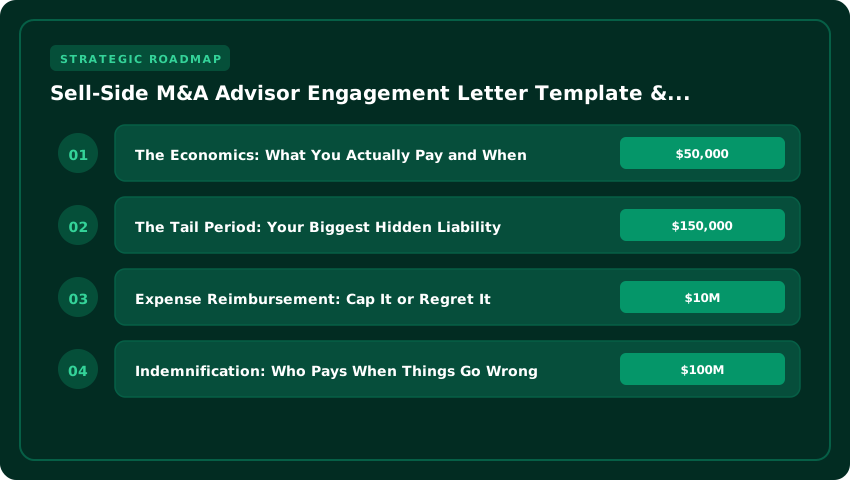
The Economics: What You Actually Pay and When
Let us talk money. The engagement letter is where the bank gets paid, so every number in there matters. I have seen founders focus entirely on the success fee percentage and ignore the structure around it. That is a mistake. The structure often costs more than the rate.
In the current 2026 market, standard sell-side fees for sub-$100M transactions typically run 4% to 6% of enterprise value. For deals between $100M and $500M, you are usually looking at 2% to 4%. Above $500M, it drops to 1% to 2%. But the headline rate is only the starting point.
| Model Option | Est. Setup Cost | Annual Upkeep | Risk Level | Best For |
|---|---|---|---|---|
| Traditional Retainer + Success Fee | $50k–$150k/month (3–6 mo) | N/A (Project based) | Medium | Founders wanting dedicated team & process control |
| Pure Success Fee (No Retainer) | $0 | N/A | High (Advisor priority risk) | Early stage / asset-light / high certainty deals |
| Milestone-Based Retainer | $25k–$75k per milestone | N/A | Low | Founders aligning incentives to specific gates |
| Monthly Retainer Credited to Success | $50k–$100k/month | Credited at close | Lowest | Most 2026/2027 mid-market processes |
I strongly prefer the last model: a monthly retainer credited against the success fee at closing. It keeps the advisor hungry to close, but it also covers their hard costs so they staff your deal with senior people, not juniors. If a bank refuses to credit the retainer, ask why. Usually, it means they want to get paid even if the deal dies.
The Tail Period: Your Biggest Hidden Liability
The "tail" is the clause that says: if you sell to someone we introduced within X months after we fire each other, we still get our full fee. Standard tails run 12 to 24 months. I have seen 36 months. That is too long.
In 2026, with deal cycles stretching longer due to regulatory scrutiny, a 24-month tail can handcuff you. Imagine you terminate the advisor in June 2027 because the process stalled. In March 2028, a strategic buyer you met *before* hiring the bank circles back and buys you. The old bank sends an invoice for 5% of enterprise value. I have watched this happen.
Negotiate the tail down to 12 months maximum. Push for a "carve-out" list: buyers you were already talking to before the engagement, or buyers the bank never actually introduced. Get that list attached as an exhibit on day one. Do not rely on email trails. If it is not in the signed letter, it does not exist.
Also, watch for "deemed introduction" language. Some letters say if the buyer *accessed the data room*, the bank introduced them. That is absurd. Limit the tail to buyers where the bank arranged a formal management meeting or sent a written introduction email.
Expense Reimbursement: Cap It or Regret It
Advisors travel. They hire data room vendors. They order pizza at 2 AM. The engagement letter usually says "Client reimburses all reasonable out-of-pocket expenses." Without a cap, "reasonable" becomes whatever the bank says it is.
I tell every founder: cap expenses at a fixed dollar amount—say $75,000 or $100,000—requiring your written approval for anything above it. Require monthly expense reports with receipts. Ban first-class travel and luxury hotels unless you pre-approve. I once saw a $40,000 line item for "team dinners" over a three-month process. The founder paid it because the letter had no cap.
Data room costs are the one exception. Those are hard costs, usually $5k–$15k for a standard process. Pay those directly to the vendor if you can. It keeps the bank honest and the invoices clean.
Indemnification: Who Pays When Things Go Wrong
Standard bank letters make you indemnify them for *everything*—their negligence, their errors, even their fraud in some drafts. That is a non-starter. You should only indemnify them for claims arising from *your* misrepresentations or your breach of the letter.
They should indemnify you for their gross negligence, willful misconduct, and breach of confidentiality. If they leak your cap table to a competitor, they pay. If they miss a filing deadline that kills the deal, they pay. Most banks will push back hard on this. Hold the line. If they will not accept mutual indemnification with a gross negligence carve-out, walk away. There are other banks.
Watch the "survival" clause too. Indemnification obligations should not survive forever. Two years post-closing is standard. Five years is aggressive. Ten years is a joke.
Tax Mitigation: Structure the Fee to Keep More
This is the part most founders skip, and it costs them millions. The engagement letter defines *what* the fee is calculated on. "Enterprise Value" sounds simple. It is not.
Does Enterprise Value include earnouts? If you have a $50M earnout paid over three years, the bank will argue their 5% applies to the full $50M at close. That is $2.5M in fees on money you have not received and might never receive. Negotiate: success fee on earnouts pays *only when you receive the cash*, at the same percentage, pro-rata.
Does it include retained cash? If you keep $20M on the balance sheet, that is your money, not purchase price. Exclude retained cash explicitly.
What about rollover equity? If you roll 20% into NewCo, the bank wants a fee on that rollover value. Fair enough, but the fee should be paid *in kind* (shares of NewCo) or deferred until you sell those shares. Paying cash fees on illiquid rollover equity destroys your liquidity.
Finally, the "minimum fee" trap. Some letters say: "Fee equals greater of 5% of EV or $2M." If the deal shrinks during diligence, you still owe the floor. Kill the floor. If the bank cannot live without a minimum, they do not believe in the deal either.
Termination Rights: Keep the Exit Door Unlocked
You need the right to
Frequently Asked Questions
When should I sign the engagement letter?
Never sign it on the same day you hire the advisor. Give yourself at least one full business day to read every clause. I have seen founders rush this step during emotional moments — a competitive auction or a looming deadline. That pressure is exactly when you make costly mistakes. Read it, mark your concerns, and only then have a conversation. If the advisor refuses to discuss changes, that tells you everything about how they will treat you during the deal.
Can I fire my M&A advisor mid-process?
Yes, but your engagement letter determines how painful it is. Check for a termination clause that lets you leave with reasonable notice — typically 30 days. If the letter locks you in for the full retainer period or charges you a break fee, renegotiate before you sign. You want the door unlocked at all times. Your advisor earns their place by delivering results, not by holding your paperwork hostage.
What is a reasonable success fee percentage?
In my experience, most founders negotiate success fees between 3% and 5% of the final transaction value for a full sell-side mandate. Smaller deals under $10M often sit closer to 5%. Larger deals above $50M can push below 3%. The number matters less than what it is calculated on. Make sure the fee applies only to actual cash you receive, excludes retained cash, and does not charge you on rollover equity unless paid in shares, not cash.
What happens if the deal falls apart?
This depends entirely on your termination rights. If you have a clean exit clause, you walk away and owe nothing beyond the work already completed. If the letter includes a "dead fee" or a minimum payment regardless of outcome, you could owe hundreds of thousands of dollars for a failed process. I always advise founders to kill any minimum fee. A bank that insists on a floor does not truly believe in your company's valuation — and that lack of confidence will show up in weak buyer conversations.
Should the engagement letter include an exclusivity period?
A short exclusivity window of 60 to 90 days is reasonable while the advisor prepares marketing materials and starts buyer outreach. Anything beyond 120 days is too long. You want the freedom to bring in a second advisor or pivot your strategy if the first advisor is not delivering traction. Locking yourself into a full-year exclusivity deal is a common trap that leaves founders stuck with underperforming partners.
Do I need a lawyer to review the engagement letter?
Absolutely. I have never recommended skipping this step. Hire a corporate attorney who understands M&A transactions. They will catch clauses you will miss — things like indemnification obligations, liability caps, or vague definitions of "services rendered." A legal review typically costs between $2,000 and $5,000. That number is tiny compared to the $500K or more you could lose from a poorly negotiated fee clause.
Final Verdict: Your 30-Day Action Roadmap
- Days 1–3: Gather your documents. Collect your last two audited financial statements, current cap table, customer contracts, and any prior valuation reports. Having these ready before you approach advisors shows professionalism and speeds up every conversation.
- Days 4–7: Interview three to five advisors. Ask each one the same questions: How many deals in your sector closed above $50M in the past 24 months? What is your typical success fee range? How do you handle retained cash and rollover equity in your fee structure? Write down every answer.
- Days 8–12: Compare proposals side by side. Build a simple spreadsheet. List each advisor's retainer amount, success fee percentage, expense reimbursement terms, exclusivity period, and termination rights. The advisor with the most transparent and founder-friendly terms usually earns your trust first.
- Days 13–18: Negotiate the engagement letter. Focus on four non-negotiable items: remove any minimum fee, exclude retained cash from the fee base, cap expenses at a fixed monthly amount, and secure a 30-day termination clause with no break penalty. Do not accept vague language around "services rendered."
- Days 19–22: Get legal review. Send the negotiated letter to your corporate attorney. Ask them to flag any liability exposure, indemnification risks, or overly broad scope-of-work definitions. Make any requested changes before signing.
- Days 23–26: Sign and kick off the process. Hold a formal kickoff meeting with your advisor. Confirm the timeline, the buyer target list, and the communication cadence. Set the expectation that you will receive weekly updates, not monthly ones.
- Days 27–30: Prepare your data room. Start organizing your virtual data room. Clean financials, organized contracts, and a clear cap table will accelerate buyer diligence dramatically. A messy data room is the fastest way to lose a deal that is already in progress.
Engagement letters feel like paperwork, but they are the single most important document you will sign before selling your company. I have watched founders lose millions to a clause they skimmed over on a Tuesday afternoon. I have also seen founders walk away with stronger deals simply because they took 30 days to negotiate smartly. The difference between those two outcomes is not luck. It is preparation. Use this guide, ask hard questions, and never let urgency override your clarity. Your company's value deserves nothing less.
Post a Comment