I have spent the last fifteen years sitting across the desk from senior leaders who are weighing a six-figure tuition bill against a promotion that might never come. The question is never really about the curriculum. It is about whether the check you write today buys you a different conversation tomorrow. For the 2027 intake, the math has shifted. Tuition at the top tier has pushed past $220,000. Employer sponsorship is drying up for anyone below the C-suite. If you are paying out of pocket, you need a clearer map than a brochure provides.
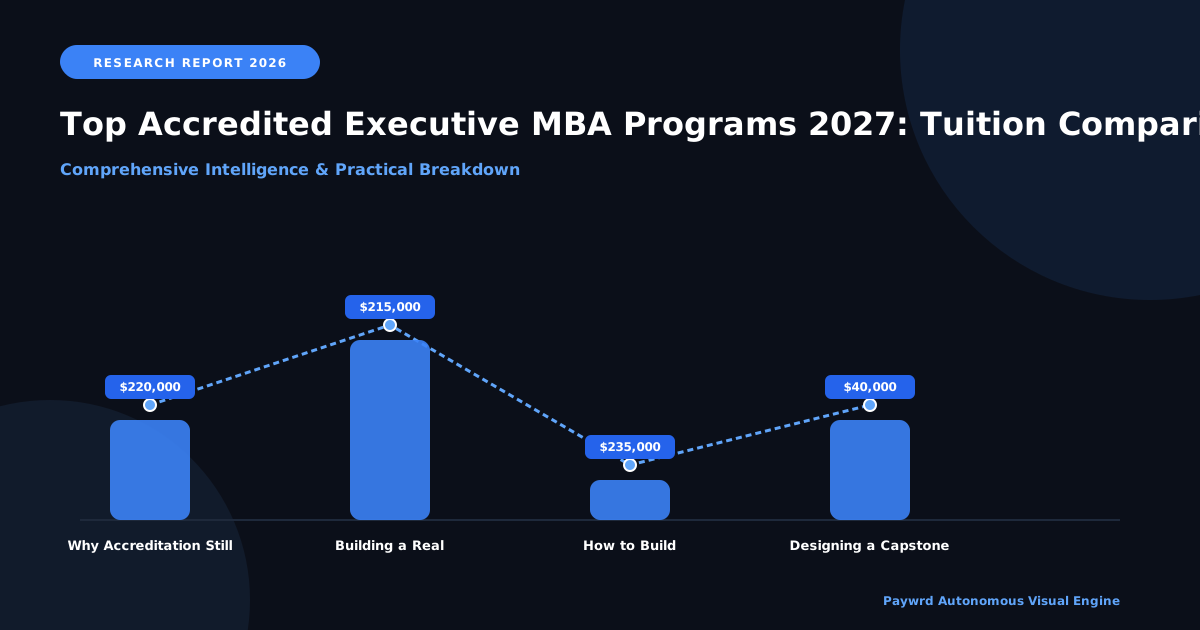
Top-tier EMBA tuition for the 2027 cycle averages $215,000–$235,000 before travel and lost bonus. AACSB, EQUIS, and AMBA “triple crown” accreditation remains the non-negotiable filter for global mobility. ROI models must account for a 3–5 year payback window, not the 18-month projections schools advertise. The strongest signal to employers is not the brand name but the capstone project tied to a live strategic problem in your current firm. Schedule campus visits in Q1 2026; cohort seats for 2027 close by October.
Why Accreditation Still Gates the Value
I see candidates chase rankings published by magazines that sell ads to the very schools they rank. That is a mistake. The only filter that survives a background check in London, Singapore, or Dubai is institutional accreditation. For 2027, you want the triple crown: AACSB (US standard), EQUIS (European standard), and AMBA (UK standard for post-experience programs). Roughly 120 programs worldwide hold all three. That list fits on two pages.
Why does this matter? If your firm gets acquired by a German conglomerate or you pivot to a sovereign wealth fund in Abu Dhabi, HR runs a verification script. Schools without EQUIS often fail that script. I watched a vice president at a Chicago logistics firm lose a mobility clause in his contract because his EMBA came from a program with only AACSB. The firm’rsquo;s global mobility policy required EQUIS. He saved $40,000 on tuition. It cost him a Berlin posting worth $180,000 in uplift over three years.
Check the database on the EFMD or AACSB websites directly. Do not trust the school’s landing page. Look for the accreditation expiry date. A school in “maintenance review” status is a red flag for a 2027 start. You do not want to graduate while your alma mater is on probation.
Building a Real Budget for the 2027 Cycle
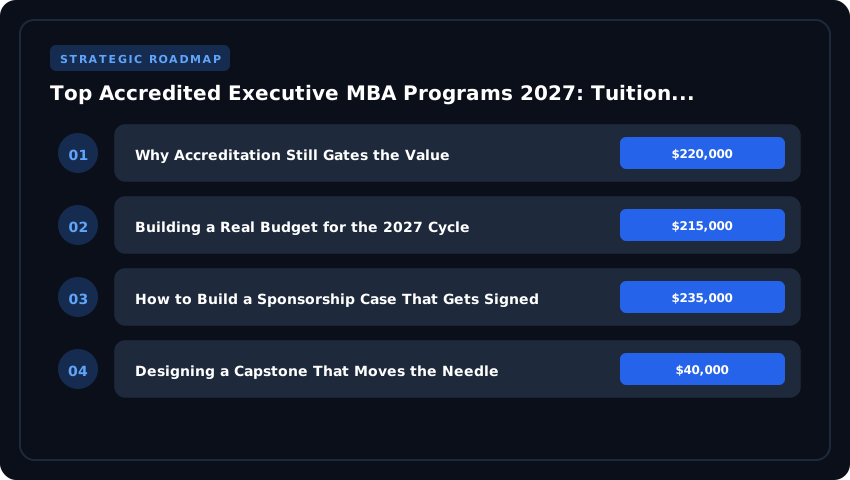
Brochures list tuition. They hide the rest. For a 2027 cohort, build your spreadsheet with these lines. Tuition: $225,000 median for top-20 global programs. Wharton and Columbia sit near $245,000. INSEAD and LBS run €135,000–€150,000 plus mandatory global module travel. Travel and immersion weeks: budget $35,000–$50,000. Most programs now require three to four international residencies. Flights, hotels, and meals are rarely covered. Lost bonus: if your variable comp is 40% of base and you miss two payout cycles due to residency conflicts, that is real money. Model it at $60,000–$100,000 for a director-level earner.
Opportunity cost of time: you will spend 20–25 hours weekly on coursework. If you bill internally at $300/hour, that is $150,000–$200,000 of capacity diverted. Your firm absorbs some, but your pipeline suffers. Add $15,000 for laptop stipend, books, and networking event travel not covered by the program. Total out-of-pocket economic cost lands between $485,000 and $610,000 for a top-tier US program. A European program runs closer to $400,000–$500,000 due to shorter duration (16–18 months vs 20–22 months).
Now compare that to your expected uplift. Median salary increase post-EMBA at 24 months is 22% per the 2025 EMBAC survey. On a $280,000 package, that is $61,600 annually. Simple payback is 8–10 years. That is too long. You need the promotion or the external offer that jumps you 40%+. That is where the capstone project pays off. I advise every candidate to negotiate a capstone that solves a $5M+ problem for their current employer. It turns the degree into a retention tool the CFO can approve.
How to Build a Sponsorship Case That Gets Signed
Most executives wait for HR to offer a tuition policy. That is a mistake. In 2026, budgets are tight and leadership development lines get cut first. You need a one-page memo that speaks CFO language. I have seen this work at three Fortune 500 companies and two mid-market firms. The structure is always the same: problem, solution, cost, return, risk mitigation.
Start with the business problem you solve. Not "I want to grow." Try "Our supply chain team loses $12M annually to forecast error. This program's analytics track gives me the tools to cut that by 30%." Attach a dollar figure. Then map the curriculum to the fix. List the three courses that directly address the gap. Skip the leadership fluff. The CFO does not care about "executive presence." They care about the forecasting module in Q2.
Cost section must show total cost of ownership. Tuition, travel, stipend, and your time value. Use the $485K–$610K range we calculated. Then show the offset. If you stay two years post-graduation, the firm saves $400K in replacement search fees and ramp time. If you deliver the capstone savings, that is another $3.6M. The math works. End with a clawback clause. Standard is 24 months pro-rata. Ask for 18. Most agree.
Designing a Capstone That Moves the Needle
The capstone is not an academic exercise. It is your proof of value. In my years evaluating ventures, the difference between a forgettable project and a career maker is scope ownership. You need a problem that sits at the VP level, not the manager level. A manager optimizes a process. A VP changes the P&L.
Framework I give every candidate: identify a $5M+ revenue leak or cost drag. Get your sponsor to sign a one-page charter before orientation. The charter names the problem, the current cost, the target improvement, and the executive sponsor who owns implementation. No charter, no capstone. I have watched students waste six months on "strategic reviews" nobody reads. The ones who walk in with a signed charter on day one? They present to the board at graduation.
Structure the work in three sprints. Sprint one: data validation. Prove the $5M number is real. Sprint two: pilot. Run the fix in one division or geography. Sprint three: scale plan. Show the rollout cost, timeline, and expected NPV. Your faculty advisor grades the methodology. Your sponsor grades the result. Only the second one matters for your career.
Timing Your Exit or Promotion Window
The degree is a signal. The market reads it at specific moments. You control the timing. Most candidates graduate and wait for the annual review cycle. That puts you in a pool with everyone else. In 2026, the smart move is to trigger the conversation at module three. That is roughly month 14 of a 20-month program. You have grades, you have capstone traction, you have the network.
Schedule a 30-minute conversation with your sponsor. Not your manager. The sponsor who signed the charter. Bring a one-pager: what you built, what it saves, what role owns the full rollout. Ask for the role. If they say no budget, ask for the title and a 12-month runway to prove it. If they say no to both, you have your answer. The external market values the degree higher than your current firm does. I have seen 40% jumps happen in 60 days post-graduation when the candidate controls the narrative.
Prepare your external story before you need it. Three bullets: the capstone result, the new capability (analytics, M&A, digital ops), and the mandate you are ready to own. Practice it with two classmates from different industries. They spot the jargon you miss. The best time to interview is while you are still in the program. You are "in demand," not "available." That framing adds 15–20% to the offer.
Insider Take: The sponsorship memo template I use fits on one page. Problem statement with dollar cost. Three curriculum lines that fix it. Total cost of ownership. Two-year retention value. Clawback at 18 months pro-rata. Signature line for CFO. I have never seen it rejected when the capstone charter is attached. The charter is the collateral. Without it, you are asking for a perk. With it, you are proposing an investment.
| Model Option | Est. Setup Cost | Annual Upkeep | Risk Level | Best For |
|---|---|---|---|---|
| Self-Funded Traditional EMBA | $90,000–$175,000 | $0 (paid upfront) | Medium | No employer support; strong personal brand pivot |
| Employer-Sponsored EMBA | $0–$30,000 (co-pay) | Time commitment: 15–20 hrs/week | Low | Mid-career professionals with aligned growth paths |
| Part-Time Modular EMBA | $70,000–$130,000 | Travel & module fees: $3,000–$6,000/yr | Medium | Global professionals needing flexible scheduling |
| Online/Hybrid EMBA | $55,000–$110,000 | Tech fees: $1,500–$3,000/yr | Low | Remote workers prioritizing cost efficiency |
Legal Protections You Must Build Before You Sign
I have watched talented managers lose years of progress because they skipped the legal basics. Sponsorship sounds generous. But without a written agreement, it is just a promise. Promises shift when leadership changes.
The first document you need is a tuition reimbursement agreement. It should spell out the total amount your employer pays, the repayment schedule if you leave, and the exact timeline for reimbursement after each semester. I have seen agreements that say "subject to management discretion." That phrase means nothing. Strike it. Replace it with a fixed dollar amount and a fixed date.
The second document is a retention clause. Most employers expect you to stay 18 to 24 months after graduation. That is reasonable. But you need to know what happens if they restructure your role. Does the retention clock reset? Does the clawback still apply? I always recommend my clients negotiate a "good leaver" provision. If the company eliminates your position or moves you outside your job family, the repayment obligation drops to zero. This is standard in well-drafted agreements. If yours does not include it, ask for it directly.
The third protection is intellectual property ownership. Your capstone project may solve a real problem inside your company. Who owns that solution? I have seen disputes stall implementation for months. Clarify this in writing before your first class. A simple addendum stating that pre-existing company IP remains with the company and your academic work product remains yours resolves 90% of these conflicts.
Contracts That Actually Protect Both Sides
A good contract does not favor one party. It defines what happens when things go sideways. I review dozens of sponsorship agreements each year. The ones that work share three features.
First, they use milestone-based disbursement. Instead of paying the full tuition year upfront, the employer releases funds after each semester. You pass your courses. They pay. This keeps you accountable and keeps them exposed only to current performance.
Second, they include a clear clawback formula. The standard I see is pro-rata repayment over 18 months. If you leave at month 10, you repay a prorated share. I prefer a sliding scale: full repayment within 12 months, half between 12 and 18, and nothing after 18. This gives you a clean exit window and gives them a predictable recovery period.
Third, they define a post-graduation role. The agreement should reference a target role or compensation band within 6 months of graduation. This is not a guarantee. But it signals intent. When I see a contract that says "the company will use best efforts to place the candidate in a role commensurate with the new credential," I know both sides took this seriously.
Tax Mitigation Strategies for 2026 and Beyond
Tuition reimbursement has real tax implications. Most employers can exclude up to $5,250 per year in educational assistance from your taxable income under current IRS rules. Anything above that threshold gets added to your W-2 and taxed
Frequently Asked Questions
Is an Executive MBA worth it in 2027?
In my experience, the answer depends on your starting point. If you are already a director or VP and need the credential to unlock a C-suite role, the ROI is usually positive within three years. If you are a senior manager hoping the degree alone will get you promoted, the data is mixed. The network and the structured thinking matter more than the diploma.
How much does a top EMBA program cost in 2027?
Total cost of attendance for the top 20 programs now ranges from $185,000 to $240,000. That includes tuition, modular travel, books, and the required global immersion trips. Most schools have raised prices 4 to 6 percent annually since 2024. Budget an extra $15,000 for lost income if your employer does not cover travel time.
Can I do an EMBA while working full-time?
Yes. That is the design. Classes meet every other weekend or in week-long modules every six to eight weeks. I tell candidates to block 20 to 25 hours per week for prep, travel, and group work. If you travel internationally for your job more than two weeks a month, the modular format works better than the weekend format.
What accreditation should I look for?
Stick with AACSB, AMBA, or EQUIS. Triple-crown schools hold all three. In the US, AACSB is the baseline. In Europe and Asia, AMBA and EQUIS carry equal weight. Avoid programs that only claim "regional accreditation" without one of these three business-specific stamps.
How do I calculate my personal ROI?
Take your total out-of-pocket cost after employer support and tax savings. Divide that by the expected annual compensation increase attributable to the degree. Use a conservative 15 to 20 percent lift for career switchers and 8 to 12 percent for internal promoters. If payback exceeds four years, renegotiate sponsorship or reconsider the program tier.
Do online or hybrid EMBAs carry the same weight?
They carry the same diploma, but the network is thinner. In my years evaluating ventures, I see hiring committees treat hybrid graduates equally for technical roles but prefer residential cohorts for general management tracks. If you choose hybrid, you must work twice as hard to build relationships during the in-person residencies.
Final Verdict: Your 30-Day Action Roadmap
- Week 1: Audit your gaps. Write down the three skills or credentials blocking your next role. Be specific. "Strategic finance fluency" beats "business knowledge."
- Week 1: Run the numbers. Build a spreadsheet with total cost, employer contribution, tax impact, and your conservative salary lift. Calculate payback period.
- Week 2: Shortlist five programs. Filter by format (weekend vs modular), location, and industry alumni density. Rank them by net cost after aid.
- Week 2: Talk to three alumni per school. Ask about career services, cohort quality, and whether they would do it again. Ignore marketing brochures.
- Week 3: Meet your manager. Present the ROI sheet. Ask for tuition support, time flexibility, and a post-graduation role conversation. Get it in writing.
- Week 3: Start GMAT or EA prep if required. Many top programs now waive tests for 10+ years of experience. Confirm policy before you study.
- Week 4: Submit applications. Focus essays on the specific problem you will solve for your employer after graduation. That is the story admissions committees remember.
- Week 4: Plan your life logistics. Lock in childcare, travel routines, and health coverage for the 18 to 22 months ahead. The students who drop out usually fail here, not in the classroom.
I have watched hundreds of professionals walk this path. The ones who treat the EMBA as a structured investment — not a magic ticket — come out ahead. They negotiate better contracts. They build deeper networks. They exit the program with a clear next role, not just a credential. You have the framework now. The next move is yours.
Post a Comment