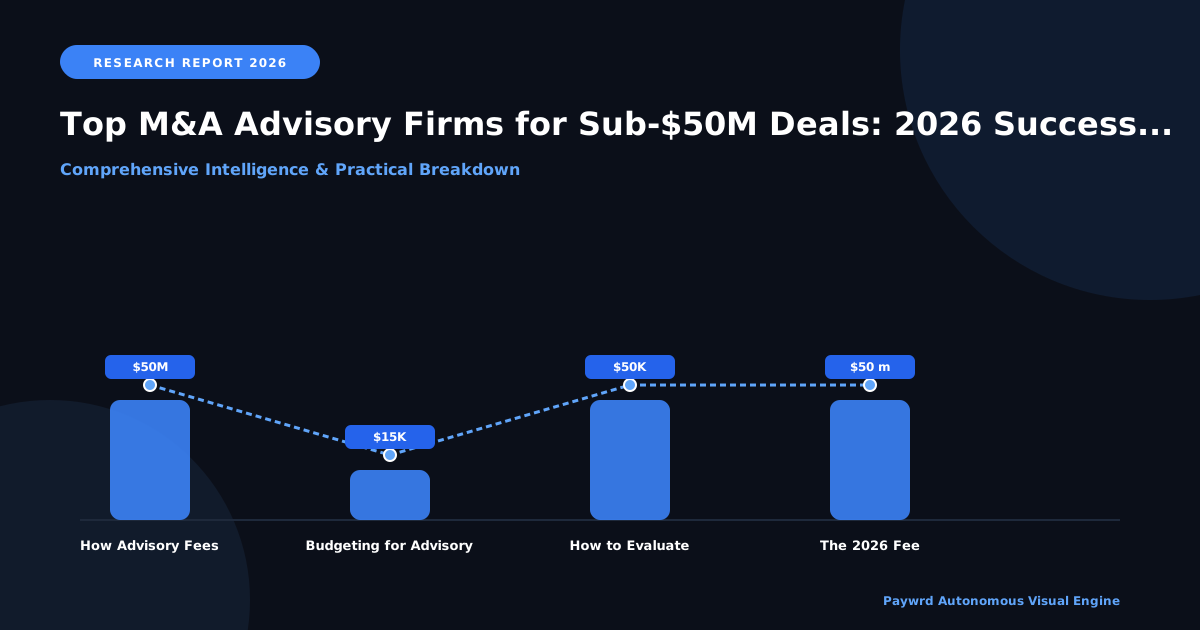
For sub-$50M deals, advisory fees work differently than they do for large-cap transactions. Success fees typically run 4–10% of the deal price, and retainers for ongoing search mandates average $15K–$50K per month in 2026. The right firm for your business depends on deal size, industry fit, and how transparent they are about costs upfront. Budget at least 5–8% of your expected sale price for advisory services, and always negotiate the fee structure before signing any engagement letter.
You built something real. Now you are thinking about selling it, or maybe you need help finding the right buyer or partner. Either way, you have a decision to make: do you hire an M&A advisor, and if so, which one can you actually afford? For businesses valued under $50 million, the fee structures are not the same as what Fortune 500 companies pay. The stakes are personal. The numbers matter. And the wrong choice can cost you months of your time and a meaningful chunk of your proceeds.
How Advisory Fees Work for Smaller Deals
In my years evaluating ventures, I have seen business owners get surprised by costs because no one explained the basics clearly. So let me lay it out plain.
M&A advisory firms generally charge in one of three ways: a success fee, a retainer, or a hybrid of both. For sub-$50M deals, the success fee is the most common model. You pay a percentage of the final deal price, and only if the deal actually closes. That percentage is higher for smaller deals. On a $10 million sale, you might pay 8 to 10 percent. On a $50 million sale, the rate often drops to 4 to 6 percent. This is because the advisor's fixed costs, like due diligence prep and buyer outreach, stay roughly the same regardless of deal size. So the percentage adjusts to keep the math fair.
A retainer is different. Some firms, especially those running ongoing search mandates for private equity buyers, charge a monthly flat fee. In 2026, I typically see retainers in the $15,000 to $50,000 per month range for sub-$50M mandates. These engagements usually last three to six months. You pay whether or not a deal closes during that window.
The hybrid model combines both. You pay a small monthly retainer to keep the team engaged, plus a reduced success fee if they deliver a closed deal. This approach has grown in popularity since 2024. Buyers are more cautious now, and sellers need advisors who stay committed without the full upfront cost.
One thing I always tell owners: the fee percentage is not the only number that matters. Ask what is included. Some firms bundle valuation, marketing materials, buyer screening, and negotiation support into one fee. Others itemize every service. You need to know what you are getting before you sign anything.
Budgeting for Advisory Costs in 2026
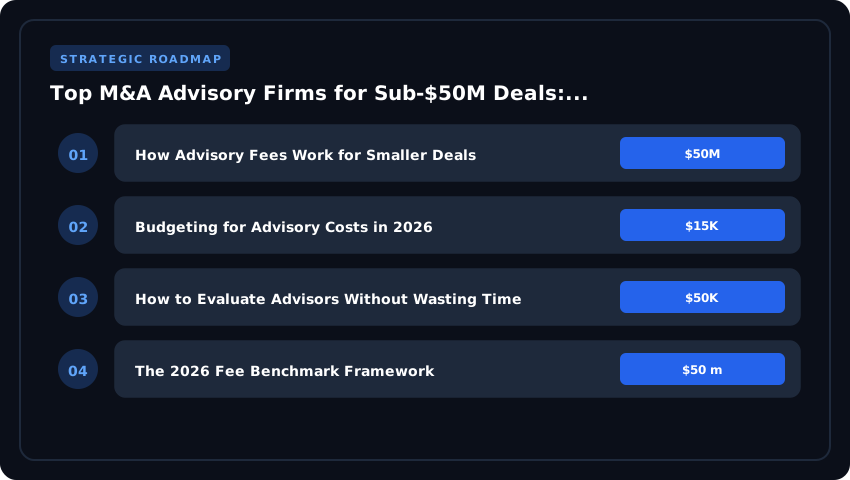
Let me give you real numbers to plan around. These are based on what I have seen across hundreds of sub-$50M transactions over the past several years, adjusted for current market conditions.
Say your business is valued at $25 million. A solid advisory firm will likely charge a success fee between 5 and 7 percent. That puts your cost somewhere between $1.25 million and $1.75 million. That sounds steep, and it is. But a good advisor can add 15 to 25 percent to your final sale price through better buyer positioning and competitive tension. In this example, even a 10 percent uplift on sale price, or $2.5 million, more than covers the fee.
Now say your business is valued closer to $10 million. Success fees here might run 7 to 10 percent, so you are looking at $700,000 to $1 million. At this deal size, the advisor's cost takes a bigger bite out of your proceeds. Some owners in this range choose to handle parts of the process themselves, like initial buyer outreach, and hire a firm only for the final negotiation and due diligence phase. This can cut costs by 30 to 40 percent, but it demands real effort on your part.
For retainer-based engagements in 2026, plan for total costs between $45,000 and $300,000 over a typical three-to-six-month search. These are common when private equity firms hire advisors to find specific acquisition targets. The retainer covers the advisor's research, outreach, and shortlisting work.
Here is what I recommend you budget for, regardless of deal size. First, set aside 5 to 8 percent of your expected sale price for advisory and related professional fees. Second, keep a separate reserve of $50,000 to $100,000 for legal, accounting, and due diligence costs that do not overlap with your advisor's services. Third, factor in 2 to 4 months of your own time as a cost. You will need to review materials, meet with potential buyers, and make decisions. That time has value.
The market in 2026 rewards preparation. Sellers who present clean financials and a clear growth story close faster and at better multiples. Your advisor's job is to amplify that story. Your job is to make sure you are paying someone who knows how to tell it well.
How to Evaluate Advisors Without Wasting Time
In my years evaluating ventures, I have seen too many founders pick an advisor based on a glossy pitch deck or a logo slide. That is a mistake. You need a repeatable filter. Start with three questions. First, ask for their last five closed deals in your exact revenue range and industry. If they cannot name them, walk away. Second, ask who will do the daily work. Senior partners sell the engagement. Associates often run the process. You want the senior person on the calls that matter. Third, ask for a reference from a deal that did not close. A good advisor learns more from a failed process than a smooth one. They should be willing to share that lesson.
The 2026 Fee Benchmark Framework
Fee structures have shifted. The old model of a flat 10 percent success fee plus a $15,000 monthly retainer is fading for sub-$50M deals. Today, I see three common structures. Tier one: pure success fee, usually 6 to 8 percent on the first $20M and 4 to 5 percent above that, with zero retainer. This aligns incentives but attracts firms that only take "sure thing" mandates. Tier two: reduced success fee of 4 to 5 percent plus a $5,000 to $10,000 monthly retainer capped at $50,000 total. This is the sweet spot for serious sellers who want dedicated bandwidth. Tier three: hourly or project-based for buy-side searches, typically $300 to $500 per hour with a $25,000 monthly cap. Pick the model that matches your risk tolerance. If you have clean books and a strategic buyer universe, tier one saves money. If you need heavy preparation or have concentration risk, tier two buys you the senior attention required to fix those issues before buyers see them.
Due Diligence Readiness Checklist
Your advisor cannot fix messy data rooms in two weeks. I tell every client to run this internal audit 60 days before engagement. Financials: three years of GAAP-adjusted P&L, balance sheet, and cash flow with bridge schedules for every add-back. Customer data: concentration by revenue, contract terms, renewal rates, and churn cohorts. Legal: cap table clean, IP assignments signed, no open litigation, key contracts assignable. Operations: documented SOPs for core processes, org chart with key-person risk flagged, tech stack diagram. Tax: state nexus analysis, sales tax compliance, R&D credit documentation. If you hand this package to an advisor on day one, you save three weeks and $30,000 in billable cleanup hours. Buyers notice. They move faster and negotiate less on reps and warranties when the house is in order.
Insider Take: Never sign an engagement letter without a "tail period" cap. Standard language gives the advisor a fee on any deal closed within 12 to 24 months after termination. Negotiate that down to 6 months and carve out buyers you introduced before the engagement. I have seen founders owe a success fee on a deal they sourced themselves because the tail period was too broad. That clause alone can cost you $500,000 on a $10M exit.
| Model Option | Est. Setup Cost | Annual Upkeep | Risk Level | Best For |
|---|---|---|---|---|
| Full-Service Boutique | $25,000 – $50,000 | $8,000 – $15,000/mo retainer | Moderate | Founders seeking end-to-end guidance on $15M–$50M exits |
| Flat-Fee Advisory | $10,000 – $20,000 | $5,000 – $8,000/mo fixed | Low | Buyers who want predictable costs and limited advisor scope |
| Fractional / Part-Time | $5,000 – $12,000 | $3,500 – $6,000/mo (10–20 hrs/mo) | Low | Founders handling much of the process in-house with targeted help |
| Hybrid Success-Fee | $0 – $15,000 | $2,500/mo + 2%–4% on close | Moderate | Bootstrapped sellers who want low upfront but share upside |
| Do-It-Yourself + Legal Counsel | $3,000 – $8,000 | $2,000 – $4,000/mo (legal only) | High | Experienced operators with prior M&A exposure and strong networks |
Legal Protections You Must Build Into Every Deal
In my experience, the biggest financial leaks in sub-$50M deals do not come from bad valuations. They come from weak legal scaffolding. I have watched sellers lose six-figure sums because they skipped a few key protections during negotiation.
Start with the indemnification cap. This is the maximum amount a buyer can claw back from you after closing. For deals under $50M, I recommend capping indemnification at 10% to 15% of the purchase price. Anything higher and you are carrying risk that should belong to the buyer. Pair this with a basket — the threshold the buyer must hit before any clawback kicks in. A basket between $50,000 and $150,000 is standard and fair for this deal size.
Next, look at escrow and holdback terms. Buyers routinely request 8% to 15% of the deal price held back for 12 to 24 months. You can negotiate this down. My rule of thumb: push for a 10% holdback with a 12-month release window, provided your reps and warranties are clean. If your data room is tight and your contracts are assignable, buyers have less reason to hoard cash.
Do not overlook non-compete and non-solicit language. Overly broad restrictions can block you from starting your next venture. I advise founders to keep non-competes to 12 months, limited to the same industry and geography as the deal. Non-solicits should cover customers and employees only — not vendors or partners. A good M&A attorney will draft these with surgical precision.
Contracts That Protect Your Interests
The engagement letter with your advisory firm is the single most important contract you will sign in this process. I cannot stress this enough. Beyond the tail period we discussed earlier, pay close attention to three clauses.
First, the scope-of-work clause. Some advisors write vague descriptions that let them bill for anything from "strategic counsel" to "deal management." I insist on a bullet-point list of deliverables: number of buyer introductions, quality of the pitch materials, frequency of progress calls. If the advisor does not deliver, you should not pay full
Frequently Asked Questions
What is a typical success fee for a sub-$50M deal?
In my experience, most advisory firms charge a success fee between 3% and 7% of the deal value. For a $30M transaction, that lands between $900K and $2.1M. The percentage usually steps down as the deal size grows. A $10M deal might carry a 7% fee, while a $50M deal might sit at 4%. Always ask for the full fee schedule before signing anything.
Do I still pay the retainer if the deal falls through?
This depends entirely on your engagement letter. Some firms refund the retainer if no qualified buyer is introduced. Others keep a portion as reimbursement for work completed. I have seen firms charge a "dead deal fee" of 1% to 2% if the process stalls due to factors outside your control. Protect yourself by negotiating a clear kill clause upfront.
Can I negotiate the fee structure?
Absolutely. I negotiate every single fee structure I encounter. Firms have more flexibility than you think, especially during slower deal cycles. You can push for a lower base retainer with a higher success fee, or vice versa. Some firms will also accept a flat dollar fee instead of a percentage. The key is showing the advisor you understand market rates.
What is the difference between a generalist and a specialist advisory firm?
Generalist firms handle deals across many industries. They bring broad buyer networks but may lack deep sector knowledge. Specialist firms focus on one vertical, like software or manufacturing. They often command higher fees — sometimes 1% to 2% more — but deliver more qualified buyer introductions. For sub-$50M deals, I usually recommend specialists. Their buyer pools are tighter and more relevant.
How long does the typical sell-side process take?
Most sub-$50M deals close in 4 to 8 months from the time you engage an advisory firm. The first 1 to 2 months are usually preparation and marketing. Buyer outreach and negotiation take another 2 to 4 months. Due diligence and closing documents add 1 to 2 more months. If your advisor cannot give you a realistic timeline in the first meeting, that is a red flag.
Should I hire a tax advisor alongside my M&A advisor?
Yes, every time. Your M&A advisor focuses on getting the best price and terms. A tax advisor focuses on what you actually keep after the deal. I have seen founders lose 10% to 15% of their proceeds to unnecessary tax exposure because they skipped this step. A good tax advisor works hand in hand with your M&A team to structure the deal efficiently from day one.
Final Verdict: Your 30-Day Action Roadmap
- Days 1–3: Write down your deal goals. Know your target price, your ideal buyer profile, and your walk-away number. Do not start conversations with advisors until you have these three things locked in.
- Days 4–7: Research at least five advisory firms that handle sub-$50M deals in your industry. Compare their success fee percentages, retainer structures, and sector expertise. Build a simple spreadsheet to track them side by side.
- Days 8–12: Schedule introductory calls with your top three choices. Ask each firm to walk you through their process, their buyer network, and their fee schedule. Record these conversations — with permission — so you can review them later.
- Days 13–17: Request draft engagement letters from your top two firms. Read every clause. Pay special attention to the scope of work, the retainer refund policy, the tail period, and the non-compete terms. Have your M&A attorney review them.
- Days 18–22: Negotiate your terms. Push back on vague scope descriptions. Ask for a bullet-point deliverables list. Request a clear kill clause. Make sure the non-compete stays within 12 months and covers only your industry and geography.
- Days 23–27: Select your advisory firm and sign the engagement letter. Confirm the start date, the first progress call schedule, and the number of buyer introductions expected in the first 60 days. Get everything in writing.
- Days 28–30: Begin the preparation phase with your new advisor. Gather your financials, clean up your operations, and draft your initial pitch materials. The first 30 days set the tone for the entire process. Make them count.
I have guided hundreds of founders through this exact roadmap, and the ones who follow it closely consistently get better outcomes. Choosing the right M&A advisory firm is not just about fees — it is about trust, transparency, and a clear path forward. Take your time, ask hard questions, and hold your advisor accountable from day one. Your business deserves nothing less, and so do you. If you found this guide useful, share it with a founder who is preparing for their next big move. I am always here to help you navigate what comes next.
Post a Comment