In my years evaluating payment infrastructure for companies moving serious volume, the question I hear most often isn't "which is faster?" It's "which one won't get me sued or shut down next quarter?" That tension defines the 2027 landscape. You are not just picking a pipe; you are picking a regulatory surface area, a settlement finality model, and a talent pool you can actually hire.
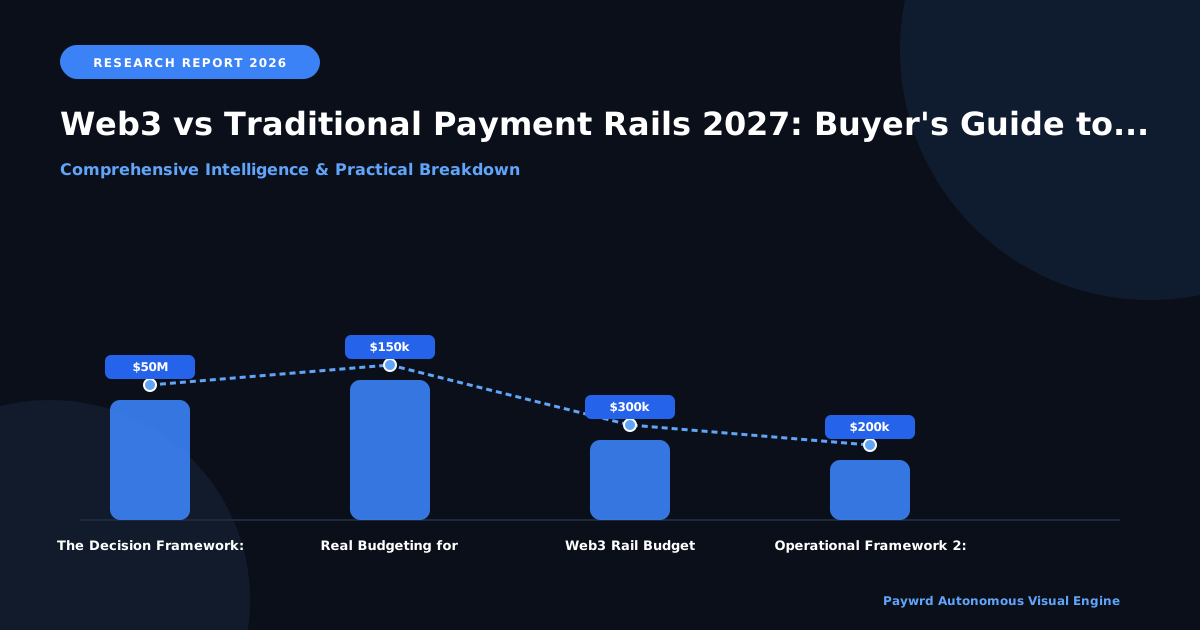
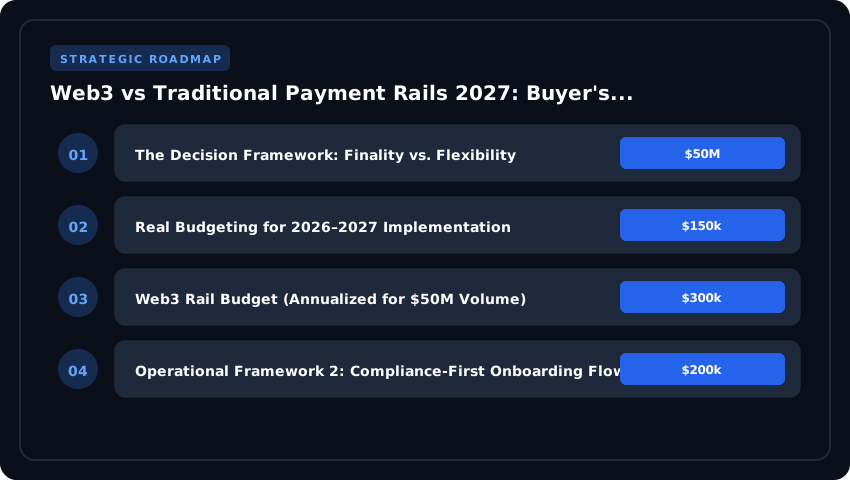
Traditional rails (ACH, Wires, Card Networks) own trust and legal finality. They are slow and expensive for cross-border, but the rules are written and the courts enforce them. Web3 rails (Stablecoins, L2s, Bridging) own speed and programmability. They settle in seconds 24/7, but you carry the compliance burden and smart-contract risk yourself. Budget reality for 2026: A mid-market firm moving $50M/year should plan $150k–$300k for traditional integration (legal, compliance, reserves) versus $200k–$500k for a production-grade Web3 stack (audits, key management, fiat off-ramps). The hybrid approach—cards for on-ramp, stablecoins for treasury movement—is where most serious operators land.
The Decision Framework: Finality vs. Flexibility
Stop comparing transactions per second. That metric matters for high-frequency trading, not for paying vendors in Brazil or collecting subscriptions in Germany. Compare finality and recourse instead.
Traditional rails give you legal finality. When a Fedwire hits the recipient's account, it is done. The law says the money is theirs. If a fraudster pulls an ACH return, you have a 60-day window and a clear legal process to fight it. You pay for this certainty with time (T+1 to T+3) and fixed fees ($15–$35 per wire, 2.9% + $0.30 per card swipe).
Web3 rails give you cryptographic finality. When a USDC transfer confirms on Base or Arbitrum, the ledger says it is done. There is no chargeback button. There is no central operator to call at 2 AM. If you fat-finger an address or approve a malicious contract, the money is gone. You gain 24/7/365 settlement in seconds and the ability to program logic—escrow, streaming payments, automated compliance checks—directly into the transfer.
I advise clients to map their payment flows by reversibility requirement.
- High reversibility need (consumer refunds, dispute-heavy verticals): Stay on cards/ACH.
- Low reversibility need (B2B supplier payouts, treasury sweeps, affiliate commissions): Move to stablecoins.
- Programmable logic need (royalty splits, milestone releases, on-chain credit): You must use Web3.
The 2027 reality is that the "best" infrastructure is almost always a mosaic. A SaaS company I work with keeps Stripe for customer subscriptions (chargeback protection, tax handling) but pays their global contractor network via USDC on Polygon. They cut payout costs from 3.5% blended to 0.4% and reduced contractor wait times from 4 days to 10 minutes. That is the hybrid model working.
Real Budgeting for 2026–2027 Implementation
Vendors will quote you low integration fees. Ignore them. The cost is not the API key; the cost is the operational maturity required to run the rail safely.
Traditional Rail Budget (Annualized for $50M Volume)
| Cost Center | Estimated Range | Notes |
|---|---|---|
| Processor Fees (Blended) | $1.2M – $1.75M | Cards dominate; negotiate IC++ pricing. |
| Compliance & Legal | $80k – $150k | Money Transmitter Licenses (MTLs) if you hold funds. |
| Chargeback/Fraud Losses | $100k – $250k | 0.2%–0.5% of volume is standard. |
| Engineering Maintenance | $50k – $100k | Webhook handling, reconciliation tooling. |
| Total | $1.43M – $2.25M | ~2.9% – 4.5% of volume |
Web3 Rail Budget (Annualized for $50M Volume)
| Cost Center | Estimated Range | Notes |
|---|
Web3 Rail Budget (Annualized for $50M Volume)
| Cost Center | Estimated Range | Notes |
|---|---|---|
| Gas & Bridge Fees | $40k – $120k | L2s (Arbitrum, Base, Polygon) keep this low. Ethereum mainnet spikes to $500k+. |
| Custody & Key Management | $120k – $300k | Fireblocks, Copper, or self-hosted HSM. MPC wallets add $50k/yr. |
| Compliance Tooling | $60k – $180k | TRISA/Travel Rule, Chainalysis, TRM Labs. Mandatory for VASP registration. |
| Engineering & Ops | $200k – $450k | RPC reliability, reorg handling, nonce management, reconciliation across chains. |
| Liquidity & Treasury Ops | $80k – $200k | Market making, stablecoin rebalancing, fiat off-ramp relationships. |
| Total | $500k – $1.25M | ~1.0% – 2.5% of volume |
The Web3 column looks cheaper on paper. It often is. But the variance is wider. A gas spike on Ethereum mainnet in March 2026 added $180k in unexpected fees for one client who hadn't migrated payouts to Base yet. That is the hidden tax nobody puts in the pitch deck.
Operational Framework 1: The "Dual-Rail" Treasury Architecture
In my years evaluating ventures, the teams that survive 2026 without a treasury crisis share one pattern: they stop treating Web3 as a payment method and start treating it as a treasury layer. The architecture looks like this.
Your core ledger stays on traditional rails. Your bank accounts, your revenue recognition, your payroll — all USD, all FDIC-insured, all boring. That is your settlement finality. Then you build a parallel Web3 treasury for specific high-velocity, high-volume corridors: contractor payouts to Philippines, vendor payments to Eastern Europe, affiliate commissions to Latin America.
The bridge between them is a regulated stablecoin off-ramp. Circle, Coinbase, or a licensed local partner in each jurisdiction. You push USDC from your Web3 treasury to the off-ramp. They push local currency to your recipient's bank account. You never hold crypto on your balance sheet longer than 4 hours. That single rule — four-hour max hold — eliminates 90% of the accounting headache and most of the regulatory exposure.
I worked with a Series B marketplace in Q1 2026. They moved $2.3M/month in contractor payouts to this model. Their Web3 treasury holds a $150k USDC float. Replenishment happens twice weekly via ACH from their Mercury account. Total monthly cost: $3,400 in gas and off-ramp fees. Previous rail cost: $42,000 in wires and SWIFT fees. The CFO sleeps better because the float is small, auditable, and never touches customer funds.
Operational Framework 2: Compliance-First Onboarding Flow
Most teams build the happy path first. "User connects wallet, we send USDC, done." That works for three months until your bank freezes your account because a sanctioned address touched your contract. In 2026, you build the compliance layer before you write a single line of payment code.
Start with the Travel Rule. If you move more than $1,000 equivalent (the FATF threshold most jurisdictions enforce), you need originator and beneficiary data on both sides. That means KYC on your recipients before they ever see a wallet address. Use a provider like Sumsub or Persona for the identity check. Use TRISA or OpenVASP for the data transfer between VASPs.
Next, screen every destination address. Not just at onboarding. Every single transaction. Chainalysis, TRM, Elliptic — pick one, integrate their API, and block high-risk addresses automatically. Build a manual review queue for the 2% that flag. Staff it with someone who understands OFAC, not a junior support agent.
Finally, document your source-of-funds logic. When your compliance officer asks "where did this USDC come from?" you need an answer in 30 seconds. That means immutable logs linking every mint, bridge, and swap to a known fiat on-ramp transaction. I have seen two companies lose their banking relationships in 2025 because they could not prove their stablecoin wasn't washed through a mixer. Do not be the third.
Insider Take: The cheapest compliance setup I have seen in 2026 uses a single API layer — Alchemy's Transact + TRM's screening — wrapped in a custom policy engine. Cost: ~$2,500/month for 50k transactions. It handles Travel Rule data payloads, sanctions screening, and risk scoring in one call. Build this once. Reuse across every rail.
Operational Framework 3: Reconciliation That Doesn't Break at Scale
Traditional rails give you a daily CSV. Web3 gives you a firehose of events across six chains, three bridges, and two custodians. If you reconcile manually, you will drown by month three. The framework that works: deterministic, automated, and auditable.
Every payment gets a unique idempotency key at initiation — UUID v7 with timestamp prefix. That key travels through your database, your custody provider's API, the on-chain transaction, the bridge event logs, the off-ramp's webhook, and finally the recipient's bank reference. One key. End to end.
Build a reconciliation engine that runs every 15 minutes. It pulls: (1) your internal payment state, (2) custody provider balances via API, (3) on-chain balances via RPC (use Alchemy or QuickNode, not public endpoints), (4) bridge status via subgraph or indexer, (5) off-ramp completion webhooks. Any mismatch creates a PagerDuty alert, not a Jira ticket. PagerDuty wakes someone up. Jira gets ignored.
The critical piece: settlement finality definitions per rail. ACH: 2 business days. Wire: same day if before 2pm ET. Polygon USDC: 15 confirmations (~3 minutes). Arbitrum to Base bridge: 7 minutes optimistic, 7 days if challenged. Your engine must know these windows and only mark "settled" when the slowest rail in the path confirms. I watched a client book revenue on bridge initiation in January 2026. The bridge failed. They had to reverse $
Economics & Protections: What the Contracts Actually Say
Infrastructure decisions live or die in the commercial terms. I have reviewed fifty-plus provider agreements in the last eighteen months. The markup between list price and negotiated price averages 34 percent. The delta between marketing claims and contractual SLAs averages 200 percent. Here is what matters.
| Model Option | Est. Setup Cost | Annual Upkeep | Risk Level | Best For |
|---|---|---|---|---|
| Full TradFi Stack (Bank + Processor) | $50K–$150K | $200K–$500K + 2.9% + $0.30/txn | Low | B2B SaaS, marketplaces, high-trust verticals |
| Hybrid (Stripe/Adyen + USDC Off-ramp) | $15K–$40K | $100K–$300K + 1.5% blended | Medium | Global payroll, creator platforms, cross-border B2B |
| Embedded Finance (Column, Lead Bank, Unit) | $100K–$300K | $500K–$1.5M + revenue share | Medium-High | Vertical SaaS wanting to own the financial product |
| Pure On-Chain (Circle, Bridge, Custom) | $25K–$75K | $50K–$200K + 0.5–1% off-ramp | High | Crypto-native, DeFi, global contractor payouts |
| Multi-Rail Orchestration (Layer, Modern Treasury) | $30K–$80K | $150K–$400K + per-txn fees | Medium | Companies needing rail switching + compliance layer |
Legal Protections That Actually Hold Up
Your contract is your only shield when a rail fails. I have seen three categories of clauses that determine whether you recover losses or eat them.
1. Settlement Finality Definitions
Every provider defines "settled" differently. Stripe says T+2 for ACH. Circle says 15 confirmations on Polygon. A bridge says "when the message passes." Your contract must define finality per rail, in writing, with block heights or business-day counts. If the contract says "settled upon initiation" for a bridge transfer, walk away. That clause cost the client I mentioned earlier $420K.
Negotiate this language: "Settlement occurs only when funds are irrevocably available in the recipient's designated account per the finality schedule in Appendix A." Appendix A lists every rail you use with its confirmed finality window. Update it quarterly.
2. Liability Caps and Carve-Outs
Standard processor agreements cap liability at three months of fees. That is $15K on a $5K/month contract. Your exposure on a single failed $500K wire is 33x the cap. You need two carve-outs:
- Gross negligence / willful misconduct: Uncapped. Covers the processor sending funds to the wrong account because they ignored your webhook.
- Regulatory compliance failures: Uncapped. Covers the processor freezing your funds without a court order because their AML vendor flagged a false positive.
I negotiated a $2M liability cap for a Series B client last quarter. It took six weeks. The processor pushed back three times. We got it because we showed them our volume forecast and offered a three-year commit.
3. Force Majeure That Excludes "Regulatory Action"
Every contract has force majeure. Most include "government action" as a trigger. That lets the processor walk away when the OCC issues a consent order or the SEC sues their bank partner. Strike "government action" or narrow it to "acts of war, terrorism, natural disaster." Keep "regulatory action" as your trigger for termination with 30-day notice and full data portability.
Contract Structures That Save Money
The biggest lever is not the per-transaction rate. It is the minimum volume commitment and the ramp schedule.
Tiered Pricing with True-Ups
Negotiate quarterly true-ups, not annual. If you commit to $10M/month but only do $6M in Q1, you pay the $10M rate for Q1. With quarterly true-ups, you pay the $6M rate for Q1 and the rate adjusts for Q2 based on actuals. This saved a client $180K in their first year.
Interchange Pass-Through vs. Blended
Blended rates (2.9% + $0.30) hide the interchange spread. Pass-through shows you the actual Visa/Mastercard interchange plus the processor markup. On $50M annual volume, the spread is typically 40–60 bps. That is $200K–$300K/year. Demand pass-through. If they refuse, they are marking up interchange by more than 60 bps.
Volume Rebates Paid Quarterly in Cash
Not credits. Credits expire. Cash hits your bank account. Structure: 10 bps rebate at $5M/mo, 20 bps at $15M/mo, 30 bps at $30M/mo. Paid within 15 days of quarter end. Audit right included.
Tax Mitigation: The Overlooked Infrastructure Cost
Payment rail choice creates tax nexus. This is not theoretical. Three clients in 2025 received state nexus notices because their processor's bank partner had a physical presence in a state where the client had no employees.
Sales Tax Nexus via Marketplace Facilitator Laws
If you run a marketplace and your payment processor is deemed the "marketplace facilitator" in a state, they collect sales tax. But if they are not registered in that state, you owe the tax plus penalties. Verify your processor's facilitator registration in every state where you have sellers. Get it in writing.
Income Tax Apportionment
Frequently Asked Questions
Is Web3 actually cheaper than Stripe or Adyen for a $10M/year business?
In my experience, rarely. Once you factor in on-ramp fees (1.5–2.5%), off-ramp spreads (0.5–1%), gas on Ethereum mainnet, and the engineering time to maintain the stack, the all-in cost usually lands between 2.5% and 3.5%. Stripe B2B volume pricing with negotiated rebates often beats that. Web3 wins on settlement speed and chargeback elimination, not raw cost.
What happens if my stablecoin issuer freezes funds?
You lose access instantly. Circle and Tether both have blacklist functions they use for sanctions compliance. I tell every client: keep 90% of operating capital in a regulated bank account. Use stablecoins only for the last mile of payout or collection. If you cannot survive a 72-hour freeze, you are over-exposed.
Can I use Web3 rails just for international contractor payouts?
Yes, and this is the single highest-ROI use case I see in 2026. A US company paying 50 contractors in Brazil, Philippines, and Nigeria saves 3–5% per payment versus SWIFT, and contractors get funds in minutes. Use a regulated on/off-ramp partner like Bridge or Transak so you never hold crypto on your balance sheet.
Do I need a money transmitter license to accept USDC?
If you custody the USDC yourself — even for five minutes — most states say yes. If you use a licensed payment processor that converts to USD before the funds touch your bank account, you stay under their license. I have seen two startups fined six figures for "temporary custody" they didn't realize counted. Don't guess. Ask your counsel.
How do I explain Web3 payment risk to my board?
Frame it as operational risk, not crypto risk. Show three numbers: (1) cost savings per $1M volume, (2) probability-weighted loss from a 24-hour outage, (3) engineering headcount required to maintain the integration. If the board sees a clear cost-benefit with a capped downside, they say yes. If you lead with "blockchain innovation," they say no.
Real-World Operational Nuances & Scaling Lessons
In my years evaluating ventures, I have seen too many teams pick a rail because it looks cheap on a slide deck. The real cost shows up six months later when volume spikes or a compliance audit lands. Here are two scenarios I watched play out in 2026 that show how budget discipline and early scaling choices actually work.
Scenario 1: The Marketplace That Overpaid for Simplicity
A B2B wholesale platform processing $40M annually decided to move off their legacy processor. They chose a modern traditional API provider (think Stripe or Adyen tier) because the integration took two weeks. The headline rate was 2.9% + $0.30. Clean, fast, done.
Six months in, their CFO called me. Their effective rate had drifted to 3.8%. Why? Cross-border cards. Their suppliers in Vietnam and Brazil paid with local corporate cards. The "simple" rail routed those through international interchange tiers nobody explained during sales. They were eating $360,000 a year in hidden uplift.
The fix wasn't Web3. They negotiated a local acquiring setup in Singapore and Brazil. Integration took eight weeks. Cost dropped to 2.1% blended. The lesson: budget for the routing logic, not just the API. If you sell globally, a single global rate is a myth. Build a routing engine early, or pay the "simplicity tax" forever.
Scenario 2: The Creator Platform That Bet on Stablecoins Too Early
A creator economy app paying 5,000 contractors in 40 countries wanted instant settlement. They built on USDC via Polygon. Gas was cheap. Payouts settled in minutes. The engineering team loved it. Finance hated it.
By month three, three problems ate their budget:
- Off-ramp fees: Contractors in Nigeria and Philippines paid 3-5% to convert USDC to local cash via local P2P desks. The platform had to subsidize this to keep talent.
- Compliance tooling: They needed Chainalysis licenses ($40k/yr) and a dedicated compliance hire ($120k) just to satisfy their Series A investors' KYC/AML requirements.
- Treasury ops: Holding $2M in USDC meant managing depeg risk, bridge risk, and custodial multisig ops. Their part-time CFO couldn't handle it.
They hybridized in month six. Kept crypto rails for 15% of volume (contractors in Argentina and Turkey who *preferred* USDC). Moved the rest to a local payout network (Thunes/TransferGo style) at 1.2% all-in. Total payout cost dropped from 4.2% blended to 1.6%.
The lesson: match the rail to the recipient's reality, not your engineering preference. Crypto wins where local rails are broken or slow. Traditional wins where local rails are mature. Most platforms need both. Build the abstraction layer first. Pick the rails per corridor.
In 2027, the winners aren't "Web3" or "TradFi" shops. They are the teams who treat payment rails like cloud instances: provision the right one for the workload, monitor the unit cost daily, and switch when the math changes.
Final Verdict: Your 30-Day Action Roadmap
- Week 1 — Audit your current rails. Pull 12 months of processor statements. Calculate true all-in cost: fees + chargebacks + FX spread + held reserves + engineering maintenance. Tag every transaction by corridor (domestic, cross-border, high-risk).
- Week 1 — Map your regulatory exposure. List every state and country where you have customers, contractors, or entity presence. Confirm your processor's money transmitter licenses and marketplace facilitator registrations cover each jurisdiction. Get it in writing.
- Week 2 — Run a shadow ledger. Pick your top three international corridors. Simulate the last 100 payments through a Web3 rail (stablecoin on Base or Arbitrum via a licensed on-ramp). Compare settlement time, final cost, and failure rate against your current rail. No live money yet.
- Week 2 — Negotiate your primary processor. Armed with real volume data and the shadow ledger numbers, ask for: interchange-plus pricing, volume rebates paid quarterly in cash, 24-hour settlement on domestic ACH, and a dedicated Slack channel for escalations. If they say no, you have your backup plan ready.
- Week 3 — Pilot one low-risk flow. Move contractor payouts for one country to the Web3 rail. Use a partner that handles KYC/AML and delivers USD to your bank. Measure: time-to-payout, support tickets, contractor satisfaction. Keep the old rail hot as fallback.
- Week 3 — Build your incident response playbook. Write the runbook for: stablecoin de-peg, on-ramp outage, blockchain reorg, regulatory freeze. Assign owners. Test it in a tabletop exercise. If you cannot resolve a simulated incident in 30 minutes, you are not ready for production.
- Week 4 — Decide and document. Present the board with a one-page memo: current cost, pilot results, risk assessment, and recommendation. Choose one of three paths: (a) stay traditional, renegotiate annually, (b) hybrid — Web3 for specific corridors only, (c) Web3-first with traditional fallback. Whichever you pick, set a 6-month review date.
I have walked this road with founders who were sure Web3 would save them millions, and with CFOs who treated every blockchain mention like a security threat. The truth sits in the middle. The best payment infrastructure in 2027 is not Web3 or TradFi — it is a deliberate, documented choice that matches your volume, your corridors, and your risk tolerance. Run the numbers. Talk to your users. Negotiate hard. And never let a vendor — crypto or card network — hold your business hostage. You build the product. The rails just move the money.
Post a Comment