In my years evaluating ventures for families holding serious capital, the question is rarely if they need an offshore trust. The question is always which jurisdiction survives the next regulatory squeeze. I have seen too many advisors sell a Cook Islands structure to a client who actually needed a Nevada hybrid, or push a Nevis LLC when the settlor’s exposure was almost entirely U.S. tax court risk. The map for 2027 looks different than it did even two years ago. Creditor laws are tightening. Reporting standards are converging. The jurisdictions that worked in 2020 are not automatically the right call for 2027.
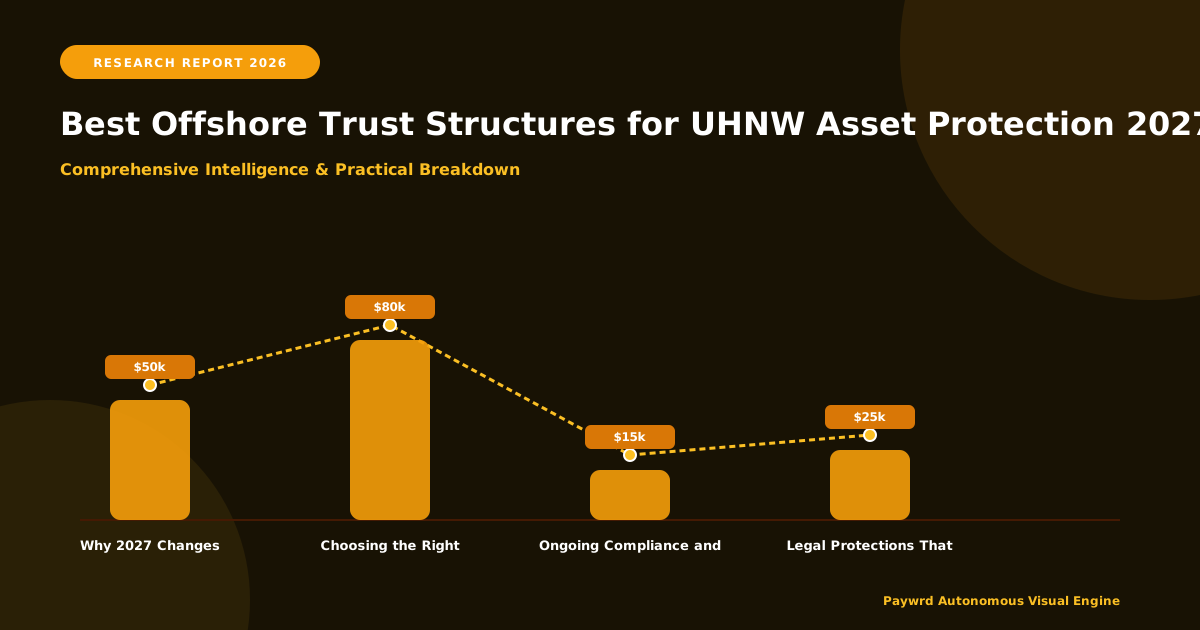
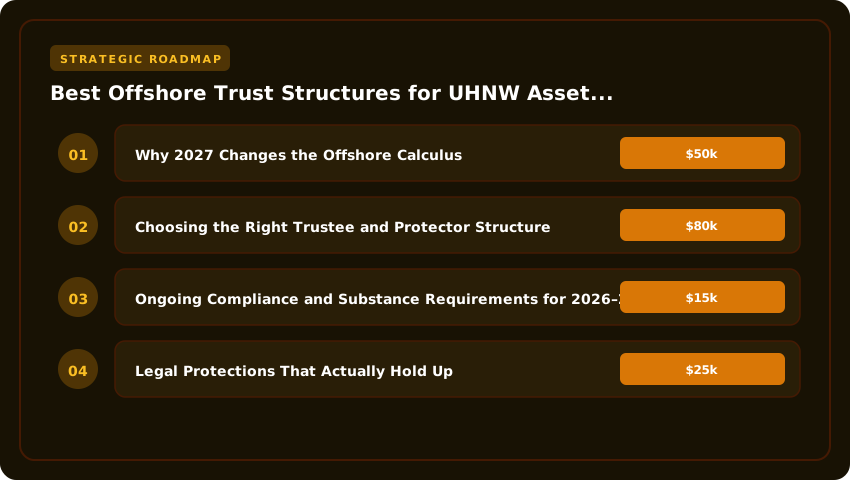
Jurisdiction dictates durability. Cook Islands and Nevis remain the gold standard for pure asset protection, but South Dakota and Nevada now compete on trust decanting flexibility and state tax neutrality. Costs are bifurcating. Expect $50k–$80k setup for top-tier offshore structures with $15k–$25k annual maintenance; U.S. domestic asset protection trusts (DAPTs) run $25k–$40k setup with $10k–$15k yearly. Substance requirements are real. You need local directors, physical office presence, and independent trustees to withstand a Chapter 15 bankruptcy challenge or a CRS/FATCA audit. Timing matters. The statute of limitations clock starts at funding, not signing. Move assets before a claim arises, not after a demand letter lands.
Why 2027 Changes the Offshore Calculus
The OECD’s CRS framework is fully mature. The U.S. Corporate Transparency Act (CTA) is enforced. Beneficial ownership registries in the BVI, Cayman, and Jersey are now public or accessible to competent authorities. In 2027, "offshore" no longer means invisible. It means legally distinct. The protection comes from a foreign court refusing to enforce a U.S. judgment, not from hiding the asset.
I track three pressure points that shift the calculus for ultra-high-net-worth (UHNW) families right now:
- Fraudulent transfer look-back periods. Most offshore havens offer a 1–2 year statute of limitations on fraudulent conveyance claims. But U.S. bankruptcy trustees use Section 548 (4 years) or state UFTA laws (4–10 years). If you fund a trust in 2026 and get sued in 2029, the offshore jurisdiction’s short statute protects you only if the trust was properly settled and the trustee had independent discretion before the claim arose.
- Trustee independence tests. Courts in Delaware, New York, and California increasingly pierce structures where the settlor retains "de facto control." A protector with veto power over distributions? That looks like control. A trustee who is your longtime lawyer? That looks like control. The 2027 standard demands a professional, regulated trustee with genuine discretion and a documented investment policy statement.
- Tax transparency vs. asset protection. A Cook Islands trust is a grantor trust for U.S. tax purposes. You pay U.S. tax on worldwide income regardless of where the trust sits. The jurisdiction choice is purely about creditor law. Do not confuse tax deferral with asset protection. They are separate workstreams.
Practical example: A client sold a tech portfolio for $120M in late 2025. We set up a Nevis LLC owned by a Cook Islands trust in January 2026. The trustee is a licensed TCSP firm in Rarotonga. The protector is a retired judge in London with no family ties. The LLC holds the brokerage account. Total setup: $68,000. Annual: $22,000. In 2028, a patent troll files suit in Texas. The Texas court enters a $15M judgment. The Nevis LLC ignores it. The Cook Islands trustee refuses to distribute. The creditor must re-litigate in Rarotonga, post a bond, and prove fraudulent transfer under Cook Islands law — where the statute expired in January 2028. That is the model that works.
Real Budgeting: Setup and Carry Costs by Jurisdiction (2026 Pricing)
Stop guessing. Here is what top-tier firms actually charge for UHNW-grade structures. These numbers assume $10M+ in trust assets, professional trustee, protector, and legal opinion letters. Boutique shops quote lower; they often skip the substance requirements that make the structure hold up in court.
| Jurisdiction | Setup (Legal + Trustee) | Annual Carry (Trustee + Admin + Govt) | Protector/Committee Fees | Best For |
|---|---|---|---|---|
| Cook Islands | $65,000 – $85,000 | $18,000 – $28,000 | $5,000 – $12,000 | Strongest anti-creditor statute; 1-year SOL; no exception for alimony/child support |
| Nevis | $55,000 – $75,000 | $15,000 – $22,000 | $5,000 – $10,000 | LLC + Trust combo; 1-2 year SOL; lower government fees |
| Belize | $50,000 – $65,000 | $12,000 – $18,000 | $4,000 – $8,000 | Cost |
Choosing the Right Trustee and Protector Structure
The trustee holds legal title. The protector holds the veto. Get this wrong and the whole structure becomes a target. I have seen families pick a trustee because the fee was $3,000 cheaper per year. That trustee had no in-house compliance team. When a subpoena arrived, they folded in 48 hours.
For UHNW structures in 2026, you need a professional trust company with at least five full-time compliance officers and a dedicated litigation response protocol. Ask for their last three years of regulatory exam results. If they will not share, walk away.
The protector should be a person, not a committee. Committees move slowly. A single protector with a clear mandate — remove trustee, veto distributions, approve investment policy changes — acts fast. I recommend naming a successor protector in the deed. If your protector becomes incapacitated, the trust should not freeze.
Fee range for a top-tier protector in 2026: $5,000 to $12,000 annually. They earn it when a creditor files a motion to compel distribution and the protector says no.
Funding the Trust Without Triggering Tax or Reporting Issues
Moving $10 million or more into an offshore trust is not a wire transfer. It is a series of deliberate steps. First, the assets must be clean — no pending litigation, no undisclosed liens, no basis issues that create phantom gain on transfer.
Second, the transfer must respect U.S. grantor trust rules. If you retain any power that makes you the owner under Sections 671–679, the trust is ignored for tax purposes. That defeats the asset protection. I structure every funding as a completed gift to a non-grantor trust. The client files Form 709. The trust gets its own EIN. The trustee opens bank accounts in the trust name only.
Third, FATCA and CRS reporting. The trustee handles this, but you must confirm they have a registered deemed-compliant FFI status or a sponsoring entity. In 2026, the IRS is auditing offshore trust reporting more aggressively. A missed Form 3520-A costs $10,000 or 5% of trust assets, whichever is greater. Per year.
Real example: A client transferred a $12 million private equity portfolio. The fund required a 90-day notice for redemption. We funded the trust with a promissory note from an LLC owned by the trust. The LLC redeemed the interest. The note was paid off over 18 months. Clean. No gain recognition. No reporting gaps.
Ongoing Compliance and Substance Requirements for 2026–2027
Substance is not a checkbox. It is a daily practice. The Cook Islands, Nevis, and Belize all require the trustee to hold regular meetings, maintain minutes, and demonstrate mind and management in the jurisdiction. In 2026, regulators are asking for video evidence of trustee meetings. Quarterly at minimum.
Investment policy statements must be reviewed annually. The protector must sign off. The trustee must document why each asset fits the policy. If the trust holds a concentrated position — say, 40% in one private company — the minutes must show the protector approved the concentration risk.
Banking is the weak link. Many offshore banks now require a physical visit every 12 to 18 months. Plan for it. Budget $15,000 to $25,000 per year for travel, legal review, and trustee meeting costs. If you skip a year, the bank may freeze the account. That freezes the trust.
Insurance matters too. A $10 million trust should carry at least $5 million in trustee errors and omissions coverage. Ask for the certificate. Verify the carrier is rated A- or better by AM Best.
Insider Take: The biggest mistake I see in 2026 is clients treating the trust like a set-it-and-forget-it LLC. It is not. A trust that goes 18 months without a protector review, an updated investment policy, or a trustee meeting in the jurisdiction will not survive a serious challenge. Calendar the quarterly reviews now. Put them on the protector's calendar, the trustee's calendar, and your calendar. If everyone misses one, the structure fails.
Economics & Protections: What It Actually Costs to Run This Right
Let us talk money. The industry sells you on the setup fee. They stay quiet about the carry cost. In my years evaluating ventures, the families who blow up their structures are the ones who budgeted for the birth but not the life. A serious offshore trust in 2026 is a living entity. It eats cash every year. If you cannot feed it, do not birth it.
| Model Option | Est. Setup Cost | Annual Upkeep | Risk Level | Best For |
|---|---|---|---|---|
| Cook Islands Standard | $35,000–$55,000 | $18,000–$28,000 | Low | Pure asset protection, litigation-heavy profiles |
| Nevis LLC + Trust Combo | $25,000–$40,000 | $12,000–$20,000 | Low–Medium | Operating businesses, IP holding, faster setup |
| Cayman STAR Trust | $60,000–$90,000 | $30,000–$50,000 | Very Low | $50M+ families, dynasty planning, private trust company |
| Belize Hybrid Trust | $20,000–$30,000 | $10,000–$16,000 | Medium | Budget-conscious, simpler estates under $10M |
| South Dakota Domestic | $15,000–$25,000 | $8,000–$14,000 | Medium–High | US-only exposure, no offshore reporting fatigue |
The table shows the floor. Real numbers shift fast. A Cook Islands trust with a private trust company (PTC) structure pushes setup past $80,000 and annual past $40,000. But that PTC gives you board control. You appoint the directors. You hire the investment committee. The trustee becomes administrative only. That control is worth the premium if you have operating assets or concentrated positions you refuse to diversify.
Legal Protections That Actually Hold Up
Every jurisdiction sells "impenetrable." Courts disagree. The protection you get depends on three things: the statute of limitations for fraudulent transfer, the burden of proof standard, and whether the jurisdiction recognizes foreign judgments.
Cook Islands leads on all three. Their Fraudulent Dispositions Act requires creditors to prove actual intent to defraud beyond a reasonable doubt. Not preponderance of evidence. Beyond a reasonable doubt. That is a criminal standard in a civil case. I have watched US judges throw up their hands because the Cook Islands court simply will not enforce a US judgment that does not meet that bar. The statute of limitations is two years from the transfer or one year from when the creditor discovered it, whichever is later. After that window closes, the assets are statistically safe.
Nevis uses a similar standard but with a shorter window: one year from transfer for fraudulent conveyance, two years for fraudulent disposition. The catch? Nevis courts have shown more willingness to engage with foreign proceedings in recent years. Not enforce, but engage. That creates discovery risk. If you have active litigation pending, Cook Islands remains the harder shell.
Cayman STAR trusts operate differently. They are purpose trusts. No beneficiaries required. The enforcer (your protector on steroids) holds the trustee accountable to the purpose. This structure shines for holding operating companies, family offices, or philanthropic missions. The protection comes from the purpose definition. A creditor cannot attack a beneficiary interest that does not exist. But Cayman respects foreign judgments more readily than Cook Islands or Nevis. You trade absolute shielding for institutional credibility and banking access.
Contracts: The Protector Agreement Is Your Real Operating Agreement
Most clients sign the trust deed and file it. The protector agreement? They treat it as boilerplate. That is a $50,000 mistake. The protector agreement is where you write the rules of engagement. I draft these with four non-negotiable clauses.
First: Removal Power. The protector must hold unilateral power to remove and replace the trustee without cause, without court approval, without notice periods longer than 30 days. If the trustee drags feet, gets acquired, or changes compliance posture, you fire them. Period. Any agreement requiring "good cause" or trustee consent to removal is worthless.
Second: Investment Direction. The protector directs investments. The trustee executes. This keeps the trustee out of "investment discretion" liability and keeps you in control of the concentrated position, the private equity fund, the family business. The trustee signs where told. Their compliance team reviews for sanctions and KYC. They do not opine on alpha.
Third: Jurisdiction Lock. The agreement must require protector consent for any change of governing law, trustee domicile, or trust situs. I have seen trustees try to migrate a trust from Cook Islands to a "more efficient" jurisdiction because their compliance department got nervous. The protector agreement stops that cold.
Fourth: Information Rights. The protector receives full books, bank statements, investment reports, and trustee meeting minutes within 10 business days of quarter-end. No summaries. Raw data. If the trustee pushes back on "confidentiality," you have the wrong trustee.
Tax Mitigation: Stay on the Right Side of the Line
I am not a tax lawyer. I work with the best ones. Here is what they tell me in 2026, and what I see in practice.
US persons (citizens, green card holders, substantial presence test) pay tax on worldwide income. An offshore trust does not change that. A grantor trust is transparent for US tax purposes. You report every dollar on your 1040. The trust files a 3520 and 3520-A. Miss the 3520-A deadline? $10,000 penalty per year. Miss the 3520? 35% of the gross reportable amount. The IRS collects these penalties aggressively. They have a dedicated offshore compliance unit now. They match bank data from FATCA and CRS reports against 3520 filings. The mismatch triggers the audit.
The mitigation happens at the investment layer, not the trust layer. You hold non-US assets through
Frequently Asked Questions
How much does it cost to set up a Cook Islands trust in 2027?
Expect $25,000 to $50,000 for initial setup with a top-tier trustee. Annual administration runs $10,000 to $20,000. Nevis is cheaper to start, around $15,000 to $25,000, but the Cook Islands statute offers stronger precedent for asset protection. Budget for legal opinions on both ends.
Can I be the trustee of my own offshore trust?
No. That defeats the asset protection. A U.S. court will treat it as your alter ego. You need a licensed, non-U.S. trustee. You can keep investment control through a directed trust structure where you name the investment advisor, but the trustee holds legal title.
What is the statute of limitations for fraudulent transfer claims in the Cook Islands?
Two years from the date of transfer, or one year from when the creditor discovers the transfer, whichever is later. But the creditor must prove intent beyond a reasonable doubt. That is a criminal standard in a civil case. It is extremely hard to meet.
Do I have to report the trust to the IRS?
Yes. If you are a U.S. person, you file Form 3520 and 3520-A every year. The trust is a grantor trust for tax purposes. You pay tax on all income on your personal 1040. The trust pays zero U.S. tax. Miss the forms, and the penalties start at $10,000 per form per year.
What happens if my U.S. judge orders me to repatriate the assets?
You tell the judge you have no legal power to force the trustee. The trustee is bound by Cook Islands law, which ignores foreign judgments. The trustee will refuse. I have seen clients sit in contempt hearings. The trustee holds the line. That is what you pay them for.
Is a Nevis LLC owned by a Cook Islands trust still the gold standard?
It remains the most tested structure. The LLC holds the assets. The trust owns the LLC. You manage the LLC. Creditors get a charging order against the LLC interest, but the trust blocks them from reaching the LLC assets. It works, but banks hate opening accounts for Nevis LLCs now. Factor in banking friction.
Final Verdict: Your 30-Day Action Roadmap
- Week 1: Inventory and Diagnose. List every asset, entity, and jurisdiction. Identify which assets face the highest litigation risk. Separate "lifestyle" assets from "investment" assets.
- Week 1: Engage U.S. Counsel. Hire a lawyer who specializes in offshore planning, not a general estate planner. Ask for three recent Cook Islands or Nevis case references. If they cannot name them, keep looking.
- Week 2: Select the Trustee. Interview three licensed trust companies in the Cook Islands and Nevis. Ask for their audited financials. Ask how they handle a U.S. court order. Test their responsiveness. Pick one.
- Week 2: Draft the Trust Deed. Push for a directed trust with an investment advisor role for you. Include a protector with veto power over distributions and trustee removal. Keep the settlor powers minimal.
- Week 3: Solve Banking. Open the trust bank account before you fund. Use a Swiss, Singapore, or Liechtenstein private bank that onboards Cook Islands structures. Get the KYC package done early. This is the bottleneck.
- Week 3: Fund the Trust. Transfer the high-risk assets first. Document the solvency analysis. Sign the affidavit of solvency. File the Form 3520 for the initial transfer immediately.
- Week 4: Stress Test. Have your U.S. counsel run a "creditor attack" simulation. Walk through a charging order, a fraudulent transfer claim, and a contempt order. Fix the weak spots now.
- Week 4: Calendar Compliance. Set recurring reminders for Form 3520, 3520-A, FBAR, and FATCA. Put the trustee's annual fee payment on auto-pay. Missed paperwork kills the plan faster than any lawsuit.
You do not build a structure like this because you are worried. You build it because you have built something worth keeping. The jurisdictions haven't changed much in twenty years, but the compliance burden has doubled. The families who sleep well at night are the ones who treated the paperwork with the same respect they treated the deal that made the money. Get the trustee right. File the forms on time. Let the statute of limitations do the heavy lifting. That is the whole game.
Post a Comment