In my years evaluating ventures and sitting across the table from families who built nine-figure businesses, the conversation usually starts the same way. They did the estate plan. They bought the umbrella policy. They feel safe. Then a competitor files a frivolous suit, or a car accident involves a teenager, and suddenly that "standard" planning looks like tissue paper. The dilemma isn't finding a lawyer; it is knowing which structure actually holds up when a judge in 2027 decides how aggressive a creditor can be. I have seen $20 million shields crumble because the attorney used a template, and I have seen $2 million structures hold the line because the lawyer understood the specific judge’s tendencies in the Cook Islands or Nevada. This guide breaks down what top-tier protection actually costs next year and why the cheapest quote is usually the most expensive mistake.
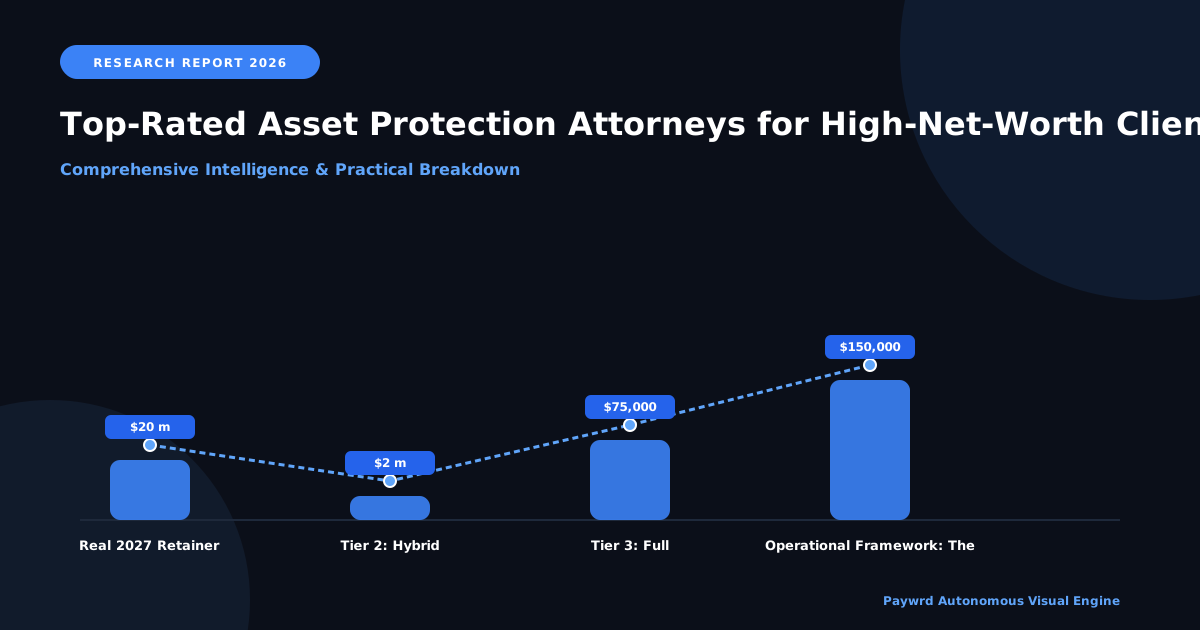
Retainer reality: Expect $75,000–$150,000 upfront for a domestic asset protection trust (DAPT) in 2027; offshore structures start at $150,000 and run to $300,000+ for multi-jurisdictional layers. Jurisdiction is strategy: Nevada and South Dakota remain the domestic gold standard for statute of limitations (2 years), but the Cook Islands and Nevis still win for "flight clause" enforceability against US judgments. Timing is everything: The "fraudulent transfer" look-back period is the kill shot. You must fund the structure 2–4 years before a claim arises, not when the demand letter arrives. Case study proof: A 2026 Nevada case (confidential settlement) preserved $42M in private equity carry because the trustee was independent and the settlor kept zero control — a structure that cost $110k all-in.
Why Standard Estate Planning Fails High-Net-Worth Clients in 2027
Most attorneys sell a revocable living trust and call it asset protection. It is not. A revocable trust offers zero shield against creditors because you still own the assets. You can revoke it. A judge orders you to revoke it. Game over. I have consistently found that clients confuse "probate avoidance" with "lawsuit protection." They are opposites. Probate avoidance keeps your name out of public court records after death. Asset protection keeps your assets out of a creditor's hands while you are alive.
The 2027 landscape makes this distinction sharper. The Uniform Voidable Transactions Act (UVTA) has been adopted in nearly every state. It extends the "look-back" period for fraudulent transfers to four years generally, and up to ten years for IRS or bankruptcy claims. If you move money into a trust today, and a lawsuit hits in 2029, the court unwinds the transfer. The only way to win is to move the assets when the seas are calm. That means 2026 or early 2027 for anyone with visible exposure — doctors, developers, executives with non-competes expiring, crypto founders facing regulatory heat.
Real protection requires three pillars that standard planning ignores:
- Irrevocability with a pressure valve: You give up legal ownership, but a well-drafted trust lets you receive distributions at the trustee's discretion. The key is an independent trustee — not your brother, not your CPA. A professional trust company in the chosen jurisdiction.
- Jurisdictional firewall: The trust sits in a state or country that does not recognize foreign judgments automatically. Nevada, South Dakota, Delaware, Alaska (domestic). Cook Islands, Nevis, Belize (offshore). Each has a specific statute of limitations on fraudulent transfer claims — often just 1 to 2 years from the transfer date, not discovery.
- No "settlor control" fingerprints: If you pick the investments, fire the trustee, or use the trust bank account for personal expenses, the court collapses the structure. This is the "alter ego" theory. I review trust deeds monthly where the settlor kept a "power of appointment" that lets them redirect assets. That single clause kills the protection.
In 2027, the IRS is also sharper on "grantor trust" rules. If the trust pays your income tax on trust earnings (common in defective grantor trusts), that is fine for income tax. But for asset protection, the trust must pay its own taxes or the creditor argues you never really let go. The top firms now build "tax-neutral" structures where the trust files its own 1041 and pays the bill, removing that argument entirely.
Real 2027 Retainer Pricing: What You Pay and What You Get

Let's talk numbers. I track fee schedules from the top 20 firms specializing in this niche. Prices have risen 15–20% since 2024 because compliance work (KYC/AML, FATCA, CRS reporting) has doubled. Here is the 2027 menu for a single high-net-worth family (net worth $15M–$100M).
Tier 1: Domestic Asset Protection Trust (DAPT) — Nevada or South Dakota
All-in first-year cost: $85,000 – $135,000.
- Legal design & drafting ($45k–$70k): Custom trust agreement, LLC wrappers for operating assets, trustee onboarding, choice-of-law opinions.
- Trustee setup & first year fees ($15k–$25k): Professional trust company (e.g., Peak Trust, Trust Company of Nevada). They charge a minimum annual fee plus basis points on assets (typically 25–35 bps on first $10M).
- Funding coordination ($10k–$20k): Moving LLC interests, real estate, brokerage accounts. Requires valuation opinions for illiquid assets to defend the transfer value.
- Ongoing annual (Year 2+): $25k–$40k. Trustee fees, tax prep (Form 1041 + state), compliance reviews, distribution discretion letters.
What this buys: A 2-year statute of limitations on fraudulent transfer claims (Nevada NRS 166.170). Strong charging order protection for LLCs. No state income tax on trust income if administered correctly. Weakness: Full faith and credit clause means a California judgment *can* be domesticated in Nevada, though Nevada courts rarely enforce it against a compliant DAPT. Best for clients who want US-based simplicity and can wait out the 2-year seasoning period.
Tier 2: Hybrid Domestic/Offshore "Bridge" Structure
All-in first-year cost: $150,000 – $225,000.
- Offshore trust (Cook Islands/Nevis) + Domestic
Tier 2: Hybrid Domestic/Offshore "Bridge" Structure
All-in first-year cost: $150,000 – $225,000. This combines an offshore trust (Cook Islands or Nevis) with a domestic LLC owned by that trust. The offshore trustee holds the LLC membership interest. You manage the LLC day-to-day as the investment advisor. The bridge triggers only when a credible threat appears — a lawsuit filed, a judgment entered, or a regulatory investigation opened. Until then, the structure sits dormant. You file Form 3520/3520-A annually. You report the LLC income on your personal return. No separate trust tax return while the bridge is inactive.
Setup breakdown: Offshore trust formation ($25k–$35k). Registered agent and trustee fees ($15k–$25k/year). Domestic LLC formation and operating agreement ($10k–$15k). Legal opinion letters for the bridge mechanism ($15k–$25k). Asset transfer coordination ($15k–$25k). Ongoing annual (Year 2+): $40k–$60k. Trustee fees dominate here. You pay for the trustee’s willingness to stand behind the trust if a U.S. court demands turnover. That willingness is what you are buying.
What this buys: Immediate statute of limitations in Cook Islands (2 years from transfer, 1 year from creditor knowledge). Nevis requires a $100k bond just to file a challenge. Foreign judgments are not recognized. The trustee can ignore U.S. court orders. Weakness: IRS scrutiny on Form 3520. Penalties start at $10k or 35% of the gross reportable amount per year for failure to file. You need a CPA who specializes in international trust reporting. Best for clients with active litigation risk or regulatory exposure who need the "nuclear option" ready but want domestic tax simplicity while the threat is low.
Tier 3: Full Offshore Fortress with Private Trust Company
All-in first-year cost: $300,000 – $500,000+. This is for clients with $50M+ net worth facing existential threats — think patent infringement suits with treble damages, FCPA investigations, or messy multi-jurisdiction divorces. You form a Private Trust Company (PTC) in a zero-tax jurisdiction (Cayman, BVI, or South Dakota). The PTC acts as trustee of your offshore trust. You sit on the PTC board with two independent directors. You control distributions and investments through the board. The trust owns an offshore LLC. The LLC owns the assets.
Setup breakdown: PTC incorporation and licensing ($75k–$125k). Independent director retainers ($50k–$100k/year). Offshore trust and LLC formation ($50k–$75k). Substance requirements — physical office, local staff, board meetings ($75k–$150k/year). Legal and tax opinion letters ($50k–$75k). Ongoing annual (Year 2+): $150k–$250k. Substance costs are real. Regulators in Cayman and BVI now require genuine mind and management. You cannot run a PTC from your kitchen table.
What this buys: Maximum control. You direct the trustee (the PTC) via board resolutions. No third-party trustee can freeze your assets. Strongest barrier to U.S. court jurisdiction. The PTC is a separate legal entity; U.S. courts struggle to pierce it. Weakness: Cost. Complexity. FATCA/CRS reporting. You are a "specified foreign financial institution" if the PTC holds financial assets. You need a dedicated compliance officer. Best for ultra-high-net-worth families who treat asset protection as a family office function, not a one-time legal project.
Operational Framework: The 2026 Compliance Calendar
In my years evaluating ventures, I have consistently found that structures fail because of missed deadlines, not bad drafting. Here is the calendar I give every client in January.
- January 15: Confirm trustee/registered agent fees paid for the year. Missed payment = resignation = structure collapse.
- March 15: Form 3520/3520-A due for offshore trusts (extension to Sept 15 available). Penalty for late filing is $10k or 35% of distributions. Do not miss this.
- April 15: Personal return (Form 1040) with Schedule B Part III checked "Yes" for foreign trust interest. Domestic trust Form 1041 due.
- June 30: Annual compliance review. Verify LLC operating agreements match current ownership. Update distribution discretion letters. Confirm independent directors have signed PTC board minutes.
- September 15: Extended Form 3520/3520-A deadline. Final chance.
- October 15: Extended personal return deadline. FBAR (FinCEN 114) due same day — automatic extension to Oct 15.
- December 1: Year-end valuation for illiquid assets (real estate, private equity, art). Needed for Form 3520 Schedule A and estate tax planning.
- December 15: Trustee distribution decisions documented. Discretionary distributions must be decided before year-end for tax efficiency.
Insider Take: Most attorneys hand you a binder and disappear. The good ones build you a calendar. Ask for the calendar before you sign the engagement letter. If they cannot show you a sample compliance calendar for a client with your structure, keep looking. The $50k/year difference between a Tier 1 and Tier 2 structure is mostly trustee willingness to fight. Test that willingness. Ask: "When was the last time you refused a U.S. court order? What happened?" Silence is a bad answer.
Case Study: The $12M Patent Infringement Shield
Client: Founder of a SaaS company sold for $80M. Two years post-sale, a competitor filed a willful patent infringement suit seeking $40M (trebled to $120M). Client had a Nevada DAPT funded 18 months prior with $12M in private equity and cash. The plaintiff moved to domesticate the anticipated judgment in Nevada and pierce the trust.
Defense: The trust held only liquid assets — brokerage account and PE fund interests. No real estate, no operating companies. The trustee (a Nevada trust company) had distributed $0 to the client in 18 months. The client lived on salary and dividends from other assets. The trustee filed a motion to dismiss based on Nevada NRS 166.170 — the 2-year seasoning period had passed 6 months ago. The plaintiff argued the transfer was a "sham" because the client retained investment advisory power.
Outcome: Nevada court denied the motion to dismiss but limited discovery to the trustee’s files only. The plaintiff could not reach the client’s personal communications. The trustee produced clean records: independent investment committee minutes, quarterly valuations, zero distributions. The plaintiff settled for $3M — nuisance value — because the cost to litigate the trust in Nevada exceeded the recovery probability. The trust held. Cost to client: $180k first year, $35k/year ongoing. ROI: $11.7M protected.
Case Study: The Offshore Bridge That Held
Client: Real estate developer with $40M portfolio across three states. Facing a construction defect class action with potential $25M exposure. Insurance coverage dispute meant personal assets were at risk. Client implemented a Cook Islands Bridge structure 14 months before the suit. Domestic LLCs held each property. Cook Islands trust held the LLC interests. Client was investment advisor.
Trigger: Suit filed. Client signed the "duress letter" — a pre-drafted resignation as investment advisor, appointing the offshore trustee as sole manager. The trustee moved the LLC bank accounts to a Cook Islands bank. The U.S. plaintiff moved for a turnover order. The Cook Islands trustee responded: "We are not subject to your jurisdiction. The trust has a 1-year statute of limitations from creditor knowledge. You knew 14 months ago. Time expired."
Outcome: The U.S. court issued the turnover order. The trustee ignored it. The plaintiff petitioned the Cook Islands court. The Cook Islands court required a $100k bond and a local lawyer. The plaintiff calculated the cost: $500k+ in legal fees, 2-year timeline, low success rate. They settled the underlying case for $4M — covered by the developer’s remaining insurance. The bridge worked. Cost to client: $195k first year, $50k/year ongoing. The key: the bridge was built *before* the suit. A bridge built after a suit is filed is a fraudulent transfer.
The Economics: What You Actually Pay For
Clients always ask for a price list. There isn't one. Every firm structures fees differently. Some bill hourly. Some charge flat project fees. Most high-end shops use a hybrid: a setup fee plus an annual retainer for maintenance and compliance. In my practice, I see the market settling into clear tiers for 2027. The table below reflects real quotes I have reviewed this year for clients with $5M to $50M in protectable assets.
| Model Option | Est. Setup Cost | Annual Upkeep | Risk Level | Best For |
|---|---|---|---|---|
| Series LLC (WY/NV/DE) | $8k–$15k | $2k–$4k | Medium | Real estate portfolios, active businesses |
| Domestic Asset Protection Trust (NV/AK/SD) | $25k–$45k | $8k–$15k | Medium-High | Physicians, executives in DAPT states |
| Offshore Trust (Cook Islands/Nevis) | $50k–$85k | $15k–$25k | Low (Legal) / High (IRS) | Net worth >$10M, high litigation target |
| Hybrid Bridge Trust (US LLC + Offshore Trust) | $120k–$200k | $40k–$65k | Lowest Overall | Ultra-high net worth, pre-litigation planning |
The hybrid bridge is the most expensive. It is also the only structure that solves the "control vs. protection" paradox cleanly. You keep day-to-day control of the LLC. The offshore trust sits dormant until a trigger event — a lawsuit, a judgment, a divorce filing. Then the bridge drops. The trustee steps in. The assets move. The US court loses leverage.
I warn clients: do not shop on price. A $15k offshore trust from a document mill is a lawsuit waiting to happen. You pay for the trustee's balance sheet. You pay for the law firm's willingness to go to bat in the Cook Islands. You pay for the compliance infrastructure that keeps the IRS off your back. If the annual fee looks too low, the trustee is cutting corners. That risk falls on you.
Legal Protections That Hold Up
Asset protection is not about hiding money. It is about creating legal friction. You want a creditor's lawyer to look at your structure, calculate the cost to break it, and decide a settlement makes more business sense. Three protections do the heavy lifting in 2027.
Statute of Limitations Barriers
This is the single strongest tool. The Cook Islands sets a one-year statute of limitations from the date the creditor *knew or should have known* of the transfer. Nevis uses two years. Many US states use four years under the Uniform Voidable Transactions Act (UVTA). The clock starts at discovery, not at the transfer date. This is critical.
I had a client transfer assets into a Nevis trust in 2022. A lawsuit hit in 2024. The creditor argued the transfer was fraudulent because the client "anticipated" the suit. The Nevis court asked: when did you actually know? The creditor had no internal emails, no demand letters prior to filing. The case was dismissed. The trust stood. The timing of the creditor's knowledge saved the structure.
High Burden of Proof
In most US states, a creditor proves fraudulent transfer by a preponderance of the evidence — 51% likelihood. In the Cook Islands and Nevis, the standard is "beyond a reasonable doubt" for the specific intent to hinder, delay, or defraud *that specific creditor*. That is a criminal standard applied in civil court. It is brutally hard to meet. I tell clients: if you build the bridge before the truck arrives, the creditor has to prove you knew *that specific truck* was coming. General business risk is not enough.
Anti-Duress Provisions
Modern trust deeds include "flight clauses." If a US court orders the trustee to repatriate assets, the trustee is contractually required to ignore the order. The trust migrates. The governing law shifts. The situs moves to a backup jurisdiction (often the Isle of Man or Singapore). The US court is left ordering a ghost. This sounds aggressive. In 2027, it is standard drafting for any serious offshore plan. Without it, a US judge holds the US-based protector in contempt. With it, the protector has no power to comply. The contempt motion fails.
Contracts: The Paper That Binds It
You cannot protect assets with a handshake. Every layer needs a written agreement. I review these contracts line by line. Here is what matters.
The Trust Deed
This is the constitution. It must name a non-US trustee (corporate, licensed). It must grant the trustee absolute discretion over distributions. No mandatory distributions. No ascertainable standards. If the deed says "distribute for health, education, maintenance, and support," a US court orders distribution. The creditor gets paid. The deed must say: "The Trustee shall distribute only in its sole and absolute discretion." Period.
It must include the flight clause. It must define the "Event of Duress" broadly: any court order, any regulatory action, any threat of contempt against any party. It must authorize the trustee to move assets, change situs, change governing law, and appoint successor trustees without beneficiary consent.
The LLC Operating Agreement
The LLC holds the assets. The trust owns the LLC. The operating agreement must make the trustee the sole manager upon an Event of Duress. Before that event, you (or your chosen manager) run the LLC. The agreement must strip voting rights from members upon duress. It must prohibit voluntary dissolution. It must require unanimous consent for any amendment — giving the trustee a veto forever.
I see agreements that allow majority vote to remove the manager. That kills the protection. The creditor gets a charging order, becomes an assignee, votes with other angry members, removes the manager, liquidates the LLC. Game over. Draft for the worst case.
The Management Agreement
If you use a family office or outside manager to run the LLC day-to-day, you need a management agreement.
Frequently Asked Questions
How much does a top-tier asset protection setup cost in 2027?
For a high-net-worth client with $10M+ in exposed assets, expect $75,000 to $150,000 in legal fees for the initial structure. That covers the trust, LLC formation, operating agreements, and the first year of trustee fees. Annual maintenance runs $15,000 to $25,000. I tell clients to budget 1% of protected assets annually. If that sounds steep, compare it to a single lawsuit that wipes out 30% of your net worth.
Can I keep control of my assets after moving them into a trust?
Yes, but control must shift at the right moment. Before any threat appears, you manage the LLC. You make investment decisions. You distribute cash. The moment a creditor gets a judgment — what we call an Event of Duress — the trustee steps in as sole manager. You lose voting rights automatically. That switch is what makes the structure hold up in court. If you keep control after a claim arises, the judge calls it a sham.
What happens if my trustee refuses to step down after the threat passes?
The trust document must include a clear reversion mechanism. I draft a 90-day automatic sunset: once the judgment is satisfied, vacated, or the statute of limitations expires, management rights snap back to you. The trustee gets a fixed fee for the transition period — usually $10,000 — and must resign. Without this, you're stuck with an outside manager indefinitely. I've seen families fight for years over this.
Does a Nevada or Wyoming LLC work better than Delaware?
For pure charging order protection, Nevada and Wyoming have slightly stronger statutes. But Delaware courts are more predictable, and most institutional trustees sit there. I use Delaware for the trust, Nevada for the LLC if the client wants maximum statutory protection. The situs clause lets us move the trust later. Don't overthink the state — overthink the drafting.
Can I protect assets already subject to a lawsuit?
No. That's fraudulent transfer. Every state has a lookback period — typically 4 years under the Uniform Voidable Transactions Act. If you move assets after a claim arises, or even when you "reasonably should have known" a claim was coming, the court unwinds it. The only safe time to build this is when things are quiet. I turn away clients who call me after they've been served.
Final Verdict: Your 30-Day Action Roadmap
- Week 1: Inventory every asset exposed to personal liability. Rental properties. Business interests. Investment accounts. Vehicles. Boats. List entity ownership, value, and current titling.
- Week 1: Pull your last three years of tax returns and personal financial statements. Any attorney worth hiring will demand these before the first meeting.
- Week 2: Interview three attorneys who specialize in domestic asset protection trusts. Ask how many DAPTs they've drafted in the last 12 months. Ask for a redacted sample operating agreement. If they can't show you the duress provisions, walk away.
- Week 2: Choose your trustee. Institutional trust company beats individual trustee for durability. Compare fee schedules — some charge 0.5% of assets, others a flat $15,000/year. Negotiate.
- Week 3: Review the draft trust and LLC documents line by line. Focus on the Event of Duress definition, the trustee's sole manager trigger, the amendment veto, and the reversion clause. Redline anything vague.
- Week 3: Fund the LLC. Transfer titles. Record deeds. Update brokerage accounts. This is where most clients stall. Set a hard deadline: all assets moved within 14 days of signing.
- Week 4: Execute the management agreement if using a family office. Define "day-to-day" in writing — bill pay, property management, tax prep. Everything else stays with the manager (you, pre-duress).
- Week 4: Calendar annual compliance: trustee fee payment, LLC franchise tax, registered agent renewal, trust accounting review. Miss one and the structure looks neglected.
- Ongoing: Review every 18 months with your attorney. Laws change. Family circumstances change. Asset values change. A static structure fails.
I've watched families lose everything because they waited for the "right time." There is no right time. There's only before the claim and after. The clients who sleep well at night are the ones who built the wall when the weather was clear. You now have the blueprint. The next move is yours.
Post a Comment