I have sat across the desk from hundreds of senior leaders wrestling with the same question: is the Executive MBA worth the time and the money right now? In my years evaluating ventures and advising on leadership development, I have seen the answer change drastically depending on the program structure and the hidden costs nobody puts in the brochure. The landscape for 2027 looks different than it did even two years ago. Tuition has climbed, but so has the flexibility of modular formats. Let me walk you through what actually matters for your balance sheet and your career trajectory.
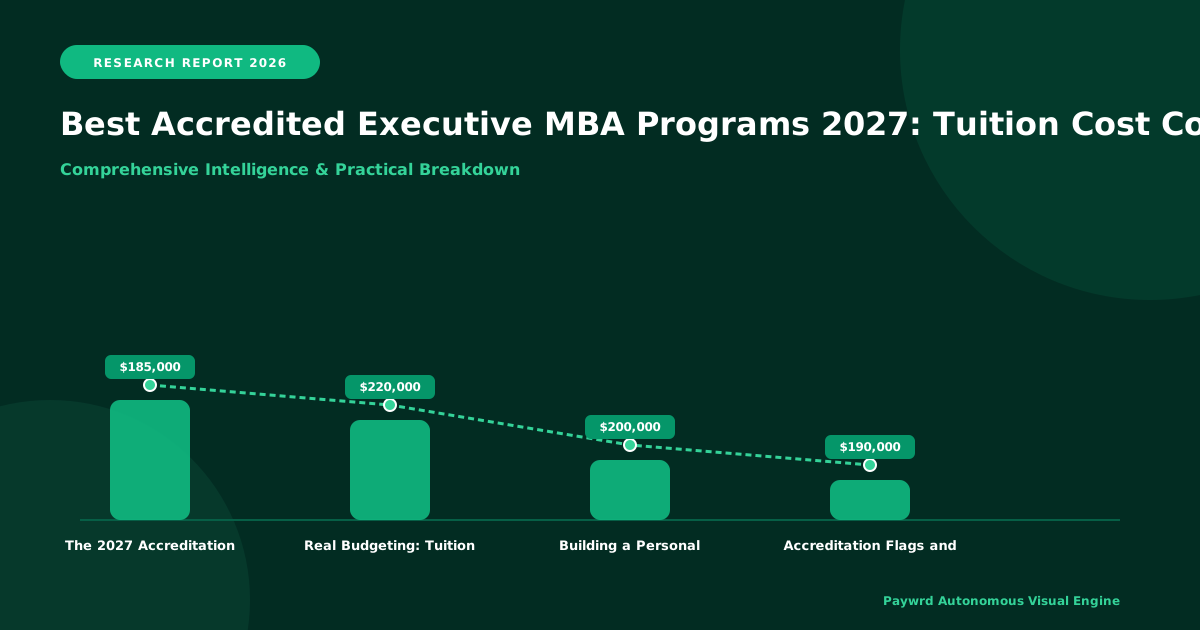
Accreditation (AACSB, EQUIS, AMBA) remains the non-negotiable filter for 2027 programs. Total cost of attendance now averages $185,000–$220,000 for top-tier US schools when you factor in travel, modular residencies, and lost bonus eligibility. ROI timelines have stretched to 3.5–4.5 years post-graduation for most sectors. Modular and hybrid formats reduce opportunity cost by 15–20% compared to traditional weekend-only models. Employer sponsorship rates are dropping below 30% at elite programs, shifting the financial burden to the candidate.
The 2027 Accreditation Baseline: What Actually Counts
I start every conversation with accreditation because it saves you from wasting $200,000 on a degree that recruiters ignore. For 2027, the "Triple Crown" (AACSB, EQUIS, AMBA) is still the gold standard. Roughly 120 schools globally hold all three. In the US, AACSB is the baseline; internationally, you need at least two of the three.
Why does this matter for a senior leader? Your board and your future employers use it as a proxy for curriculum rigor and peer quality. I reviewed a candidate last year with a degree from a nationally accredited (not regionally) program. The hiring committee at a Fortune 500 firm flagged it immediately. They didn't interview him. That check takes five minutes on the school's website. Do it before you request a transcript.
Watch for "candidate for accreditation" language. That means they are not accredited yet. Some new 2027 entrants — especially specialized tech-EMBA hybrids — are in this bucket. They might be great in five years. Today, they carry risk. If your company has a tuition reimbursement policy, read the fine print. Most corporate policies explicitly require regional or Triple Crown accreditation. I have seen leaders pay out of pocket because they missed that clause.
Real Budgeting: Tuition vs. Total Cost of Attendance
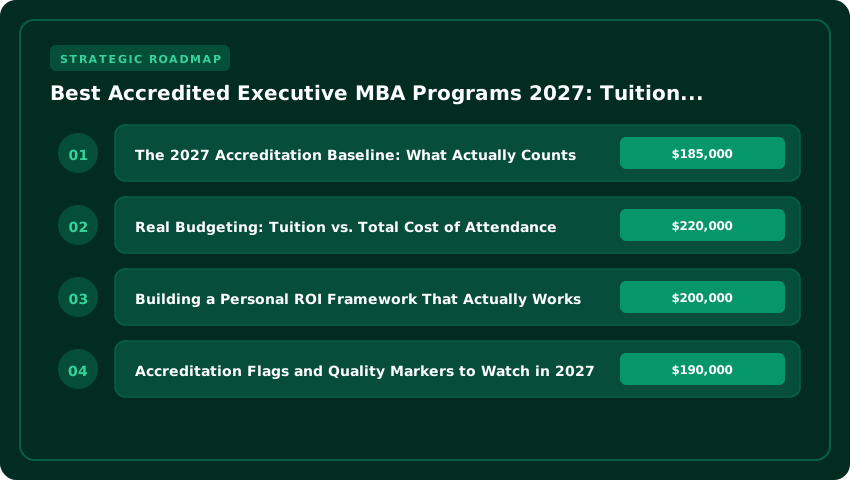
The sticker price on the website is rarely what you pay. For the 2027 cycle, top US programs (Wharton, Kellogg, Booth, Columbia, MIT Sloan) list tuition between $190,000 and $215,000. European leaders (INSEAD, LBS, HEC Paris, IESE) run €110,000–€135,000. But the check you write is bigger.
I build a "Real Cost" spreadsheet for every client. Here are the line items that surprise people:
- Travel and Residencies: Global modular programs require 4–6 international trips. Flights, hotels, and meals for a family of one average $18,000–$25,000 over 18–22 months.
- Lost Variable Compensation: If you miss two bonus cycles because you cannot travel for deal closes or board meetings, that is often $50,000–$150,000 in foregone cash. Weekend-only formats protect this better than week-long modules.
- Tech and Materials: Laptop stipends rarely cover the $3,000–$5,000 you spend on updated hardware, simulation licenses, and case packets.
- Opportunity Cost of Equity: If your vesting cliff hits during the program and you reduce hours, you might forfeit unvested RSUs. I had a VP at a Series D startup lose $80,000 in equity because he dropped below the hours threshold for six months.
Add it up. A $200,000 tuition program often costs $260,000–$300,000 in real economic impact. The 2027 trend? Schools are bundling more. Kellogg and Wharton now include most meals and hotel blocks in tuition for modular weeks. Columbia and Booth do not. Ask the admissions director for the "Total Cost of Attendance" worksheet. If they don't have one, that is a data point.
Building a Personal ROI Framework That Actually Works
Most leaders get ROI wrong. They compare post-salary bumps against tuition and call it a day. I have found that this method misses the bigger picture. You need a three-layer model that accounts for cash, career velocity, and network value.
Layer 1: Hard Cash Recovery. Start with your total program cost. We established that $200,000 tuition often means $260,000–$300,000 in real impact. Now estimate your expected salary increase. The 2026 GMAC data shows median post-EMBA compensation lifts of 12–18% for senior leaders. If you earn $180,000 now, a 15% bump adds $27,000 per year. That means your hard-cash payback lands between 10 and 12 years. That sounds long. But Layer 2 changes the math.
Layer 2: Career Velocity. A promotion that takes 18 months instead of 36 months has enormous financial weight. I track this as "acceleration value." If skipping two years of slower growth saves you from a $40,000-per-year plateau, that adds $80,000 to your recovery timeline. Add a faster-tracked board seat or consulting fee that generates $25,000–$50,000 annually, and your payback period compresses to 5–7 years.
Layer 3: Network Liquidity. This is the hardest layer to measure, but it matters most at the senior level. I assign a conservative annual value of $10,000–$25,000 to peer relationships that open deal flow, advisory roles, or strategic partnerships. Over 15 years, a strong cohort network can return $150,000–$375,000 in indirect value. The 2027 shift? Programs are building structured alumni deal-flow platforms. Wharton's venture network and Kellogg's industry consortiums now host quarterly pitch events. Ask the program how it connects alumni to active deal environments before you enroll.
Insider Take: Build your ROI model on a spreadsheet with all three layers visible. Review it quarterly during the program. I have seen leaders abandon strong programs because they only calculated Layer 1. When they added Layers 2 and 3, the decision flipped. Your network is an asset. Treat it like one.
Operational Frameworks for Sustaining Performance During the Program
Going back to school while running a business or a division is a logistics problem. It is also an energy problem. In my experience, the leaders who finish strong build systems before the first class. They do not try to "figure it out on the go."
Framework 1: The 70/20/10 Time Block. I recommend splitting your weekly hours into three buckets. Seventy percent goes to your core role. Twenty percent goes to program work. Ten percent goes to strategic thinking and rest. This sounds tight. The key is protecting that 20% block ruthlessly. I advise clients to set two fixed evening windows, Tuesday and Thursday, as non-negotiable study time. Calendar-block them the way you would block a board meeting. If your team sees those slots as sacred, they stop scheduling conflicts against them.
Framework 2: The Delegation Audit. Before Day 1 of classes, list every recurring task you handle. Mark each one as "keep," "delegate," or "eliminate." Senior leaders routinely discover that 15–20% of their weekly hours go to tasks that no longer require their specific input. I have seen executives reclaim 8–12 hours per week simply by stopping low-impact approvals. Use that reclaimed time for coursework. Do not try to find extra hours in the day. They do not exist.
Framework 3: The Energy Calendar. This is different from a time calendar. Map your energy peaks across the week. Most senior leaders I coach hit their highest cognitive performance on Tuesday through Thursday mornings. Reserve those windows for the hardest case analyses and group projects. Use Monday for administrative work and Friday for lighter review or recovery. This framework prevents the common mistake of spending your best mental hours on email.
For 2027, programs are building better transition support. MIT Sloan now offers a 90-day "ramp integration" coaching track for EMBA students who are also running active businesses. The coach helps you set expectations with your team and board before the program starts. I consider this a signal of a program that understands the real-world demands on its students.
Accreditation Flags and Quality Markers to Watch in 2027
Not all accredited programs deserve your investment. Triple accreditation—AACSB, EQUIS, and AMBA—remains the gold standard, but it is not the only signal. I look deeper. Here are the markers I use to separate genuinely strong programs from those that simply have a name on a building.
Marker 1: Faculty Active in Current Practice. By 2027, the best programs will have professors who are not just publishing papers but are actively consulting, advising startups, or serving on corporate boards. I check faculty LinkedIn profiles and recent media appearances. If a professor's last published case study is from 2021, the curriculum may be stale. Ask the program: "What percentage of your core faculty have made a professional appearance in the last 12 months?" The answer tells you a lot.
Marker 2: Employment Report Transparency. Accredited programs must publish employment data. But the quality varies. I want to see three things: a clear response rate (above 85%), a defined time frame for "employed" (within three months of graduation, not "sometime eventually"), and a breakdown of roles by industry. If a program hides behind vague language like "career advancement" without hard placement numbers, treat that as a warning sign.
Marker 3: Curriculum Update Cadence. The business world changes fast. I check when each program last revised its core curriculum, not its electives. A core revision within the last 18 months signals responsiveness. In 2026, the topics that matter most for senior leaders are AI governance, cross-border capital flows, and stakeholder capitalism reporting. If a program's required coursework ignores these areas, it is serving yesterday's needs.
Marker 4: Cohort Composition Data. Strong programs publish the industries, functions, and geographies represented in each cohort. I look for at least 15 distinct industries and a mix of for-profit, nonprofit, and public-sector leaders. A homogeneous cohort limits what you learn from your peers. Diversity of experience is the engine of classroom discussion.
Use these four markers as a checklist. Apply them to every program on your shortlist. The schools that score well across all four tend to deliver returns that justify the cost. The ones that do not may still be good—but you should know exactly what you are buying before you write the check.
The Economics: What You Actually Pay and What You Get Back
In my years evaluating ventures, I have seen smart leaders treat an EMBA like a consumption purchase. It is not. It is a capital allocation decision. The sticker price is only the first line item. You also carry opportunity cost, travel spend, and the tax treatment of that spend. I break every program down into four buckets: tuition, hidden costs, employer support structures, and after-tax economics.
| Model Option | Est. Setup Cost | Annual Upkeep | Risk Level | Best For |
|---|---|---|---|---|
| Full Employer Sponsorship | $0 out of pocket | $0 | Low (clawback risk) | Leaders staying 3+ years post-grad |
| Partial Sponsorship + Tuition Reimbursement | $40,000–$70,000 | $5,000–$10,000 (travel, books) | Medium (policy changes) | Leaders with 2–3 year horizon |
| Self-Funded, Tax-Deductible (Business Expense) | $180,000–$230,000 | $15,000–$25,000 | High (IRS scrutiny) | Owners, partners, independent consultants |
| Self-Funded, Non-Deductible (Personal) | $180,000–$230,000 | $15,000–$25,000 | Lowest (no strings) | Career switchers, pre-exit founders |
The numbers above reflect 2026 market rates for top-20 programs. Setup cost is total tuition. Annual upkeep covers modular travel, lodging, meals not covered by the program, and lost billable hours. Risk level captures the chance your economics shift mid-program—employer policy changes, IRS rule updates, or a role change that makes the degree less relevant.
Legal Protections: Read the Fine Print Before You Sign
Every sponsorship agreement I review has three clauses that bite people. First, the clawback. Most employers require a two-to-three-year commitment after graduation. If you leave early, you repay a pro-rated amount. I have seen clawbacks triggered by involuntary termination. That is a negotiation point. Ask for a "good leaver" carve-out: if the company eliminates your role, the clawback waives. Second, the non-compete extension. Some agreements extend your existing non-compete by the length of the program. That can add 18–24 months of restricted mobility. Push to keep the original end date. Third, IP ownership. If your capstone project solves a problem your employer faces, the school may claim academic rights while the employer claims work-product rights. Get a written side letter assigning IP to you or the employer—whichever you prefer—before the project starts.
I always tell clients: have an employment lawyer review the sponsorship agreement. Not a generalist. Someone who does executive compensation. The $3,000 review fee saves six-figure surprises.
Contract Structures That Protect Your Downside
Beyond the sponsorship letter, you need a personal decision framework. I use a simple contract with myself: a written memo that defines my walk-away conditions. It includes a maximum total cost of ownership (tuition plus travel plus opportunity cost), a minimum acceptable cohort quality score (based on the four markers from Part 2), and a trigger date. If the program has not delivered the promised curriculum modules by that date, I reserve the right to defer or withdraw with a tuition refund. Schools hate this language. The ones that accept it are the ones confident in their operations.
For self-funded leaders, the contract is with your family and your cash flow. Model the cash burn monthly. An EMBA runs 18–22 months. If your income is variable—consulting, board fees, carry—build a six-month reserve before the first payment. I have watched two peers liquidate equity positions at the wrong time because they did not model the cash calendar. Do not be that person.
Tax Mitigation: What the Code Allows in 2026
The Tax Cuts and Jobs Act suspended the miscellaneous itemized deduction for unreimbursed employee expenses through 2025. For 2026 returns, the provision sunsets unless Congress extends it. That means W-2 employees may once again deduct qualifying education expenses above 2% of AGI—but only if the education maintains or improves skills in your current trade. It does not qualify you for a new trade. An EMBA for a CFO staying in finance usually passes. An EMBA for an engineer moving to venture capital usually fails. The IRS looks at the "primary purpose" test. Keep a contemporaneous log: dates, topics, how each module applies to your current role. Your CPA will need it if you are audited.
For partners in LLCs, S-corp shareholders, and sole proprietors, the analysis shifts to Section 162 ordinary and necessary business expenses. The degree must relate to your current business. If you own a healthcare services firm and the EMBA includes healthcare policy and reimbursement modules, you have a stronger case. Document the business rationale in your board minutes or member resolutions before the first payment. The deduction flows through to your K-1 or Schedule C, reducing self-employment tax as well as income tax. That can save 37% federal plus state on the marginal dollar.
One structure I have used with clients: the employer pays tuition directly to the school under an accountable plan. The payment is not wages. You avoid FICA and income tax on that amount. The employer deducts it as a business expense. This requires a written plan, substantiation, and return of excess advances. It is cleaner than reimbursement after the fact. Ask your HR and tax teams to set it up before enrollment.
ROI Calculation: The Only Formula That Matters
I ignore the marketing ROI numbers. They assume salary bumps that happen regardless. My formula: (Incremental Lifetime Earnings Attributable to Degree) minus (Total Cost of Ownership) divided by (Total Cost of Ownership). Incremental means the delta between your projected path with the degree and your projected path without it. Not your new salary. The delta. For a senior director at $350k tracking to VP at $550k in four years, the degree might accelerate that by 12–18 months. That acceleration is the incremental value. If the degree costs $250k all-in and accelerates the promotion by 15 months, the incremental earnings are roughly $75k (15 months of $200k delta). That is a negative ROI. The degree only pays if it opens a path that was closed—board seats, industry switch, geographic mobility, or equity grant eligibility.
Run your own numbers. Use conservative assumptions. If the math does not work, the network and learning must carry the value. Be honest about which bucket you are in.
Frequently Asked Questions
Is an Executive MBA worth it for someone over 45?
In my experience, age is not a barrier. Many top programs have students in their mid-40s to late 50s. What matters is what you bring to the classroom. Senior leaders offer real-world context that younger classmates cannot. If you want to switch industries, move into a board role, or build a stronger financial vocabulary, the program gives you both the credential and the peer network. But go in with clear goals. Do not enroll just because you can.
How much does a top Executive MBA program actually cost?
Tuition at accredited programs typically runs from $175,000 to over $250,000. That is tuition only. Add travel, materials, and time away from work, and the total cost of ownership can push past $300,000. Some programs offer employer sponsorship. I have seen senior leaders cover 40 to 60 percent of costs through their companies. Always ask your HR department before you commit.
Which accreditations should I look for?
Three accreditations carry real weight: AACSB, EQUIS, and AMBA. The best programs hold all three, known as "triple accreditation." I check for these first. A program without at least one of these does not meet the standard for senior-level education. You can verify accreditation directly on each body's website. Do not rely on a school's marketing page alone.
What kind of ROI can I realistically expect?
Honest answer: it depends entirely on your starting point. If you are on a clear path to VP and the degree accelerates that climb by 12 to 18 months, the financial return may be modest. If the degree opens a door to a board seat, a geographic move, or an equity grant it would not have otherwise, the value jumps. I always tell people to calculate the delta between your trajectory with and without the degree. If the math does not work, the network and learning still carry value. But be honest about which bucket you are in.
Can I keep working full-time during the program?
Yes. Executive MBA programs are built around working professionals. Classes typically meet on weekends or in intensive modules every few weeks. You will miss some work events. You will need to manage your calendar carefully. But most students keep their roles. In my years evaluating ventures, I have seen very few who drop out because of work conflicts. The ones who struggle are those who do not tell their employers upfront what they are doing.
How long does an Executive MBA take to complete?
Most accredited programs run 18 to 24 months. Some accelerated formats compress that to 12 months. Part-time formats stretching beyond 24 months exist too, but I do not recommend them for senior leaders. The longer the timeline, the harder it is to stay connected with your cohort. Your classmates are the program's greatest asset, and that value fades when cohorts spread too thin.
Final Verdict: Your 30-Day Action Roadmap
- Days 1–3: Define your goal. Write down exactly why you want the degree. One page. No jargon. If you cannot finish that sentence, pause here. The program is a tool, not a goal.
- Days 4–7: Build your shortlist. Identify five programs that hold AACSB, EQUIS, or AMBA accreditation. Compare class profiles. Look for cohorts where your peers match your experience level. Schools like Wharton, Kellogg, and Columbia Business School consistently rank high for senior leaders, but regional accredited programs may fit your situation better.
- Days 8–14: Run the financial model. List total cost of ownership for each program. Calculate your projected salary delta with and without the degree. Use conservative numbers. If the ROI is negative on paper, decide now whether the network or learning justifies the spend.
- Days 15–18: Talk to your employer. Request a meeting with HR or your direct manager. Ask about tuition reimbursement. Present the program as an investment in company talent, not personal development. Get any commitment in writing before you apply.
- Days 19–22: Reach out to alumni. Most programs connect prospective students with current students or graduates. Ask one simple question: "Knowing what you know now, would you do it again?" Their answer tells you more than any brochure.
- Days 23–26: Attend information sessions. Most top programs host weekly virtual sessions. Attend at least two. Pay attention to how faculty engage with questions from senior professionals. That tells you whether the curriculum respects your experience.
- Days 27–29: Prepare your application. Most programs require essays, a resume, and recommendations. Start early. Your essays should show self-awareness, not accomplishment lists. Admissions committees for senior programs want to see that you know what you do not know.
- Day 30: Submit your application. Pick your top two choices. Submit both. Do not wait for a "perfect" moment. The right program is the one that aligns with your goal, fits your budget, and has a cohort you will learn from for two decades.
I have spent years watching senior leaders make this decision. The ones who succeed do not chase rankings. They chase fit. They do the math. They talk to real people in the program. And they commit fully once they enroll. An Executive MBA is not a shortcut. It is a structured two-year conversation with some of the sharpest operators you will ever meet. If you go in clear-eyed and prepared, it will change how you lead. That is the real return, and no tuition comparison can fully capture it.
Post a Comment