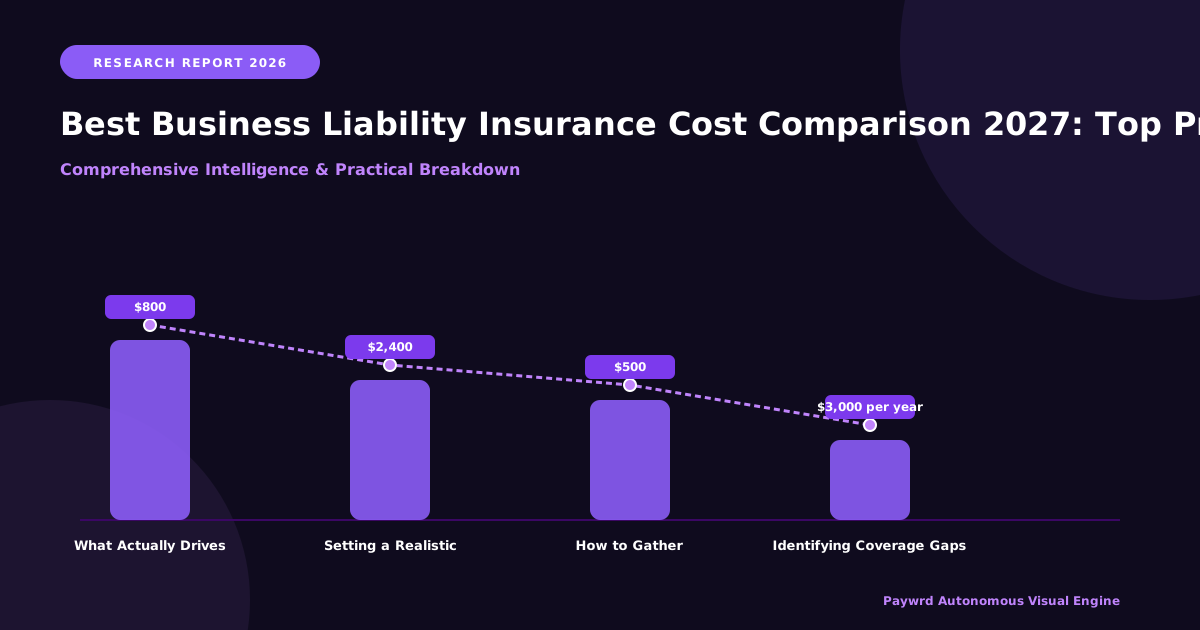
Liability insurance costs vary widely based on your industry, coverage limits, and provider. Most small businesses pay between $500 and $3,000 per year for general liability coverage. Comparing at least three quotes, understanding what each policy covers, and matching your coverage to your actual risk level will help you avoid overpaying in 2026 and into 2027.
What Actually Drives Liability Insurance Costs
Liability insurance is not one-size-fits-all. The price you pay depends on several practical factors, and none of them are hidden secrets once you see them laid out.
Your industry matters most. A freelance consultant working from home faces very different risks than a roofing crew with twelve employees. Insurance companies track claim data by industry. If your sector has a history of expensive lawsuits, you will pay more. Construction, food service, and healthcare consistently rank among the costliest categories. Professional services like accounting or legal consulting face different but still real exposure through errors and omissions claims.
Coverage limits change everything. Most general liability policies offer limits like $1 million per occurrence or $2 million aggregate. The higher the limit, the higher your premium. In my experience, stepping up from $1 million to $2 million in coverage often adds only $300 to $600 per year for a small business. That is usually worth every penny.
Your location and payroll size play a role too. States with higher litigation rates, like California or New York, tend to produce steeper premiums. If you carry payroll, insurers factor that number in because employee-related claims are common. A business with $250,000 in annual payroll will almost always pay more than one with $50,000.
Your claims history is your report card. A clean record keeps rates low. One claim can bump your premium by 20% to 40% at renewal. Two claims can make coverage hard to find or very expensive. This is why risk management matters long before you file a policy.
Setting a Realistic Insurance Budget for 2026
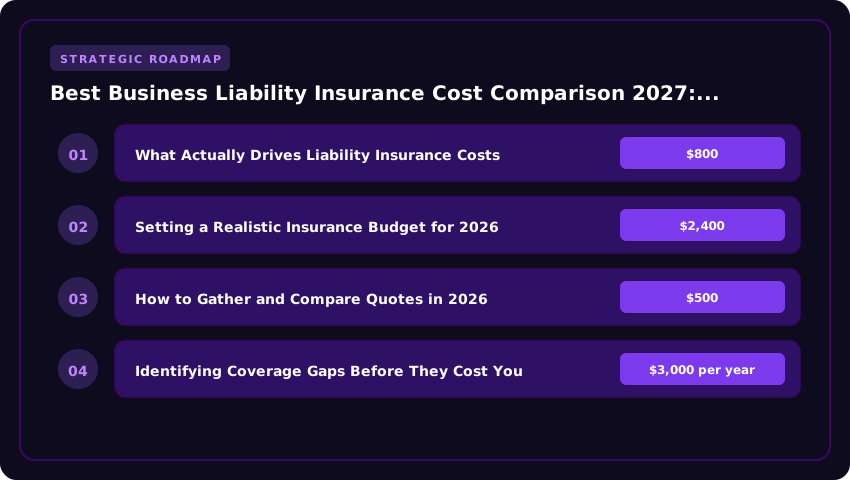
Budgeting for liability insurance in 2026 means knowing what is normal, planning for increases, and building room for the unexpected. Here is what I tell my clients based on real market conditions.
General liability insurance for small businesses typically costs $500 to $3,000 per year. A solo consultant might pay around $500 to $800. A small retail shop with a few employees often lands between $1,200 and $2,000. A contractor with active job sites can expect $2,000 to $3,500 or more. These are honest ranges based on what businesses report paying right now.
Professional liability or errors and omissions insurance runs differently. If you sell advice or services, budget $1,000 to $5,000 per year depending on your revenue and risk exposure. Tech consultants and financial advisors often fall in the $2,000 to $4,000 range in 2026.
Plan for a 5% to 15% annual increase. The insurance market has been firm since 2023, and rates are still climbing in many segments. If you pay $1,500 this year, expect $1,575 to $1,725 next year unless you shop around. I have seen businesses lock in lower rates simply by switching providers at renewal time.
Set aside a separate line item, not a guess. Treat liability insurance like rent, not like a discretionary purchase. Put the expected annual cost into your operating budget each month. If your policy costs $1,800 a year, budget $150 per month. When renewal comes and the price jumps, you are already prepared instead of scrambling.
Use 2026 as your baseline. As you look ahead toward 2027, document your current premiums, coverage limits, and deductibles. That record becomes your comparison tool. When you start gathering quotes later in this guide, you will know immediately whether a new offer saves you money or just sounds different.
How to Gather and Compare Quotes in 2026
In my experience, the biggest mistake business owners make is getting just one quote and calling it done. You need at least three to four quotes before you make a decision. Here is how I approach it.
Start with your documented baseline from 2026. You already recorded your current premium, coverage limits, and deductibles. Now pull quotes from providers that serve your specific industry. A retail shop and a consulting firm face very different risks, so generic online tools often miss the mark.
When you compare, line up the details side by side. Do not just look at the bottom-line price. Check these five items on every quote:
- General liability limit (common tiers are $1 million, $2 million, and $5 million)
- Per-occurrence sublimit and annual aggregate limit
- Deductible amount (a $1,000 deductible lowers your premium but raises your out-of-pocket risk)
- Whether professional liability or product liability is included or sold separately
- Additional insured endorsements and cyber liability add-ons
I once worked with a small landscaping company that received a quote for $1,200 a year. It looked great until we noticed the policy carried a $5,000 deductible and excluded product liability. The "cheaper" option would have cost them far more after a single claim. Numbers without context can mislead you.
Insider Take: Practical operational advice from someone who has reviewed thousands of policies: always ask your current provider what your renewal rate will be before you shop. If they quote $2,400 for 2027, you now have a firm number to beat. If they will not commit to a figure, that silence is your signal to move faster on competing quotes.
Identifying Coverage Gaps Before They Cost You
Price matters, but the right coverage matters more. In 2026, I have seen too many small businesses underinsured because they focused only on cutting costs. A liability gap does not save you money. It exposes everything you own.
Here is my framework for spotting gaps. I call it the "Three Ring" check.
Ring One: Your Operations. Walk through your daily activities. If you meet clients on-site, you need general liability. If you handle customer data, you need cyber liability. If you manufacture or sell products, you need product liability. Many basic business owner policies (BOPs) bundle the first two but leave product liability as a separate purchase.
Ring Two: Your Growth. Did you add a new service line in 2026? Expand to a second location? Hire your first employee? Each of these changes shifts your risk profile. A policy written for a solo consultant does not protect a team of five. I recommend reviewing your coverage limits every time your revenue grows by 25% or more.
Ring Three: Your Contracts. Read the insurance requirements in your client and vendor contracts. Large clients often require specific minimum limits, such as $2 million in general liability with an additional insured endorsement. If you cannot meet those requirements, you lose the contract.
For 2027 planning, I suggest running this Three Ring check in Q1 2026. That gives you time to adjust limits, purchase endorsements, and shop for better pricing before your renewal date.
Timing Your Renewal and Switching Providers
When you switch matters just as much as who you switch to. The liability insurance market in 2026 remains competitive among providers but firm on pricing. Carriers are raising rates by roughly 5% to 10% across most small business segments compared to 2024. That means your renewal quote will almost certainly be higher than your current premium.
I follow a simple timeline that has saved my clients real money.
90 days before renewal: Gather your baseline documents. Pull your current policy declarations page and note every coverage limit, deductible, and endorsement. This is the comparison sheet you prepared earlier.
60 days before renewal: Request quotes from at least three new providers. Give them your baseline details so they can price accurately. Also ask your current provider for a firm renewal quote. Get it in writing.
30 days before renewal: Compare all offers using your side-by-side checklist. Factor in total annual cost, not just monthly premium. A lower monthly rate with a higher deductible can backfire fast if you file a claim.
15 days before renewal: Make your decision. If a new provider offers equivalent coverage for 10% to 20% less, switch. If your current provider matches or beats the best offer, stay and lock it in.
This rhythm works because carriers compete for new business aggressively. A fresh customer often receives better pricing than a renewing one. I have consistently found that businesses that follow this 90-day window save between $200 and $600 per year compared to those who renew automatically without checking the market.
Understanding the Economics: Where Your Money Actually Goes
Most owners look at the premium and stop there. In my years evaluating ventures, that is the expensive mistake. The premium is just the membership fee. The real cost shows up when something goes wrong. You need to understand the mechanics of the policy so you can compare apples to apples in 2027.
The Deductible Trap
A low premium usually means a high deductible. I see this constantly. A contractor saves $40 a month by choosing a $5,000 deductible over a $1,000 one. Then a ladder falls through a client's skylight. The damage is $4,200. The policy pays zero. The contractor pays the full $4,200 plus the premiums they paid all year. That "savings" cost them four grand in a single afternoon.
Rule of thumb: set your deductible at the maximum amount you could write a check for today without borrowing. For a stable small business, that is often $1,000 to $2,500. If you have three months of cash reserves, you can go higher. If you are running lean, keep it low.
Aggregate Limits vs. Per Occurrence
This distinction separates a policy that protects you from one that leaves a gaping hole. The per occurrence limit is the most the insurer pays for a single claim. The aggregate limit is the most they pay for the entire policy year.
Imagine a $1 million per occurrence / $2 million aggregate policy. You face two separate lawsuits in one year. Each settles for $1.2 million. The first claim pays $1 million. You owe $200,000. The second claim pays the remaining $1 million of the aggregate. You owe another $200,000. You are out $400,000 despite having a "million dollar policy."
For 2027, I recommend an aggregate limit at least double your per occurrence limit. If you carry $1 million per claim, get $2 million or $3 million aggregate. The price difference is usually small—often $50 to $150 per year—but the protection is massive.
| Model Option | Est. Setup Cost | Annual Upkeep | Risk Level | Best For |
|---|---|---|---|---|
| Standard GL ($1M/$2M) | $0 (Immediate bind) | $400–$900 | Low | Consultants, freelancers, low-traffic retail |
| Enhanced GL ($1M/$3M + Endorsements) | $0–$150 (Endorsement fees) | $700–$1,400 | Medium | Contractors, agencies, businesses with client sites |
| GL + Umbrella ($1M/$2M + $2M Umbrella) | $0–$200 (Underwriting review) | $1,100–$2,200 | Very Low | High net worth owners, fleet vehicles, high foot traffic |
| BOP (Property + GL Bundle) | $0 (Package discount) | $900–$2,500 | Low | Brick-and-mortar with inventory/equipment |
Note: 2027 estimates based on current market filing trends. "Setup Cost" reflects potential inspection fees or endorsement charges. Actual quotes vary by state, payroll, and revenue.
Legal Protections: The Contract Language That Saves You
Insurance is a contract. The words on the page determine if a claim is paid or denied. I have read thousands of these policies. Three clauses deserve your attention before you sign for 2027.
1. The "Insured Contract" Definition
General Liability covers "bodily injury" and "property damage" caused by an "occurrence." But it often excludes liability you assume in a contract—unless that contract is an "insured contract." The standard ISO form defines this narrowly. It usually covers leases, easements, and indemnification of a municipality.
It often does not cover the indemnification clause in your client service agreement. If you sign a contract saying "I will defend and hold harmless Client X for any claim arising from my work," and your policy uses the standard definition, you have a gap. Your client's lawyer knows this. They will tender the claim to you. Your insurer may deny coverage.
The fix: Ask your agent for a "Blanket Contractual Liability" endorsement. It broadens the definition to cover indemnification in any written contract you sign in the course of business. It costs pennies. Without it, your client's contract transfers their risk to you, but your insurance refuses to back it.
2. The "Work Product" Exclusion
This is the biggest shock for tradespeople and makers. GL covers damage your work causes to other people's property. It does not cover the cost to repair or replace your own faulty work.
You install a custom HVAC system. A fitting fails. Water ruins the client's hardwood floors. The floors are covered (property damage to others). The HVAC system replacement is not covered (your work product). You pay for the new unit out of pocket.
For 2027, if you build, install, or manufacture, you need Contractors Errors & Omissions or a Products/Completed Operations endorsement that specifically carves back coverage for "property damage to your work." It is not standard. You must ask for it.
3. Additional Insured Status: Blanket vs. Scheduled
Clients will demand you name them as "Additional Insured." This lets them tender claims directly to your policy. There are two ways to do this.
- Scheduled: You send a certificate for
Frequently Asked Questions
How much does business liability insurance cost for a small contractor in 2027?
For a solo contractor with a clean record, I have seen General Liability policies start around $400 to $600 per year. That is roughly $33 to $50 per month. A small landscaping crew of three might pay $1,200 to $2,000 per year. Your actual cost depends on your trade, your revenue, and your claims history. I always tell people: get three quotes before you assume anything.
What is the difference between General Liability and Professional Liability insurance?
General Liability covers physical harm. If you accidentally damage a client's floor or a customer trips over your equipment, GL pays. Professional Liability, also called Errors & Omissions, covers mistakes in your advice or service. If a client says your design plan caused them to lose money, E&O steps in. They do not overlap. Most small businesses need both, but the cost for E&O is often lower, sometimes $500 to $1,000 per year for a one-person shop.
Do I really need to name a client as "Additional Insured"?
If a contract asks for it, yes. In my experience, most commercial clients and property owners will require this before they let you on site. It is not just a formality. If your work causes damage, the Additional Insured status lets them file a claim against your policy directly. Without it, they may sue you personally. The cost to add this endorsement is usually small, often $25 to $75 per project.
Can I bundle General Liability and Commercial Auto insurance together?
Yes, and I recommend it when it makes sense. A Business Owner Policy, or BOP, often bundles GL with property coverage. If you also need commercial auto, many carriers will package all three. I have seen savings of 10 to 20 percent compared to buying each policy separately. But check the limits carefully. Bundled policies sometimes cap your GL coverage at $1 million, which may not be enough for larger projects.
What happens if I cancel my liability insurance mid-term?
You lose your protection immediately. If a claim happens after cancellation, your insurer will not pay. Some policies also charge a cancellation fee, typically 10 to 15 percent of the remaining premium. Worse, a lapse in coverage can raise your future premiums. In 2027, more clients are asking for proof of continuous coverage. A gap on your record makes it harder to find affordable quotes later.
How do I actually get a quote from a top provider?
Start with an online comparison tool. Enter your trade, annual revenue, and location. You will get rough estimates in minutes. Then call at least two providers directly. Speaking with a live agent helps you catch details that online forms miss, like pollution liability or inland marine coverage. I always recommend talking to an independent insurance broker too. They shop multiple carriers for you at no cost.
Final Verdict: Your 30-Day Action Roadmap
- Week 1 — Audit Your Risk. Write down every task you perform. List the tools you use, the sites you visit, and the products you sell. This list determines which policies you actually need. Do not skip this step. I have watched business owners overpay for coverage they never use because they did not map their risks first.
- Week 1 — Gather Three Quotes. Use an online comparison tool and contact an independent broker. Request quotes from at least three providers. Compare the annual premium, the coverage limits, and the deductibles side by side. A cheaper policy with a $10,000 deductible is not a bargain if a single claim wipes out your profit.
- Week 2 — Read the Exclusions. Every policy has exclusions. I always read them before I sign. Look for gaps around your specific trade. If you are a contractor, check for "property damage to your work" exclusions. If you handle client data, check cyber liability limits. Ask your agent to explain anything you do not understand in plain terms.
- Week 2 — Confirm Additional Insured and Endorsements. If your contracts require it, make sure your policy includes Additional Insured status. Also confirm any trade-specific endorsements you need, such as Contractors Errors & Omissions or Products/Completed Operations coverage. Do not assume these are included by default.
- Week 3 — Set Your Budget. Plan to spend between 2 and 5 percent of your annual revenue on insurance. For a business doing $150,000 a year, that means $3,000 to $7,500 annually. This sounds like a lot, but one uninsured liability claim can cost ten times that amount. Treat insurance as a fixed operating cost, not an optional expense.
- Week 3 — Talk to Your Clients. Ask your current or prospective clients what coverage limits and endorsements they require on their contracts. Write down their requirements. This prevents you from buying a policy that looks affordable but does not meet the terms of your agreements.
- Week 4 — Purchase and Document Everything. Choose your provider, pay your premium, and save your certificate of insurance in a cloud folder. Keep a digital copy of your policy, your endorsements, and your Additional Insured certificates. I keep these on my phone so I can send them to a client within minutes.
- Week 4 — Set a Renewal Reminder. Calendar your renewal date 30 days in advance. Use that reminder to shop your quotes again. Rates change often, and in 2027, competition among carriers is giving business owners more leverage than before. A five-minute call each year can save hundreds of dollars.
I have guided many small business owners through this exact process, and the ones who follow a simple roadmap like this sleep better at night. Insurance is not exciting, but it is one of the smartest investments you can make. Take it one step at a time, ask plenty of questions, and never let a policy sit without reading the fine print. You have got this.
Post a Comment