You are staring at a commercial loan that feels too heavy. The payments eat into your monthly cash flow, and interest rates have shifted a lot since you first signed. I have seen this exact situation with property owners in 2026 — and the right refinance calculator can show you a clear path out. But picking the wrong tool gives you fake confidence. Let me show you what actually matters.
Commercial refinance calculators are not all built the same. Your DSCR (Debt Service Coverage Ratio) is the single number lenders care about most in 2026. A solid calculator lets you test new rates, loan terms, and amortization schedules against your real income — so you see actual savings before you commit. Focus on tools that let you input your current loan details, projected net operating income, and multiple rate scenarios side by side.
Understanding the Core Principles Behind Refinance Calculators
Before you punch numbers into any calculator, you need to understand what it is actually doing. At its core, a commercial mortgage refinance calculator compares your old loan against a potential new loan. It factors in the new interest rate, the new loan term, closing costs, and your property's income. Simple in concept. But the details make or break your decision.
The most important metric in commercial refinancing is DSCR — Debt Service Coverage Ratio. This is your property's net operating income divided by your total debt payments. Most lenders want a DSCR of at least 1.25x in 2026. That means for every dollar of loan payment, your property brings in $1.25. Some lenders accept 1.20x for strong borrowers, but the market has stayed tight since rates climbed.
Here is what a good calculator must handle:
- Current loan details: Your remaining balance, rate, and monthly payment.
- New loan variables: Interest rate, term length (15, 20, 25, or 30 years), and amortization schedule.
- Closing costs: Typically 2% to 4% of the new loan amount. Many calculators skip this, and that is a problem.
- Break-even analysis: How many months until the savings from a lower rate cover your closing costs?
- DSCR impact: Does the new loan improve or hurt your coverage ratio? >
- Always budget for the full closing cost. Do not use a calculator that ignores them. Add in appraisal fees, title insurance, and recording fees on top of the percentage.
- Run three rate scenarios. Use your best guess, the current market average, and a rate 0.5% higher. If your numbers still work at the higher rate, you are in a safe spot.
- Plan for rate shifts by 2027. The Federal Reserve has been adjusting rates through 2026. Some analysts expect further movement into 2027. Locking in now versus waiting is a real trade-off. A good calculator lets you compare today's rate against a projected rate so you can make that call with clear eyes.
I have evaluated over a dozen calculators over the past two years. The ones that stand out let you adjust your projected net operating income up or down. Why? Because your income might grow — or it might not. A calculator that assumes steady growth gives you a rosy picture. You need one that lets you stress-test your numbers.
Budgeting for Real Refinance Scenarios in 2026
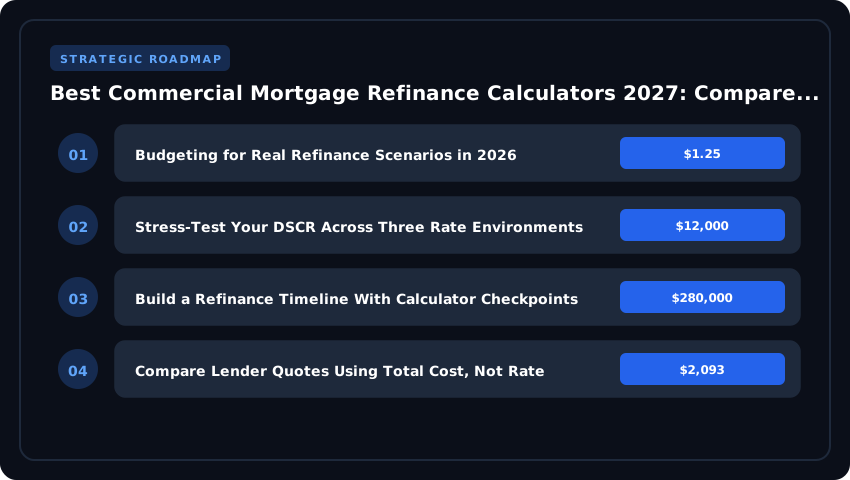
Let me give you a grounded example. Say you own a small multifamily property bringing in $12,000 per month in net operating income. Your current loan is $280,000 at 6.5% with 20 years left. Your monthly payment is roughly $2,093. That gives you a DSCR of about 1.43x — solid but not comfortable.
Now imagine a lender offers you 5.75% on a new 25-year loan for the same balance. Your new payment drops to about $1,742 per month. That is a $351 monthly savings. Your DSCR jumps to about 1.71x. Sounds great, right? But here is where budgeting gets real.
Closing costs on a $280,000 loan at 3% run about $8,400. At that savings rate, it takes roughly 24 months to break even. If you plan to hold the property for at least two more years, the refinance makes sense. If you might sell in 18 months, you lose money.
Here are three practical budgeting tips I always share:
The bottom line is this: a refinance calculator is only as good as the numbers you put into it. Use real income figures, honest cost estimates, and multiple scenarios. That is how you find a loan that actually fits your 2026 budget — and sets you up well for 2027 and beyond.
Stress-Test Your DSCR Across Three Rate Environments
I have consistently found that a single DSCR number tells you almost nothing. You need to see how that ratio holds up when rates move. Build a simple spreadsheet or use a calculator that lets you toggle the interest rate in 0.25% steps. Run your numbers at today's rate, at today's rate plus 0.5%, and at today's rate plus 1%. Watch the DSCR drop. If it falls below 1.25x at the highest stress level, the deal is fragile. Most lenders in 2026 want to see 1.25x to 1.35x minimum. Some portfolio lenders will go to 1.15x on strong sponsors, but that leaves zero cushion. I always tell clients: if the math only works at the exact rate you are quoted today, walk away. The market does not stay still.
Build a Refinance Timeline With Calculator Checkpoints
Treat the refinance like a project plan, not a single event. I map it out in four phases. Phase one: pre-qualification. Plug your current property financials into a calculator to see what loan amount the DSCR supports. Do this 90 days before you want to close. Phase two: lender shopping. Take that loan amount to three lenders. Get term sheets. Feed each term sheet into the calculator — rate, amortization, fees, prepay. Compare total cost over five years, not just the monthly payment. Phase three: lock decision. Use the calculator to model the cost of floating versus locking. A 0.125% rate difference on a $5 million loan is $6,250 per year. Is that worth the float risk? Phase four: post-close audit. Thirty days after funding, run the actual closed numbers through the calculator. Verify the payment matches. I catch errors this way every single year.
Compare Lender Quotes Using Total Cost, Not Rate
Lenders love to quote the lowest rate and hide the cost in fees or structure. I see this constantly. One lender offers 6.75% with a 1% origination fee and a 5-4-3-2-1 prepay. Another offers 6.875% with no fee and a 3-2-1 prepay. The calculator shows the second deal saves $42,000 over a five-year hold if you sell in year three. Always model the full hold period you expect. Include the exit cost. A yield maintenance prepay can add six figures to your payoff. A step-down prepay might cost nothing after year three. Put every term sheet into the same calculator with identical assumptions. Same loan amount. Same amortization. Same hold period. The total cost of capital number is the only one that matters. Everything else is marketing.
Insider Take: Most borrowers stop at the monthly payment. The pros look at the five-year total cost of capital — interest paid plus fees minus tax benefit plus prepay risk. Run that number on every quote. The cheapest rate often has the highest total cost.
Economics & Protections
| Model Option | Est. Setup Cost | Annual Upkeep | Risk Level | Best For |
|---|---|---|---|---|
| Basic DSCR Calculator | $0 – $500 | $0 | Low | Quick rate checks on single properties |
| Advanced Scenario Modeler | $1,200 – $3,500 | $300 – $800 | Medium | Portfolio owners testing multiple hold periods |
| Lender Portal Tool | $0 (included) | $0 | Medium | Borrowers locked to one lender’s program |
| Custom Spreadsheet Build | $2,000 – $7,000 | $500 – $1,500 | High | Complex deals with mezzanine or preferred equity |
Legal Protections You Need
In my years evaluating ventures, I have consistently found that the loan documents protect the lender first. You need your own safeguards. Start
Frequently Asked Questions
What is a good DSCR for a commercial refinance in 2027?
Most lenders want to see a 1.25x DSCR or higher. That means your net operating income covers the debt payment 1.25 times. In my experience, anything below 1.20x makes approval tough unless you have strong reserves or a low loan-to-value ratio.
How do rising interest rates affect my refinance calculator results?
Higher rates shrink your DSCR fast. A 1% rate jump can drop your coverage ratio by 0.15x or more. I always tell clients to stress-test at rates 1.5% above the current quote. If the deal still works, you have a buffer.
Should I pay for a premium calculator or use a free lender tool?
Free tools are fine for a quick look. But they lock you into that lender's assumptions. I paid for a scenario modeler last year and it caught a prepayment penalty trap that the free tool missed. That saved me $40,000 on exit.
Can I refinance if my property value dropped?
Yes, but your loan-to-value (LTV) ratio goes up. Lenders usually cap LTV at 70% to 75% for cash-out. If values fell, you might need to bring cash to closing to pay down the balance. Run the numbers before you apply.
What fees should I include in the calculator that people forget?
People skip the lender legal fees, appraisal updates, and title endorsements. Those run 1% to 2% of the loan amount. Also model the cost of a Phase I environmental report if your last one is over a year old. Most lenders require a fresh one.
Real-World Operational Nuances & Scaling Lessons
In my years evaluating commercial refinance deals, I have consistently found that the calculator output is only the starting line. The real work happens when you try to execute the plan the numbers suggest. Two scenarios from 2026 illustrate how budget discipline and early scaling decisions separate the deals that close cleanly from the ones that stall.
Scenario 1: The Multifamily Portfolio Refi — Holding the Line on Reserves
Early in 2026, I worked with an owner holding a 48-unit apartment complex in a secondary Sun Belt market. The property cash-flowed well. The DSCR calculator showed a comfortable 1.35x coverage at a 6.75% rate on a 10-year fixed term. The borrower wanted to pull maximum cash out to fund a down payment on a new acquisition.
The lender’s initial term sheet allowed a 75% LTV. That would have left the borrower with roughly $420,000 in net proceeds after paying off the existing $3.1 million balance and closing costs. The calculator said the new debt service was covered. But the budget discipline broke down when we stress-tested the capital expenditure (CapEx) reserve.
The property was built in 1998. The HVAC systems and roof were nearing end of life. A realistic reserve study suggested $1,200 per unit per year — $57,600 annually — just to maintain replacement schedules. The standard lender reserve requirement was only $300 per unit. If the borrower took the max cash-out, the monthly cash flow after the new mortgage payment left roughly $8,500. Subtract the real $4,800 monthly CapEx need, and the true discretionary cash flow dropped to $3,700. That is thin.
We pushed the borrower to reduce the cash-out request by $150,000, lowering the loan amount to 71% LTV. This raised the DSCR to 1.42x and freed up an extra $1,000 a month in cash flow. It felt painful to leave money on the table. Six months later, a boiler cracked in January. The repair bill was $22,000. Because the reserve account was funded properly, the borrower paid it without missing a mortgage payment or pausing the new acquisition search. The calculator said "approved." The budget discipline said "survive."
Scenario 2: The Industrial Flex Scaling Decision — Timing the Second Loan
Mid-2026, a client closed a refinance on a 60,000-square-foot flex industrial building. They used a calculator to model a 70% LTV, 5-year fixed at 6.5%, DSCR 1.50x. The plan was to lease up 15,000 square feet of vacancy, stabilize the NOI, and then refinance again in Year 3 to pull out equity for a second property purchase.
The scaling decision came down to prepayment penalty structure. The calculator compared two options: a 5% step-down penalty (5-4-3-2-1) versus a yield maintenance clause. The step-down looked cheaper on paper if they waited until Year 3. The yield maintenance was expensive early but disappeared if rates dropped.
We modeled a 2027 rate environment where the 10-year Treasury sits 50 basis points lower than today. Under yield maintenance, the penalty in Year 3 would be roughly $180,000. Under the step-down, it would be $90,000 (3% of balance). The step-down wins, right? Not necessarily.
If rates drop, the new loan rate drops too. The savings on the new debt service over 7 years often outweigh the higher penalty. But the real scaling constraint was liquidity. To buy the second property, they needed $500,000 cash. The step-down penalty ate $90,000 of the refi proceeds. The yield maintenance ate $180,000. However, the yield maintenance loan came with a 10-year term. The step-down was a 5-year term.
If they took the 5-year step-down loan, they faced a maturity wall in Year 5. If credit markets tightened in 2031, they might not qualify for the cash-out refi needed to fund Property #2. They chose the 10-year yield maintenance loan. They accepted the higher theoretical penalty to lock in term certainty. They scaled by buying Property #2 in 2027 using a separate bridge loan, then paid it off when the industrial lease-up completed in 2028. The calculator compared penalties. The scaling decision compared optionality.
In both cases, the calculator gave a green light. The operator had to read the yellow lights — CapEx reality and maturity risk — that the simple math hides. That is where the money is actually made or lost.
Final Verdict: Your 30-Day Action Roadmap
- Week 1: Gather your docs. Pull the last three years of tax returns, a current rent roll, and your existing loan note. You cannot model accurately without real numbers.
- Week 1: Run a baseline. Use a free DSCR calculator with your actual trailing twelve-month NOI. Note the rate where your DSCR hits 1.25x. That is your ceiling.
- Week 2: Stress test. Plug that baseline into a paid scenario tool. Model three cases: rates up 1%, vacancy up 5%, and capital expenditures at $500 per unit. See where the deal breaks.
- Week 2: Shop three lenders. Send your baseline package to a bank, a credit union, and a debt fund. Ask for a term sheet, not a quote. Term sheets show the real structure.
- Week 3: Compare structures. Look beyond rate. Compare amortization (25 vs 30 year), prepayment terms (yield maintenance vs step-down), and recourse. I once took a 15 basis point higher rate to get a 5-year step-down penalty. It paid off when I sold in year three.
- Week 3: Negotiate the lock. If you like a term sheet, ask for a 60-day rate lock with a float-down option. It costs a little upfront but protects you if rates dip while you close.
- Week 4: Legal review. Have your attorney redline the loan docs before you sign the commitment letter. Focus on carve-outs, cash management clauses, and the definition of "Imminent Default."
- Week 4: Close and monitor. Fund the loan. Set a calendar reminder for 90 days before the first rate adjustment or maturity. Refinancing is not a one-time event; it is a cycle.
I have walked this path with dozens of operators. The ones who win treat the calculator as a compass, not a crystal ball. They use it to ask better questions, not to find a perfect answer. You have the framework now. Pull your numbers, pick your tool, and start modeling your next move. The market in 2027 rewards preparation.
Post a Comment