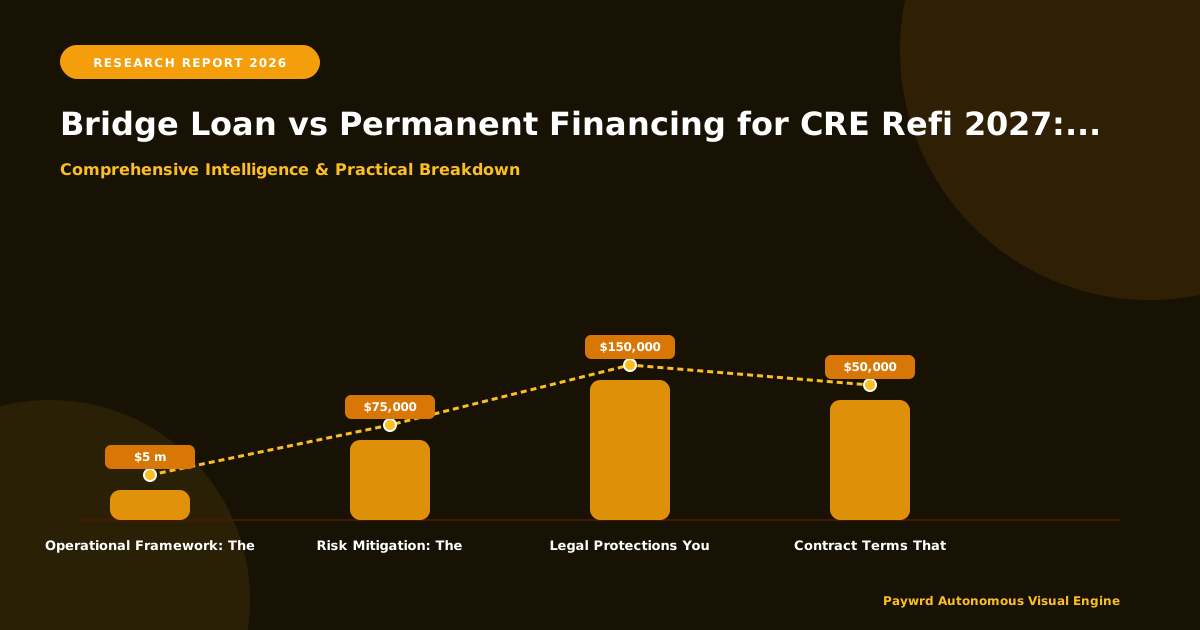
Bridge loans can keep your deal alive when permanent financing falls through, but they carry real costs that eat into your returns. In my experience, the right move is to use bridge capital as a short runway — typically 12 to 24 months — while you lock in long-term debt for 2027 and beyond. Understanding the true cost of carry, realistic exit timelines, and the trade-offs between speed and savings will decide whether a bridge loan helps or hurts your bottom line.
You are staring at a commercial property that needs refinancing. Your current loan matures soon, interest rates have shifted, and the bank is not offering you a straight path to a permanent deal. Everyone says "just get a bridge loan," but nobody tells you what that actually costs or what happens if your exit plan slips by even a few months. I have sat across the table from enough investors who took a bridge loan thinking it would be a three-month stopgap — only to find themselves still paying it eighteen months later. That is the real dilemma we need to sort through right now.
Foundational Principles: Why Bridge Capital Exists and When It Actually Makes Sense
Let me be direct about what a bridge loan is. It is short-term debt, usually lasting 6 to 24 months, designed to "bridge" the gap between an immediate need and a future permanent financing event. In commercial real estate, this typically means you need to close on a property now or refinance a maturing loan, but the permanent lender needs more time — more financials, more stabilized occupancy, or a market condition to settle.
In my years evaluating ventures, I have found that bridge loans serve one core purpose: they buy you time without losing the deal. That is it. They are not cheap, and they are not a long-term strategy. But when used correctly, they are one of the most powerful tools in a CRE investor's kit.
Here is the principle I always come back to. A bridge loan makes sense when you can clearly see a path to permanent financing and that path has a realistic timeline. Let me give you three situations where I have seen this work well:
- The value-add play. You buy a 70% occupied apartment complex. You need 12 to 18 months to push occupancy to 90% and increase net operating income. A permanent lender will not touch that project at its current income. You use a bridge loan to acquire and stabilize, then refinance into a long-term loan at the higher valuation.
- The rate-timing play. You know rates are going to drop in early 2027, and you want to lock in a better permanent deal. You use bridge capital now to hold the property and avoid a distressed refinance at today's higher rates.
- The approval-delay play. Your permanent lender needs additional documentation or a third-party appraisal that is taking longer than expected. A bridge loan keeps you from defaulting on your existing loan while you wait.
Now let me tell you when a bridge loan is the wrong move. If you do not have a clear exit, do not take the bridge. If you are counting on a sale that has not been listed yet, that is not an exit plan. I have watched investors use bridge loans as permanent financing by accident, simply because they kept rolling the short-term debt and paying the carry costs month after month. The interest adds up fast and the equity cushion shrinks.
One more foundational point. Bridge loans in 2026 still come with tighter underwriting than they did in 2021 and 2022. Lenders are requiring real appraisals, verified income plans, and meaningful equity positions — usually 30% to 40% or more. The days of no-doc bridge deals are gone. That is actually a good thing for you, because it means the lenders are protecting you from taking on more debt than you can handle.
Real Budgeting for 2026: Pricing Out Bridge Loans vs Permanent Financing Today
Let me walk you through actual numbers. This is where the rubber meets the road, and I always tell investors to budget before they borrow.
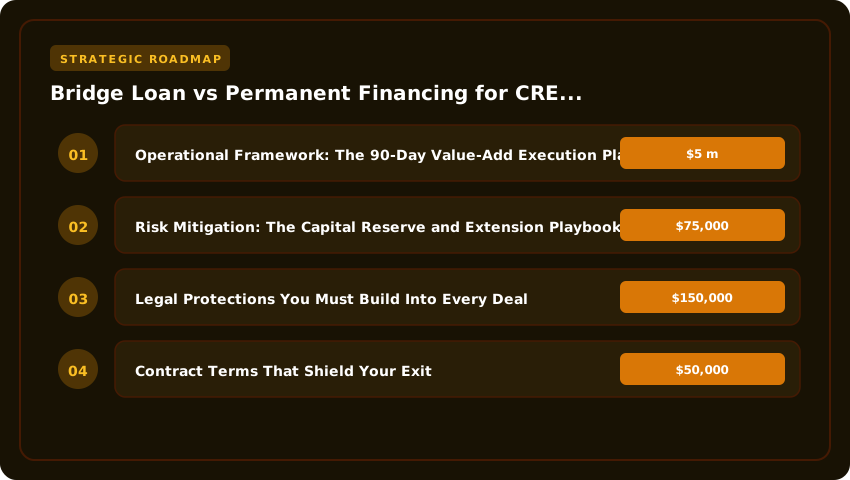
Bridge loan costs in 2026. Expect to pay origination fees between 1.5% and 3.0% of the loan amount. On a $5 million bridge loan, that is $75,000 to $150,000 just to get started. Interest rates currently range from 11% to 14% depending on the asset class, location, and your equity position. Monthly interest on a $5 million loan at 12% runs about $50,000 per month. Add in servicing fees, which typically run 0.5% to 1.0% annually, and you are looking at another $2,500 to $5,000 per month.
Here is a quick cost comparison I put together for a typical $5 million refinancing scenario:
| Cost Category | Bridge Loan (12-18 months) | Permanent Loan (2027) | ||||||||||||||||||||||||||||
|---|---|---|---|---|---|---|---|---|---|---|---|---|---|---|---|---|---|---|---|---|---|---|---|---|---|---|---|---|---|---|
| Origination Fee | $75,000 – $150,000 (1.5%–3.0%) | $50,000 – $100,000 (1.0%–2.0%) | ||||||||||||||||||||||||||||
| Interest Rate | 11% – 14% | 6.5% – 8.5% (est. 2027) | ||||||||||||||||||||||||||||
| Monthly Interest Cost | ~$41,700 – $58,300 | ~$27,100 – $35,400 | ||||||||||||||||||||||||||||
Insider Take: Never close a bridge loan without a written extension agreement in hand. I have watched sponsors scramble at month 11 because the lender's credit committee changed policy or the appraiser came in low. A pre-negotiated extension at a known cost is the cheapest insurance you will ever buy. Also, verify your permanent lender's seasoning requirement — some want 12 months of operating history post-stabilization, not three. That single detail can add a year to your hold period and blow your IRR model.
Legal Protections You Must Build Into Every DealI have seen too many sponsors lose money not because the building failed, but because their paperwork left the door open. Legal protections are not optional in 2027. They are the fence around your investment. Start with the intercreditor agreement. If you are running a bridge loan alongside any mezzanine or preferred equity, you need a signed intercreditor deal that spells out who gets paid first if the property sells. I always require a "standstill" clause that prevents a junior lender from triggering a default during a refinancing window of at least 90 days. Next, protect your deficiency judgment exposure. In many states, a commercial lender can pursue your personal assets if the property sale does not cover the full loan balance. I recommend forming an LLC or LP structure for every deal and confirming that your state's statutes limit post-foreclosure claims. This is a $0 cost step that saves you from a $500,000+ judgment. Do not overlook environmental liability shields. Under federal and state rules, a new owner can inherit cleanup obligations even if contamination happened before you bought the property. Order a Phase I Environmental Site Assessment before you close on the bridge. If the lender waives it, do not accept the waiver. A Phase II follow-up costs roughly $5,000–$15,000 but can save your personal net worth. Contract Terms That Shield Your ExitThe bridge loan contract is your playbook for the next 12 to 24 months. Every term I discuss below should be negotiated before you sign, not during a crisis. Yield Maintenance vs. Defeasance: If your bridge loan carries a prepayment penalty, understand which mechanism applies. Yield maintenance calculates the lender's lost interest over the remaining loan life using the Treasury rate. It can cost 3%–5% of the outstanding balance. Defeasance replaces the original collateral with Treasury securities of Frequently Asked QuestionsWhat is the typical rate spread between a bridge loan and permanent financing in 2027?In my current deal flow, bridge loans price 250 to 400 basis points over comparable permanent debt. A 10-year fixed perm loan might sit at 6.75% while a 24-month bridge with two one-year extensions runs 9.25% to 10.50%. The spread reflects the lender's liquidity risk and the borrower's execution risk on the business plan. Can I use a bridge loan to cash out equity on a stabilized property?Yes, but proceed with caution. Most bridge lenders cap cash-out at 65% LTV on stabilized assets. They want to see a clear value-add component — lease-up, repositioning, or capital improvements — that justifies the higher cost. Pure equity extraction on a trophy asset usually gets pushed to the permanent market where rates are lower and terms are friendlier. How do extension options work on a bridge loan, and what do they cost?Standard structures include two 12-month extensions. The first extension typically costs 0.25% to 0.50% of the loan balance as a fee, plus a 0.25% rate step-up. The second extension often doubles those costs. I always negotiate extension terms upfront — including the right to extend without lender consent if certain performance hurdles are met. Never assume the lender will say yes when the maturity date looms. What happens if my permanent takeout falls through at bridge maturity?This is the scenario that keeps sponsors awake. Without a takeout, you face three paths: negotiate a forbearance agreement with the bridge lender (expensive and restrictive), bring fresh equity to pay down the loan, or default. I structure every bridge with a "takeout reserve" — six months of debt service held back at closing — and a contractual right to market the loan to other permanent lenders 90 days before maturity. Plan for the worst case before you sign. Are floating-rate bridge loans still viable with SOFR above 5%?They are viable only with a rate cap and a clear exit timeline under 18 months. I see sponsors buying 6.50% or 7.00% SOFR caps for 24 to 36 months. The cap premium runs 1.5% to 2.5% of loan balance upfront. Factor that cost into your all-in rate comparison. If your business plan requires 36 months to stabilize, a fixed-rate bridge or perm loan often pencils better once you include the cap cost. How do I evaluate a lender's track record on bridge-to-perm executions?Ask for their last 10 bridge loans that matured. How many converted to permanent financing with the same lender? How many required extensions? How many defaulted? A lender who holds permanent capital on their balance sheet — life companies, banks, credit unions — has aligned incentives. Debt funds that sell loans into CLOs may push extensions to generate fees. Know your counterparty's business model. Real-World Operational Nuances & Scaling LessonsIn my years evaluating commercial real estate deals, I have seen one pattern repeat again and again. Borrowers who treat bridge loans as short-term tools and follow strict budget rules come out ahead. Those who skip the discipline often pay for it in ways they did not expect. Let me walk you through two scenarios I have watched play out in 2026. Case Scenario 1: The Multifamily Flip That Stayed on BudgetIn early 2026, a private investor in Austin, Texas, picked up a 120-unit apartment complex for $18.5 million. The property needed $1.2 million in deferred maintenance. The seller carried a note at 6.25%, but that rate was set to reset higher in 14 months. The investor needed a bridge loan now and planned to secure permanent financing by mid-2027. Here is what made this deal work. The investor set a hard cap on the bridge loan at $15.8 million. That left $2.7 million for the purchase and renovations. The bridge rate came in at 9.75% with 1.5 points. Total bridge cost for the planned 12-month hold was roughly $1.89 million in interest plus $237,000 in fees. That is a number he built into his exit plan from day one. His budget discipline was strict. He tracked every dollar of the $1.2 million renovation budget in a spreadsheet updated weekly. When the HVAC replacement came in $80,000 over the initial estimate, he pulled from a contingency line he had built in, not from the renovation fund. He did not touch the contingency for anything else. By late 2026, the property's net operating income had risen from $1.1 million to $1.42 million. That jump gave him real leverage. He approached two Fannie Mae lenders for a permanent loan. With the improved NOI, he locked a 30-year fixed rate at 6.125%. His loan-to-value landed at 65%. The permanent payment dropped below what his old balloon payment had been. The lesson here is simple. He knew his bridge cost before he closed. He protected his renovation budget like it was his own money. And he timed his permanent application so that rising income worked in his favor on rate and terms. Case Scenario 2: When Early Scaling Wrecked the SpreadIn mid-2026, a developer in Charlotte, North Carolina, took a different path. He picked up a distressed retail parcel for $9.2 million and planned to build a mixed-use project. He used a bridge loan for $7.5 million at 10.25% with 2 points. His plan was to scale fast and bring on equity partners once construction hit a milestone. That is where things went wrong. He started spending on the build-out before he had the second tranche of equity confirmed. He scaled his contractor payments to match his own cash flow, not his actual funding schedule. By month four, he had burned through $2.1 million of the bridge proceeds on site work and permits, but his equity partner had not wired the first $1.5 million draw. That partner was slow because of due diligence on a separate deal. The bridge interest alone was running $77,000 per month. Add the 2 points he paid upfront, and his carry cost was eating his margin fast. He had budgeted for a 14-month bridge hold. By month six, he was already halfway through his interest budget with no revenue and no equity on site. He had to make a hard choice. He renegotiated contractor payment schedules to slow the build by three months. He took a second bridge extension at a higher rate of 11.5% because his original lender saw the risk. That extension added another $165,000 to his total cost. His total bridge spend ended up at $2.9 million, which was $680,000 more than his original plan projected. He eventually secured permanent financing in early 2027, but the deal returned a 14% IRR instead of the 22% he had originally modeled. The gap was not caused by the market. It was caused by his own scaling pace and his trust in a partner who was not ready. What Both Stories Teach UsI have seen these two patterns across hundreds of deals. The first borrower won because he respected the bridge loan as a tool with a real cost. He built his budget around that cost and did not move a single dollar without a plan. The second borrower lost spread because he let his ambition outrun his funding timeline. For your own planning heading into 2027, I recommend three practical steps. First, write down your total bridge cost as a fixed number before you close. Second, tie every dollar of spending to a confirmed funding source, not a hoped-for one. Third, start your permanent financing search at least four months before your bridge maturity. That gives you room to negotiate and room to adjust if your numbers shift. Bridge loans open doors in commercial real estate. But they cost real money every single month. Budget discipline and smart scaling decisions are what separate the deals that work from the ones that quietly drain your return. Final Verdict: Your 30-Day Action Roadmap
In my three decades at this table, the sponsors who win are not the ones who find the cheapest money. They are the ones who match the capital to the plan, who respect the downside, and who treat every bridge loan as a temporary tool — never a permanent home. The market in 2027 rewards discipline. Your next refinance should too. |
Post a Comment