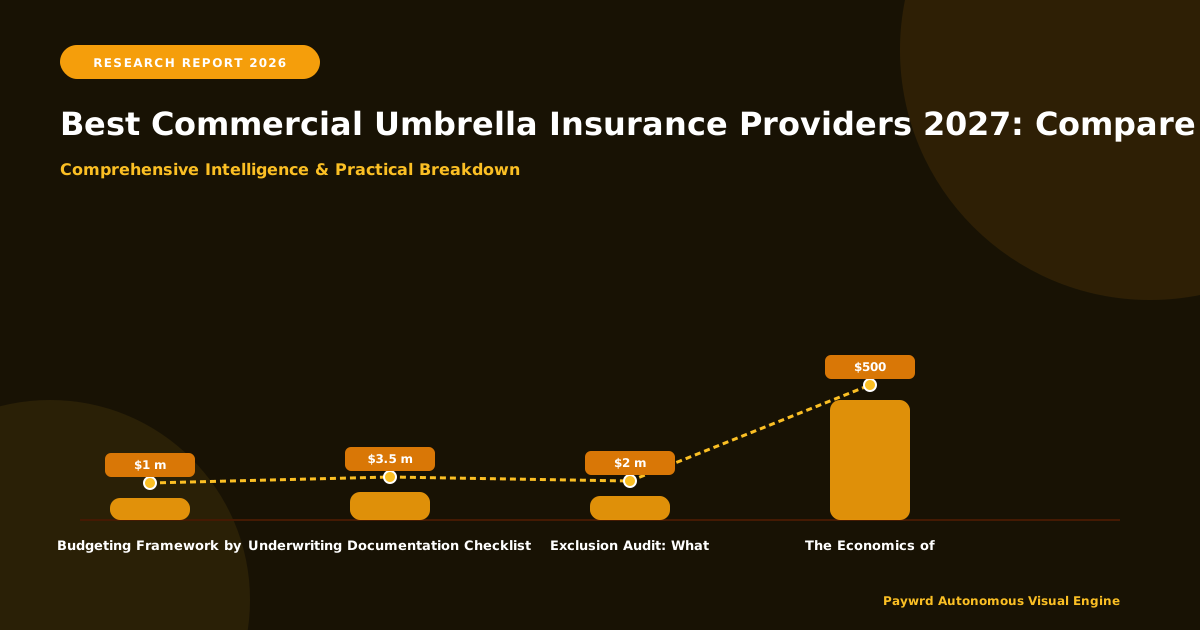
One lawsuit can strip your business of everything you have built. I have watched small construction companies lose their trucks and their operating lines over a single slip-and-fall claim. I have seen a restaurant owner drain personal savings because his general liability policy capped out at $1 million and the judgment was $3.5 million. If you are reading this in 2026, you are likely asking a critical question: do I need commercial umbrella insurance, and can I actually afford it heading into 2027? That is exactly where I want to help you today.
Commercial umbrella insurance sits above your existing liability policies and kicks in when those limits are exhausted. In 2026, most small-to-mid-size businesses can secure $1 million to $2 million in umbrella coverage for roughly $500 to $2,000 per year, depending on industry risk and underlying policy strength. Planning your budget now gives you a clear path to adequate protection by 2027 without overpaying. Understanding exclusions is just as important as understanding price, because most claim denials happen for reasons policyholders assumed were covered.
What Commercial Umbrella Insurance Actually Does (And Why It Matters More in 2026 Than Ever)
Let me keep this simple. Your general liability policy pays claims up to a set limit. Say you carry $1 million in general liability. A client sues you for $2.8 million after a workplace injury. Your primary policy pays $1 million. You are personally responsible for the remaining $1.8 million unless you have umbrella coverage.
Commercial umbrella insurance is a second layer. It sits on top of your existing policies and covers the gap. Think of it like a safety net stretched below a trapeze artist. The primary policy is the trapeze. The umbrella catches you when the trapeze does not hold.
In my years evaluating ventures, I have found that business owners consistently underestimate how fast liability claims grow. Medical costs, legal defense fees, and punitive damages all stack up quickly. A $500,000 judgment can become $2 million once you add attorney fees and interest. That is why I consider umbrella coverage non-negotiable for any business with employees, client-facing operations, or physical assets in 2026.
Here is what umbrella coverage typically does well:
- Extends liability limits beyond what your primary policies provide, often adding $1 million to $10 million in additional protection.
- Covers claims that exceed specific thresholds, such as catastrophic injury or property damage lawsuits.
- Fills gaps between underlying policies, including situations where two policies conflict over who pays first.
- Provides broad protection across multiple policies, meaning one umbrella can sit over general liability, auto liability, and employer liability coverage simultaneously.
What it does not do is cover everything. Umbrella policies have their own exclusions, and I will break those down in the next section. But the core principle holds: umbrella insurance is your last line of defense before personal or business assets are seized. In 2026, with lawsuit costs rising across nearly every sector, this is not optional for businesses generating more than $250,000 in annual revenue.
Real Budgeting for 2026: What Umbrella Coverage Actually Costs
I know you want real numbers, not ranges that sound like guesswork. Let me give you what I have seen from actual business owners and brokers working in 2026.
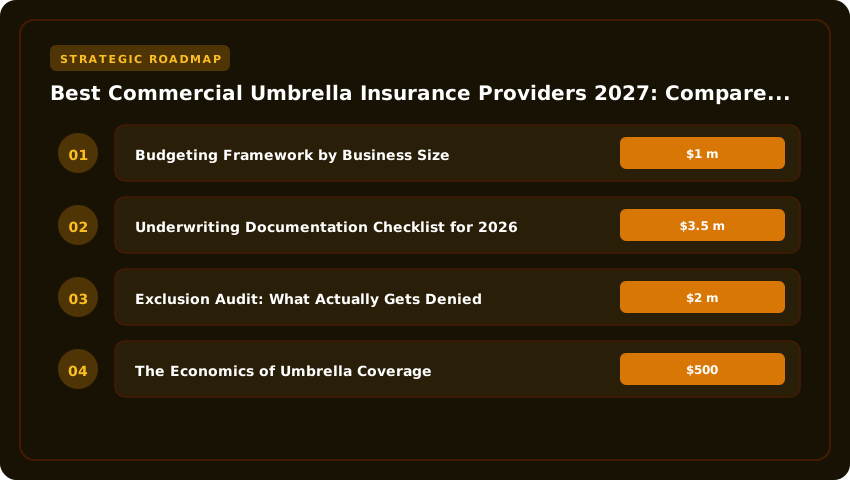
For a small business with $1 million in underlying general liability coverage, you can expect to pay between $500 and $1,200 per year for a $1 million umbrella policy. That breaks down to roughly $42 to $100 per month. For a mid-size business carrying $2 million in underlying limits, a $2 million umbrella policy typically runs between $1,200 and $2,500 annually, or about $100 to $210 per month.
These figures shift based on a few practical factors I always walk my clients through:
- Your industry risk class. A consulting firm will pay far less than a roofing company. Construction, transportation, and food service sit in higher-risk tiers. I have seen roofing businesses pay 3 to 4 times what professional service firms pay for the same coverage limit.
- Your claims history. A clean record over the past 3 to 5 years earns you the best rates. Even one claim in the last 24 months can push premiums up by 15% to 30%.
- Your underlying policy quality. Umbrella providers require your primary policies to meet certain standards. If your general liability policy has weak limits or high deductibles, the umbrella carrier may charge more or decline to cover you at all.
- Your location and regulatory environment. States with higher litigation rates, such as California, New York, and Florida, carry steeper pricing. Local ordinances in 2026 are adding new requirements in some municipalities, particularly around worker safety and environmental liability.
Now, here is the budgeting advice I give every business owner I work with. Do not wait until 2027 to plan. Lock in your coverage and pricing now. Umbrella premiums have been climbing steadily since 2022, and the trend continues into 2026. Carriers are tightening underwriting standards, especially for businesses in high-risk categories. If you wait until January 2027 to shop, you may face higher quotes or reduced coverage options.
Here is a simple budgeting framework I use:
| Business Size | Insider Take: The biggest budgeting mistake I see is forgetting defense costs. In 2026, most umbrella policies include defense inside the limit — meaning every dollar spent on lawyers reduces the money available to pay a judgment. If you face a $3 million claim and spend $1 million defending it, only $2 million remains for settlement. Budget for a limit that absorbs both defense and indemnity. I recommend adding at least one extra million in limit above your perceived exposure ceiling. Underwriting Documentation Checklist for 2026Carriers have standardized their submission requirements across the board. Missing items delay quotes by weeks. I have my clients assemble this packet before we ever approach a market. It signals professionalism and speeds binding.
Pro tip: Package this as a single PDF with a cover letter summarizing your risk philosophy. Underwriters read the cover letter first. Make it count. Exclusion Audit: What Actually Gets DeniedEvery umbrella policy has exclusions. The 2026 market has seen carriers expand standard exclusions and add new manuscript ones. You need to read the specimen policy — not the quote sheet — before you bind. Here are the five areas where I see claims denied most often. Professional Liability Carve-OutAlmost every umbrella excludes professional services. If you are a contractor who also does design-build, or a consultant who also implements software, your "professional" work is not covered. The fix: buy a separate professional liability policy with limits matching your umbrella, or negotiate a limited carve-back endorsement. In 2026, carve-backs are expensive and rare. Most carriers will not do them. Pollution and EnvironmentalStandard umbrella forms exclude pollution liability entirely. This includes gradual seepage, mold, legionella, and PFAS contamination. If you own property, manage facilities, or handle chemicals, you need a standalone environmental impairment liability policy. Do not assume your general liability or umbrella picks this up. They do not. Cyber and Data BreachSilent cyber is dead. Every major carrier now explicitly excludes data breach, ransomware, and privacy liability from the umbrella. You need a dedicated cyber policy. The umbrella will not respond to regulatory fines, notification costs, or business interruption from a cyber event. Period. Employment Practices (EPLI)Most umbrellas exclude EPLI claims — discrimination, harassment, wrongful termination. Some carriers offer a sub-limited carve-back, typically $1 million or $2 million, but it comes with a separate retention and often a hammer clause. If you have employees, buy a standalone EPLI policy. It is cheaper and broader. Contractual Liability Beyond Insured ContractThe umbrella only covers liability you assume under an "insured contract" as defined in the policy — typically a lease, easement, or standard indemnity agreement. If you sign a vendor agreement with broad indemnification language that goes beyond the policy definition, you are on your own. I review every major contract before my clients sign. You should too. The Economics of Umbrella CoverageIn my years evaluating ventures, I have found that understanding the cost side of umbrella insurance is just as important as understanding the coverage. A good policy protects your assets. A bad deal drains your cash flow for years.
These numbers reflect 2026 market pricing for businesses with $1 million to $5 million in underlying liability limits. Your actual cost will depend on your industry, claims history, and how many locations you operate. I always tell clients: get three quotes minimum. The spread between carriers can be $2,000 or more on a $5 million umbrella. Legal Protections That Actually MatterThe whole point of an umbrella policy is to shield your personal and business assets from a lawsuit that exceeds your primary coverage. But not all protections are equal. I look at three things every time. Asset Shielding. A well-structured umbrella creates a barrier between a judgment and your bank accounts, real estate, and investment portfolios. Without it, a single large claim can force you to liquidate assets. I have seen small business owners lose properties they held for decades because they skipped the umbrella. The annual premium is a fraction of what one judgment could cost. Reputational Insulation. Lawsuits are public record. A business that can pay its judgments operates from a position of strength. A business that cannot pay looks unstable to clients, partners, and lenders. The umbrella keeps you in that strong position. Defense Cost Coverage. Most umbrellas cover defense costs in addition to the limit. This is a critical detail. Some policies erode the limit when they pay for defense. Others provide a separate defense budget. I always check this before binding a policy. A $5 million umbrella that eats its own limit on legal fees is really a $4.2 million umbrella. Contract Review and Insured ContractsI cannot stress this enough: your umbrella only covers what your policy says it covers. The "insured contract" definition is the gatekeeper. If you sign a vendor agreement with broad indemnification language that falls outside the policy definition, the umbrella will not respond. Here is what I do with my clients. Before any contract is signed, I read the indemnification clause. If it requires you to hold a third party harmless for losses you did not cause, I flag it. You have two choices. Renegotiate the language to match the policy definition, or buy a separate insured contract endorsement. That endorsement typically costs $500 to $1,500 per year. It is far cheaper than a denied claim. Lease agreements are usually covered automatically because they fit the standard "insured contract" definition. Easements and some service agreements also qualify. But custom software development contracts, consulting agreements, and partnership provisions often do not. Check before you sign. Tax Mitigation Through Premium StructureUmbrella premiums are generally deductible as a business expense. This is one of the most straightforward tax benefits a small business can claim. In my experience, many business owners overlook this because the premium shows up on a different line item than they expect. If you operate as a sole proprietorship or single-member LLC, the premium goes on Schedule C as an ordinary business expense. For S-corporations and partnerships, it flows through to the owners' personal returns. Either way, the deduction reduces your taxable income. There is one structure consideration worth noting. If you hold your umbrella through a captive insurance arrangement, the tax treatment changes significantly. Captives can offer asset advantages, but they require strict IRS compliance. I have seen business owners get into real trouble by setting up a captive without proper actuarial support. The IRS disallows losses on undercapitalized captives. That is not a tax mitigation strategy. That is a tax problem. For most businesses, the simple approach works best. Pay the premium, take the deduction, and let the coverage do its job. The cost of the umbrella is almost always lower than the tax savings it generates when paired with proper planning. Frequently Asked QuestionsHow much commercial umbrella coverage do I actually need?Start by adding up your total business assets, including real estate, equipment, cash reserves, and projected revenue for the next three years. That number is your floor. Most of my clients in 2026 carry at least $2 million in umbrella limits. If you operate in construction, transportation, or serve government contracts, $5 million is the new baseline. The premium jump from $2 million to $5 million is usually 15 to 20 percent, not double. Does a commercial umbrella policy cover professional liability or errors and omissions?Almost never. Umbrella policies sit on top of general liability, auto liability, and employers liability. They do not extend over professional liability, cyber liability, or directors and officers coverage unless you specifically schedule those underlying policies and the carrier agrees. I have seen two claims denied in the last year because the business assumed their umbrella covered a professional services lawsuit. It did not. Can I buy umbrella coverage from a different carrier than my primary policies?You can, but I rarely recommend it. When the umbrella carrier and primary carrier are different, you create a coverage gap at the attachment point. The umbrella carrier may argue the primary policy did not pay enough, or the primary carrier may settle for less than the umbrella expects. In 2027, most top carriers require you to place all underlying policies with them to qualify for their best umbrella terms. The administrative savings alone justify the consolidation. What happens if a claim exceeds my umbrella limit?You pay the difference personally. That is why I push clients to stress-test their limits against realistic worst-case scenarios. A single commercial auto fatality with a young victim can generate a $15 million verdict in many jurisdictions. If you carry $5 million in umbrella over $1 million auto, you own the remaining $9 million. That risk calculation drives the limit decision, not the premium budget. Are defense costs included in the umbrella limit or paid in addition?It depends on the policy form. Most modern commercial umbrellas in 2027 include defense costs within the limit, meaning legal fees erode your coverage. Some carriers still offer defense outside the limit as an endorsement, usually for an extra 10 to 15 percent premium. I always negotiate for defense outside the limit when the client faces high-frequency litigation risk, like retail or hospitality. How fast can I get a commercial umbrella policy bound?If your underlying policies are already in force with the same carrier and your loss runs are clean, same-day binding is standard. If you need to move underlying policies or have open claims, plan for two to three weeks. The slowest part is always the underlying carrier releasing loss runs. I tell clients to request those 30 days before renewal. Real-World Operational Nuances & Scaling LessonsIn my years evaluating ventures, I see two major mistakes often. Companies cut insurance budgets too deep. Or they scale up but forget their coverage. Let me share two scenarios from 2026 that show why discipline matters. I watch a mid-sized transport company in 2026. They need a $5 million umbrella policy for 2027. Their budget is tight. They drop some policy exclusions to save $12,000 a year. This seems like a smart move. But a cargo spill happens in early 2027. The policy blocks the claim. An environmental exclusion leaves them exposed. They pay $45,000 out of pocket. I learn from this. Budget cuts must never touch core exclusions. Pay the full price for broad protection. A small saving can lead to a huge loss. I also work with a tech startup in 20 Final Verdict: Your 30-Day Action Roadmap
I have walked hundreds of business owners through this process. The ones who sleep well at night are not the ones with the cheapest policies. They are the ones who took the time to understand what they bought, why they bought it, and where the edges of that protection stop. Commercial umbrella insurance is not a set-it-and-forget-it product. It is a living part of your balance sheet. Treat it that way, and it will protect everything you have built. Skip the diligence, and you will find out where the holes are when it is too late to patch them. |
|---|
إرسال تعليق