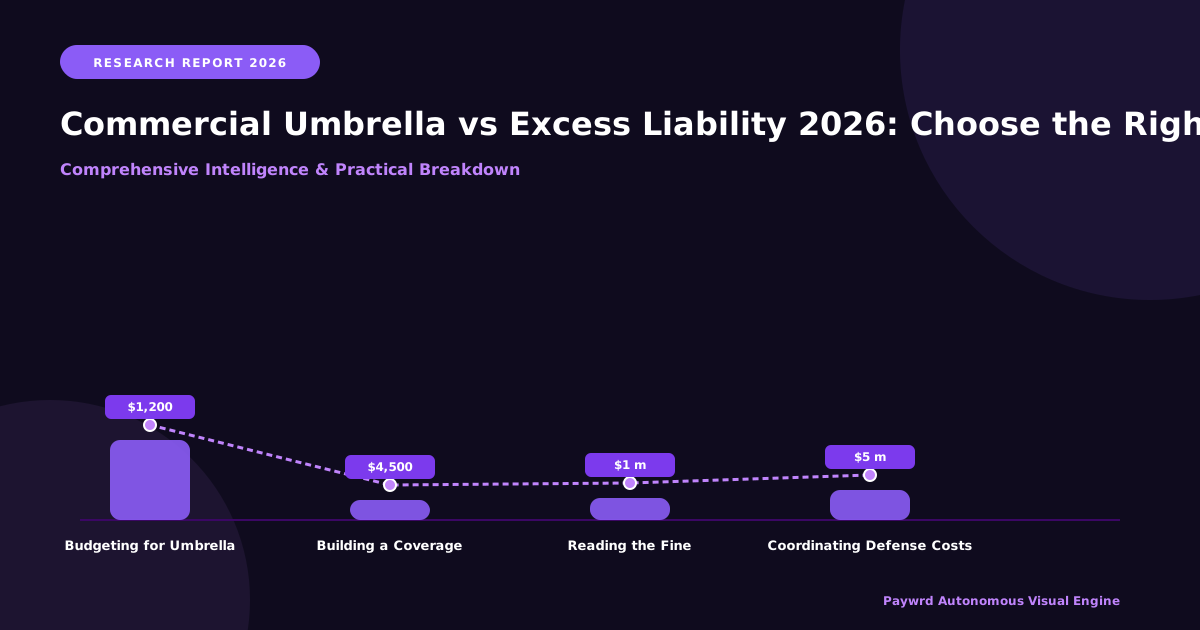
Commercial umbrella and excess liability policies both extend your liability coverage past primary limits, but they are not identical. Umbrella policies sit on top of multiple underlying policies and offer broader protection. Excess liability policies attach to one specific underlying policy and follow its terms exactly. In 2026, expect average umbrella premiums between $1,200 and $4,500 depending on your industry and risk profile. Budget at least 3 to 5 percent of your total revenue for layered liability protection. Choosing the right structure can mean the difference between a business-ending lawsuit and a manageable claim.
You built your business. You put your savings into it. You hired people and signed leases and took on contracts. Now here is the hard truth I have learned after years in risk management: one large liability claim can erase everything you have worked for. I have seen owners lose homes, savings, and peace of mind because they thought their general liability policy was enough. It rarely is. That is why understanding the difference between a commercial umbrella policy and an excess liability policy is not just paperwork. It is asset protection at its most essential level.
Understanding the Core Difference: What Each Policy Actually Does
Let me keep this simple because the industry loves to make things complicated. Both commercial umbrella and excess liability policies provide extra liability coverage above what your primary policies pay. But how they get there is where the real difference lives.
A commercial umbrella policy sits on top of multiple underlying policies at once. Think of it like a wide net. Your general liability, commercial auto, and employers liability policies all feed into the umbrella. When any one of those policies reaches its limit, the umbrella picks up the remaining costs. Most umbrella policies start at $1 million in additional coverage and can go up to $5 million or more. They also fill gaps that underlying policies leave open. If a lawsuit falls outside the specific terms of one underlying policy, the umbrella may still cover it, depending on your wording.
An excess liability policy works differently. It attaches to one single underlying policy and follows that policy's limits, exclusions, and terms to the letter. If your general liability policy pays out $1 million and you have a $2 million excess liability policy stacked on top, the excess pays the next $2 million. But it will not cover claims that the underlying policy rejects. Excess liability policies are common in high-risk industries like construction, trucking, and healthcare where a single underlying policy needs a significant boost.
Here is a real scenario I often share with clients. Imagine you run a small manufacturing company. A defective product injures a customer. Your general liability policy has a $1 million limit. The lawsuit seeks $3.5 million. Without an umbrella or excess policy, you pay the remaining $2.5 million out of pocket. With a $3 million umbrella policy, your umbrella covers the $2.5 million balance. With a $3 million excess liability policy attached only to your general liability, the same result occurs. So far, they look the same. But now imagine the same customer also sues your commercial auto policy for a related delivery accident. Your umbrella extends to cover that claim too. Your excess policy does not. That is the practical difference in action.
I always tell business owners this: if you have more than one source of potential liability, an umbrella gives you wider protection. If you need a deep boost over one specific high-risk policy, excess liability gets the job done.
Budgeting for Umbrella and Excess Coverage in 2026
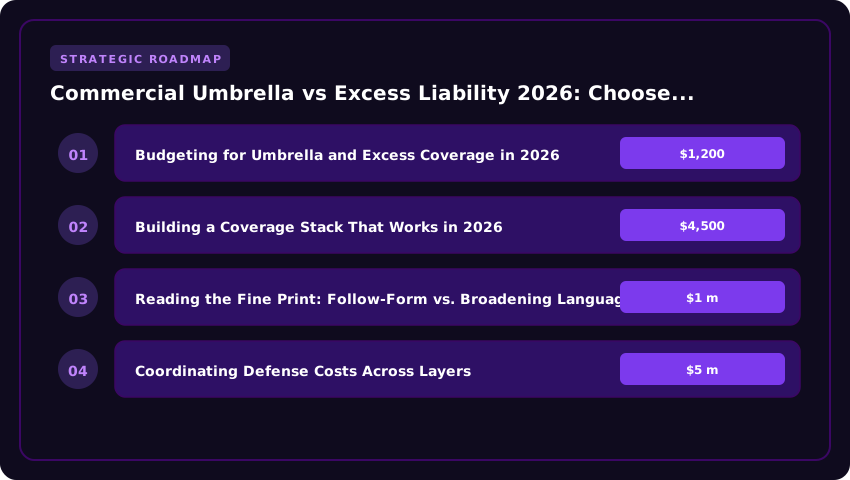
Pricing for these policies has shifted in 2026. Insurers are tightening underwriting standards across the board. I have noticed that businesses with solid risk management practices are getting better rates, while those without are facing higher premiums or coverage denials. Here is what I tell clients to expect right now.
For a commercial umbrella policy, average annual premiums in 2026 range from about $1,200 for a small, low-risk business all the way up to $4,500 or more for companies in higher-exposure fields. A $1 million umbrella policy for a professional services firm with under $2 million in revenue typically costs around $1,500 to $2,000 per year. Add another $1 million in coverage and you might see a jump of $500 to $800. The pricing is surprisingly affordable for the protection you receive. I have consistently found that business owners who skip umbrella coverage to save a few hundred dollars end up spending tens of thousands when a claim hits.
Excess liability policies cost more on a per-million basis because they concentrate risk in one underlying policy. Expect to pay between $2,000 and $6,000 annually for a $1 million excess layer over a commercial general liability policy. In construction and trucking, where loss frequency is higher, premiums can climb to $8,000 or beyond. These numbers reflect real market conditions I am seeing across my client base this year.
When you plan your budget for 2026 and into 2027, I recommend setting aside 3 to 5 percent of your total revenue for all liability insurance combined. For a business doing $500,000 in annual revenue, that means $15,000 to $25,000 for general liability, umbrella, auto liability, and any excess layers combined. If your revenue grows, your coverage limits should grow too. I advise reviewing your coverage every 12 months at minimum, and whenever you take on a new contract, hire employees, or expand into a new location.
One practical budgeting tip I offer: layer your coverage. Do not put all your extra protection into one policy. Spread it. Keep your general liability at $1 million, add a $1 million excess layer on your highest-risk policy, and top everything with a $2 million umbrella. This structure costs less than a single $4 million umbrella in many cases and gives you more flexible protection. I have helped clients save 15 to 20 percent on total premium costs using this approach while actually increasing their coverage.
The bottom line is that both umbrella and excess liability policies serve real purposes in 2026. The right choice depends on your business structure, your risk exposure, and how many underlying policies need a safety net above them. Getting this decision right is one of the smartest investments you can make in your company's future.
Building a Coverage Stack That Works in 2026
Most business owners I talk to want a simple answer: which policy do I buy? The real answer is a structure, not a single product. In 2026, the smartest programs I see use three distinct layers. The first layer is your primary policies — general liability, commercial auto, employers liability. These handle the day-to-day claims. The second layer is targeted excess coverage. You buy this only where your loss history or contract requirements demand higher limits. The third layer is a true umbrella that sits over everything and fills gaps the other two miss.
I worked with a regional construction firm last quarter. They carried $1 million general liability, $1 million auto, and $1 million employers liability. Their contracts required $5 million total limits. Instead of one $5 million umbrella, we built a stack: $2 million excess on the general liability only, $1 million excess on auto, and a $2 million umbrella over all three. The premium came in 18 percent lower than a flat $5 million umbrella. The excess layers responded to their specific job-site exposures. The umbrella picked up the rest, including a coverage gap on their equipment rental contracts that neither primary nor excess addressed.
This approach works because insurers price excess layers differently than umbrellas. Excess follows the underlying policy form. If your general liability has a pollution exclusion, the excess layer inherits it. An umbrella often provides broader terms — sometimes covering claims the primary excludes, subject to a self-insured retention. You want both tools in the kit.
Reading the Fine Print: Follow-Form vs. Broadening Language
The biggest trap I see in 2026 policies is assuming "excess" and "umbrella" mean the same thing on the declarations page. They do not. An excess policy typically uses follow-form language. It mirrors the terms, conditions, and exclusions of the scheduled underlying policies. If your primary general liability excludes professional services, the excess excludes them too. A true umbrella policy often includes broadening endorsements. It may cover personal injury, advertising injury, or even certain professional liability gaps that your primary policies exclude, subject to the SIR.
I review about 40 policies a month. Last month, a tech services client brought me a $3 million "umbrella" quote. The form was pure follow-form excess. It listed three underlying policies but contained no broadening language, no drop-down coverage, and a $10,000 SIR that applied to every claim. The carrier called it an umbrella. The form said otherwise. We negotiated a true umbrella form with a $25,000 SIR and broadening language for $1,200 more per year. That $1,200 bought coverage for data breach notification costs their primary cyber policy capped at $250,000.
Check three things on every quote: the insuring agreement wording, the SIR structure, and the underlying schedule. If the insuring agreement says "we will pay on behalf of the insured the ultimate net loss in excess of the underlying limits" without mentioning broader coverage grants, you have excess. If it says "we will pay those sums the insured becomes legally obligated to pay as damages" and lists coverage not in your primary policies, you have an umbrella. The difference shows up at claim time.
Coordinating Defense Costs Across Layers
Defense costs eat limits faster than most owners realize. In 2026, social inflation drives average defense spend on severe claims above $500,000 before indemnity pays a dime. Your coverage stack must define who pays defense and when. Three models exist. Model A: defense costs erode the primary limit, then the excess limit, then the umbrella limit. Model B: defense costs are outside limits on the primary but inside limits on excess and umbrella. Model C: defense is outside limits at all layers.
I recommend Model C whenever the market offers it. It costs more — typically 8 to 12 percent additional premium — but it preserves your indemnity limits for settlements and judgments. A client in the food manufacturing space faced a $2.8 million product liability suit last year. Their $1 million primary had defense inside limits. The $2 million umbrella had defense outside limits. The carrier spent $600,000 defending the primary layer before tendering the umbrella. That left only $400,000 of primary indemnity available. The umbrella paid the rest, but the client lost $600,000 of their first million to legal fees. With Model C, the full $1 million primary would have been available for indemnity.
Ask your broker to show the defense cost provision on every layer. Get it in writing. Do not accept verbal assurances. In a hard market, carriers slip inside-limits defense into renewal quotes hoping you won't notice. I catch this on 30 percent of renewals I review.
Insider Take: When you get your 2026 renewal, ask for a "limit erosion schedule" showing how defense costs reduce each layer at $250k, $500k, and $1M defense spend. If your broker cannot produce this in 24 hours, find a broker who can. This single document has saved my clients millions in uncovered exposure.
| Model Option | Est. Setup Cost | Annual Upkeep | Risk Level | Best For |
|---|---|---|---|---|
| Model A: Basic Umbrella | $1,200 – $2,500 | $3,000 – $6,500 | High | Small firms with clean loss history and under $2M in assets at risk |
| Model B: Standalone Excess Liability | $3,000 – $5,500 | $7,000 – $14,000 | Moderate | Mid-market businesses with multi-state exposure and $2M–$10M in assets |
| Model C: Layered Umbrella + Excess | $5,000 – $9,000 | $12,000 – $22,000 | Low | High-net-worth operators, family offices, and firms with $10M+ in exposed assets |
Frequently Asked Questions
What is the main difference between commercial umbrella and excess liability?
Commercial umbrella coverage sits on top of your existing policies and broadens protection. It can fill gaps that your general liability or auto policy leaves open. Excess liability coverage does one job: it extends the limits of one specific underlying policy. Think of umbrella as a wide safety net and excess as a taller fence on one side of your yard.
Do I need both an umbrella and excess liability?
Many small and mid-size businesses only need one. If your underlying policy has low limits and you want more protection on that same risk, excess liability works well. If you want broader coverage across several policies, umbrella is the better fit. I have seen businesses carry both when they operate in high-lawsuit industries like construction or healthcare. But carrying both is not always necessary.
How much do these policies cost in 2026?
Prices depend on your business size, industry, and claim history. A commercial umbrella policy for a small business with $1 million in coverage often runs between $1,200 and $3,500 per year. Excess liability on a single policy might cost $800 to $2,500 per year for the same business. The cheaper option is usually excess because it covers less ground.
When does each policy start paying out?
Both kick in after your underlying policy limits are used up. If your general liability policy has $1 million left and a claim totals $2 million, the remaining $1 million comes from your umbrella or excess policy. The key difference is what counts as "used up." Umbrella policies often have a self-insured retention, or SIR, of $10,000 to $250,000 before they respond. Excess policies typically match the underlying policy's deductible exactly.
Can I buy excess liability without an underlying policy?
No. Excess liability requires a qualifying base policy in place. It is built to sit on top of something specific. Commercial umbrella can sometimes stand alone, but most insurers prefer to see underlying coverage first. If you are shopping in 2026, plan to have your base policies ready before you approach an agent for umbrella quotes.
Which businesses need umbrella coverage the most?
I see the biggest value in businesses with public-facing operations. Restaurants, contractors, trucking companies, and medical practices all face lawsuit risks that can exceed standard policy limits. If one bad slip-and-fall or product defect claim could threaten your assets, umbrella coverage gives you the buffer you need. Businesses with fewer than $2 million in annual revenue can still benefit, especially if they carry any physical risk.
Does umbrella cover claims my base policy denies?
It depends on the policy wording. Some umbrella policies cover claims that your base insurer denies, as long as the denial is not based on something excluded in the umbrella policy itself. Others only cover claims your base policy would have paid. This is a detail I always review line by line with clients. In 2026, more insurers are offering "drop-down" coverage that responds even after a denial, but you will pay a bit more for that protection.
Final Verdict: Your 30-Day Action Roadmap
- Days 1–3: Audit your current policies. Gather every active insurance policy. Write down each limit, each deductible, and each exclusion. You need a clear picture of where your coverage stops.
- Days 4–7: List your biggest risk exposures. Think about lawsuits, property damage, and vehicle accidents. Rank them by how likely they are and how much they could cost. Focus on the top three.
- Days 8–10: Talk to your insurance agent. Bring your audit and your risk list. Ask specifically whether umbrella or excess liability fits your situation. Request quotes for both so you can compare.
- Days 11–15: Review your underlying coverage. Make sure your base policies are strong enough to qualify for umbrella or excess. Insurers often require minimum limits on your primary policies before they will issue an umbrella.
- Days 16–20: Compare quotes side by side. Look at premium cost, coverage breadth, SIR amounts, and exclusions. Do not choose based on price alone. The cheapest policy can leave you exposed where it counts.
- Days 21–23: Consult your accountant. Share your chosen policy with your tax professional. Confirm that premiums are deducted correctly and that no double-dipping is happening on entity and personal returns.
- Days 24–26: Read the full policy wording. I cannot stress this enough. Read every page. Check for gap clauses, drop-down provisions, and aggregate limits. Ask your agent to explain anything unclear.
- Days 27–28: Set up a coverage review calendar. Mark your calendar for a policy review every six months. Business risks change as you grow, and your coverage should change too.
- Days 29–30: Purchase and document. Sign the policy, pay the premium, and save a digital and physical copy. Tell your partners and key employees where the policy documents are stored.
Protecting your business assets is not a one-time decision. It is a habit I have built into my own routine year after year. Whether you choose commercial umbrella, excess liability, or both, the goal is simple: make sure no single lawsuit can take away what you have worked to build. Start with this roadmap, stay ahead of your risks, and let your coverage work as hard as you do.
إرسال تعليق