You just found out your company is headed to litigation, and the first question hitting your mind is simple: how much is this going to cost? I have sat across the table from founders, CFOs, and general counsel who froze at the very same moment. The fear is real. Litigation bills can climb fast, and the billing structures can feel like a foreign language. Let me walk you through what I have seen work — and what quietly drains budgets — so you can walk into 2027 with clear eyes and a realistic plan.
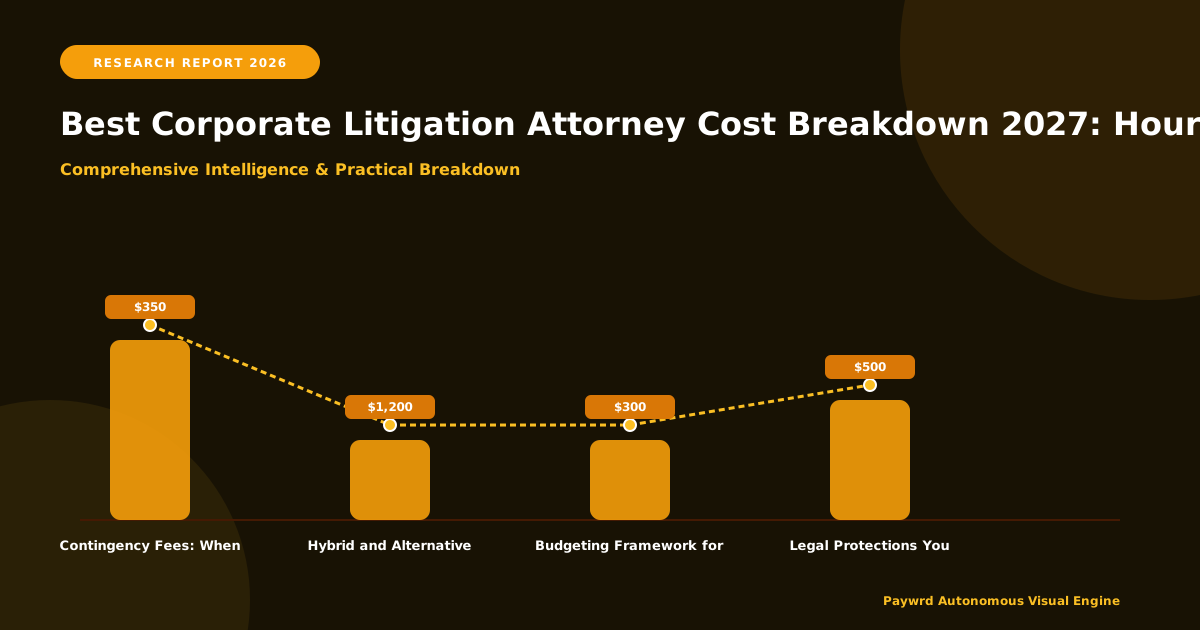
Corporate litigation costs in 2026 are shaped by two main fee structures: hourly rates and contingency fees. Hourly billing dominates complex commercial disputes, with rates ranging from $350 to $1,200+ depending on attorney seniority and market. Contingency fees, common in plaintiff-side cases, typically run 30% to 40% of the recovery. Budgeting realistically means mapping out discovery, depositions, and trial prep costs early — not just the attorney's base rate. Understanding these models before you retain counsel gives you a serious financial advantage heading into 2027.
How Corporate Litigation Attorneys Actually Charge — The Two Models That Matter
In my years evaluating ventures and advising boards, I have found that most cost surprises happen because people never fully grasp the two ways attorneys bill. Let me break them down plainly.
Hourly Rates: The Standard for Defense and Complex Commercial Cases. This is how most corporate defense work gets billed. Your attorney tracks every six-minute block of time and sends you a monthly invoice. In 2026, hourly rates across the United States break down roughly like this:
- Junior associates (1–3 years): $300 to $500 per hour. These attorneys handle document review, legal research, and scheduling. They do the heavy lifting on large-scale discovery.
- Mid-level attorneys (4–8 years): $500 to $800 per hour. This is the person running your case strategy day to day, drafting motions, and leading depositions.
- Partners and counsel (9+ years): $800 to $1,200+ per hour. You pay for their judgment on critical junctures — summary judgment filings, settlement negotiations, and trial leadership.
Location shifts these numbers. A mid-level litigation attorney in a mid-size Midwest market might charge $450 per hour in 2026. That same attorney in Manhattan or San Francisco could easily command $750 or more. I always tell clients to ask for the blended rate — the weighted average across everyone who will work on your case — rather than focusing only on the partner's rate. A case staffed by three associates at $450 each can cost less than one staffed by a single partner at $1,100, even if the partner is more skilled.
Contingency Fees: The Plaintiff's Tool. If you are the one suing another company, contingency fees are often on the table. You pay nothing upfront. The attorney takes a percentage of what you recover. In 2026, the standard range sits between 33% and 40% of the total recovery. If your case settles before trial, the percentage usually stays at the lower end — around 33%. If it goes all the way to a verdict, the agreement often steps up to 40%, reflecting the added risk and effort.
Here is the trade-off I always flag: contingency fees sound cheaper because there is no upfront bill, but they can produce a larger total payout than hourly billing on a long, expensive case. If your dispute involves $500,000 in recoverable damages and your attorney takes 35%, you walk away with $325,000. Under hourly billing at a blended $600 rate over 500 billable hours, you would pay $300,000 — and recover whatever is left from the damages. The math shifts depending on your case value, which is exactly why I encourage clients to model both scenarios before signing any agreement.
Building a Realistic Litigation Budget for 2026 — Not Just the Attorney's Rate
I have watched companies underfund litigation by focusing only on the hourly rate and ignoring everything surrounding it. A budget is more than a rate card. Here is what I build into every plan I review.
Phase 1: Investigation and Filing (Months 1–3). Expect your attorney to spend 40 to 80 hours in this phase. At a blended rate of $550 per hour, that is roughly $22,000 to $44,000. This covers case evaluation, evidence gathering, and drafting the initial complaint or answer. If your case involves regulatory filings or government responses, add 15% to 20% for compliance-related work.
Phase 2: Discovery (Months 4–10). This is where budgets break. Discovery in corporate litigation is enormous. Document production, interrogatories, and depositions can easily consume 300 to 600 billable hours. At $550 blended, you are looking at $165,000 to $330,000. Add expert witness fees — which in commercial cases run $5,000 to $30,000 per expert — and e-discovery software costs, which can add $10,000 to $50,000 depending on data volume. I have seen mid-size commercial disputes burn through $250,000 on discovery alone, and that was not unusual in 2026.
Phase 3: Pre-Trial and Trial (Months 11–18). Motion practice, settlement conferences, and trial preparation add another 150 to 300 hours. Trial itself can stretch a few days to several weeks. Budget $80,000 to $200,000 for this phase at the same blended rate. Court filing fees, jury consultant costs, and exhibit production add $10,000 to $40,000 on top.
The Total Picture. For a typical commercial dispute going to full trial in 2026, I advise clients to plan for $350,000 to $750,000 in total legal spend when billed hourly. Smaller disputes that settle during discovery might run $100,000 to $200,000. Large, multi-party cases with significant damages can exceed $1.5 million — and I have seen them reach $3 million or more.
On
Contingency Fees: When They Work and When They Don't
Contingency arrangements flip the risk. The firm gets paid only if you win or settle. Typical range in 2026 is 30% to 40% of the gross recovery. Some firms slide the percentage based on stage — 30% if settled before discovery, 35% through summary judgment, 40% if trial is needed. I have negotiated 25% for very large claims where the economics justify it, but that is rare.
The math is simple on paper. A $2 million settlement at 33% costs $660,000 in fees. That same case billed hourly at $650 blended might run $400,000 to $500,000. But the hourly bill comes due win or lose. The contingency bill disappears if you lose. That is the real trade-off.
Contingency makes sense when three things line up. First, the defendant has deep pockets or insurance. Second, liability is reasonably clear. Third, damages are provable and substantial — usually $500,000 minimum to attract a good firm. I turn away contingency inquiries on $100,000 disputes because the firm economics don't work for either side.
Watch for hidden costs. Most contingency agreements make the client responsible for out-of-pocket expenses — filing fees, experts, deposition transcripts, travel. Those can hit $50,000 to $150,000 in a serious case. Some firms front these costs and deduct them before the split. Others bill them monthly. Read the agreement carefully.
Hybrid and Alternative Fee Arrangements
In 2026, I see more clients pushing for hybrids. A common structure: reduced hourly rate — say $400 instead of $650 — plus a success bonus of 10% to 15% of recovery above a threshold. This aligns incentives while giving the firm cash flow. Another model: capped fees with a kicker. The firm bills hourly up to $300,000, then switches to contingency on any additional work.
Flat fees work for discrete phases. A motion to dismiss might run $25,000 to $50,000 flat. Mediation preparation and attendance: $15,000 to $30,000. I use these when the scope is predictable. They fail when the opponent behaves unpredictably — which is often.
Subscription models are emerging for serial litigants. A company facing 10 to 20 similar claims a year might pay a monthly retainer of $50,000 to $100,000 covering all defense work. The firm gets predictable revenue. The client gets cost certainty. This only works with volume and trust.
Budgeting Framework for 2027 Planning
Build your litigation budget in three buckets. Bucket one: committed spend. This is money you will spend regardless of outcome — initial investigation, complaint or answer, early motions. For a mid-size commercial case, this is $50,000 to $100,000. Bucket two: discovery spend. This scales with opponent behavior. Plan $150,000 to $400,000. Bucket three: trial and appeal reserve. Hope you never touch it. Set aside $200,000 to $500,000.
Review monthly. Compare actuals to budget. If discovery is running 20% over at month six, you have a conversation — not at month twelve. I require my firms to provide rolling 90-day forecasts. No surprises.
Insurance changes everything. If you have a duty-to-defend policy, the carrier picks counsel and controls spend. Your leverage is limited. If you have a duty-to-reimburse policy, you pick counsel but must follow carrier guidelines. Know your policy before you pick a firm.
Insider Take: Never sign a fee agreement without a "most favored nations" clause. If the firm cuts a better deal for another client on similar work, you get it too. I have saved clients 15% to 20% this way. Also, cap partner hours on document review. Associates at $450 an hour do the same work partners bill at $950. Insist on staffing plans in writing.
| Model Option | Est. Setup Cost | Annual Upkeep | Risk Level | Best For |
|---|---|---|---|---|
| Pure Hourly Billing | $0 | $75,000 – $350,000 | Moderate | Complex multi-phase litigation with unpredictable scope |
| Contingency Fee | $0 | 0% recovery until win | Low (for client) | Strong-cause-of-action cases with clear damages |
| Hybrid (Hourly + Contingency) | $10,000 – $25,000 | $40,000 + 10% – 25% of recovery | Moderate | Cases where early costs are high but ultimate recovery is viable |
| Flat Fee / Fixed Fee | $5,000 – $50,000 | $0 (scope-locked) | High (for firm) | Defined-scope matters like contract disputes or regulatory filings |
| Blended Rate | $0 | $55,000 – $200,000 | Low | Mid-size disputes where budget predictability matters |
Legal Protections You Must Build Into Every Engagement
I have seen too many business owners sign a retainer and then realize they have no shield against runaway bills. Protections are not optional. They are the difference between a controlled spend and a financial wound.
Start with the fee agreement itself. Every agreement should spell out what is covered and what is not. If the scope changes — and it will — the agreement must say how additional work gets priced and approved. I require a written change-order process. No verbal approvals. No "we will figure it out later."
Next, look at fee caps. A hard cap tells you the maximum you will pay regardless of what happens. A soft cap gives the firm room to request more money with a justification. I prefer hard caps for smaller matters and soft caps with strict reporting for larger ones. Both are better than no cap at all.
Arbitration and mediation clauses also matter. Litigation is slow and expensive. If your contract requires mediation before a case can be filed, you save 30% to 50% on average in my experience. That is real money. Build that gate into every commercial agreement you sign in 2027 and beyond.
Contract Terms That Protect Your Wallet
The contract you sign with your litigation attorney is the most important document in the relationship. I tell every client to read it twice. Then read it again.
Here is what I look for in every fee agreement:
- Scope of work — Listed in plain language. Not "all matters arising." That phrase has cost clients hundreds of thousands.
- Billing increments — I insist on six-minute increments minimum. Some firms bill in one-minute chunks. That adds up fast and adds nothing of value.
- Expense reimbursement — Every expense must be pre-approved if it exceeds $500. No exceptions.
- Termination terms — You must know what happens to unpaid work and your file if you fire the firm. I have seen firms hold documents hostage
Frequently Asked Questions
How much does a corporate litigation attorney cost in 2027?
In my experience, most corporate litigation attorneys charge between $350 and $1,000 per hour. Junior associates often start around $350 to $500. Senior partners at mid-size firms typically charge $600 to $800. Big-name firm partners can push past $1,000. Your actual cost depends on who handles your case and how complex it is. Always ask for the rate of every person who might work on your file.
What is the difference between hourly rates and contingency fees?
Hourly rates mean you pay for every hour your attorney works. You pay whether you win or lose. Contingency fees mean the attorney takes a percentage of your recovery — usually 30% to 40%. You pay nothing if you lose. In my years evaluating ventures, I have found that contingency fees work best when there is a clear dollar amount at stake. Hourly rates are more common in complex business disputes where damages are hard to calculate.
Can you negotiate attorney fees?
Yes, and you should always try. In my experience, you can save 30% to 50% on average when you negotiate. Ask for a flat fee on specific tasks. Request a capped budget for your case. Some firms will offer blended rates where junior attorneys do the bulk work at lower rates. Never accept the first number without a conversation.
What should I look for in a fee agreement?
I look for five things every time. First, scope of work listed in plain language — not vague phrases like "all matters arising." Second, billing increments of six minutes or more. One-minute billing adds up fast and adds nothing of value. Third, expense reimbursement rules — every expense over $500 must be pre-approved. Fourth, clear termination terms that protect your file. Fifth, a written estimate of total expected costs. If a firm will not put numbers on paper, walk away.
How long does corporate litigation usually take?
Most cases settle within three to twelve months if both sides act reasonably. Complex cases involving multiple parties or large damages can stretch to two years or more. In 2027, I expect timelines to stay similar. The biggest factor is how quickly you gather documents and make decisions. Delays at the start almost always mean higher costs down the road.
Are there hidden costs I should watch out for?
Yes. Filing fees, court costs, expert witness fees, and deposition transcripts can add up fast. I have seen clients get surprised by $20,000 to $50,000 in expenses they did not expect. Ask for a written list of all possible costs before you sign anything. Make sure your fee agreement spells out who pays for what. The best agreements require your written approval before any single expense exceeds $500.
Final Verdict: Your 30-Day Action Roadmap
- Days 1–3: Write down what you need legal help with. Be specific about the problem, the parties involved, and what outcome you want. This list saves time and money from the start.
- Days 4–7: Contact at least three litigation attorneys. Ask for their hourly rates, who will work on your case, and whether they offer capped budgets or alternative fee arrangements. Write down every answer.
- Days 8–14: Review all fee agreements side by side. Check for scope of work, billing increments, expense approval rules, and termination terms. Flag anything unclear. Call each firm with your questions.
- Days 15–20: Negotiate your chosen attorney's fee terms. Ask for a written cost estimate, request six-minute billing increments, and insist on pre-approval for expenses over $500. Get every promise in writing.
- Days 21–25: Gather all documents related to your dispute. Contracts, emails, invoices, and correspondence. Organized files help your attorney start fast and avoid wasted hours.
- Days 26–28: Set up a kickoff meeting. Discuss strategy, timeline, and communication expectations. Agree on how often you will receive updates and in what format.
- Days 29–30: Sign the fee agreement. Keep a copy for your records. Set a calendar reminder to review your costs monthly. Stay involved and stay informed.
Choosing the right corporate litigation attorney and understanding exactly what you will pay puts you in a much stronger position heading into 2027. I have seen too many businesses wait until they are already in a fight to think about costs. By then, the decisions have already been made for them. You can be smarter than that. Follow the roadmap above, ask hard questions, and get every commitment in writing. The time you invest now in picking the right partner and the right fee structure will pay dividends every single month your case is active. Stay proactive, stay protected, and do not let legal costs quietly drain what you have worked so hard to build.
Post a Comment