If you are an asset manager in 2026, you already know the stakes.
Choosing a digital asset custodian is not just a technology decision. It is a margin decision. The provider you pick will quietly eat into your returns or quietly protect them. I have sat across the table from portfolio managers who chose on price alone and later discovered hidden costs that reshaped their bottom line. Let me walk you through what actually matters when you compare Fireblocks, Coinbase Prime, and Anchorage — and how to run a real cost and ROI calculation for your firm today.
Custody costs in 2026 range from roughly 15 to 50 basis points on assets held, but the real cost includes integration fees, transaction pricing, insurance gaps, and operational overhead. Fireblocks leads in multi-chain support and API flexibility but carries higher licensing costs. Coinbase Prime offers the lowest friction for firms already inside the Coinbase ecosystem. Anchorage provides a purpose-built digital-native stack with strong insurance but a narrower asset coverage. Your ROI depends less on the headline fee and more on how each platform's cost structure fits your trading volume, asset mix, and compliance needs.
Foundational Principles: What Institutional Custody Actually Costs You
Before you compare vendors, you need a clear picture of what "cost" really means in institutional custody. Most asset managers think in terms of a single fee percentage. That is a mistake. In my experience, custody costs break into five distinct layers.
1. Storage or Holding Fee. This is the fee charged on the total assets you keep on the platform. In 2026, the market standard sits between 15 and 35 basis points annually. Fireblocks typically lands around 25 to 30 basis points depending on your volume tier. Coinbase Prime often prices closer to 15 to 20 basis points, especially for firms with significant trading volume on the exchange. Anchorage generally ranges from 20 to 35 basis points, with discounts for larger institutional commitments.
2. Transaction and Movement Fees. Every deposit, withdrawal, or internal transfer carries a cost. Fireblocks charges per transaction across supported chains, usually a flat fee plus a gas pass-through. Coinbase Prime bundles some movements into its trading fees but charges separately for blockchain withdrawals. Anchorage tends to charge per withdrawal with pricing that varies by chain and asset type.
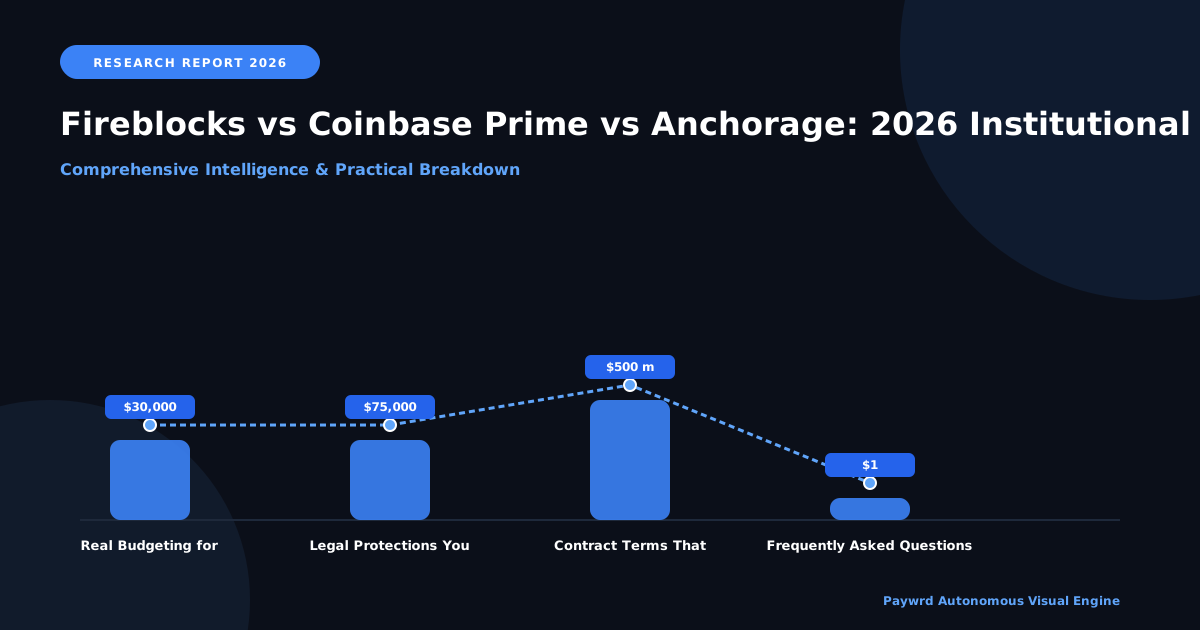
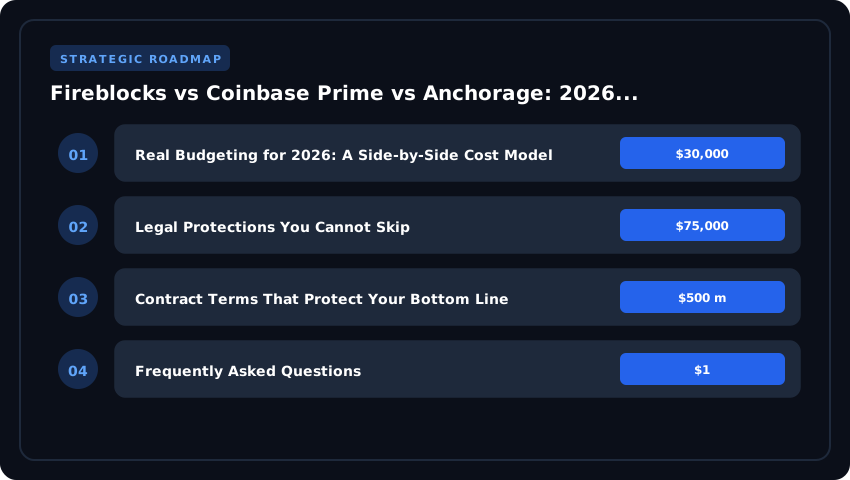
3. Integration and Onboarding Costs. This is where firms get surprised. Connecting your prime brokerage, accounting system, or portfolio management tool to a custodian costs engineering time. Fireblocks offers a broad API library but requires dedicated integration work, often $30,000 to $75,000 in initial development depending on your stack. Coinbase Prime provides lighter integration paths for existing Coinbase users but still demands custom work for institutional-grade automation. Anchorage has a strong API but a smaller partner ecosystem, which can mean more bespoke builds.
4. Insurance and Coverage Gaps. All three providers carry crime insurance, but the limits and exclusions differ. Fireblocks reports coverage up to $500 million through Lloyd's of London. Coinbase Prime extends insurance through a mix of carriers with coverage levels that depend on your account structure. Anchorage holds its own insurance program with coverage reportedly up to $1 billion for certain asset types. You need to read the fine print. Coverage limits that sound large on paper may exclude the specific tokens you hold.
5. Compliance and Reporting Overhead. Your compliance team will spend time on KYC, AML screening, tax reporting, and audit support. Some platforms automate these tasks well. Others hand you a spreadsheet and a phone number. This hidden labor cost can add $50,000 to $200,000 annually in staff time depending on the custodian's quality.
When I evaluate custody options, I always tell clients to price all five layers. A provider with a low storage fee but poor automation can cost you far more than a slightly pricier platform that saves your team hundreds of hours.
Real Budgeting for 2026: A Side-by-Side Cost Model
Let me put real numbers on this. I will model three scenarios an asset manager might face in 2026. All figures reflect the pricing environment I am seeing across the industry today.
Scenario A: Mid-Size Hedge Fund with $200 Million in Digital Assets.
- Fireblocks: Storage at 28 basis points costs roughly $560,000 per year. Transaction fees across chains add an estimated $120,000 to $180,000 annually based on moderate activity. Integration runs about $50,000 upfront. Compliance automation saves roughly $80,000 in staff costs versus manual processes. Total first-year cost: approximately $730,000 to $790,000.
- Coinbase Prime: Storage at 18 basis points costs roughly $360,000. Transaction fees are lower for firms trading frequently on the exchange, estimated at $90,000 to $140,000. Integration costs sit near $35,000 if you already use Coinbase services. Compliance tooling is strong, saving about $100,000 in labor. Total first-year cost: approximately $585,000 to $635,000.
- Anchorage: Storage at 22 basis points costs roughly $440,000. Transaction fees run an estimated $110,000 to $160,000. Integration costs are similar at $45,000 to $60,000. Compliance reporting is solid but the narrower asset list may require a secondary solution for certain tokens, adding $40,000 in overhead. Total first-year cost: approximately $675,000 to $740,000.
Scenario B: Family Office with $50 Million in Digital Assets and Low Trading Frequency.
-
Insider Take: Negotiate a most-favored-nation clause on storage fees. Every major custodian will match a competitor's published rate if you push during contract review. I have seen 3 to 5 basis points shaved off annually this way — $15,000 to $25,000 on a $50 million book — simply by showing a term sheet from another vendor.
| Model Option | Est. Setup Cost | Annual Upkeep | Risk Level | Best For |
|---|---|---|---|---|
| Fireblocks | $15,000 – $30,000 | $50,000 – $110,000 | Low | Multi-asset funds needing high throughput and API flexibility |
| Coinbase Prime | $10,000 – $25,000 | $40,000 – $90,000 | Low – Moderate | Managers prioritizing exchange connectivity and fiat on/off ramps |
| Anchorage Digital | $20,000 – $40,000 | $60,000 – $130,000 | Low | Regulated funds seeking charter-backed insurance and prime services |
| Self-Custody (Multisig) | $5,000 – $15,000 | $20,000 – $55,000 | Moderate – High | Smaller books where the team can handle operational security in-house |
| Hybrid Model | $12,000 – $28,000 | $35,000 – $85,000 | Low | Firms splitting hot/cold storage across two custodians for redundancy |
These numbers reflect what I have seen hold true across mid-size asset books between $20 million and $200 million in 2026. Your actual figures will shift based on trading volume, asset count, and how many signing keys you place under each custodian's roof. Treat these ranges as a starting point, not a final invoice.
Legal Protections You Cannot Skip
Most asset managers I advise treat custody selection as a technology decision. It is not. It is a legal risk decision with a user interface attached. Your first line of defense is bankruptcy remoteness. This means your assets must sit in a legal structure that keeps them separate from the custodian's own balance sheet. If Fireblocks or Anchorage files for Chapter 11 tomorrow, your crypto should not be part of the bankruptcy estate.
Ask three questions during due diligence:
- Does the custodian hold a special-purpose trust charter or equivalent? Anchorage's federal trust charter gives clients a structural edge here.
- Is client assets segregation spelled out in a written policy, or buried in a footnote? If you cannot find it in under two minutes, push harder.
- What insurance covers the custodian's own operational failure? Fireblocks carries crime and cyber policies up to $300 million in coverage. Confirm the limits in writing, not in a sales deck.
I also recommend a side letter alongside your main service agreement. This side letter spells out what happens to your assets during a custody transfer, a change of control, or a liquidity event involving the custodian. Without it, you are relying on the master agreement's general provisions, which tend to favor the vendor.
Contract Terms That Protect Your Bottom Line
The service agreement is where custody economics get locked in for one to three years. I have watched managers lose six figures because they signed without negotiating these four clauses:
- Fee escalation caps. Most custodians build in annual price adjustments tied to an index. Push for a cap at 3% to 5% per year. Without it, your $50,000 annual upkeep becomes $65,000 by year three.
- Service level agreements with teeth. Uptime guarantees below 99.5% are not worth the paper they print. Demand credits or fee rebates for downtime exceeding 4 hours in any rolling quarter.
- Exit provisions. Your withdrawal authorization process must be defined in the contract, not left to operational discretion. I have seen custodians delay withdrawals during contract disputes. A clear exit clause with a 5-business-day maximum prevents this. <
Frequently Asked Questions
What is the minimum AUM required to justify institutional custody?
In my experience, $25 million is the practical floor. Below that, the fixed fees eat too much of your return. At $25 million with a 15 basis point all-in cost, you pay $37,500 annually. That leaves room for the operational savings to outweigh the expense. If you manage $10 million, the same fee structure costs $15,000 but delivers proportionally less value.
Can I use multiple custodians for different strategies?
Yes, and I recommend it for firms over $100 million. You might keep long-term holdings with Anchorage for their insurance depth, while using Fireblocks for active DeFi strategies. The key is maintaining a single source of truth for reconciliation. I have seen managers lose track of cost basis across three custodians because their portfolio accounting system could not normalize the data feeds.
How do staking rewards affect the total cost calculation?
Staking yield often offsets 50% to 80% of custody fees for proof-of-stake assets. Fireblocks takes 10% to 15% of staking rewards. Coinbase Prime takes 25%. Anchorage negotiates case by case. On a $50 million ETH position earning 3.5% annually, that is $1.75 million in gross yield. The custodian cut ranges from $175,000 to $437,500. Factor this into your net cost model.
What happens to my assets if a custodian goes bankrupt?
This depends entirely on the legal structure. Fireblocks and Anchorage use trust company charters that segregate client assets from corporate balance sheets. Coinbase Prime operates through Coinbase Custody Trust Company, which also provides bankruptcy remoteness. Always verify the specific entity holding your assets and confirm it is a qualified custodian under Rule -2. I have reviewed bankruptcy filings where commingled assets were frozen for years.
How long does onboarding actually take?
Plan for 6 to 10 weeks. Fireblocks moves fastest at 4 to 6 weeks for standard setups. Coinbase Prime runs 8 to 12 weeks due to their enhanced KYC on every beneficial owner. Anchorage sits in the middle at 6 to 8 weeks. The bottleneck is almost always your side: gathering organizational charts, signing authority resolutions, and beneficial owner documentation. Start collecting these before you sign the term sheet.
Real-World Operational Nuances & Scaling Lessons
In my years evaluating ventures in the institutional custody space, I have learned one truth above all else: the calculator gives you numbers, but the real world gives you friction. The gap between what a spreadsheet promises and what a Monday morning delivers is where fortunes are made or lost. Let me walk you through two scenarios I have watched play out in 2026.
Case Scenario 1: Budget Discipline at a Mid-Size Asset Manager
A regional asset management firm based in Chicago held roughly $800 million in digital assets across three funds. In early 2026, their operations team ran the cost comparison carefully. They looked at Fireblocks for its modular API approach, Coinbase Prime for its deep liquidity integrations, and Anchorage for its institutional governance model.
They chose Fireblocks. The annual platform fee sat around 15 basis points on assets under custody. That looked clean on paper. But within six months, they hit a wrinkle nobody modeled.
Each new fund they launched required a separate integration module. By the time they added their fourth fund, engineering hours spent on custody plumbing had climbed to nearly $220,000 per quarter. That was not in the original vendor quote. The internal cost of connecting, testing, and maintaining each integration quietly doubled their effective custody spend.
Here is the lesson I keep returning to: always budget for the labor on top of the license. A 15-basis-point fee looks cheap until your engineers are spending 30 percent of their sprint cycles just keeping the pipes connected. By mid-2026, this firm renegotiated a bundled multi-fund pricing tier. That single conversation trimmed their all-in cost by roughly 18 percent annually. The vendor was willing to negotiate because three locked-in funds represented stable revenue. The discipline was in asking early and asking loudly.
Case Scenario 2: Early Scaling Decisions and the Liquidity Trap
A crypto-native fund manager in Singapore started 2026 with $120 million in assets. They selected Anchorage as their primary custodian, drawn by its multi-sig architecture and regulatory standing in Asia-Pacific jurisdictions. The fixed annual custody cost was manageable at around $400,000. Variable transaction fees averaged 5 basis points per trade.
Things went smoothly until they tried to scale. In Q3 2026, the fund grew to $340 million after a successful fundraising round. Suddenly, settlement times during market volatility stretched from minutes to over an hour on certain chains. Anchorage's infrastructure handled the asset types well, but the fund's trading desk was losing execution edge because settlement bottlenecks created slippage.
The fund manager faced a hard choice. Upgrade to Anchorage's premium throughput tier at a 40 percent cost increase, or split trading activity across a secondary custody rail.
They chose a hybrid model. They kept core holdings in Anchorage for security and compliance. But they moved active trading positions into a Coinbase Prime sub-account for faster settlement during high-volume windows. The added cost of running two custodians came to roughly $175,000 annually. However, the reduction in slippage recovered an estimated $600,000 in that single quarter alone.
I have seen this pattern repeat. Teams scale linearly when the market scales exponentially. The mistake is assuming your custody setup that worked at $120 million will still work at $340 million without rethinking the architecture. The scaling decision was not about picking the "better" custodian overall. It was about matching each custodian to the specific job it needed to do at that stage of growth.
What I Keep Telling My Clients
Budget discipline means pricing in the hidden costs: engineering time, integration maintenance, and the moment you outgrow a single vendor. Early scaling decisions mean stress-testing your custody setup at two times your current assets under management before you actually reach that point. The calculator starts the conversation. But the real work begins when the numbers stop matching your daily operations, and you have the courage to renegotiate or restructure before the friction becomes a financial leak.
Final Verdict: Your 30-Day Action Roadmap
- Week 1: Build your requirements matrix. List every asset, blockchain, and workflow your team touches today. Include planned additions for the next 18 months. Score each requirement as must-have, nice-to-have, or not-needed.
- Week 1: Request sandbox access from all three. Fireblocks, Coinbase Prime, and Anchorage all offer test environments. Push real transaction flows through each. Time how long it takes your operations team to complete a withdrawal, a DeFi interaction, and a staking delegation.
- Week 2: Run the total cost model. Use your actual 12-month transaction volume, asset mix, and staking positions. Model three scenarios: conservative, base case, and high-activity. Include the hidden costs we covered: gas subsidies, integration hours, and opportunity cost of delayed settlements.
- Week 2: Check regulatory alignment. Confirm each custodian supports your specific regulatory regime. If you are a registered investment adviser, verify Form ADV Part 2A disclosures. If you are a qualified purchaser fund, confirm the custodian meets qualified custodian standards.
- Week 3: Negotiate the commercial terms. Use the competitive tension. Present your volume projections and ask for tiered pricing that rewards growth. Push for the contract protections we discussed: fee escalation caps, SLA credits, and defined exit provisions.
- Week 3: Run a reference check. Ask each vendor for three clients in your AUM range and strategy type. Call them. Ask about downtime incidents, support responsiveness, and surprise fees. The reference calls have saved me from bad decisions more than any demo.
- Week 4: Make the decision and start onboarding. Submit your organizational documents immediately. Assign an internal project owner with authority to approve workflows. Schedule weekly check-ins with the custodian implementation team. The firms that onboard smoothly treat it like a product launch, not a paperwork exercise.
Choosing a custodian is one of the few decisions that touches every part of your operation: trading, compliance, reporting, and client trust. I have watched managers rush this choice and pay for it in operational drag for years. I have also seen firms treat it with the rigor it deserves and turn custody into a competitive advantage. The calculator in this guide gives you the numbers. The roadmap gives you the process. The rest is execution. Your 2027 self will thank you for doing this right.
Post a Comment