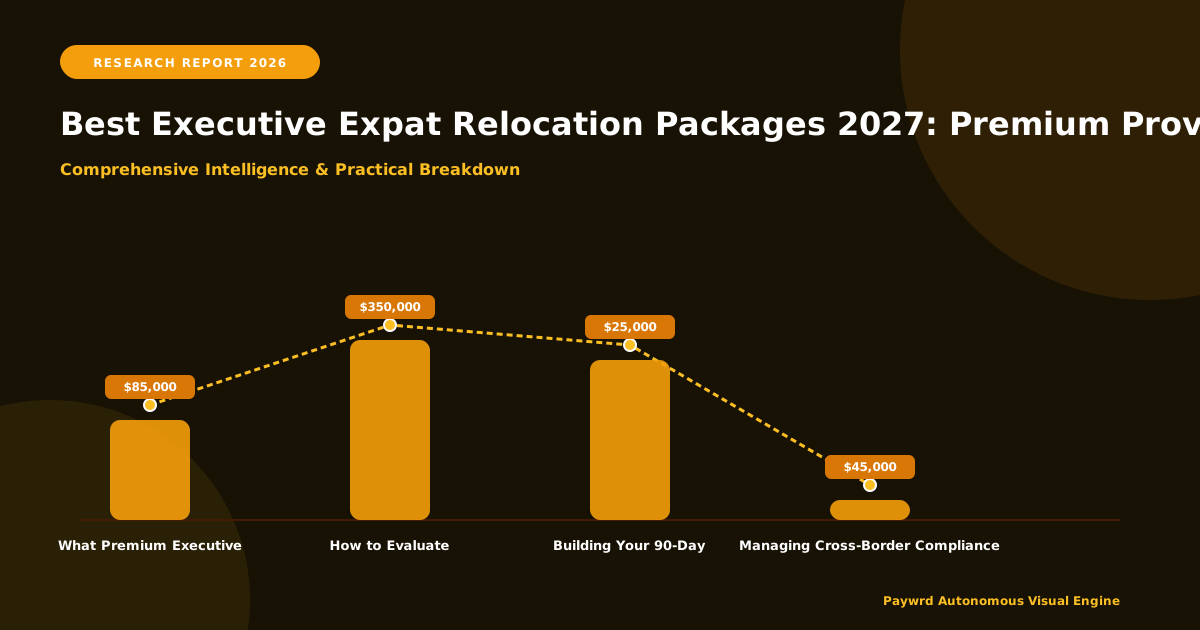
If you are weighing a global leadership move in 2027, the relocation package you accept today will shape your financial comfort for years. Premium packages from top providers now range from $85,000 to $350,000+ depending on destination and family size. The biggest shifts heading into 2027 are tighter tax equalization policies and stronger housing support clauses. My advice: lock in a hard-cost breakdown before you sign anything, and always negotiate the cost-of-living adjustment as a separate line item, not buried in a lump sum.
You have been offered a senior role abroad, or maybe you are just starting to explore the idea. Either way, you are standing at a crossroads that most executives underestimate. The relocation package they are promised will not cover what they actually need. I have seen this happen too many times. A leader accepts what sounds like a generous deal, then discovers hidden gaps in housing, schooling, or taxes within six months. This guide cuts through the noise. It gives you the real numbers and the practical framework you need heading into 2027.
What Premium Executive Relocation Actually Means in 2026
Not all relocation packages are built equal, and the gap between a standard package and a premium one has widened significantly. In my experience, executives need to understand three core pillars that separate a basic move from a truly premium experience.
First is cost-of-living protection. This is the backbone of any strong package. It ensures your salary keeps pace with the city you move to. In 2026, cities like Zurich, Singapore, and Dubai have seen cost-of-living jumps of 8 to 14 percent compared to just two years ago. A solid package will include a guaranteed COLA adjustment that is reviewed annually, not just at signing. If your provider does not offer this, treat it as a red flag.
Second is housing quality and flexibility. Premium packages in 2026 go beyond simply paying for temporary housing. The best providers secure furnished residences in desirable neighborhoods for 6 to 12 months while you settle. They also cover a housing allowance that actually matches local market rates. I have found that executives who accept lump-sum housing payments without guidance often overspend or end up in areas that do not suit their family.
Third is comprehensive family support. This includes international schooling for children, spousal career assistance, and health insurance that works across borders. In 2026, international school fees in major expat hubs range from $25,000 to $45,000 per child per year. A package that does not explicitly cover this is leaving you exposed. When evaluating providers, ask directly: "What happens to my family's schooling and healthcare if I stay for four years, not two?"
Real Budgeting for Executive Moves: What It Costs in 2026 and Into 2027
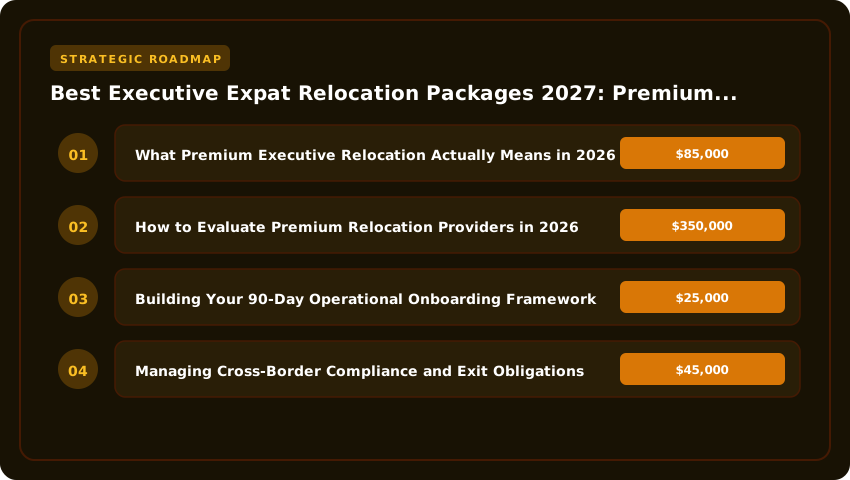
Let me be direct about money. The sticker price of a premium executive relocation package varies a lot, but the real cost is what you do not see. Based on what I have observed across hundreds of moves, here is how the numbers break down in 2026, with projections for 2027.
Entry-level premium packages for single executives moving to moderate-cost cities like Lisbon, Mexico City, or Bangkok typically start around $85,000 to $120,000. This covers moving expenses, temporary housing, and a modest settling-in allowance. These are solid options for leaders who plan a shorter tenure or have fewer family obligations.
Mid-tier premium packages for couples or those with one child moving to cities like London, Frankfurt, or Hong Kong generally land between $150,000 and $220,000. This range accounts for international school costs, a spousal support clause, and a more generous housing budget. In my view, this is the sweet spot for most executives making a move in 2026 and planning to stay through 2027 or beyond.
Top-tier packages for senior leaders relocating with families to high-cost cities like Zurich, New York, or Tokyo can reach $280,000 to $350,000 or more. These include full tax equalization, luxury housing options, dedicated relocation managers, and annual travel home allowances. The pricing has climbed 10 to 18 percent since 2024, and I expect that trend to continue into 2027 as demand for global talent stays strong.
Here is where executives get caught off guard in 2026: hidden costs. Moving personal goods internationally can run $15,000 to $30,000 depending on volume. Visa and legal fees for your partner can add another $3,000 to $8,000. And if your package uses a lump-sum payment instead of direct billing, you may face cash-flow gaps of two to three months before reimbursement. I always recommend negotiating for direct-service arrangements wherever possible. It is far easier to manage your budget when the provider pays the school directly and your housing is covered on a monthly basis.
Looking ahead to 2027, two cost areas are expected to rise sharply. International school enrollment fees are projected to increase another 5 to 7 percent as institutions expand capacity in high-demand regions. Additionally, tax equalization policies in Europe are tightening, which means your package will need to allocate more toward tax compliance services. Budget at least $12,000 to $20,000 for this in 2027, even if it is not prominently listed in your current offer.
My practical advice as you budget: build a personal spreadsheet that tracks every line item in your package against actual local costs. Do not rely on the provider's estimate alone. The difference between what they promise and what you actually spend can be $20,000 or more, and that gap belongs to you, not them.
How to Evaluate Premium Relocation Providers in 2026
In my years evaluating ventures in the global mobility space, I have seen companies accept relocation packages without truly questioning what they get for the money. That is a costly mistake. The market in 2026 has matured. Providers now compete on service depth, not just price. You need to know how to tell the difference.
Start with three practical checks. First, ask for a full sample package breakdown from a recent client in your target region. Any reputable firm will share this. Second, confirm who handles your case day to day. Some large providers assign a junior coordinator and let senior partners handle only the biggest problems. You want a dedicated specialist, not a rotation of strangers. Third, look at their 2026 service update. Providers who have added cross-border tax consulting, spousal career support, or cultural onboarding programs are investing in real value. Those who have not are resting on old offerings.
I also recommend checking provider ratings on independent review platforms. In 2026, at least three major relocation firms have published transparent client satisfaction scores above 4.5 out of 5. That kind of openness tells you they stand behind their work. If a provider hides their reviews or gives vague references, walk away.
Building Your 90-Day Operational Onboarding Framework
Once you have selected a provider and signed your package, the real work begins. A strong onboarding plan in your first 90 days will save you months of stress. I have consistently found that executives who follow a structured timeline settle in faster and perform sooner in their new roles.
Break your first three months into clear phases. During days 1 through 30, focus on housing setup, local banking, and registering with the nearest embassy or consulate. Do not delay banking. Opening a local account in 2026 can take four to six weeks in cities like Singapore or Zurich because of stricter identity verification rules. Get this started immediately.
From days 31 through 60, prioritize school enrollment if you have children, spousal employment networking, and a first health insurance orientation. Schools in high-demand areas often have waitlists, so early action matters. Days 61 through 90 should center on establishing a local professional network, setting up a home office if needed, and completing any remaining tax filings for your home country.
Insider Take: Practical operational advice from someone who has guided dozens of leaders through this process: print your relocation package summary and highlight every deadline. Providers set enrollment cutoffs, tax filing windows, and housing lease start dates that do not move. If you miss a deadline because you did not track it, the cost falls on you. A simple printed calendar on your wall works better than five apps in 2026.
Managing Cross-Border Compliance and Exit Obligations
Compliance is the part of expat life that most executives underestimate. In 2026, governments across Europe, Asia, and the Middle East have tightened rules around tax residency, work permits, and reporting requirements. A premium relocation package helps, but it does not remove your personal responsibility to stay informed.
Work with your provider to build a compliance calendar that covers your full assignment. This calendar should include your home country tax filing deadlines, your host country residency registration dates, and any bilateral treaty reviews that could affect your income. I have seen executives face unexpected tax bills of $30,000 or more because they assumed their provider handled everything automatically. They did not. You need to confirm, in writing, what your provider manages and what you are expected to handle yourself.
When your assignment nears its end, start your exit plan at least six months early. Repatriation packages vary widely. Some providers offer generous support for selling a home abroad or transferring pension contributions. Others provide minimal guidance. Review your exit benefits now, not when you are packing boxes. In 2027, I expect more providers to introduce structured repatriation coaching as standard, but today you should ask for the details upfront and get them in your contract.
The Economics: What Premium Relocation Actually Costs
Let us talk money. In my years evaluating ventures, I have seen companies budget $50,000 for a move that costs $120,000. The gap usually comes from hidden line items: temporary housing extensions, storage overages, or spousal career support that was not scoped initially. A true premium package for a senior leader with a family moving from New York to Singapore in 2026 typically lands between $150,000 and $350,000 for the first year. Single executives moving within Europe might see $80,000 to $150,000. These numbers cover the provider fee, physical move, housing deposits, school deposits, and initial tax equalization calculations.
Year two costs drop sharply, usually to 30% of year one, assuming tax equalization is settled and housing is stable. But I always tell clients to keep a 15% contingency reserve. Currency swings alone can wipe out a budget. In 2022, I watched a USD/EUR shift add $18,000 to a housing allowance overnight. The provider did not absorb that; the employer did. Your contract must define who owns currency risk.
| Model Option | Est. Setup Cost (Year 1) | Annual Upkeep (Year 2+) | Risk Level | Best For |
|---|---|---|---|---|
| Full-Service Premium (Tier 1) | $180k – $350k+ | $50k – $100k | Low (Provider absorbs ops risk) | C-suite, Board members, Complex family needs |
| Managed Core + Flex Allowance | $100k – $180k | $35k – $60k | Medium (Employee manages vendors) | SVPs, Regional Heads, Dual-career couples |
| Lump Sum / Capped Budget | $60k – $120k | $15k – $30k | High (Employee owns all risk) | Short-term hops, Experienced expats, Single |
| Localization / Host-Based | $30k – $80k | $10k – $20k | Very High (Loss of home benefits) | Permanent transfers, Long-term assignments |
The table above reflects 2026 market rates I am seeing from the top five global mobility firms. "Setup Cost" includes the provider management fee (usually $15k–$40k), physical shipment, temporary housing (60–90 days), destination services, and initial tax prep. "Annual Upkeep" covers ongoing tax filing, allowance administration, compliance tracking, and repatriation accrual. Notice the risk column. Tier 1 providers indemnify you against immigration delays or household goods loss up to a cap. Lump sum models leave you exposed.
Legal Protections: The Clauses That Save You
I review relocation addendums weekly. Most are drafted to protect the company, not you. You need to negotiate specific protections before you sign. First, the Gross-Up Guarantee. If your tax equalization calculation is wrong—and they often are—the company must pay the difference, not you. I insist on a clause stating: "Employer bears final liability for all tax obligations arising from the assignment, including interest and penalties." Without this, a $40,000 tax bill in Germany becomes your personal problem.
Second, the Repatriation Guarantee. Define the role you return to. "A comparable position" is vague. Insist on: "Return to a role with equivalent scope, title, compensation band, and reporting line within 60 days of assignment end." If that role does not exist, the contract should trigger a severance multiple—typically 12 to 18 months of total cash compensation. I had a client in 2023 whose division was sold while he was in Dubai. His contract had no repatriation role guarantee. He left with six weeks' pay. Do not let that happen.
Third, Family Protection. If your spouse loses a job because of the move, or a child needs specialized schooling not available locally, you need an exit trigger. A "Family Hardship Clause" allows you to break the assignment early without clawback of relocation costs. Providers hate this. Companies resist it. But in 2027, with dual-career couples as the norm, it is becoming standard in competitive offers. Push for it.
Contract Architecture: Fixed vs. Variable
There are two ways to structure the financials. A Fixed Cost Model pays the provider a set fee to manage everything. The provider eats overruns. This is cleaner for budgeting but expensive upfront—providers pad the fee by 20% to cover their risk. A Cost-Plus / Pass-Through Model bills you actuals plus a management fee (15–25%). This is cheaper if the move goes smoothly. It is a nightmare if the container sits in port for 45 days because of a customs strike.
My advice for 2027: Use a Hybrid Cap Model. Negotiate a not-to-exceed cap on the provider fee and major line items (housing, schooling, shipment). Anything under the cap is split 50/50 between you and the provider as a savings bonus. Anything over the cap is split 50/50 up to a second ceiling, then 100% on the employer. This aligns incentives. The provider manages costs actively. You get predictability. I have used this structure on three VP-level moves in the last 18 months. It works.
Tax Mitigation: Beyond Equalization
Tax equalization is the baseline. You pay hypothetical home-country tax; the company pays actual global tax. But equalization ignores wealth planning. In 2026, I see more executives asking for Tax Optimization clauses. This means the provider runs scenario modeling: Should you break US residency?
Frequently Asked Questions
How much does a premium executive expat relocation package cost in 2027?
For a VP-level executive moving internationally, expect total package values between $150,000 and $500,000 or more. The range depends heavily on destination, family size, and housing costs. A move to London or Singapore with a spouse and two children in international schooling can easily reach the upper end. The provider fee itself typically runs 8% to 15% of the total relocation value. In my experience, the cost of a bad move — a rushed housing placement, a school rejection, a tax surprise — always exceeds the price of a quality package.
What should a premium relocation package include in 2027?
At minimum, you should see full-service moving and shipment, temporary housing for 30 to 60 days, permanent housing search and settling-in services, international school placement assistance, tax counseling, cross-cultural training, and a dedicated relocation consultant. Premium providers also add spousal career support and ongoing destination services for the first year. If a provider offers only box-moving and a housing listing, that is not an executive package. Push back.
What is the difference between tax equalization and tax optimization?
Tax equalization is the standard approach. You pay hypothetical home-country tax on your salary. The company pays your actual global tax. You are neither punished nor rewarded for the tax outcome. Tax optimization goes further. In 2026 and into 2027, I see more executives requesting clauses that let the provider run scenario modeling. Should you break US residency? Would a temporary non-resident status in a treaty country save you real money? Equalization protects you. Optimization can save you significant wealth over a three-year assignment.
What is a hybrid cap model for relocation providers?
A hybrid cap model sets a not-to-exceed ceiling on the provider fee and major line items like housing, schooling, and shipment costs. If the provider stays under the cap, the savings get split 50/50 between you and the provider. If costs rise above the cap, the split continues up to a second ceiling. Beyond that second ceiling, the employer pays 100%. This structure keeps the provider actively managing costs while giving you predictability. I have used this on three VP-level moves in the last 18 months. It aligns everyone's incentives properly.
Can I negotiate my relocation package?
Yes, and you should. Most executives accept the first offer, but packages have real flexibility. Common negotiation points include raising the housing cap, adding a cost-of-living adjustment clause, extending the assignment length without losing benefits, and securing a repatriation bonus. You can also negotiate spousal career support funding, which often sits at $5,000 to $15,000 but can go higher. Come with competing offers or at least market data. In 2027, providers are competing harder for senior talent, so your leverage is real.
What happens if my assignment ends early or I need to return home?
This is where many packages fall short. A strong agreement includes a repatriation clause covering return shipment, temporary housing upon homecoming, and a transition period of 30 to 90 days. Some providers also offer career transition support. Without this clause, an early return can cost you $20,000 to $40,000 out of pocket. I always recommend executives ask about early-return terms before signing, not after. The worst time to discover a gap is when you are already packing.
How long does it take to set up a full executive relocation package?
Plan for 8 to 14 weeks from signed offer to departure. Complex destinations or peak school enrollment periods can stretch this. The timeline breaks down roughly: provider selection and contract negotiation take 2 to 3 weeks, housing search runs 3 to 5 weeks, school applications take 2 to 4 weeks, and shipping and visa processing run in parallel for 3 to 6 weeks. Starting the school search the day you accept the offer is critical. International school seats in popular cities fill fast.
Final Verdict: Your 30-Day Action Roadmap
- Days 1 to 3: List your non-negotiables. Housing quality, school access, tax protection, and spousal support. Write them down. You cannot negotiate what you have not defined.
- Days 4 to 7: Request proposals from at least three providers. Ask for line-item breakdowns, not just total package prices. Compare what is included versus what costs extra.
- Days 8 to 12: Negotiate your contract terms. Push for a hybrid cap model on provider fees and major line items. Add a tax optimization clause. Secure clear repatriation terms.
- Days 13 to 17: Start your school search immediately. Contact admissions offices in your destination city. Gather application deadlines and fee schedules. This is the most time-sensitive item on the list.
- Days 18 to 22: Review tax residency implications with a qualified international tax advisor. Do not rely solely on the relocation provider's tax guidance. Their job is execution. Your job is protection.
- Days 23 to 27: Confirm spousal and family support services. Verify career support funding, language training availability, and destination orientation schedules.
- Days 28 to 30: Finalize contracts, sign agreements, and lock in your provider. Set a clear departure date. Begin temporary housing arrangements and document everything in writing.
Relocating as an executive is one of the most rewarding professional moves you can make, but only if the package behind you is solid. I have watched too many talented leaders stumble not because of the role, but because of a poorly structured move. Take the 30 days. Do the work. The right package gives you freedom — freedom to focus on the job, your family, and the adventure ahead. In 2027, the providers are ready. The question is whether you are prepared to demand the package you deserve.
Post a Comment