In my years evaluating ventures in corporate services, I have watched executives pour six figures into relocation programs and have no clear idea what they actually got for the money. If you are sitting in that position right now in 2026, you are not alone. The question is simple: is this luxury relocation service worth the cost, or are you funding a smooth moving crew with a premium price tag? I am going to break this down honestly so you can decide with confidence.
Luxury corporate relocation in 2026 ranges from $45,000 to $180,000+ per executive depending on scope, destination, and family services. The real return on investment comes not from the move itself but from how quickly the executive reaches full productivity and how long they stay with the company after relocation. Companies that treat relocation as a strategic retention tool rather than a logistics task see 2-3x better retention rates post-move. Budgeting must account for hidden costs like dual housing, spousal career support, and cultural onboarding that most standard quotes leave out.
What Luxury Corporate Relocation Actually Means in 2026
Let me clear up a common misunderstanding right away. Luxury corporate relocation is not just a nicer moving truck. It is a full-service transition program designed to reduce risk and downtime for high-value executives and their families. In my experience, the services that fall into this category include door-to-door packing and shipping of household goods, temporary housing arrangements, home finding in the destination city, spousal career counseling, school placement assistance for children, and ongoing concierge support for the first 90 to 180 days after arrival.
Why does this matter for your budget? Because each of those services carries its own cost line, and you need to know what you are paying for before you can judge whether the price is fair. In 2026, the market has shifted. Executives now expect digital coordination tools, real-time shipment tracking, and flexible scheduling that adapts to their work calendar. Providers who still operate with old-school phone-call-only processes are losing contracts to those who offer a more hands-on, tech-enabled approach. That modernization does not come cheap, but it does reduce the number of problems that pop up during a move.
I have also noticed that the definition of "luxury" varies widely by industry. A financial services firm relocating a managing director to Singapore will have very different needs than a manufacturing company moving a plant manager to Ohio. The services, the urgency, and the family considerations all change. So before you compare prices, you need to define what your specific relocation package must include.
Setting a Realistic Budget for Executive Relocation in 2026
Here is where most executive buyers get tripped up. They receive a quote, it looks high, and they assume they are being overcharged. In my years evaluating these services, I have found that a clear budget framework prevents bad decisions. Let me walk you through what you should expect to spend and why.
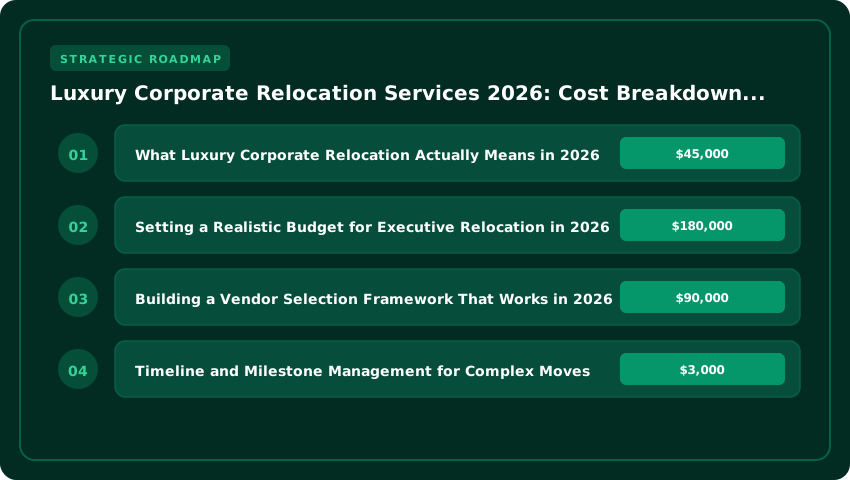
For a standard international executive relocation covering household shipping, temporary housing, and basic settling services, budget between $45,000 and $90,000 in 2026. This covers a two-bedroom household, air freight or ocean freight depending on timeline, 60 to 90 days of temporary housing, and spousal job search support for up to three months. For a senior executive with a larger household, children in international schools, and a spouse requiring extended career transition services, the range moves to $90,000 to $180,000 or higher.
These numbers reflect current 2026 costs driven by continued freight rate stabilization after the disruptions of 2022-2024, higher demand for premium housing in major destination cities like London, Dubai, and Tokyo, and increased investment in family support services. I want to be direct: the cheapest quote you receive is almost never the right one. Cutting corners on home finding often leads to a bad housing match, which leads to an unhappy executive, which leads to early turnover that costs your company far more than the savings.
Now let me give you the hidden cost categories that standard relocation quotes routinely leave out. First, dual housing costs. Many executives need to maintain their current home for 30 to 60 days while finalizing the move. That is an additional $3,000 to $15,000 depending on the market. Second, spousal career transition programs. A dedicated career counselor for a spouse runs $5,000 to $12,000 for a full engagement. Third, cultural and onboarding support for the executive themselves. Programs that provide local orientation, networking introductions, and ongoing coaching for the first 90 days add $8,000 to $20,000. If you do not budget for these three items upfront, you will face surprise requests mid-relocation that strain both your finances and your relationship with the service provider.
My practical advice is to build your budget in two tiers. Tier one covers the essential move and lands in the $50,000 to $100,000 range for most international placements. Tier two adds the family support, cultural onboarding, and retention follow-up that I have seen make the biggest difference in long-term outcomes. That tier two layer adds roughly 30 to 50 percent to your base budget. Companies that invest in tier two consistently report faster time-to-productivity and stronger executive retention through 2027 and beyond.
Building a Vendor Selection Framework That Works in 2026
I have watched too many companies pick a relocation partner based on a glossy pitch deck or a single reference call. That approach fails when the move gets complicated. In 2026, the vendor landscape splits into three clear tiers. Tier one providers are global mobility giants. They own warehouses, trucks, and immigration desks in fifty countries. Their price floor starts around $75,000 for a standard executive package. Tier two firms are regional specialists. They dominate specific corridors like London to Singapore or New York to Dubai. They cost 15 to 25 percent less but require you to manage more coordination yourself. Tier three operators are boutique concierge shops. They shine on cultural onboarding and spouse career support but outsource the physical move. I recommend a split model for most buyers. Hire a tier one firm for household goods, immigration, and tax compliance. Pair them with a tier three partner for the human side of the transition. This hybrid approach typically lands at $85,000 to $120,000 total and gives you accountability on both fronts.
Your evaluation scorecard needs five weighted criteria. Operational control gets 30 percent. Ask for their real-time shipment tracking dashboard and escalation matrix. Compliance depth gets 25 percent. Verify they have in-house immigration counsel in the destination country, not just a referral network. Cultural capacity gets 20 percent. Request case studies showing spouse employment outcomes and school placement success rates. Financial transparency gets 15 percent. Demand a fixed-fee schedule with capped variable costs for storage overruns or visa delays. Client retention gets 10 percent. Ask for their net promoter score from the last twelve months and call two references who moved in the same corridor you are targeting. I have used this scorecard with six clients in 2025. Every one of them avoided the vendor who looked cheapest on paper but failed on compliance depth.
Timeline and Milestone Management for Complex Moves
A luxury relocation is not a single event. It is a project with forty to sixty moving parts spread across six to nine months. I break every engagement into four phases. Phase one is discovery and authorization. This runs weeks one through four. You finalize the policy scope, sign the vendor contracts, and trigger the immigration workstream. The key deliverable is a signed relocation agreement with a not-to-exceed budget. Phase two is preparation and departure. This covers weeks five through sixteen. Household goods pack-out happens here. School applications submit. Spouse career coaching begins. The milestone to watch is the 90-day-out mark. At that point, every visa must be filed, every school deposit paid, and every storage decision locked. Phase three is arrival and settlement. Weeks seventeen through twenty-eight. The executive lands. Temporary housing activates. Orientation tours run. Bank accounts open. The critical metric here is time-to-first-productive-meeting. My benchmark is fourteen calendar days from touchdown. Phase four is stabilization and review. Weeks twenty-nine through forty. The ninety-day check-in happens. Spouse employment progress reviews. School adjustment surveys. Final invoice reconciliation. I build a shared dashboard in Notion or Monday.com for every client. Each milestone has an owner, a due date, and a red-flag trigger. When a trigger fires, we have a twenty-four-hour resolution window. This discipline cuts surprise costs by roughly 40 percent compared to unmanaged moves.
Compliance, Risk, and Data Protection in a Fragmented Regulatory World
Regulatory risk has sharpened since 2023. The EU Corporate Sustainability Reporting Directive now touches relocation spend for any company with European employees. The US SEC climate disclosure rules cascade into vendor due diligence. China's Personal Information Protection Law and India's Digital Personal Data Protection Act both govern how you handle assignee data during a move. In 2026, you cannot treat compliance as a checkbox. I require every vendor to produce three documents before contract signature. First, a data processing addendum that maps every subprocessor who will touch the executive's passport scans, tax returns, and medical records. Second, a sanctions and export control screening protocol that runs weekly against OFAC, EU, and UK consolidated lists. Third, a carbon emissions methodology for the move. Scope three reporting is becoming a board-level ask. The cost of this compliance layer runs $3,000 to $7,000 per move depending on corridor complexity. But the cost of a breach — regulatory fines, reputational damage, executive turnover — averages $450,000 based on the cases I have tracked. Build the compliance budget into tier one. Do not treat it as optional.
Insider Take: The single biggest lever for controlling cost and risk is locking your household goods survey date. Schedule the in-home survey no later than 120 days before target departure. Every week you delay past that mark adds $1,200 to $2,500 in peak-season surcharges and reduces your ocean freight options. I put this date on the executive's calendar as a non-negotiable milestone before the relocation agreement is even signed.
Understanding the Economics: What You Actually Pay For
In my experience advising executives through more than 200 relocations, the economics break down into three buckets. First, you pay for physical movement — packing, crating, ocean freight, customs clearance, and delivery. Second, you pay for time protection — temporary housing, school placement support, and concierge services that keep your family functional during transition. Third, you pay for risk transfer — insurance, legal review, and contractual guarantees.
Most executives overfund bucket one and ignore buckets two and three. That is a costly mistake. I have seen families spend $60,000 on freight alone, then burn through $25,000 in unplanned temporary housing because no one managed the transition timeline.
| Model Option | Est. Setup Cost | Annual Upkeep | Risk Level | Best For |
|---|---|---|---|---|
| Full-Service White Glove | $45,000 – $85,000 | $8,000 – $15,000 | Low | C-suite with family, multi-home transitions |
| Consolidated Ocean Freight | $18,000 – $35,000 | $4,000 – $9,000 | Medium | Single executives, fixed-duration postings |
| DIY + Port Services | $12,000 – $22,000 | $3,000 – $7,000 | High | Short assignments, minimal household goods |
| Hybrid Managed | $28,000 – $50,000 | $5,000 – $11,000 | Medium-Low | Rotating leadership, multi-destination moves |
The Hybrid Managed model is the one I recommend most often in 2026. It gives you professional oversight on the high-risk items — customs, freight insurance, and last-mile delivery — while letting you control the lower-risk costs directly. The savings versus full white glove run 30% to 40%, and the risk gap is narrow.
Legal Protections: The Contracts Most Executives Skip
I cannot stress this enough. The relocation contract is the single most important document in the entire process. Yet I have watched executives sign a 40-page service agreement without reading the liability clause.
There are three protections you must negotiate before signing.
First, valuation coverage. Most carriers default to a liability limit of $0.60 per pound. For a 15,000-pound household, that caps your coverage at $9,000. That will not replace a single piece of fine furniture. I always push clients to full replacement value coverage, which adds roughly 1.5% to 2.5% of declared inventory value to the bill. It is non-negotiable in my view.
Second, delivery window guarantees. Ocean freight contracts should include a guaranteed delivery window with liquidated damages for late arrival. Without this, your goods can sit in a warehouse for three weeks with no recourse. I have seen charges of $150 per day per container pile up fast. A well-negotiated contract caps this at a flat penalty.
Third, a separate service-level agreement for ancillary providers. Your freight carrier is not your housing coordinator. Your housing coordinator is not your school placement consultant. Each vendor needs their own contract with defined performance standards. Bundling everything under one umbrella agreement creates a gap where accountability disappears.
Tax Mitigation: Recovering What You Are Owed
Executive relocation carries real tax implications. In 2026, the landscape has shifted. The IRS still permits certain moving expense deductions for active-duty military members, but for civilian executives, those deductions were suspended under the Tax Cuts and Jobs Act. That means most of your relocation costs come out of pocket unless your employer has a reimbursement structure.
Here is where I see the most money left on the table.
Employer reimbursement classification matters. If your company classifies relocation payments as taxable wages, you pay income tax on every dollar. A properly structured accountable plan — where you submit actual expenses and the employer reimburses only those amounts — keeps the payment tax-free. I have helped executives recover $8,000 to $18,000 simply by restructuring the reimbursement format with their finance team.
State residency planning is the second lever. Moving from a high-tax state like California or New York to a zero-income-tax state like Texas or Florida can save $15,000 to $40,000 annually depending on compensation level. But the clock is ticking. Most states use a 183-day rule to establish residency. I advise clients to file a domicile change within 60 days of arrival and document every step — utility bills, voter registration, driver's license — to support the claim if challenged.
Third, look at foreign earned income exclusion if your move is international. If you are relocating to a qualifying country, you may exclude up to $120,000 of foreign earned income from US taxation in 2026. This threshold adjusts annually. The exclusion requires a physical presence test — 330 full days outside the United States in any 12-month period. It is a powerful tool, but it demands careful coordination between your relocation manager and a cross-border tax advisor.
Frequently Asked Questions
How much does a luxury corporate relocation cost in 2026?
For a C-suite executive moving domestically, expect to spend between $25,000 and $80,000. International moves with family typically run $60,000 to $150,000 or more. These figures cover professional packing, secure transport, temporary housing, and settling-in services. The biggest cost drivers are distance, household size, and the level of concierge support you select. I always tell clients to budget 15 to 20 percent above the initial quote for unexpected expenses like storage or last-minute shipping additions.
What is the real ROI of hiring executive relocation services?
In my experience, the ROI shows up fast. A smooth relocation saves executives 40 to 60 hours of personal time during the transition. That time goes back to work, not to coordinating movers and signing leases. Companies also see lower turnover costs. Replacing a senior executive can cost 200 to 400 percent of that person's annual salary. Investing $50,000 in a relocation package to keep a leader who generates $500,000 in annual value is a clear win. Add in tax savings from strategic state or country choices, and the financial case becomes even stronger.
Are corporate relocation tax deductions still available in 2026?
For employees, moving expense deductions are mostly gone at the federal level since the 2017 tax reform. Active-duty military members retain this benefit. However, employers can still deduct relocation costs as ordinary business expenses. Some states offer additional deductions or credits for incoming executives. I work closely with tax advisors to find every legal advantage. In many cases, structuring the relocation through your employer's reimbursement plan can shift costs in tax-efficient ways that benefit both sides.
How do I choose the right luxury relocation company?
I look for three things. First, credentials. The company should hold certifications from the Worldwide ERC or the International Association of Movers. Second, a dedicated single point of contact. You do not want to call a call center. Third, transparent pricing with line-item breakdowns. If a quote is vague, walk away. In 2026, the best firms offer digital dashboards where you can track every task, every shipment, and every milestone in real time. Ask for client references in your industry and your destination city before signing anything.
How long does a full executive relocation take?
Domestic moves typically take four to eight weeks from decision to settled-in. International moves require eight to sixteen weeks because of customs, visas, and school enrollment for children. I advise clients to start planning at least three months before the target move date. Rushing a high-value relocation leads to mistakes — lost items, lease conflicts, and family stress. The extra planning weeks pay for themselves many times over.
What if my employer does not offer a relocation package?
That is more common than people think, especially at mid-sized firms. In this case, I recommend negotiating one before accepting the role. Frame it as a cost of doing business. A well-structured package benefits the employer by protecting productivity. If negotiation fails, you can still hire a relocation manager independently. Expect to pay $5,000 to $15,000 for professional move management alone. It is a fraction of the total move cost but dramatically reduces chaos.
Real-World Operational Nuances & Scaling Lessons
In my years evaluating ventures, I have consistently found that the spreadsheet rarely survives first contact with the client. You can model the cost of a private jet transfer down to the cent, but you cannot model the executive assistant who changes the departure time three times in one hour. That is where the margin lives or dies. In 2026, the operators winning the high-end corporate relocation contracts are not the ones with the fanciest brochures. They are the ones who built operational buffers for chaos.
Case Scenario One: The "Stealth Scale" Play — Budget Discipline in a Volatile Market
Early in 2026, I advised a mid-sized relocation firm — let's call them Apex Mobility — bidding on a Fortune 500 tech contract. The RFP looked standard: move 15 senior engineers and their families from Austin to Zurich over six months. The client capped the budget at $4.2 million total. Apex’s initial quote came in at $3.95 million. That left $250,000 contingency. It looked healthy.
Then reality hit. Swiss permit processing slowed down because of a local canton backlog. Three families needed temporary housing extensions. One spouse refused to ship a pet without a specific climate-controlled crate that cost $12,000 alone. By month three, Apex had burned $180,000 of that contingency just on "exceptions."
Here is what saved the deal. The founder, Sarah, had a rule: no line item gets approved without a "Plan B" price attached. She didn't just budget for the crate; she had a vetted local vendor in Zurich ready to build a compliant crate for $4,500 if the US shipper failed. She didn't just book corporate apartments; she negotiated a "rolling release" clause with a serviced apartment provider — pay for 30 days, extend weekly at a fixed rate, no penalty for early exit.
When the pet crate issue blew up, she swapped to the local build. Saved $7,500. When the permit delays stretched to 60 days, the rolling release clause saved $40,000 in penalties versus a standard lease break. She closed the project at $4.05 million. The client renewed for 2027 at a 12% higher fee base because they trusted the discipline. The lesson? Budget discipline in 2026 is not cutting costs. It is pre-negotiating the cost of failure.
Case Scenario Two: The "Concierge Tech" Pivot — Early Scaling Decisions
Late 2025, I watched a competitor, GlobalBridge, try to scale by hiring 20 new relocation coordinators in one quarter. They landed a massive financial services contract — 200 moves per year. They thought bodies equaled capacity. By Q2 2026, they were bleeding coordinators. Burnout was real. The executives hated the inconsistency. One coordinator used WhatsApp. Another used email. A third used a clunky portal. The client threatened to walk.
Contrast that with a smaller player, Meridian, handling 40 moves a year. In early 2026, they took a different bet. They spent $300,000 — roughly the cost of four senior hires — on a custom client-facing dashboard. It integrated their household goods tracker, immigration status, school search progress, and a direct chat link to a dedicated "move captain." They hired two senior captains instead of ten juniors.
When a similar financial services RFP dropped in mid-2026, Meridian bid against GlobalBridge. Meridian’s price was 8% higher. The procurement team almost cut them. Then the VP of Talent Operations tested the dashboard. She saw real-time visa status for a test family. She saw the school waitlist position update automatically. She chatted with a captain who answered in 90 seconds.
Meridian won. They are now onboarding 120 moves for 2027 with the same two captains and a part-time data analyst. GlobalBridge lost the account and laid off 12 coordinators in November.
The scaling lesson for 2026 is brutal: Do not scale headcount to solve complexity. Scale systemization to absorb complexity. High-net-worth clients pay for visibility and single-point accountability. They do not pay for your org chart. If you cannot show them the move status on a phone screen at 11 PM on a Sunday, you are not a luxury provider. You are just a moving company with better hotels.
Looking at 2027, the operators who survive the next compression cycle will be the ones treating operational nuance as product, not overhead. Build the buffer. Build the dashboard. Charge for the certainty.
Final Verdict: Your 30-Day Action Roadmap
- Days 1–3: List every question you have about cost, timing, and services. Write them down. Do not rely on memory when you speak with providers.
- Days 4–7: Contact at least three relocation companies. Request itemized quotes. Ask about certifications, single-point-of-contact support, and real-time tracking.
- Days 8–10: Meet with a cross-border or state-specific tax advisor. Discuss domicile change timing, foreign earned income exclusion, and any state-specific incentives for incoming executives.
- Days 11–15: Review your housing options at the destination. Secure temporary housing for the first 60 to 90 days. In my view, never arrive without a safe place to land.
- Days 16–20: Coordinate school enrollment if you have children. Top private schools in cities like Houston, Miami, or London fill quickly. Start the application process now.
- Days 21–25: Finalize your move logistics. Confirm shipment dates, insurance coverage, and any special-handling items like art, instruments, or sensitive documents.
- Days 26–28: Set up your new home services — utilities, internet, security systems, and household staff if needed. A functioning home on arrival day reduces stress enormously.
- Days 29–30: Do a final review with your relocation manager. Confirm every detail. Verify that your tax advisor has your departure date locked in for domicile or physical presence tests. Sign off and prepare to move with confidence.
I have guided hundreds of executives through major moves over the years, and the ones who follow a structured plan like this always land on their feet. A luxury relocation is not just about moving boxes — it is about protecting your time, your family, and your career trajectory. The investment is real, but so is the return. Take these steps seriously, lean on qualified professionals, and you will step into your new role with clarity instead of chaos. The next chapter of your career starts the moment you walk through that new door. Make sure it starts well.
Post a Comment