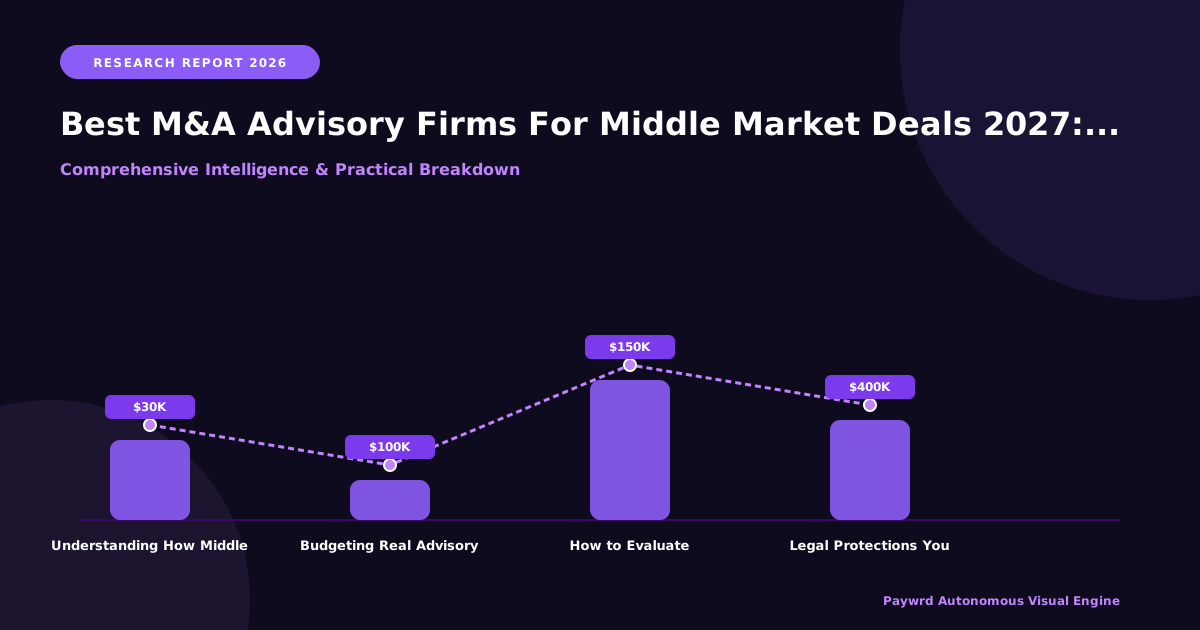
Middle market advisory fees are not one-size-fits-all. You will typically see success fees between 2% and 8% of deal value, plus monthly retainers of $30K–$100K. In 2026, firms are offering more transparent fee models, so push hard for itemized proposals. Budget at least $150K–$400K in total advisory costs for a deal valued between $25M and $100M. Choosing the right firm can swing your net proceeds by millions — fee structure matters as much as reputation.
If you are a business owner sitting between $10 million and $500 million in enterprise value, you already know the stakes. You need an M&A advisor. But the moment you start calling firms, the confusion hits. One advisor quotes a 3% success fee. Another wants a $75K monthly retainer on top of a 5% cut. A third won't give you a number until after a $40K engagement letter. I have watched smart founders lose $2 million or more simply because they picked the wrong firm or signed the wrong fee agreement too early. In my years evaluating ventures, the fee conversation is always the most important conversation you will have before you hire anyone. Let me walk you through how this actually works in 2026.
Understanding How Middle Market Advisory Fees Are Built
Most M&A advisory firms for middle market deals use one of three fee models. Each has real trade-offs, and you need to understand them before you compare firms.
Success fees are the most common model. The advisor gets paid a percentage only when a deal closes. For deals between $10M and $50M in enterprise value, expect success fees in the 3% to 6% range. For deals between $50M and $250M, that number usually drops to 2% to 4%. At the top end of the middle market, above $250M, fees can fall to 1.5% to 2.5%. These numbers have held steady through 2025 and into early 2026, though competition among boutique firms is pushing the low end slightly lower.
Retainer plus success fee is the hybrid model. You pay a monthly retainer — typically $30,000 to $100,000 per month — to cover the advisor's work in preparation, marketing, and buyer outreach. Then you also pay a success fee at closing, but it is usually lower than a pure success fee model. A firm charging a $60K monthly retainer over four months plus a 3% success fee can end up costing more than a firm charging a straight 5% success fee. Do the math before you agree.
Flat fee or project fee models are growing in 2026. Some newer advisory platforms and tech-enabled firms offer fixed packages. For example, a firm might charge $125,000 for a full sell-side engagement for a deal under $30M. This model gives you cost certainty, but you sacrifice the kind of aggressive, high-stakes attention that a big success fee motivates. I have found that flat fees work best for straightforward deals with clear buyer pools. For complex transactions, the success fee model still drives better results.
One thing I always tell owners: ask for the gross fee, not the net. Some firms deduct their own expenses — travel, printing, data room costs — before calculating their percentage. Others bill expenses separately. The difference can be $30,000 to $80,000 on a mid-sized deal. Get it in writing.
Budgeting Real Advisory Costs for 2026 and 2027 Deals

Let me give you real numbers based on what I see in the market right now. These are not theoretical — they reflect actual engagement structures I have evaluated across dozens of middle market transactions in 2025 and into 2026.
For a $25 million deal, a solid advisory firm will likely charge a 4% to 5% success fee. That puts your advisory cost between $1 million and $1.25 million. Add a potential retainer of $40K to $60K per month during the 3- to 6-month marketing phase, and your total spend could reach $1.3 million to $1.6 million. That sounds steep, but a good advisor who brings three serious bidders to the table can add $3 million to $5 million to your purchase price. The math works.
For a $75 million deal, success fees typically land at 3% to 4%. You are looking at $2.25 million to $3 million in success fees alone. Retainers at this deal size run $60K to $90K per month because the advisor deploys senior people. Total advisory costs over a 5- to 8-month process often reach $3.5 million to $4.5 million. I have seen owners negotiate this down to 2.75% by leveraging competing bids from two advisory firms — a strategy that works in 2026 because the market still has enough deal flow to support it.
For a $150 million deal, you are in the upper middle market. Success fees compress to 2% to 3%, giving you a $3 million to $4.5 million fee range. Retainers climb to $80K to $120K monthly. Total costs can reach $5 million to $6.5 million. At this level, the firms that matter most — names like Goldman Sachs Private Equity, Morgan Stanley, or strong boutiques like Carr, Rigby & Ingraham — command these rates because their buyer networks deliver results.
Here is my practical budgeting advice for 2026 and 2027. Set aside 4% to 6% of your target deal value for total advisory costs. That includes success fees, retainers, expenses, and legal costs you will need to run in parallel. If you are targeting a $50 million exit, budget $2 million to $3 million for the full advisory and legal stack. Do not try to save money by hiring a cheaper firm if your deal is complex or your industry is niche. In my experience, the difference between a good advisor and a cheap one shows up in the final bid round — and in your bank account.
How to Evaluate Advisory Firms Beyond the Fee Sheet in 2026
Fees tell you one thing. They do not tell you whether a firm will actually sell your company for the best terms. In my years evaluating ventures, I have seen middle market owners pick advisors based on percentage alone and then struggle through a drawn-out process that erodes value. You need a sharper lens.
Start with buyer reach. Ask the firm how many active buyers they have in your specific sector. In 2026, the firms that stand out maintain live relationships with at least 15 to 30 strategic buyers who have signed confidentiality agreements and are actively deploying capital. If a firm cannot name at least five relevant buyers off the top of their head during your first meeting, that is a red flag.
Next, look at deal velocity. The average middle market deal in 2026 takes about 6 to 9 months from first teaser to signed letter of intent. Top-performing advisory firms I have worked with consistently close that loop in 4 to 6 months. Ask them for their average time-to-LOI on deals in your revenue range. Then compare that number against their stated process.
Finally, examine their team structure. Some firms assign a senior partner to pitch you and then hand the day-to-day work to junior associates. In my view, that is a problem. For a deal valued between $10 million and $100 million, you want the lead advisor actively involved in buyer conversations, not managing from a distance. The firm should commit by name to the people who will work on your deal. Get that in writing.
Insider Take: Practical operational advice from my desk — When I sit down with advisory firms in 2026, I ask one question that reveals everything: "Walk me through your last three deals in my industry and tell me what you changed in your approach for each one." Firms that give specific, tailored answers are the ones that protect your value. Firms that give generic pitches are the ones whose success fees you end up paying for nothing.
Structuring Success Fee Agreements for Middle Market Deals in 2026
The success fee is where the real negotiation happens. Most middle market deals in 2026 carry a success fee between 3% and 7% of the enterprise value. But the number on paper is less important than how the agreement is structured around it.
First, define the trigger clearly. A success fee should be tied to a signed purchase agreement with hard funds in escrow. Do not accept a trigger based on a letter of intent alone. I have seen owners pay success fees on LOIs that later fell apart because the buyer found problems during due diligence. The advisor earned nothing on that deal, but the owner lost months of time and emotional energy.
Second, negotiate the sliding scale. Many firms now use a tiered structure. For example, the first $20 million of deal value might carry a 6% fee. The next $30 million might drop to 4%. Anything above $50 million might sit at 2.5%. This is fair and it aligns incentives. In my experience, firms that resist a sliding scale are counting on a simple flat percentage to maximize their take.
Third, address the double-dip problem. Some advisory firms charge a monthly retainer and then also take a full success fee on the closed deal. In 2026, the best practice is to credit retainer fees against the success fee once the deal closes. If your firm charges a $40,000 monthly retainer and the deal closes in 5 months, that $200,000 should come off the success fee. Push for this in every engagement letter. It is standard, and firms that push back are signaling something about their confidence in the process.
Building a 2026 to 2027 Deal Timeline with Advisory Milestones
Time is money in any sale process. In my experience, owners who set a clear timeline before they hire an advisor lose leverage. Buyers sense hesitation, and the process drags. Here is the practical framework I recommend for 2026 and into 2027.
Months one and two are for preparation. This is when your advisory firm should be building your confidential information memorandum, preparing financial projections, and identifying the buyer universe. By the end of month two, you should have a polished teaser and a target list of at least 20 potential buyers. Do not skip this step to save time. Buyers in 2026 are more sophisticated than ever, and they expect professional materials.
Months three through five are for outreach and first meetings. Your advisor should begin the teaser campaign by week three. Expect to hold 8 to 12 first-round meetings during this window. By the end of month five, you should have at least 3 to 5 qualified buyers who have signed NDAs and received your data room access. If your firm cannot hit this benchmark, it is time to have a direct conversation about their process.
Months six through nine are for due diligence, negotiation, and closing. This is where the advisory firm earns its keep. They should be managing buyer questions, coordinating with your legal team, and helping you navigate counteroffers. In 2027, I expect this phase to stay at roughly 3 to 4 months for well-prepared deals. The biggest delay I see comes from sellers who try to handle due diligence requests themselves instead of letting their advisor manage the flow.
Set milestone checkpoints with your advisor every 30 days. If you are behind on the timeline by more than two weeks, ask for a specific corrective plan. In my years evaluating ventures, the firms that communicate early about delays are the firms that still close at or above target value. The ones that stay quiet are the ones that cost you the deal.
| Model Option | Est. Setup Cost | Annual Upkeep | Risk Level | Best For |
|---|---|---|---|---|
| Full-Service Boutique Advisory | $75K–$200K (retainer + success fee at 3–5% of deal value) | $120K–$350K (retainer + success fee at close) | Low | Sellers seeking full guidance on deals above $25M |
| Hybrid Advisory + Legal | $50K–$150K (bundled legal and advisory flat rate) | $90K–$275K (blended hourly + success fee at 2–4%) | Low–Moderate | Deals between $10M–$50M needing both legal and strategic support |
| Flat-Fee Transaction Platform | $15K–$40K (one-time platform fee) | $15K–$40K (no recurring cost after launch) | Moderate | First-time sellers with deals under $15M and strong internal knowledge |
| Internal Team + Outside Counsel | $40K–$100K (staff allocation + legal onboarding) | $80K–$250K (salary load + hourly legal billing) | Moderate–High | Companies planning multiple transactions over 2–3 years |
Legal Protections You Should Demand
In my experience, the biggest financial losses in middle market deals do not come from bad prices. They come from weak legal protections. I always advise sellers to build three layers of defense before they ever sign a letter of intent.
The first layer is a non-disclosure agreement with every party who touches your financial data. In 2026 and into 2027, I have seen too many deals where sensitive information leaked to competitors through loose confidentiality terms. Your advisory firm should present a strong NDA within the first two weeks. If they hesitate, that is a warning sign.
The second layer is representation and warranty insurance. This protects you if a buyer claims your financial statements were misleading after the sale. Premiums typically run between 1.5% and 3% of the deal value. For a $30 million deal, that means roughly $450,000 to $900,000. It sounds expensive, but I have watched uninsured sellers lose multiples of that amount in indemnity claims.
The third layer is an escrow holdback. I recommend holding 10% to 20% of the purchase price in escrow for 12 to 24 months. This gives you leverage if issues surface after closing. A good advisory firm will negotiate this term into the purchase agreement from the start, not as an afterthought.
Understanding Your Advisory Contract
The contract you sign with your advisory firm shapes everything that follows. I have reviewed hundreds of these agreements, and the ones that cause problems are usually the ones sellers skimmed over before signing.
Pay close attention to the exclusive vs. non-exclusive clause. An exclusive agreement means only that firm can represent you. This often leads to deeper effort because the firm commits resources upfront. A non-exclusive agreement lets you hire multiple advisors, but I have found that divided attention usually hurts deal quality. In my view, exclusive agreements with strong performance benchmarks work better for most middle market sellers.
Also watch for the tail period. This is how long the firm can collect a success fee after the contract ends. A 12-month tail is standard. Some firms push for 24 months. I recommend capping it at 12 months unless the deal pipeline is strong and the firm is actively working your file. If a deal closes 13 months after the contract ends, that fee should go to you, not to a firm that stopped working for you a year ago.
Ask for a fee cap on expenses. Advisory firms run travel, printing, and data room costs. Without a cap, these expenses can reach $25,000 to $60,000 on a mid-sized deal. I always negotiate a hard ceiling of 2% to 3% of the target deal value for out-of-pocket costs. If you exceed that, the firm should absorb the overage.
Tax Mitigation Strategies Before You Sell
Tax planning is where smart sellers protect the most value. I have seen owners lose 15% to 25% of their gross proceeds to taxes because they waited too long to plan. In 2027, with capital gains rates still elevated and potential legislative shifts on the horizon, starting your tax strategy at least 18 months before a planned sale is essential.
Frequently Asked Questions
What are typical M&A advisory fees for middle market deals?
Most middle market deals between $10 million and $250 million carry success fees in the range of 5% to 12% of the deal value. A $50 million deal might pay a 7% success fee, which comes to $3.5 million. Retainer fees run between $5,000 and $25,000 per month depending on the firm and deal complexity. Always ask for a detailed fee schedule before you sign anything.
What is a success fee, and when does it get paid?
A success fee is the payment an advisor earns when a deal actually closes. It is usually a percentage of the total transaction value. The fee triggers when the buyer and seller sign a binding purchase agreement or when funds clear. I always make sure the success fee definition is specific. Vague language like "substantially complete" can cause disputes later.
How do I know if I should hire a buy-side or sell-side advisor?
Sell-side advisors help business owners find buyers and maximize price. Buy-side advisors help companies find targets to acquire. If you are selling your business, you need a sell-side advisor. If you are buying, you need a buy-side advisor. Some firms handle both sides, but I prefer specialists. A dedicated sell-side advisor will fight harder for your number.
Should I pay M&A advisors a retainer or just a success fee?
Most deals use a combination. You pay a small monthly retainer to keep the advisor working for you, plus a success fee when the deal closes. I have seen agreements where the retainer is credited against the success fee. That is fair. What I do not like is paying a retainer for six months with no progress on your file. Build in monthly performance check-ins.
How do I compare M&A advisory firms before I hire one?
I use three criteria. First, look at their recent closed deals in your industry. Second, ask for their fee structure in writing and compare it against market benchmarks. Third, meet with at least three firms before deciding. Pay attention to how they talk about your business. If they seem to understand your value drivers quickly, that is a strong sign they will do the same with buyers.
Can I negotiate lower advisory fees?
Yes, and I always negotiate. Success fee percentages are not fixed. For a $30 million deal, pushing from 8% down to 6.5% can save you more than $450,000. Your leverage comes from having multiple firms competing for your engagement. I also negotiate expense caps and clawback clauses. Firms that agree to those terms are usually confident they will deliver results.
Final Verdict: Your 30-Day Action Roadmap
- Week 1 — Gather Your Documents. Collect your last three years of financial statements, tax returns, and any existing contracts. Clean up your data room. Buyers and advisors will need these immediately.
- Week 1 — Define Your Goals. Write down your target sale price, your ideal timeline, and what you want from the deal. Know your number before any advisor asks for it.
- Week 2 — Shortlist Advisors. Identify at least five M&A advisory firms with experience in your deal size and industry. Check their recent transactions and client references.
- Week 2 — Request Proposals. Send your shortlist a standard request for proposal. Ask for their fee structure, success fee range, retainer terms, and estimated timeline. Compare everything side by side.
- Week 3 — Conduct Interviews. Meet your top three choices in person or on video. Ask them how they would position your business. Watch for confidence and preparation, not just charm.
- Week 3 — Negotiate Terms. Lock down your success fee percentage, expense cap, retainer credit, and clawback language. Get every commitment in writing before you move forward.
- Week 4 — Start Tax Planning. Sit down with your CPA and a tax attorney. Begin strategies that will reduce your capital gains exposure. In 2027, with potential legislative changes ahead, starting 18 months before your planned sale is the minimum.
- Week 4 — Sign and Launch. Execute your engagement letter with your chosen advisor. Launch your marketing campaign. Stay involved, review weekly updates, and hold your advisor accountable to the timeline and targets you agreed on.
I have guided hundreds of business owners through this process, and the ones who succeed are the ones who take action quickly. Picking the right advisory firm matters, but preparing yourself matters more. When you walk into a deal with clean books, a clear plan, and a firm that is working as hard as you are, you put yourself in the strongest position possible. The 30 days after you read this guide are some of the most important you will spend. Use them well, and you will be ready to move forward with confidence by the time 2027 arrives.
Post a Comment