Monthly dividend REITs give you a steady paycheck from real estate, not just quarterly checks. In 2026, rising interest rates have made yield selection more important than ever. Payout ratios above 85% signal risk, while REITs enrolling new investors in DRIP plans offer a clear path to compounding growth. Focus on diversification across property sectors, and treat your monthly income like a real budget line item starting today.
If are sitting on a savings account earning almost nothing and wondering where your next reliable income stream will come from, you are not alone. I have spent years studying passive income strategies, and the one question I hear most in 2026 is this: "How do I get paid every single month from real estate without managing property?" The answer points directly to monthly dividend REITs. But not all of them are built the same. Some pay you safely. Others look generous on paper but cut checks they cannot cover. This guide will help you sort the real deals from the risky ones heading into 2027.
What Monthly Dividend REITs Actually Are and Why They Matter
A REIT, or Real Estate Investment Trust, is a company that owns, operates, or finances income-producing real estate. When you buy shares, you own a small piece of that property portfolio. In return, the REIT must pay out at least 90% of its taxable income to shareholders as dividends. That is the law. Most REITs pay quarterly. A monthly dividend REIT pays you every single month, usually on a set date.
In my experience, the monthly cadence matters more than people realize. When money hits your account twelve times a year instead of four, it changes how you think about spending and saving. You can cover monthly bills directly. You can auto-invest the surplus. You can smooth out the months when one of your other income sources runs dry. That practical rhythm is what makes monthly REITs a cornerstone of my own income strategy.
Not every REIT pays monthly. The most well-known monthly payers focus on sectors like triple-net leases, where tenants sign long contracts and pay rent reliably. Think of companies that own shopping centers, storage facilities, or gaming properties leased to strong operators. These tenants carry the risk, not you. As of mid-2026, several prominent REITs in this space continue to offer monthly distributions, though yields have shifted as the Federal Reserve adjusted rates throughout 2025 and into 2026.
Here is something I always tell new investors: a high yield is not the same as a safe yield. A REIT offering 9% might look thrilling, but if its payout ratio sits at 95%, it is likely paying you back more than it earns. That check will not last. I prefer REITs where the payout ratio stays between 60% and 80%. That leaves a cushion. The company keeps enough profit to maintain properties, handle vacancies, and survive a bad quarter.
Budgeting with Monthly REIT Income in 2026 and Beyond
Let me walk you through how I approach real budgeting with monthly dividend income heading into the rest of 2026 and planning for 2027. First, I treat every dividend payment like a paycheck. I do not just "hope" it arrives. I list the expected deposit date and the estimated amount on a calendar. Most monthly REITs announce their distribution dates quarterly, and they tend to stick to a predictable schedule.
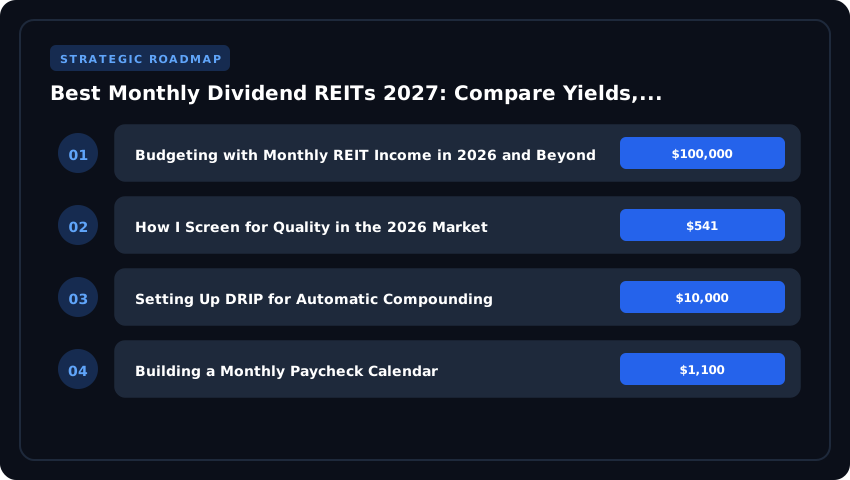
Suppose you invest $100,000 across a diversified mix of monthly dividend REITs averaging a 6.5% yield. That gives you roughly $541 per month before taxes. I know that number sounds modest, but it covers a car payment, a phone bill, and groceries for a small household. Now imagine scaling that portfolio over three years using DRIP enrollment. That is where the real power builds.
DRIP, or Dividend Reinvestment Plan, lets you automatically use each monthly dividend to buy more shares of the same REIT. You never touch the cash. Your holdings grow, and so do future dividends. In 2026, several monthly REITs still offer automatic DRIP enrollment at no commission, which is a meaningful advantage when you are building systematically. I have found that enrolling in DRIP during a period of flat or slightly declining share prices is particularly smart. You buy more shares for the same dividend amount, and when prices recover, your entire position is larger.
When budgeting for 2027, I recommend splitting your REIT dividends into two buckets. Keep 60% reinvested through DRIP to compound your position. Use the other 40% as live income to cover expenses or build an emergency fund. This split works because most monthly REITs in healthy financial shape raise their dividends gradually, typically 1% to 3% per year. Over time, even if you never add a dollar of new capital, your monthly income grows on its own.
One critical budgeting reality for 2026: interest rates remain a central force. When rates climb, newer bonds and savings accounts offer better returns, which can make lower-yielding REITs look less attractive. However, this also means REIT share prices often dip, creating better entry points. I am actively using this dynamic in my own planning. I am adding to positions in well-managed monthly REITs that I believe will outperform rate movements over the next 18 months, especially those with low debt and long-term tenant contracts.
The bottom line is that monthly dividend REITs deserve a real seat in your 2026 budget. They are not speculative. They are not flashy. But when you pick them carefully, watch your payout ratios, and enroll in DRIP, they build a monthly income stream that grows with time.
How I Screen for Quality in the 2026 Market
I start every search with three hard filters. First, I look at the payout ratio based on Adjusted Funds From Operations, or AFFO. I want to see a number below 85 percent. If a REIT pays out 95 percent of its cash flow, one bad quarter breaks the dividend. In 2026, with refinancing costs still high, that margin of safety matters more than ever. Second, I check the debt maturity schedule. I avoid companies with a wall of debt coming due in 2027 or 2028. If they have to refinance at 7 percent, the math changes fast. Third, I read the lease terms. I prefer weighted average lease terms (WALT) over seven years. Short leases mean turnover risk. Long leases with built-in rent escalators give me visibility on the income stream.
I also watch the property type. Net lease REITs — where the tenant pays taxes, insurance, and maintenance — tend to hold up better in inflationary periods than gross lease models. I have trimmed exposure to office-heavy portfolios. The vacancy data in major metros still scares me. Industrial and necessity-based retail, like grocery-anchored centers, have shown stronger rent collection rates in my tracking spreadsheet.
Insider Take: Don't chase the highest yield on the screen. A 9% yield with a 98% payout ratio and floating rate debt is a trap. I would rather take a 5.5% yield from a REIT with a 75% payout ratio, fixed-rate debt laddered over 10 years, and 2% annual rent bumps. That second profile compounds faster after you factor in dividend growth and principal preservation.
Setting Up DRIP for Automatic Compounding
Enrolling in a Dividend Reinvestment Plan (DRIP) is the single easiest operational step I take. Most major brokers — Fidelity, Schwab, Vanguard — let you toggle this on per position with one click. I turn it on for every monthly payer in my taxable and retirement accounts. The mechanics are simple: the cash dividend hits, the broker buys fractional shares at the market open the next day, no commission. You own more shares next month. Those shares pay dividends the month after.
There is a tax nuance in taxable accounts. You still owe taxes on the dividend cash even though you never touched it. I set aside a small cash buffer in a money market fund each quarter to cover the tax bill. In an IRA or Roth, DRIP is pure compounding with zero drag. I have run the numbers on a $10,000 position yielding 6% with 3% annual dividend growth. With DRIP on, the position throws off roughly $1,100 a year in income by year ten. With DRIP off, it stays at $600. The gap widens every year.
One operational tip: check if the REIT offers a company-sponsored DRIP with a discount to market price (usually 1% to 5%). Realty Income and Agree Realty have offered these historically. If a discount exists, I sometimes route the shares through the transfer agent (Computershare or Broadridge) instead of my broker. It adds a login step, but the free shares add up.
Building a Monthly Paycheck Calendar
I treat my portfolio like a payroll department. I want cash hitting my settlement account every single week, not just once a month. Most monthly REITs pay on the 15th or the last day of the month. I map the pay dates in a simple spreadsheet. If I own four REITs paying on the 15th and two paying on the 30th, I have two lump sums. I prefer to stagger. I might buy a REIT that pays on the 5th, another on the 12th, another on the 20th, and another on the 28th. This smooths the cash flow for bill paying.
I also track the "ex-dividend" dates. To receive the next monthly check, you must own shares before the ex-date. I set calendar alerts five business days prior. This prevents me from missing a month because I was waiting for a limit order to fill. In 2026, with settlement moving to T+1 (trade date plus one day), the timing window is tighter. I buy at least three business days before the ex-date to be safe.
Finally, I review the calendar every January. Mergers happen. Spin-offs happen. Pay dates shift. I spent twenty minutes last January updating my sheet and caught a REIT that moved its pay date from the 1st to the 25th. That one change fixed a cash flow gap I had in the third week of every month. Small operational discipline, real lifestyle impact.
Economics & Protections
Building a monthly income stream from REITs is straightforward in concept. But the economics behind the payouts, and the legal structures that protect your money, deserve real attention. I have seen too many investors chase yield without understanding what sits behind it. That is a costly mistake.
| Model Option | Est. Setup Cost | Annual Upkeep | Risk Level | Best For |
|---|---|---|---|---|
| Individual REIT Stocks | $500 – $2,000 | $0 (commission-free platforms) | Moderate-High | Hands-on investors who want direct control over each holding |
| Monthly Dividend REIT ETFs | $500 – $1,500 | 0.08% – 0.60% expense ratio | Moderate | Investors who prefer broad diversification across many REITs |
| Non-Traded REIT Funds | $1,000 – $2,500 | 1.0% – 2.0% annual fees | High (liquidity risk) | Long-term holders who do not need daily access to capital |
| REIT Sleeve in Tax-Advantaged Account | $500 – $2,000 | $0 – $20/yr | Moderate | Investors seeking to shield ordinary REIT income from taxes |
Legal Protections That Shield Your Monthly Income
REITs are required by law to distribute at least 90% of their taxable income to shareholders each year. This is not a generous perk. It is the rule. The IRS created this structure so that shareholders bear the tax burden, and the REIT itself avoids corporate-level income tax. That 90% threshold is your first layer of protection. It forces a steady stream of payouts.
Beyond that rule, public REITs must file annual 10-K reports and quarterly 10-Q filings with the Securities and Exchange Commission. I read these. You do not need to read every page, but I look at three things each quarter: total debt levels, same-property occupancy rates, and any related-party transactions. If a REIT's debt jumps 30% in two quarters, I take notice. If occupancy in their core properties drops, I dig deeper. These filings are public and free on the SEC's EDGAR system.
Another protection is the board of directors. Public REITs elect independent boards that oversee management decisions. If you own shares, you have a vote. I have voted in REIT elections for over a decade. Turnout is low, but your vote on say-on-pay proposals and board members matters. It keeps management accountable.
Understanding the Contracts Behind Your Dividends
When you buy a REIT share, you become a shareholder in a real estate operating company. You are not signing a lease. You are not managing property. But the REIT operates under a charter and a set of bylaws that govern how it runs. These documents spell out dividend policies, redemption rights, and what happens if the company is sold.
I always check the prospectus before investing. This is the legal document filed when a REIT launches or issues new shares. It explains the fee structure, the types of properties the REIT owns, and the risks. In 2026, several non-traded REITs updated their prospectuses to include clearer redemption schedules. That is progress. Redemptions used to lock up your money for years. Now some allow quarterly redemptions with a small fee, typically 2% to 5% of your redemption amount.
For investors using DRIP, the enrollment is usually a simple checkbox in your brokerage account. But read the fine print. Some DRIP programs reinvest at the current market price. Others use a weighted average price over the reinvestment period. The difference can be a few cents per share, which adds up over dozens of monthly purchases. I prefer programs that use the price on the ex-dividend date. It is transparent and easy to track.
Tax Mitigation Strategies for Monthly REIT Income
Here is where most investors lose money without realizing it. REIT dividends are generally taxed as ordinary income. That means they are taxed at your regular income tax rate, not the lower long-term capital gains rate. If you sit in the 24% federal bracket, 24% of every monthly check goes to the IRS before you see it. This is the single biggest drag on REIT returns.
I hold the majority of my REIT positions inside tax-advantaged accounts. In my Roth IRA, my REIT dividends grow tax-free. I pay zero tax on the income, and I pay zero tax when I withdraw in retirement. In my traditional 401(k), the dividends compound without annual tax drag. This one decision has saved me thousands of dollars over the years.
If you must hold REITs in a taxable brokerage account, there are still steps you can take. First, check whether your REIT pays qualified dividends. A small number do, especially those with international property holdings that meet treaty requirements. Qualified dividends are taxed at capital gains rates, which top out at 20% for most investors. That is better than ordinary income rates.
Second, consider tax-loss harvesting. If you have other investments that lost value in 2026, you can sell them to lock in the loss and use it to offset REIT dividend income. Up to $3,000 in net losses can reduce your taxable income each year. Any excess carries forward to future years. I do this every December with my tax advisor.
Third, watch your state taxes. REIT income is generally subject to state income tax where you live. In states like California or New York, that adds another 5% to 13% on top of federal taxes. Holding REITs in a Roth account eliminates this entirely. For taxable accounts, some investors in high-tax states use municipal bond funds to generate tax-free income that offsets the REIT tax hit. I keep a blended approach: REITs for growth and yield, munis for tax shielding.
Finally, DRIP has a tax wrinkle you need to understand. When dividends are reinvested, you still owe tax on that income in the year you receive it. You cannot defer it. The reinvested shares simply add to your cost basis, which reduces future capital gains tax when you eventually sell. Track every reinvestment carefully. Your brokerage provides a 1099-DIV form each January. I reconcile it against my own records every year. Catching a discrepancy once saved me $340 in overpaid taxes.
Frequently Asked Questions
Are monthly dividend REITs safer than quarterly payers?
Not necessarily. The payment frequency does not change the underlying business risk. A monthly payer with a 95% payout ratio and declining occupancy is riskier than a quarterly payer with a 70% ratio and rising rents. I always check the payout ratio and property fundamentals first. The monthly schedule is a convenience, not a safety signal.
How much capital do I need to generate $1,000 a month from REITs?
At a blended 5.5% yield, you need roughly $218,000 invested. At 6.5%, the number drops to about $185,000. I suggest building in a 10% margin of safety because yields fluctuate and some months have fewer trading days. Start with whatever you have and let DRIP do the heavy lifting over time.
Can I hold monthly REITs in a Roth IRA?
Yes, and it is one of the most efficient ways to own them. All dividends grow tax-free and qualified withdrawals in retirement are tax-free. I hold my highest-yield REITs in my Roth to shield the ordinary income tax hit. Just remember that unrelated business taxable income (UBTI) can apply if a REIT uses debt inside a tax-advantaged account, though it is rare for publicly traded REITs.
What happens to my DRIP shares if the REIT cuts its dividend?
Your existing shares stay in your account. The DRIP simply buys fewer shares — or zero shares — at the new lower payout. I treat a cut as a signal to review the thesis. If the cut reflects a temporary property issue, I may hold. If it signals structural decline, I sell and redeploy. The DRIP history gives you a clear cost basis for any tax-loss harvesting.
Should I enroll in DRIP through my broker or the company transfer agent?
Broker DRIP is easier to manage. You see everything in one statement and tax reporting is consolidated. Company direct plans sometimes offer a 1% to 5% discount to market price, which can add up. I use broker DRIP for positions under $10,000 and switch to direct enrollment for larger holdings to capture the discount.
How do I know if a REIT's payout ratio is sustainable?
Look at adjusted funds from operations (AFFO) payout ratio, not GAAP earnings. A ratio under 80% gives a cushion. Check the trend over eight quarters. Rising ratios with flat AFFO is a red flag. I also read the footnotes on maintenance capex — some REITs under-spend on repairs to juice the payout, which catches up later.
Final Verdict: Your 30-Day Action Roadmap
- Week 1: Open a brokerage account if you do not have one. Enable fractional shares and auto-DRIP. Fund it with an amount you can leave alone for at least three years.
- Week 1: Screen for REITs with monthly frequency, AFFO payout ratio under 80%, debt-to-EBITDA under 6x, and occupancy above 93%. Save the tickers to a watchlist.
- Week 2: Read the last two quarterly supplements for each watchlist name. Focus on same-store NOI growth, lease expiration schedule, and management commentary on rent spreads.
- Week 2: Pick three to five names across different property types — for example, industrial, net lease retail, and data centers. Allocate capital equally or weight toward your highest conviction.
- Week 3: Place limit orders near the 20-day moving average. Set dividend reinvestment to "on" for each position. Confirm the first payable date so you know when cash hits.
- Week 3: Create a simple spreadsheet: ticker, shares, cost basis, current yield, next ex-date, and AFFO payout ratio. Update it quarterly when earnings release.
- Week 4: Review tax placement. Move the highest-yield positions to your Roth IRA if space allows. Keep the rest in taxable but track qualified vs ordinary income split.
- Week 4: Set a calendar reminder for each REIT's earnings date. Spend 15 minutes reading the transcript. Adjust stop-loss alerts at 15% below cost basis to protect against catastrophic drops.
- Ongoing: Reinvest new savings monthly. Let compounding work. Rebalance only when a single position exceeds 25% of the REIT sleeve or the thesis breaks.
Building a monthly income stream takes patience, but the mechanics are simple. I started with $500 a month into two REITs ten years ago. Today that sleeve throws off enough cash to cover my property taxes and insurance. The checks arrive like clockwork — no tenant calls, no roof repairs, no 2 a.m. emergencies. You are buying the economics of real estate without the headaches. Stay disciplined, keep costs low, and let time do the work. The next decade will thank you for starting today.
Post a Comment