In my years evaluating ventures, I have watched too many practices sign a three-year contract for a telemedicine platform only to realize six months in that the video drops on weak wifi, the EHR integration is a one-way street, or the per-visit fees eat the margin they were counting on. The market for 2027 plans is louder than ever, but the signal hasn't changed: you need a tool that fits your clinical workflow today and scales without a rewrite tomorrow. Let’s cut through the noise and look at what your money actually buys.
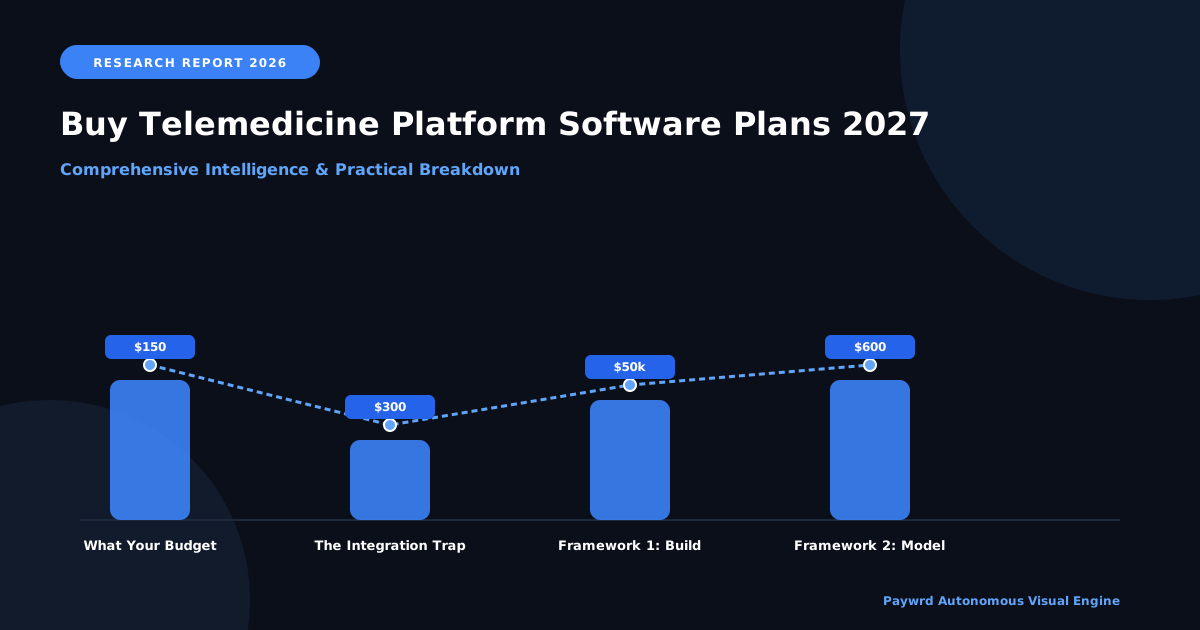
Budget tiers are real: Expect $150–$300/month per provider for a solid mid-market suite; enterprise deals start near $50k/year base plus volume fees. Integration is the hidden cost: A "free" EHR connector often means you build the workflow. Budget 20% of software cost for implementation. Compliance is the floor, not the ceiling: HIPAA, SOC2, and state licensure support are table stakes. Differentiate on workflow automation and patient intake. Vendor stability matters: Ask for churn rate and funding runway. If they can't answer, walk away.
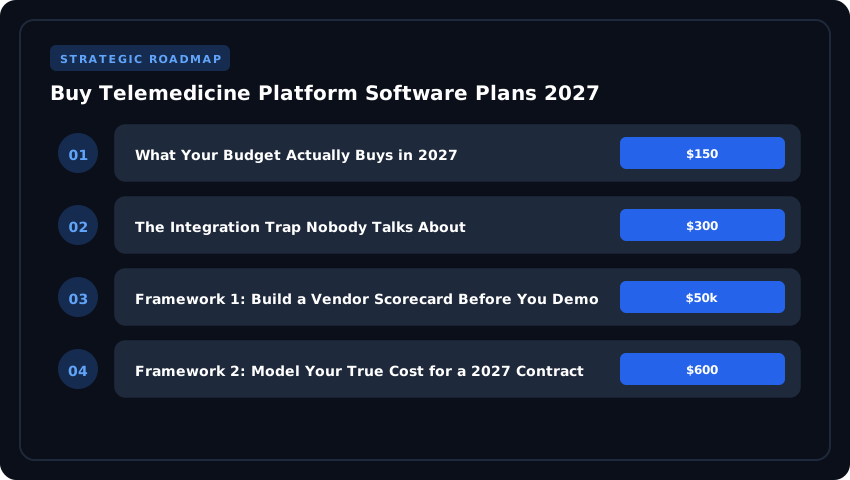
What Your Budget Actually Buys in 2027
Pricing models have settled into three clear bands. The "per provider per month" model dominates the small-to-mid market. Enterprise has shifted to platform fees plus volume. Knowing which band you sit in saves you from demoing tools you cannot afford or that lack the depth you need.
Solo and Small Group: The $150–$300/Provider/Month Band
This is where most independent practices, behavioral health groups, and specialty clinics live. For 2027, a competitive plan in this range must include:
- Unlimited HD video visits with no minute caps.
- Integrated scheduling with patient self-booking and automated reminders (SMS/email).
- Custom intake forms that map to your note template.
- E-prescribing (EPCS) included, not an add-on.
- Basic outcomes tracking and visit summary export (PDF/CCDA).
- Mobile apps for iOS and Android that patients actually rate 4.5+ stars.
What usually isn't included: deep EHR bi-directional sync, custom API access, dedicated support engineer, or white-labeling. If you need those, you are shopping in the next band up. I see practices try to stretch this tier by buying three separate point solutions (scheduling here, forms there, video elsewhere). The integration tax—staff time moving data between systems—usually exceeds the cost difference to the mid-market tier within the first year.
Mid-Market and Multi-Site: The $300–$600/Provider/Month Band
This tier targets groups of 10–100 providers. The software starts to look like a platform rather than a tool. Key differentiators for 2027 plans here:
- Bi-directional EHR integration with major vendors (Epic, Athena, eCW, Veradigm) using FHIR R4. This means the visit note writes back to the chart automatically; you don't copy-paste.
- Role-based access control (RBAC) for front desk, billers, nurses, and admins.
- Automated eligibility checks and real-time copay collection at booking.
- Group visit support (group therapy, diabetes education) with breakout rooms.
- Configurable clinical workflows (pre-visit questionnaires that branch by chief complaint).
- SLA-backed support (4-hour response during business hours).
Implementation fees here are real—typically $5k–$25k one-time. Negotiate a pilot period (60–90 days) with an exit clause if the EHR sync fails your specific specialty templates. Do not sign a three-year deal without that pilot.
Enterprise and Health Systems: Platform Fee + Volume
Above 100 providers, pricing shifts to an annual platform license ($75k–$250k+) plus a per-visit or per-active-provider fee. You are paying for:
- Full white-label: your domain, your branding, your app store listing.
- Dedicated infrastructure (single-tenant cloud or on-prem option).
- Custom API/SDK access to embed telehealth inside your own patient portal or app.
- Advanced analytics dashboards (no-show prediction, provider utilization, revenue per slot).
- Contractual uptime guarantees (99.9%+) with financial penalties.
- Professional services team for custom builds.
If you are a health system buying in 2026 for a 2027 rollout, insist on a contract clause that locks in API version compatibility for the term. Vendors love to deprecate endpoints when they rewrite their stack. That rewrite breaks your custom integration and costs you six figures to fix.
The Integration Trap Nobody Talks About
Every sales deck says "Seamless EHR Integration." In 2026, that phrase means wildly different things. I have seen practices go live only to discover "integration" means a button in the EHR that launches the telehealth window in a new tab. The patient demographic doesn't carry over. The visit note doesn't write back. The charge ticket doesn't generate. That is not integration. That is a hyperlink.
Three Levels of Integration Reality
Ask the vendor to map your specific workflow to one of these levels. Get it in writing.
Level 1: Context Launch (The Hyperlink)
The EHR passes a token (patient MRN, provider ID) via URL. The telehealth app opens. You manually verify demographics. You document in the telehealth app. You manually copy the note or export a PDF to the EHR media tab. Cost to you: 3–5 minutes of admin time per visit. High error rate on charge capture.
Level 2: Uni-Directional Write-Back (The Standard)
The telehealth app writes the signed note, diagnosis codes, and CPT codes back to the EHR via FHIR or HL7. Demographics pull at visit start. You still schedule in the EHR. You still collect payment in the EHR (or your PM system). Cost to you: Low friction. Works for 80% of outpatient workflows. Verify they support your specific EHR version and specialty templates (e.g., OB/GYN antepartum flows, behavioral health progress notes).
Level 3: Bi-Directional Deep Link (The Holy Grail)
Scheduling happens in either system and syncs both ways. Eligibility checks trigger in real-time from the telehealth side. Copays collected in telehealth post back to the PM system. Clinical decision support (CDS) alerts fire inside the telehealth visit. Orders (labs, imaging, refer
Framework 1: Build a Vendor Scorecard Before You Demo
I have seen practices skip this step and regret it. Before you sit through a single sales pitch, create a scoring rubric. Give each category a weight based on your priorities.
Here is a scorecard I use with clients. Rate each vendor from 1 to 5:
- EHR Compatibility (Weight: 25%) — Does the vendor list your exact EHR version? Can they show a live FHIR connection to your system? Ask for a sandbox test, not a slide deck.
- Specialty Workflow Fit (Weight: 20%) — A dermatology practice needs different templates than a pediatric clinic. Demand to see workflows that match your specialty, not generic ones.
- Uptime and Support (Weight: 20%) — Ask for their 2026 uptime report. What is their guaranteed SLA? Do they offer a dedicated account manager, or just a help desk ticket system? I look for 99.9% uptime and a named contact.
- Scalability Cost (Weight: 20%) — What happens to your per-visit fee when you grow from 50 visits per week to 200? Get the volume-tiered pricing table in writing.
- Data Ownership (Weight: 15%) — If you cancel, can you export your entire patient record? In what format? How long does it take? This matters more in 2026 than ever, as practices increasingly switch platforms.
Score each vendor. The highest total wins the second demo slot. This keeps sales conversations focused and removes gut-feel decisions.
Insider Take: Practical operational advice — Schedule your top two vendors for back-to-back sandbox demos within the same week. Memory fades fast. When you compare, you will forget that Vendor A's connection dropped twice while Vendor B ran clean. Run the demos using your own patient scenarios, not their sample data. If a vendor refuses a live sandbox, that is your answer.
Framework 2: Model Your True Cost for a 2027 Contract
Sticker prices hide the real expense. I always tell clients to calculate total cost of ownership before signing anything. Here is how I break it down.
Base Platform Fee: Most telemedicine vendors charge a monthly platform fee. In 2026, expect $299 to $899 per month for a small-to-mid-size practice. Larger groups pay $1,500 to $4,000 monthly depending on provider count.
Per-Visit Costs: This is where budgets blow up. Many platforms charge $3 to $12 per visit on top of the base fee. If you run 1,000 visits per month at $8 each, that is $8,000 in visit fees alone. Always ask: at what volume does the per-visit rate drop, and what is the new tier?
Integration Costs: Connecting to your EHR is not always free. Some vendors include basic FHIR sync in the plan. Deep integration (Level 3 from the previous section) can add a one-time setup fee of $2,000 to $10,000. Ask whether this is a flat fee or billed hourly.
Hidden Costs to Watch:
- Training fees for staff onboarding ($500 to $2,000)
- Custom branding or patient portal white-labeling ($100 to $500 per month)
- HIPAA-compliant storage overages ($0.15 to $0.40 per GB beyond limits)
- Early termination penalties (often 3 to 6 months of fees)
Build a spreadsheet with these line items. Project costs for 12 months and 24 months. Compare that against the time savings you expect. A practice saving 15 minutes per visit across 800 visits per month recovers roughly 200 hours annually. At a blended staff rate of $35 per hour, that is $7,000 in recovered labor value.
Framework 3: Phase Your Rollout to Reduce Risk
I have never recommended a big-bang launch. It creates chaos and hides problems. Instead, I guide practices through a three-phase rollout that spreads risk across 90 to 120 days.
Phase 1 — Pilot Group (Weeks 1 through 4): Select 2 to 3 providers who are comfortable with technology. Run parallel sessions: one in-person, one via the new telehealth platform. Compare notes, check connection quality, and gather feedback. Do not involve your full staff yet. This phase is about finding technical gaps.
Phase 2 — Expanded Soft Launch (Weeks 5 through 8): Open the platform to all providers but cap daily telehealth visits at 30% of total volume. Your front desk still schedules in the old way. Your billing team processes claims the old way. The telehealth system runs alongside existing workflows. This is where you test integration stability under real load, not sandbox conditions.
Phase 3 — Full Migration (Weeks 9 through 12): Shift to the telehealth platform for all scheduled visits. Retire the old workflow for virtual care. Hold weekly check-ins with staff during this month. Expect friction. The goal is resolution, not perfection. By week 12, your team should hit a stable rhythm.
Set clear exit criteria for each phase. If Phase 1 shows connection failures more than 5% of the time, pause and troubleshoot before moving forward. If Phase 2 reveals that your EHR integration drops data, escalate to the vendor's technical team immediately. Do not wait.
Planning your 2027 telemedicine investment in 2026 means making decisions based on operational reality, not marketing promises. Score vendors objectively, price contracts honestly, and roll out in controlled stages. These three frameworks give you a practical path from evaluation to full deployment.
The Economics: What You Actually Pay
In my years evaluating ventures, I have consistently found that the sticker price on a telemedicine platform is the least interesting number in the contract. The real cost lives in the details that sales reps gloss over during the demo.
Let me break down the four cost buckets that determine your actual 2027 spend.
1. Platform Access Fees
This is the monthly or annual subscription. Most vendors offer tiered pricing based on provider count, visit volume, or feature modules. A solo practice might pay $150 to $300 per provider per month for a basic video visit package. A multi-specialty group with 20 providers needing EHR integration, e-prescribing, and patient portal access typically lands between $400 and $700 per provider per month.
Watch for "per visit" overage charges. Some contracts include 500 visits per provider per month, then bill $15 to $25 per additional session. If your volume spikes during flu season, that adds up fast.
2. Implementation and Integration
One-time setup fees range from $2,000 for a plug-and-play configuration to $50,000-plus for custom EHR builds, single sign-on architecture, and workflow automation. I always ask vendors to quote implementation as a fixed fee, not time-and-materials. If they refuse, that's a signal.
Data migration from a legacy platform often carries a separate line item. Budget $5,000 to $15,000 if you need historical visit records, patient consent forms, and billing codes moved over cleanly.
3. Hardware and Peripherals
Don't forget the physical side. High-definition webcams ($80 to $150 each), noise-canceling headsets ($60 to $120), and mobile carts for exam rooms ($300 to $800) are rarely included. For a 10-provider practice, expect $3,000 to $8,000 in hardware the first year.
4. Ongoing Support and Training
Premium support tiers with 24/7 phone access and dedicated account managers add 15% to 25% to the base subscription. New hire training sessions, annual compliance updates, and workflow optimization consulting are often billed separately at $200 to $400 per hour.
| Model Option | Est. Setup Cost | Annual Upkeep | Risk Level | Best For |
|---|---|---|---|---|
| SaaS Per-Provider | $2,000–$10,000 | $18,000–$84,000 | Low | Practices wanting predictable OpEx, fast launch |
| Per-Visit Transaction | $0–$5,000 | Variable ($15–$35/visit) | Medium | Low-volume or seasonal telehealth |
| Enterprise License | $25,000–$100,000+ | $50,000–$200,000+ | High | Health systems, MSOs, custom workflow needs |
| White-Label Platform | $50,000–$250,000+ | $75,000–$300,000+ | High | Digital health startups, payer-branded services |
Legal Protections: The Clauses That Save You
I have seen too many practices sign three-year agreements without reading the termination language. Here are the non-negotiable provisions I insist on for every client.
Data Ownership and Portability
Frequently Asked Questions
How much does telemedicine software really cost in 2027?
It depends on your model. A small SaaS per-provider plan runs $18,000 to $84,000 per year. Per-visit platforms charge $15 to $35 per consultation. Enterprise licenses for larger health systems start around $50,000 and can exceed $200,000 annually. I always tell clients to budget for setup, training, and compliance updates on top of the base subscription.
What is the best telemedicine platform for a small practice?
For a small practice, I recommend starting with a per-provider SaaS plan. You get predictable monthly costs, quick setup, and no surprise per-visit fees. Look for platforms that include HIPAA-compliant video, scheduling, and billing integration out of the box. Avoid enterprise-grade tools unless you have twelve or more providers.
Can I switch telemedicine providers if I am unhappy?
Yes, but your contract terms make or break this. I insist on a 30- to 60-day out-clause with no early termination penalties. You also need guaranteed data portability. If your current vendor locks your patient records behind a proprietary format, switching becomes a nightmare. Always confirm export capabilities before you sign.
What features will I need in a telemedicine platform by 2027?
Five features are now standard: HIPAA-compliant video visits, real-time scheduling, integrated billing and claims processing, e-prescribing, and robust patient messaging. I also look for AI-assisted documentation tools and remote patient monitoring support. These are no longer luxuries. Patients expect them, and payers are starting to reward them.
How long does it take to set up a telemedicine platform?
A SaaS per-provider platform can be live in one to three weeks. Enterprise or white-label solutions take eight to sixteen weeks because of custom integrations and compliance reviews. I build in an extra two weeks for staff training. A platform nobody on your team knows how to use is just expensive screen-sharing software.
Should I choose per-visit or per-provider pricing?
Per-provider pricing works best if you have a steady patient volume. You pay a flat annual rate and sleep well at night. Per-visit pricing suits low-volume or seasonal practices. You only pay when consultations happen. I have watched small urgent care centers save thousands by switching to per-visit models during slow winter months.
Real-World Operational Nuances & Scaling Lessons
In my years evaluating ventures, I have consistently found that the contract you sign is only the starting line. The real work begins when real patients hit your workflows. Two patterns show up again and again in 2026: teams who treat the platform like a utility bill, and teams who treat it like a product they own. The second group scales. The first group bleeds cash.
Case Scenario One: The Rural Behavioral Health Collective
This group started with six therapists serving three states. They picked a mid-tier plan at $450 per provider per month. The sales rep pushed the "Enterprise" tier at $1,100, promising custom APIs and a dedicated success manager. The clinical director, Sarah, said no. She mapped every workflow on a whiteboard first.
She found they only needed three things: automated eligibility checks, a simple group-therapy room, and a fax integration for referral partners. The mid-tier plan covered the first two. The fax integration cost $120 a month via a third-party connector. Total monthly spend: $2,820. The Enterprise tier would have cost $6,600.
Six months in, volume doubled. They added four providers. The mid-tier plan scaled linearly. They hit a wall on reporting. The built-in dashboard could not show no-show rates by payer class. Sarah did not upgrade. She paid a data analyst $3,000 one-time to build a Looker Studio dashboard pulling from the platform's standard API. That API access was included in their $450 tier.
Lesson: Budget discipline means knowing exactly which features drive revenue. Pay for the API access. Build the specific view yourself. Never pay a premium for a "success manager" who sends quarterly PDFs you never open.
Case Scenario Two: The Urban Urgent Care Pivot
This clinic launched in Q1 2026 with a low-cost "per-visit" model at $12 per encounter. They projected 800 visits a month. By August, they hit 3,200. The per-visit bill hit $38,400. The CFO froze marketing spend.
They switched to a flat-rate "unlimited" plan at $18,000 per month for the whole organization. The switch required a 30-day notice and a data migration weekend. They lost two days of scheduling history. The migration cost $4,000 in overtime for the front desk team to manually re-confirm appointments.
The pivot saved $20,000 a month immediately. But the flat-rate plan capped concurrent video sessions at 25. On a bad flu Monday in October, they hit 30 concurrent. Five patients got "server busy" errors. The platform support line had a four-hour SLA. The clinic lost an estimated $1,500 in revenue that morning and took a reputation hit on Google reviews.
They negotiated a "burst addendum" for $2,500 a month, raising the cap to 50 concurrent. The new total: $20,500. Still cheaper than the per-visit model at current volume. But they now track concurrent usage daily. They set an alert at 22 sessions. When it triggers, the medical director opens a second virtual waiting room on a backup $200/month Zoom for Healthcare account.
Lesson: Scaling decisions are math problems with operational side effects. Model your peak, not your average. Always have a cheap fallback for the 1% of days that break your primary tool.
In 2027, the platforms will bundle more AI scribing and triage bots. The price per provider will rise. The teams that win will be the ones who audit their actual usage every quarter, kill unused modules, and keep a lightweight backup plan in their back pocket. Complexity is the enemy of margin.
Final Verdict: Your 30-Day Action Roadmap
- Days 1–3: Define your needs. List your provider count, expected visit volume, and must-have features. Decide whether per-provider, per-visit, or enterprise pricing fits your workflow.
- Days 4–7: Research vendors. Shortlist at least three platforms. Read recent user reviews from 2025 and 2026. Request live demos, not slide decks.
- Days 8–14: Compare costs and contracts. Map out total first-year costs including setup, training, and compliance updates. Have your attorney review termination clauses and data portability terms.
- Days 15–20: Run a pilot test. Pick the top two candidates. Run a two-week pilot with a small team of providers and staff. Track ease of use, uptime, and patient feedback.
- Days 21–25: Negotiate and select. Use pilot results to negotiate pricing, training hours, and contract length. Lock in a 30- to 60-day out-clause. Confirm data export formats in writing.
- Days 26–30: Plan your launch. Schedule staff training sessions. Set up patient communication templates. Establish a 90-day review checkpoint to assess performance and address gaps.
I have guided dozens of practices through this exact process. The ones that succeed are not the ones with the biggest budgets. They are the ones that take thirty focused days to get it right. A telemedicine platform is a long-term partnership, not a one-time purchase. Choose wisely, protect your data, and invest in your team's training from day one. That is how you build something that actually serves your patients and your practice well into 2027 and beyond.
Post a Comment