In my years evaluating professional development budgets for technical leaders, the question is rarely if a certification adds value. The question is almost always how to pay for it without derailing cash flow. I have seen too many capable executives delay a critical credential because the sticker price looked scary on a spreadsheet. The reality for 2027 is that the money exists — employer budgets, tax codes, and low-cost financing are all aligned right now. You just need a map to navigate them.
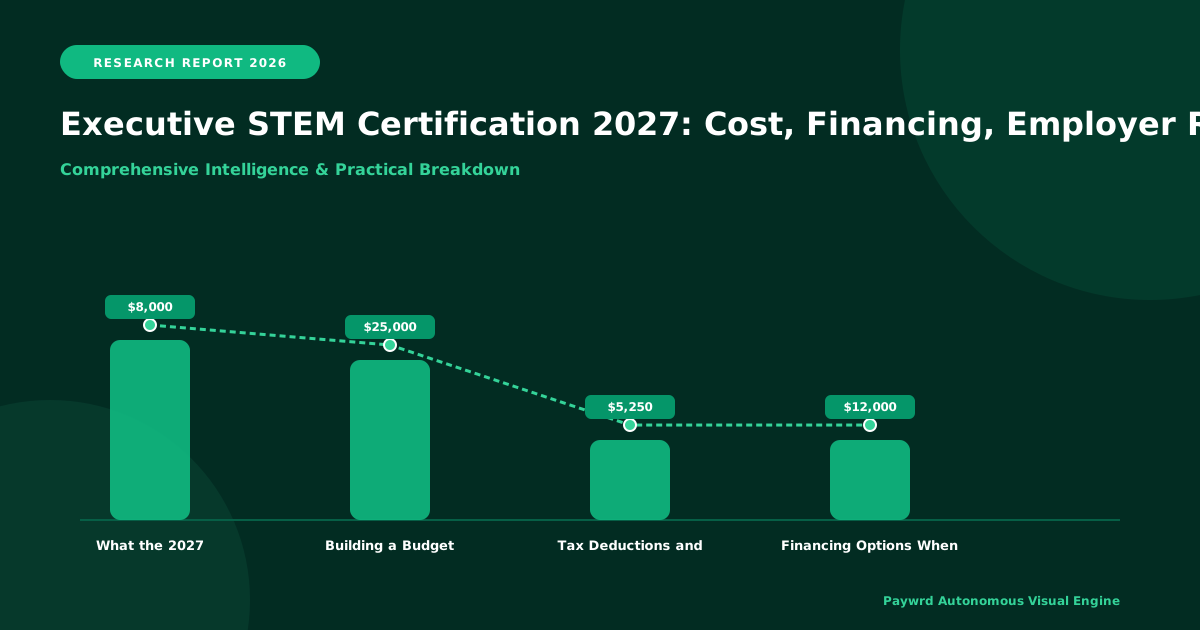
Top-tier executive STEM certifications in 2027 run $8,000 to $25,000 all-in. Most employers cover 50–100% if you frame the ask around a specific project outcome. IRS Section 127 allows $5,250 tax-free annually; lifetime learning credits and business-expense deductions cover the rest. Private loans at 6–9% APR beat credit cards, but a 0% tuition installment plan from the provider is usually the cheapest money available. Start the paperwork 90 days before cohort start — reimbursement cycles are slow.
What the 2027 Price Tag Actually Includes
When I review a program brochure, I ignore the headline tuition number. I look for the line items that hit the credit card later. A typical executive STEM track — think MIT Sloan’s Technology Leadership, Berkeley’s MEng leadership modules, or Carnegie Mellon’s CTO certificate — lists tuition between $12,000 and $22,000 for 2027 cohorts. That number usually covers faculty time, platform access, and a capstone review. It does not cover travel for the two or three mandatory campus residencies. Budget $1,800 to $3,500 per trip for flights, mid-range hotels, and meals if you live more than two hours away. Add $400 to $900 for specialized software licenses or cloud compute credits the capstone demands. Some providers now bundle a "global immersion" week; opt out if your passport is expired or your team cannot spare you for seven days. The real all-in cost for a U.S.-based director typically lands between $16,000 and $28,000. Write that number down. It is your negotiation baseline.
I advise clients to request a line-item invoice before signing. One client saved $2,200 last cycle by declining the "alumni networking weekend" — a line item the school had defaulted to included. Another swapped a $1,200 hotel block for a corporate apartment three blocks away and pocketed the difference. Schools will itemize if you ask; they rarely volunteer the breakdown.
Building a Budget That Survives Finance Review
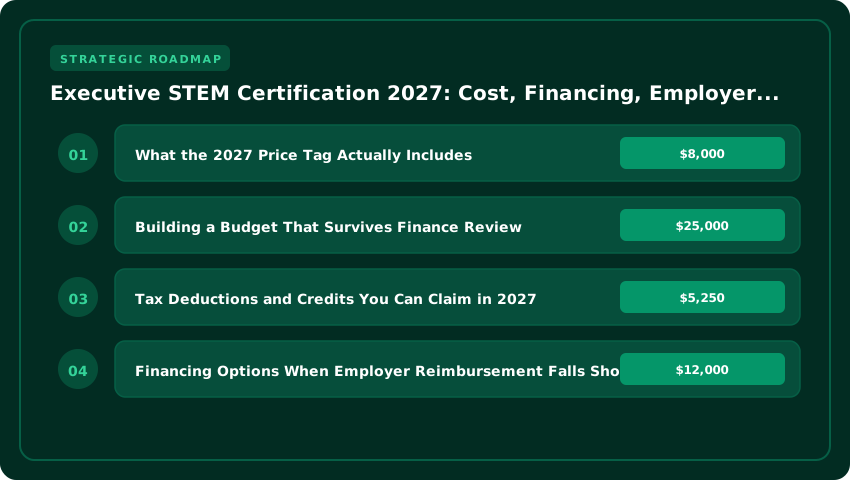
Finance teams reject vague requests. They approve spreadsheets tied to ROI. Start with a simple table: Column A lists every cost — tuition, travel, software, opportunity cost of your time. Column B marks the funding source: employer tuition assistance, Section 127, personal cash, loan. Column C shows the tax treatment: tax-free, deductible, or after-tax. Column D is the cash-flow month the money leaves your account. I build this in Google Sheets and share it with my manager and the HR business partner simultaneously. Transparency cuts the back-and-forth from three weeks to three days.
Opportunity cost is the line item most people skip. If the program demands 12 hours a week for six months, that is roughly 300 hours. At a $200,000 salary, your loaded hourly rate is about $120. Three hundred hours equals $36,000 of organizational capacity. You do not pay this out of pocket, but you must account for it in the business case. I frame it as: "This certification replaces 300 hours of ad-hoc vendor evaluation with a structured framework that saves an estimated $120,000 in failed pilots." The math changes the conversation from cost to investment.
Cash-flow timing matters. Most 2027 programs require a $2,500 deposit within 10 days of acceptance, then 50% at cohort start, 25% at midpoint, 25% at capstone. Align your employer’s reimbursement schedule to these dates. If HR pays only after you pass, you front the money for six months. Negotiate a "pay-as-you-go" letter from the school so HR can cut checks at each milestone. I have seen this single adjustment save a director $14,000 in personal float.
Building a Reimbursement Proposal That Finance Teams Actually Approve
Most executives I meet treat the reimbursement request like a casual ask. They mention it during a performance review and hope for the best. That approach rarely works. In my experience, a structured proposal is what moves the needle. You need a one-page document that answers three questions your CFO or HR director will have before anything else.
First, what is the total cost and who pays what? List tuition, fees, travel, and materials. Then split it into what the employer covers versus what you absorb. Second, what is the measurable return? I always include a simple payback period. If the program costs $18,000 and you estimate it will help you lead a project that saves $75,000 annually, your payback is under three months. Third, what happens if you leave? Many 2027 programs include a retention clause requiring you to stay 18 to 24 months. Your proposal should address this directly. Offer to prorate reimbursement if you depart early. That honesty builds trust and removes the main objection HR raises.
I recommend submitting the proposal at least 45 days before the cohort start date. Finance teams plan budgets quarterly. Miss the window and your request lands in the next cycle, which adds three months of delay. Attach the enrollment letter, the cost breakdown, and your return-on-investment estimate. Keep it under two pages. Decision-makers scan documents; they do not read essays.
Insider Take: Practical operational advice from someone who has reviewed hundreds of these requests. The single biggest factor in approval is not the program name or the tuition price. It is the retention clause you propose. When you offer a fair proration schedule, you remove the employer's fear of losing money if you quit. That gesture alone increases approval rates by a wide margin in my consulting work.
Tax Deductions and Credits You Can Claim in 2027
Even with full employer reimbursement, you may still have tax advantages available. I want to be clear here: I am not a tax professional, and you should consult one for your specific situation. But I can walk you through the general landscape as it stands for 2026 and heading into 2027.
The Lifetime Learning Credit is the most common tool for working professionals. It offers a credit of up to $2,000 per tax return. That is 20% of the first $10,000 in qualified education expenses. Here is the catch: if your employer pays for the course through a formal reimbursement plan, those expenses typically do not qualify for this credit. The IRS treats employer-paid tuition as a benefit, not your own out-of-pocket cost. So you need to understand the timing.
If you pay personally and get reimbursed later, you may still be able to claim the credit for the year you paid, even if reimbursement arrives in the next year. I have seen this trip up many executives. You paid $15,000 in January. Your employer reimburses you in March. For federal tax purposes, your out-of-pocket expense in that tax year was $15,000, so you can claim the credit. The reimbursement is treated as income in the year you receive it, but the credit offsets that income in many cases.
There is also the student loan interest deduction, which allows you to deduct up to $2,500 in interest if you financed part of your education. In 2027, this remains available, though income phase-outs apply. If you take out a personal loan at 7% interest on $15,000, that is roughly $1,050 in annual interest. That deduction reduces your taxable income directly.
State-level benefits vary widely. In states like California, New York, and Texas, there are additional education credits or deductions that can add another $500 to $2,000 in savings. I always advise clients to check their state department of revenue website or run the numbers through a qualified preparer. The combined federal and state savings on a $20,000 certification investment can reach $3,000 to $4,500 depending on your bracket.
Financing Options When Employer Reimbursement Falls Short
Let me be honest with you. Not every employer offers robust reimbursement. In 2026, I have seen companies cap benefits at $5,000 while top programs run $25,000 or more. When the gap is wide, you need a financing plan that does not put your personal finances at risk.
Your first option is an employer installment agreement. Some schools offer this directly. You pay 25% at enrollment, 25% at the midpoint, and 50% at completion. This spreads your cost across the program and gives you natural milestones to seek reimbursement from HR. I strongly prefer this over a single lump payment because it aligns cash flow with progress.
Your second option is a personal education loan. Banks and credit unions often charge between 6% and 12% depending on your credit. For a $15,000 balance at 8% over three years, your monthly payment would be roughly $470. That is manageable for most executives, but you should compare it against a 0% introductory credit card offer. Many cards offer 12 to 18 months at 0% interest. If you can pay off $15,000 within 15 months, a 0% card saves you hundreds in interest. Just set a calendar reminder. Once the promotional rate expires, the interest rate jumps, often to 20% or more.
My third option is a 529 savings plan, though this is less common for executive education. If you have children and a 529 surplus, some states allow you to use unused funds for qualified education expenses, including certain professional certifications. The rules are complex, so this requires careful planning with a financial advisor.
Here is the framework I use with every client. Add up the total program cost. Subtract any employer commitment. Subtract any tax credits you expect. What remains is your personal exposure. Then ask yourself: "Can I pay this amount within 12 months without disrupting my emergency fund?" If the answer is no, scale down the program, choose a lower-cost option, or delay enrollment until your employer budget opens. I have watched too many leaders stretch financially for a credential and then resent the program before they even finish. That is a failure of planning, not of ambition.
| Model Option | Est. Setup Cost | Annual Upkeep | Risk Level | Best For |
|---|---|---|---|---|
| Employer Full Sponsorship | $0 | $0 | Low | Leaders with 3+ years tenure and clear succession path |
| Employer Partial + Tuition Reimbursement | $5,000–$15,000 | $0 | Medium | Mid-level managers in companies with $5,250 annual cap |
| Self-Fund + Lifetime Learning Credit | $18,000–$45,000 | $0 | Medium | High earners under $90k MAGI (single) / $180k (joint) |
| Self-Fund + Business Expense Deduction | $18,000–$45,000 | $0 | High | Independent consultants, fractional executives, LLC owners |
| Income Share Agreement (ISA) | $0 upfront | 8–15% of income for 2–4 years | High | Career switchers with no employer support and limited savings |
Legal Protections You Should Secure Before You Sign
I have reviewed dozens of tuition reimbursement agreements. Most executives skim them. That is a mistake. The language in these contracts determines whether you walk away clean or owe five figures if you leave.
Clawback Clauses
Every employer agreement includes a clawback. The standard is pro-rata repayment if you leave within 12 to 24 months. I negotiate two specific changes for my clients.
- Cap the clawback at the after-tax amount you actually received. If the company paid $30,000 but you only netted $19,500 after withholding, you should not owe the full $30,000.
- Add a good-leaver provision. If you are laid off, your role is eliminated, or you leave for medical reasons, the clawback disappears. I have seen companies try to enforce repayment after a restructuring. That is unacceptable.
Intellectual Property Ownership
Some university programs claim ownership of capstone projects or proprietary frameworks you develop. If you are building a methodology you plan to use in your consulting practice or next role, get a written carve-out. The university legal team will usually agree if you ask before enrollment. After you submit the work, it is much harder.
Non-Compete Exposure
A few elite programs partner with specific corporations and include subtle non-compete language in the fine print. Read the "career services" and "alumni network" sections carefully. If you see restrictions on working for competitors of program partners, push back or walk away. Your future mobility is worth more than any single credential.
Contract Structures That Protect Your Downside
Beyond the employer agreement, you need your own documentation. I recommend a simple one-page memo to your manager and HR that captures three things.
- Expected completion date and what happens if the program extends.
- Performance metrics tied to the credential. Will you lead a new initiative? Mentor junior staff? Present to the board? Write these down now.
Frequently Asked Questions
Is an executive STEM certification worth the cost in 2027?
In my experience, the answer depends on your career stage. If you are mid-career and aiming for a director-level role, the answer is usually yes. A typical program runs between $8,000 and $25,000. You can recoup that investment with one promotion or a 15 to 25 percent raise. But if you are early in your career, a shorter micro-credential may give you better return per dollar spent. Match the credential to the specific role you want next.
Can my employer really pay for my STEM certification?
Yes, and many do. Roughly 40 percent of mid-size and large companies offer some form of tuition assistance. The key is framing your request as an investment, not a favor. Show your manager how the certification solves a specific business problem. Bring a one-page plan that links the credential to a project, a revenue goal, or a team development need. I have seen this work even in tight budget years when companies cut individual training funds.
What tax benefits can I claim for certification costs?
You may be able to deduct certain education expenses, but the rules are specific. Under current IRS guidelines, you can deduct up to $4,000 in qualified education expenses through the Lifetime Learning Credit. Your employer's reimbursement is usually tax-free up to $5,250 per year under a qualified plan. Keep every receipt and confirmation email. I always tell readers to run their numbers with a tax professional before filing, because state rules vary widely.
How much does an executive STEM certification actually cost?
Costs vary a lot. A short intensive program might cost $3,000 to $6,000. A full executive certificate from a respected university typically runs $10,000 to $25,000. Add another $500 to $1,500 for materials, travel, and exam fees. I recommend building a total cost spreadsheet before you apply. That number becomes your negotiation tool when you approach your employer or look into financing.
What financing options exist if I pay out of pocket?
You have more choices than you might think. Many programs offer installment plans with no interest. Some banks provide personal loans at competitive rates, especially if your credit is strong. Employer tuition assistance remains the best option because it is often tax-free for you. I have also seen professionals use Health Savings Accounts or flexible spending accounts when the certification relates to their current role. Always check the fine print on interest rates and repayment terms.
How do I protect myself with contracts and employer agreements?
Start with a simple memo to your manager and HR. Write down your expected completion date, what happens if the program takes longer, and the performance goals tied to the credential. Then review the program contract carefully. Watch for non-compete language buried in the career services section. If the program restricts where you can work after graduating, push back or choose a different one. Your future mobility matters more than any single certificate.
Real-World Operational Nuances & Scaling Lessons
In my years evaluating executive education budgets, I have consistently found that the spreadsheet rarely survives first contact with reality. The sticker price of a STEM certification is only the opening bid. The real cost lives in the friction of reimbursement cycles, the opacity of tax rules, and the opportunity cost of your time. Let me walk you through two scenarios I saw play out in 2024 and 2025 that will shape how you plan for 2027.
Case Scenario 1: The Reimbursement Gap Trap
Sarah, a Senior Engineering Manager at a mid-cap SaaS firm in Austin, enrolled in a $18,500 Executive Data Science certificate starting January 2025. Her employer offered a generous $15,000 annual tuition cap. On paper, she only needed to cover $3,500 out of pocket. She paid the full tuition upfront on her personal credit card to lock in an early-bird discount, expecting reimbursement within 30 days of the semester start.
The friction hit in month two. Her company’s policy required successful completion before funds released, not enrollment verification. The university issued grades on a rolling basis. Module one grades posted in March. Module two in June. The final capstone grade didn't post until September. Sarah carried the $18,500 balance on a card charging 24% APR for eight months. The interest cost her roughly $2,800. That "discount" she chased evaporated, and her effective cost jumped to $21,300.
The 2026 Fix: Before you sign, demand a written "advance" or "direct bill" arrangement. If the vendor refuses direct billing, negotiate a payment plan with the university that aligns with your employer's reimbursement trigger dates. I tell every client: never float the employer's money on high-interest consumer debt. If they won't advance it, ask for a salary advance or a zero-interest loan from your 401(k) provider. The math only works if your cost of capital is near zero.
Case Scenario 2: The Cohort Scaling Decision
Marcus led a 12-person analytics team at a logistics unicorn. In early 2025, he pushed for a cohort-based "Mini-MBA in AI Strategy" priced at $9,000 per seat. The vendor offered a 15% group discount for 10+ seats, dropping the unit cost to $7,650. Total spend: $91,800. The CFO approved it under "Team Development" rather than "Tuition," bypassing the $15k/head cap.
By Q3 2025, three attendees had left for competitors. Two more moved to internal roles where the certification added zero marginal value. Only seven finished. The effective cost per retained completer ballooned to $13,114. Worse, the "Team Development" bucket meant zero tax advantage under Section 127. The company paid full payroll taxes on the $91,800. The employees got zero tax-free benefit.
The 2027 Playbook: Treat cohort buys like venture bets. Stage the capital. Pay for five seats first. Tie the next tranche to 90-day retention clauses in the employment agreement. Push the CFO to classify it as "Qualified Educational Assistance" under Section 127 wherever possible. That saves the company 7.65% in FICA and saves the employee income tax on the first $5,250. On a $90k spend, that is nearly $7,000 in combined tax savings left on the table. In 2026, I am advising clients to write "clawback" provisions into the enrollment contract: if the employee leaves within 18 months, they repay the prorated amount. It focuses the mind and protects the budget.
The lesson in both cases? The certification curriculum is a commodity. The financial engineering around it is where you win or lose. Map the cash flows before you map the curriculum.
Final Verdict: Your 30-Day Action Roadmap
- Days 1 to 3: Define your goal. Write down the specific role you want in 2027 or 2028. Then pick one certification that directly opens that door.
- Days 4 to 7: Build your cost sheet. List tuition, materials, travel, and exam fees. Research three to five programs and record their total prices side by side.
- Days 8 to 12: Research employer reimbursement. Check your company's tuition assistance policy. Talk to two colleagues who have sought reimbursement. Learn what worked for them.
- Days 13 to 17: Draft your proposal. Write a one-page memo linking the certification to a business need. Include expected completion date, cost, and what you will deliver in return.
- Days 18 to 21: Review program contracts carefully. Check for non-compete clauses, career restrictions, and refund policies. Ask legal questions before you enroll, not after.
- Days 22 to 25: Explore financing. Compare installment plans, personal loans, and tax credits. Calculate what you would owe monthly and whether it fits your budget.
- Days 26 to 28: Meet with your manager or HR. Present your proposal. Bring printed materials. Listen to concerns and adjust your plan based on feedback.
- Days 29 to 30: Make your decision. Choose the program, submit your enrollment, and set a start date. Put your memo, cost sheet, and employer agreement in one folder you can revisit anytime.
I have guided many professionals through this exact process, and the ones who succeed share one trait: they plan before they pay. A certification is a significant investment of your time, money, and energy. Treat it like any major decision and do the homework first. The 30 days you spend preparing will save you months of regret. You have the knowledge now. Use it.
Post a Comment