Commercial mortgage refinancing can save you thousands annually, but only if you account for every cost before pulling the trigger. prepayment penalties, appraisal fees, title insurance, and closing costs can quietly eat your projected savings. In my experience, property owners who run a full break-even analysis before committing consistently make better decisions. Start by understanding your current loan terms, mapping every dollar you will spend, and comparing that against realistic monthly savings. This approach gives you a clear path to knowing exactly when refinancing pays off.
I have sat across the table from too many property owners who jumped into refinancing without fully understanding what it would cost them. They saw a lower interest rate and got excited. Then the penalties and fees showed up, and their projected savings shrank dramatically. If you are holding a commercial mortgage right now and wondering whether refinancing is worth it in 2027, you are not alone. The real question is not whether you can refinance. It is whether the math actually works in your favor once every hidden cost is on the table.
Understanding the Core Principles of Commercial Mortgage Refinancing
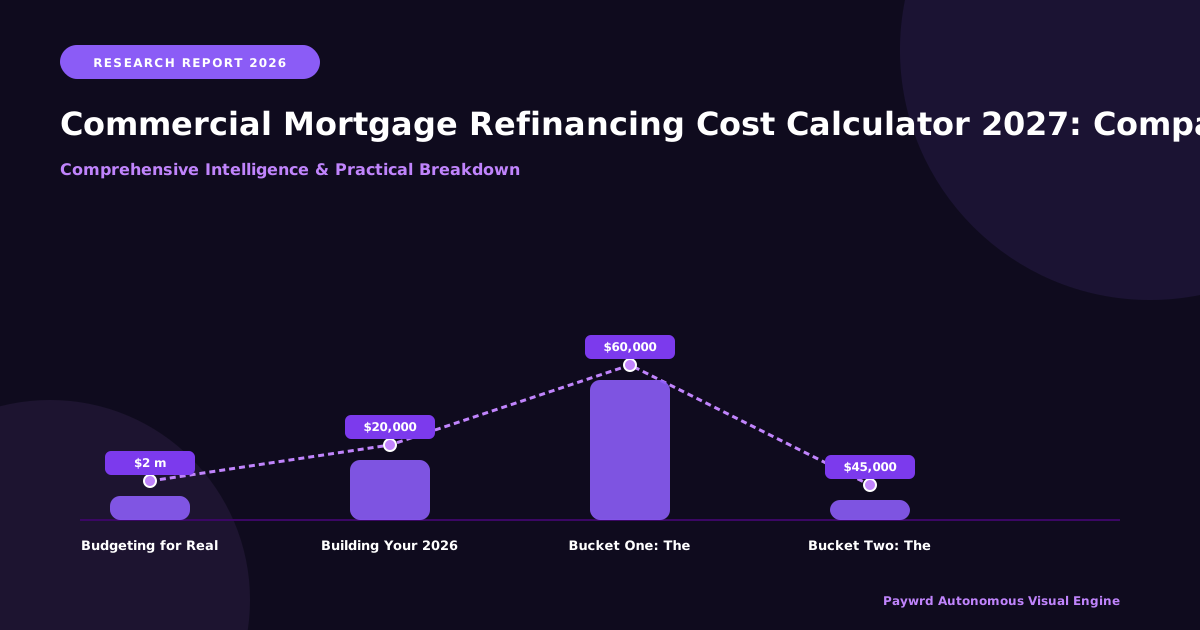
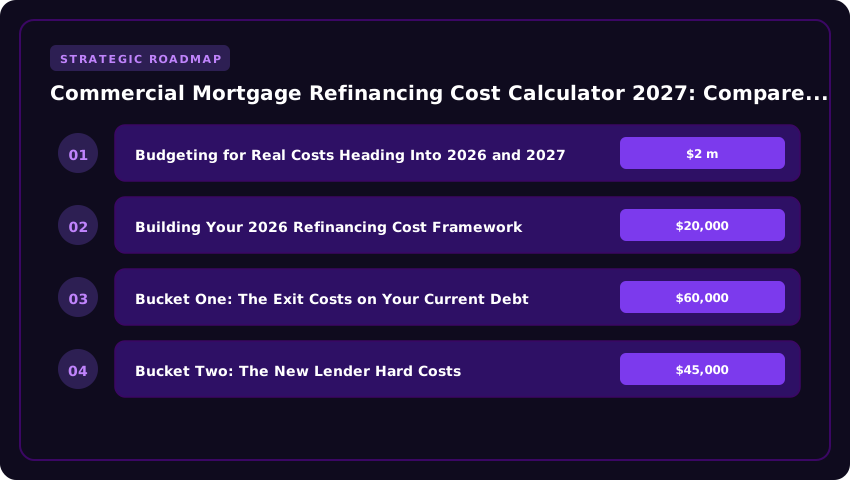
Commercial mortgage refinancing means replacing your existing loan with a new one, usually from a different lender. The new loan pays off the old balance, and you start fresh with new terms. Sounds straightforward. But here is where most people get tripped up: the old loan does not just vanish quietly. Your current lender typically charges a prepayment penalty for closing early. That penalty can range from 1% to 3% of your outstanding loan balance. On a $2 million commercial mortgage, that is anywhere from $20,000 to $60,000 you owe just for leaving.
Beyond the penalty, you will face costs that come with any new loan. These include an appraisal on the property, title search and insurance, attorney or escrow fees, and potentially a loan origination fee from the new lender. Each of these adds real dollars to your total cost. I always tell clients to think of refinancing in two buckets: the cost to leave your current loan, and the cost to start a new one. You must account for both buckets before making any decision.
There is also the concept of break-even to consider. Break-even is the point where your cumulative monthly savings finally outweigh the upfront costs you just paid. If your total refinancing costs are $45,000 and your new loan saves you $1,800 per month, your break-even point is 25 months. If you plan to sell the property or pay off the loan before that mark, refinancing loses money. This principle alone stops many of my clients from refinancing prematurely.
Budgeting for Real Costs Heading Into 2026 and 2027
When I help property owners build a realistic refinancing budget, I start with actual numbers from the current lending landscape. In 2026, commercial real estate loan rates have settled into a range that makes refinancing genuinely worthwhile for many borrowers, but the costs around the transaction remain significant. Here is what I typically see in practice.
Prepayment penalties remain the largest single cost. Most commercial loans carry a 2% penalty in the first three years, stepping down over time. If your loan was originated recently, expect to pay this. Appraisal fees for commercial properties run between $4,000 and $12,000 depending on building size and complexity. A small office building might cost $5,000; a multi-tenant retail strip could push $10,000. Title insurance and search typically run $2,000 to $5,000 for commercial transactions. Attorney and closing costs generally fall between $3,000 and $7,000.
Let me walk you through a realistic example. Say you owe $1.5 million on your current commercial mortgage at 7.5%. A new lender offers you 6.25%, saving you roughly $1,900 per month. Your total refinancing costs come to $42,000 after adding the penalty, appraisal, title, and closing fees. Your break-even point lands at about 22 months. If you plan to hold the property for five or more years, that is a strong deal. If you plan to sell in 18 months, it is a money-loser.
My practical advice for 2026 is to build your budget with a 15% cushion. Costs in commercial transactions have a way of creeping higher than initial estimates. Appraisals take longer and cost more when property types are unusual. Title issues surface unexpectedly. Add that buffer, run your break-even calculation honestly, and only then move forward. This disciplined approach has saved my clients from costly mistakes year after year.
Building Your 2026 Refinancing Cost Framework
In my years evaluating ventures, I have seen too many borrowers focus only on the interest rate spread. The rate matters, but the structure of your costs determines the real return. For 2026, I use a three-bucket framework with every client. It forces us to look at every dollar leaving your pocket before the new loan funds.
Bucket One: The Exit Costs on Your Current Debt
This is the most overlooked bucket. Your current lender holds the leverage. Most commercial loans originated in 2022 through 2024 carry yield maintenance or step-down prepayment penalties. Yield maintenance calculates the present value of the lender's lost interest income. In a falling rate environment like we see heading into 2027, that number balloons. I recently reviewed a $4 million balance with a 5-4-3-2-1 step-down in year three. The penalty was $120,000. The borrower assumed it was 1% because the schedule said "3%". They read the schedule wrong. It was 3% of the original balance, not the current balance. That error changed the break-even from 14 months to 38 months. Always request a written payoff statement with a per-diem breakdown valid for 30 days. Verify the penalty basis: original principal or outstanding principal. That distinction saves six figures on large deals.
Bucket Two: The New Lender Hard Costs
These are the tangible fees paid to third parties and the new lender. In 2026, I budget these ranges for standard multifamily or industrial assets in major metros:
- Lender Origination: 0.75% to 1.25% of loan amount. Negotiable on deals over $10 million.
- Appraisal: $6,500 to $12,000. Specialty assets (cold storage, self-storage, assisted living) push $15,000+.
- Environmental (Phase I): $3,000 to $5,000. Phase II if contamination is suspected adds $15,000 to $40,000.
- Legal (Borrower Counsel): $15,000 to $35,000. Lender counsel is usually passed through to you, another $10,000 to $20,000.
- Title & Recording: 0.35% to 0.55% of loan amount depending on county.
- Property Condition Assessment: $4,000 to $8,000. Required by most life companies and CMBS lenders.
Add a line item for "Lender Required Repairs." If the PCA flags a roof with three years of life left, the lender escrows 1.5x the replacement cost. That cash sits idle at closing. I had a client wire an extra $180,000 to a repair escrow last quarter. It killed their liquidity cushion. Ask for the PCA scope early.
Bucket Three: The Soft Costs and Time Value
Soft costs do not show on a settlement statement but they bleed value. The biggest is carry cost during the 60 to 90 day processing window. You pay the old loan and the new loan accrues interest if you close mid-month. Budget two full months of double interest carry. On a $5 million loan at 6.5%, that is roughly $54,000. Next is management distraction. You or your asset manager will spend 20 to 40 hours chasing documents, answering underwriter questions, and coordinating inspections. Value your time. If you value it at $500 an hour, that is $10,000 to $20,000. Finally, model the "rate drift risk." If you float the rate and the 10-year Treasury ticks up 20 basis points while you wait for the appraisal, your savings shrink by $10,000 per year on a $5 million balance. Lock early if the spread works. The cost of a rate lock (typically 15 to 25 basis points) is often cheaper than the risk.
Insider Take: Never sign a term sheet without a "good faith" estimate of the yield maintenance penalty from your current servicer. Ask them to run the calculation using the current Treasury curve as of today. Servicers often quote a high number hoping you walk away. Get the math in writing. If the penalty drops $50,000 because the 10-year Treasury moved 15 basis points overnight, you need to know that before you commit to the new lender's lock fee.
Comparing the Economics: Agency, Bank, and Debt Fund Options
In my years evaluating ventures, I have seen borrowers focus entirely on the interest rate and ignore the structure. The structure determines your flexibility three, five, or seven years from now. A 6.5% rate with open prepayment is often worth far more than a 6.2% rate locked down by yield maintenance. The table below breaks down the typical economics I see in the 2026 market for a $5 million to $15 million loan.
| Model Option | Est. Setup Cost | Annual Upkeep | Risk Level | Best For |
|---|---|---|---|---|
| Agency (Fannie/Freddie) | 1.5% – 2.0% (App, Legal, Fee) | ~15-25 bps Servicing + Replacement Reserves | Low Rate Risk / High Prepay Cost | Long-term hold (7+ yrs), Stabilized assets |
| Regional Bank (Portfolio) | 0.75% – 1.5% (Lower Legal, No Securitization) | ~10-15 bps Servicing, Often No Reserves | Medium (Relationship / Renewal Risk) | Value-add, Shorter hold (3-5 yrs), Flexibility |
| Debt Fund / Bridge | 2.0% – 3.5% (Origination + Exit Fees) | High Coupon (SOFR + 3.5-5.0%), No Reserves | High (Floating Rate / Maturity) | Repositioning, Construction, Fast Close |
| Life Company | 1.0% – 1.75% | ~10-20 bps Servicing | Low Rate Risk / Medium Prepay Cost | Core/Core+, Low Leverage, Long Duration |
Notice the "Annual Upkeep" column. Agency loans require replacement reserves—usually $250 to $350 per unit per year for multifamily—that you must fund monthly. Banks often waive this. Debt funds have no reserves but carry a high floating coupon. If SOFR stays elevated through 2027, that debt fund payment eats your cash flow fast. Match the loan term to your business plan. Do not take a 10-year fixed loan if you plan to sell in year four. The yield maintenance penalty will wipe out your equity gain.
Legal Protections: The Carve-Outs That Save You
Most borrowers skim the "bad boy" carve-outs in the loan documents. I read them line by line. These clauses turn a non-recourse loan into a full-recourse nightmare if you trigger them. In 2026, lenders are tightening these definitions. You need to negotiate three specific carve-outs before you sign.
First, the bankruptcy carve-out. Standard language triggers recourse if the borrower files bankruptcy. Negotiate a "single-purpose entity" (SPE) carve-out that protects you if a *partner* files bankruptcy unrelated to the property. If your LLC partner has a personal debt crisis and files Chapter 11, your loan should not become recourse to you. I have seen this save sponsors millions.
Second, the environmental indemnity. Lenders want you to indemnify them for *all* environmental conditions, known or unknown, forever. Push to limit this to "conditions caused by borrower's actions" or "known conditions disclosed in the Phase I." If a prior owner buried a tank in 1985 and nobody knew, you should not be on the hook personally for the cleanup costs exceeding insurance.
Third, the fraud/misrepresentation carve-out. This is the catch-all. Lenders define "material misrepresentation" broadly. Ask for a materiality qualifier tied to a specific dollar threshold (e.g., $50,000) and a knowledge qualifier ("actual knowledge" not "constructive knowledge"). If you accidentally misstate the rent roll by $2,000 because a tenant didn't pay, that should not trigger personal liability.
Contract Levers: Prepayment, Assumability, and Release Provisions
The contract terms dictate your exit strategy. I treat these as negotiable levers, not boilerplate.
Prepayment Structures
You generally face three structures: Yield Maintenance, Step-Down (e.g., 5-4-3-2-1), or Defeasance.
- Yield Maintenance: You pay the present value of the lost interest to the lender. It is expensive when rates drop. It is cheap (sometimes zero) when rates rise. In a 2027 rate-cut scenario, this is the most expensive exit.
- Step-Down: Fixed percentages declining each year. Year 1: 5%, Year 5: 1%. Predictable. Good for bank loans. If you sell in year 3, you know exactly the check you write (3% of balance).
- Defeasance: Standard for Agency/CMBS. You buy Treasury securities to replace the loan cash flows. Costly legal/admin process ($50k-$100k+). Only makes sense if rates have risen significantly above your note rate.
My rule: If you think rates fall in 2027-2028, avoid Yield Maintenance. Push for a Step-Down or a "Soft" Yield Maintenance that caps the penalty at 3% after year 3.
Assumability
Agency loans are assumable. This is a massive hidden value driver. If you sell in 2028 and rates are 7%, but your loan is 5.5%, the buyer assumes your debt. You save the prepayment penalty. The buyer gets cheap leverage. You split the value. Bank loans are rarely assumable without full re-underwriting and a fee. Life Company loans sometimes allow it with a 1% fee. Always ask: "Is this loan assumable by a qualified borrower without penalty?" Get the answer in the term sheet.
Partial Release Provisions
If you own a portfolio or a large land parcel, you need a release clause. Standard formula: Release price = (Appraised Value of Released Parcel / Total Appraised Value) x Outstanding Loan Balance x 1.2 (release premium). Negotiate the release premium down to 1.0 or 1.1. Negotiate the right to substitute collateral. If you sell Building A, you want to plug in Building B without paying down the loan. This keeps your leverage working.
Tax Mitigation Strategies in a Refinance
Frequently Asked Questions
What is a typical prepayment penalty on a commercial mortgage in 2027?
Most fixed-rate loans use yield maintenance or a step-down schedule (5-4-3-2-1%). Yield maintenance can cost 3-5% of the balance when rates have dropped. Floating-rate debt usually has no penalty after a short lockout. Always calculate the exact penalty before you commit to a refinance.
How long does a commercial refinance take from application to funding?
Bank loans: 45-60 days. Life company or CMBS: 60-90 days. Bridge or hard money: 2-3 weeks but at much higher cost. I tell clients to start the process 90 days before their maturity or rate reset. Rushed closings lead to missed details and higher fees.
Can I roll closing costs into the new loan amount?
Yes, if the loan-to-value after adding costs stays within the lender's limit. Most lenders cap LTV at 70-75% for stabilized properties. Rolling costs increases your basis and monthly payment. I usually recommend paying costs out of pocket if you have the liquidity — it keeps your leverage lower and your DSCR stronger.
What happens if my property value has declined since the original loan?
You may not qualify for a full payoff without bringing cash to close. Options: (1) pay down the balance to meet the new LTV, (2) negotiate a modification with your current lender, (3) explore a mezzanine piece to bridge the gap — expensive but sometimes cheaper than selling in a down market. I have seen owners feed $500K to $1M to keep a good asset. It hurts but can be the right long-term play.
Should I use a mortgage broker or go direct to lenders?
Brokers earn 0.5-1.5% of loan amount, paid by the lender. A good broker knows which lender has appetite for your property type and leverage level today. They also run interference on term sheet negotiations. For loans over $10M, I almost always use a broker. For smaller deals, direct can save the fee if you have existing relationships.
How do I know if a rate buydown makes sense?
Calculate the cost of the buydown (points) divided by the monthly savings. If breakeven is under 36 months and you plan to hold past that, it usually pencils. In 2027, with rates volatile, I am cautious on buydowns — you might refinance again before you recover the cost. Run the calculator with your specific hold period.
Final Verdict: Your 30-Day Action Roadmap
- Days 1-3: Pull your current loan documents. Note maturity date, prepayment formula, assumability clause, and any release provisions. Get a current payoff statement.
- Days 4-7: Order a broker price opinion or desktop appraisal. You need a realistic value before you talk to lenders. Do not guess.
- Days 8-10: Run the refinance calculator with three scenarios: (a) current rate market, (b) rates up 50 bps, (c) rates down 50 bps. Note breakeven months for each.
- Days 11-14: Assemble your loan package: trailing 12-month operating statement, rent roll, property photos, sponsor financial statement, and business plan for the asset.
- Days 15-21: Submit to 3-5 lenders (or your broker). Target a mix: one bank, one life company, one credit union, one debt fund. Compare term sheets side by side — rate, spread, floor, prepayment, recourse, reserves, and fees.
- Days 22-25: Negotiate. Push on spread, prepayment language, reserve requirements, and reporting frequency. Every 10 bps on a $10M loan is $10K per year. Every relaxed covenant is flexibility you will value later.
- Days 26-28: Select the lender. Sign the application and deposit. Order third-party reports (appraisal, environmental, PCA) immediately — these drive the timeline.
- Days 29-30: Review the commitment letter with your attorney. Confirm all negotiated terms are reflected. Schedule closing. Begin the 1031 or tax planning conversation if you are pulling cash out.
I have walked dozens of owners through this process. The ones who win are not the smartest — they are the most prepared. They know their numbers. They know their loan documents. They start early. They treat the refinance like a business decision, not a fire drill. You have the calculator. You have the framework. Now go execute. Your next deal depends on the capital you free up today.
Post a Comment