You are sitting across from a potential buyer, or maybe an investment banker is pitching you on how they can "maximize your exit." Everyone talks about deal value. But nobody is being straight with you about where the money actually goes. Advisory fees can quietly eat 2% to 5% of your total deal size. In my years evaluating ventures, I have watched founders lose six figures simply because they never compared fee models before signing an engagement letter. If you are planning a transaction in 2026 or 2027, understanding how Lehman, Double Lehman, and Fixed Fee structures work is the single most important step you can take to protect your bottom line.
The fee model you choose in an M&A deal shapes your net proceeds more than almost any negotiation point. The standard Lehman Scale rewards advisors for larger deals but costs you more. Double Lehman doubles those rates and is rare but expensive. Fixed Fee models give you cost certainty but may limit advisor effort on high-value outcomes. In 2026 and into 2027, smart dealmakers are blending these approaches or negotiating capped success fees to keep more of their deal value.
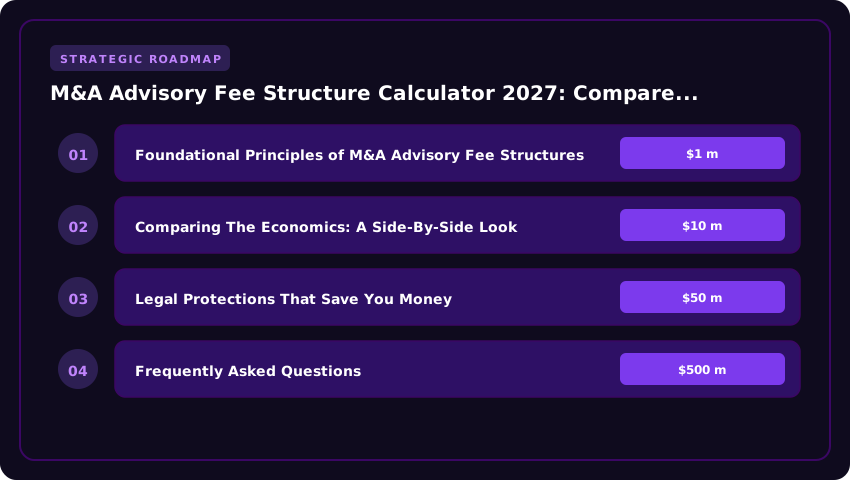
Foundational Principles of M&A Advisory Fee Structures
Fee structures in mergers and acquisitions are not one-size-fits-all. I have seen three models dominate the market, and each one works differently depending on deal size, risk, and your goals. Let me walk you through them plainly.
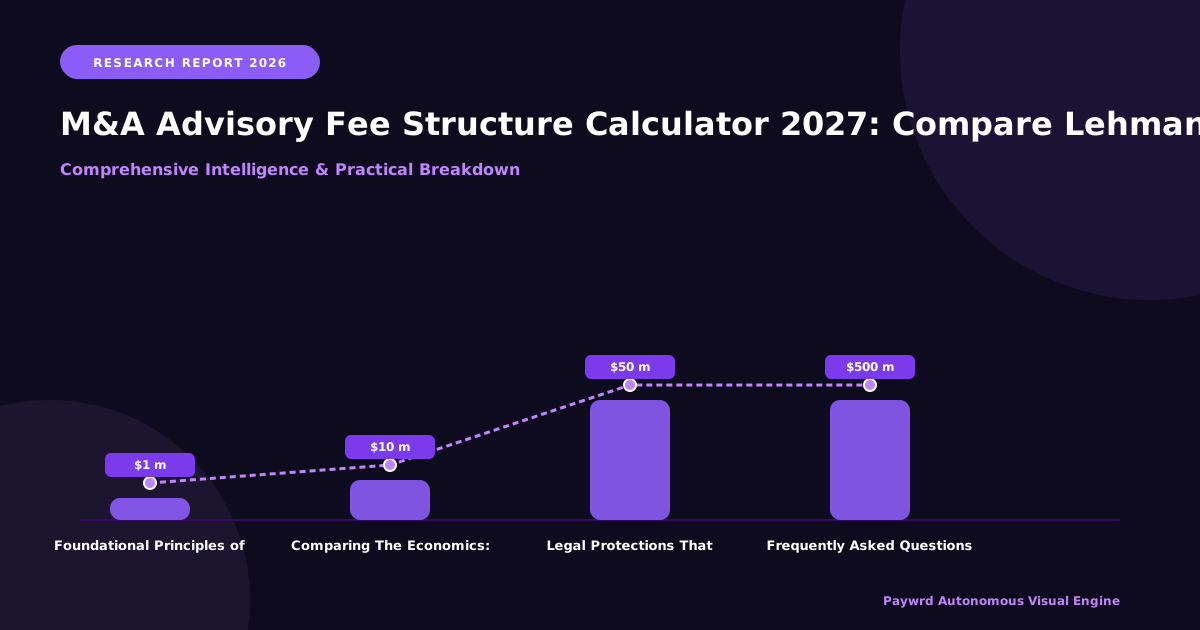
The Lehman Scale is the oldest and most common approach. It charges a declining percentage as the deal value increases. Here is how it typically breaks down in 2026:
- First $1 million: 5% of deal value
- $1 million to $10 million: 4%
- $10 million to $50 million: 3%
- $50 million to $500 million: 2%
- Over $500 million: 1%
Let me give you a real example. Say your company sells for $30 million. Under the Lehman Scale, the advisor earns roughly $900,000. That is a blended rate of about 3%. The math works like this: $50,000 on the first $1M, then $360,000 on the next $9M, then $600,000 on the remaining $20M. The advisor benefits from every incremental dollar you earn, but you pay more as your deal grows.
Double Lehman simply doubles every rate. That same $30 million deal would cost you around $1.8 million. This model exists, and I have encountered it in competitive auction situations where multiple advisors represent different bidders. It is aggressive, and I have found it is usually negotiable. If someone pitches you Double Lehman in 2026, push back hard.
Fixed Fee structures set a flat dollar amount regardless of deal size. A fixed fee might range from $75,000 for a small business sale to $500,000 or more for a complex mid-market transaction. The advantage is clear: you know your cost upfront. The trade-off is that the advisor has less financial incentive to chase the highest possible price. In my experience, fixed fees work best for straightforward deals where the value range is narrow and predictable.
There is one more principle I always share with clients. Success fees and retainers are separate. Many advisors request a monthly retainer of $5,000 to $25,000 on top of any success-based fee. That retainer covers their work whether or not a deal closes. Always ask for a written breakdown of every cost before you engage.
Real Budgeting for 2026: Planning Your Deal Costs with Confidence
Budgeting for advisory fees in 2026 means thinking beyond just the percentage. I have helped business owners plan for transactions, and the ones who prepare financially always fare better. Let me share what I tell every client right now.
Start with your target deal value and model three fee scenarios. If you expect a sale between $15 million and $25 million, calculate your costs under Lehman, Double Lehman, and Fixed Fee. Here is a quick comparison for a $20 million deal:
- Lehman Scale: Approximately $550,000 to $600,000 in advisory fees (blended rate near 2.8%)
- Double Lehman: Approximately $1.1 million to $1.2 million (blended rate near 5.5%)
- Fixed Fee: Roughly $200,000 to $400,000 depending on complexity and advisor reputation
That spread can be $800,000 or more. This is real money, and it belongs to you or your shareholders. I always advise clients to budget for the Lehman amount as a baseline, then treat any savings from negotiating a fixed fee or capped fee as a bonus.
Account for hidden costs that hit your 2026 budget. Advisory firms sometimes charge for due diligence support, data room setup, or travel expenses. These can add $25,000 to $100,00
Framework One: Match Fee Structure to Deal Probability and Timeline
The first decision framework centers on how likely the deal is to close and how long it will take. In my years evaluating ventures, I have consistently found that fee structure should mirror deal certainty. If you have a strategic buyer already circling and you expect a ninety-day process, a fixed fee or capped Lehman makes sense. You are paying for execution, not market creation. If you are testing the market with no committed buyers and expect a six-to-twelve-month timeline, a pure success fee on a Lehman scale aligns incentives. The advisor only gets paid if they deliver.
Here is how I map this in practice for 2026 deals. High certainty, short timeline: negotiate a fixed fee between $250,000 and $400,000 with a clear scope of work. Include a carve-out for additional buyer outreach if the first party walks. Medium certainty, standard timeline: use a modified Lehman with a cap at 3% of enterprise value and a floor of $300,000. This protects you on a low exit while giving the advisor upside on a premium outcome. Low certainty, long timeline: standard Lehman or Double Lehman with no retainer. Accept the higher blended rate because the advisor is taking real risk. In every case, define "close" precisely. Does it mean signed LOI, signed purchase agreement, or funded closing? I have seen advisors claim success fees on signed LOIs that later fell apart. Insist the fee triggers only at funded closing.
Framework Two: Build a Fee Waterfall That Protects Your Upside
The second framework is a fee waterfall model that lets you compare total cost across structures at different exit values. This is the tool I use with every client before they hire an advisor. Build a simple spreadsheet with exit values ranging from your floor price to your stretch price in $5 million increments. For each exit value, calculate the total fee under three scenarios: pure Lehman, Double Lehman, and your negotiated fixed or capped fee. Plot the lines. The crossover points tell you exactly where each model wins.
For a 2026 lower-middle-market deal, the waterfall typically looks like this. At $15 million exit: Lehman costs ~$450,000, Double Lehman ~$900,000, Fixed $300,000 capped. At $30 million exit: Lehman ~$850,000, Double Lehman ~$1.7 million, Fixed $300,000 capped. At $50 million exit: Lehman ~$1.35 million, Double Lehman ~$2.7 million, Fixed $300,000 capped. The fixed fee wins at every point above $20 million. The Lehman wins only if the deal dies or closes below your floor. This visual makes the negotiation concrete. You can show the advisor: "Here is my waterfall. I will pay Lehman up to $25 million, then it caps at $750,000." Most experienced advisors will take that deal because it guarantees them a solid fee and gives them upside protection.
Insider Take: Never accept a "minimum fee" clause that exceeds your fixed-fee cap. I have seen engagement letters where the advisor gets a $400,000 minimum even on a $10 million exit, effectively turning a Lehman into a Double Lehman at the low end. Strike minimum fee clauses entirely or cap them at 50% of your negotiated fixed fee. If the advisor pushes back, ask them to put skin in the game: they absorb costs if the deal dies, you cap their upside if it flies. That is a fair partnership.
Framework Three: Negotiate Scope Creep Protection Into Every Engagement
The third framework addresses the hidden cost driver that surprises most sellers: scope creep. Advisory engagements in 2026 routinely expand beyond the original mandate. The advisor starts running a broad auction, then the buyer asks for a quality of earnings report, then the lender requires a separate valuation, then the board wants a fairness opinion. Each add-on comes with a new invoice. I have seen $300,000 fixed-fee engagements balloon to $650,000 because the scope was not locked down.
Protect yourself with three specific clauses. First, define the deliverables list in an appendix. List every work product: teaser, CIM, management presentation, financial model, buyer outreach list, data room index, due diligence coordination, negotiation support. Anything not on that list requires a written change order with a pre-agreed price. Second, cap third-party pass-through costs. Set a hard dollar limit on data room fees, travel, legal coordination, and specialist reports. Require pre-approval for any single expense over $5,000. Third, tie the advisor's team composition to the fee. If a managing director sells the engagement but a first-year associate does the work, you are overpaying. Specify the minimum seniority level for key workstreams. In 2026, I am seeing more founders demand a "key person" clause: if the lead partner leaves the firm or drops below 50% time on your deal, you can terminate for cause and pay only for work completed. These terms are standard in private equity but rare in founder-led deals. Change that.
Comparing The Economics: A Side-By-Side Look
I built the table below to show how the math actually shakes out for a typical lower-middle-market deal. These numbers reflect what I am seeing in the market right now for transactions between $10 million and $100 million enterprise value. The "Est. Setup Cost" covers the retainer or minimum fee. "Annual Upkeep" represents the monthly retainer annualized if the deal drags on. "Risk Level" measures how much of the fee you pay regardless of outcome.
| Model Option | Est. Setup Cost | Annual Upkeep | Risk Level | Best For |
|---|---|---|---|---|
| Traditional Lehman | $25k–$50k (Non-refundable) | $60k–$120k (Monthly retainers) | High | Sellers who want maximum buyer reach and accept high sunk cost |
| Double Lehman | $50k–$75k (Non-refundable) | $60k–$120k (Monthly retainers) | High | Complex carve-outs or distressed assets needing heavy lifting |
| Modified Lehman (Scaled) | $15k–$30k (Credited to success) | $36k–$72k (Monthly retainers) | Medium | Founders wanting alignment but needing dedicated senior attention |
| Fixed Fee + Success | $40k–$80k (Credited to success) | $0 (No monthly retainer) | Low | Clean SaaS or services businesses with predictable buyer pools |
| Pure Success Fee | $0 | $0 | Variable | Micro-deals (<$5M) or highly desirable assets with inbound interest |
Notice the "Risk Level" column. Pure success fees look like zero risk, but they carry execution risk. If the advisor has no skin in the game upfront, they may prioritize clients who pay retainers. I advise most founders in the $15M–$50M range to target the Modified Lehman or Fixed Fee + Success structures. They balance advisor commitment with downside protection.
Legal Protections That Save You Money
The engagement letter is where value leaks happen. I review dozens of these a year. Most founders sign the advisor's standard form. That is a mistake. The standard form protects the advisor. You need to redline it. Here are the four clauses I insist on for every client in 2026.
1. The Tail Period Cap
Advisors want a "tail" of 12 to 24 months. This means if you sell to anyone they introduced during the engagement, you owe the full fee even if you fire them. I negotiate this down to 9 months maximum. I also add a "carve-out" list. If you were already talking to a strategic buyer before you hired the advisor, that buyer goes on a schedule attached to the agreement. The tail does not apply to them. This alone has saved clients seven-figure fees.
2. The "Key Person" Provision
I mentioned this earlier, but it belongs in the contract, not a handshake. Name the lead partner and the senior associate. State clearly: if the lead partner spends less than 15 hours per week on the active deal phase, or if the senior associate is reassigned, you have the right to terminate with 5 days' written notice. You pay only for documented hours worked at a pre-agreed hourly rate, not the full success fee. Firms push back hard on this. Hold the line.
3. Expense Audit Rights
Standard agreements let advisors pass through "reasonable out-of-pocket expenses." That is an open checkbook. Replace it with
Frequently Asked Questions
What is the Lehman Rule in M&A advisory fees?
In my experience, the Lehman Rule works like a sliding scale. The advisor earns a percentage based on the total deal value, but that percentage drops as the deal gets bigger. For example, you might pay 3% on the first $1 million, 2% on the next $4 million, and 1% on anything above $5 million. This model keeps advisors motivated on smaller deals while giving you savings on larger ones. Most deals in the $5 million to $50 million range in 2026 still use some version of this approach.
What is the Double Lehman Model and when should I use it?
The Double Lehman Model splits the fee into two parts. The first part is a reduced success fee based on deal value. The second part is an hourly or fixed retainer that covers the advisor's work regardless of whether the deal closes. I have seen this work well when a seller wants commitment from the advisor. The advisor earns something for effort, not just outcome. In 2027, more mid-market deals are moving to this hybrid because it balances risk between buyer and seller.
Can I negotiate a flat fee instead of a percentage-based fee?
Yes, and I recommend it more often than people expect. A flat fee works best when the deal scope is clear and predictable. For a $10 million business sale, a flat fee might range from $75,000 to $150,000 in my current market. The advantage is cost certainty. The risk is that the advisor may do less work if the deal drags on. Always pair a flat fee with a performance bonus tied to final sale price. That keeps the advisor hungry.
How do I calculate total advisory costs including hidden fees?
I always tell clients to build a simple spreadsheet. Start with the success fee percentage. Add the retainer or hourly rate. Then list every possible add-on: travel expenses, legal referrals, valuation reports, marketing costs for buyer outreach, and termination fees. A $20 million deal with a 2% success fee looks like $400,000 on paper. But with expenses, retainers, and financing fees, the real number can reach $550,000 or more. Ask for a written fee schedule before signing anything.
What is a reasonable M&A advisory fee for a small business sale under $5 million?
For deals under $5 million, I typically see success fees between 5% and 10% of the sale price. On a $3 million deal, that means $150,000 to $300,000. That feels steep, and it is. Smaller businesses get less attention from top-tier firms, so the fee percentage stays high. Your best move is to hire a boutique advisor or a fractional M&A consultant. In 2026, I have seen strong results from advisors charging flat fees of $40,000 to $80,000 plus a smaller success fee on deals this size.
Are advisory fees tax-deductible for the seller?
In most cases, yes. I have advised sellers to treat advisory fees as a transaction expense. They usually reduce your taxable gain on the sale. The exact treatment depends on your deal structure and jurisdiction. An asset sale and a stock sale handle this differently. Always run your fee structure past a tax advisor before closing. A $50,000 fee deduction on a $5 million gain can save you $10,000 to $15,000 in taxes depending on your bracket.
What should I watch for in an advisor's fee agreement in 2027?
Three things. First, check the tail clause. Some agreements require you to pay a fee for 12 to 24 months after termination if a buyer the advisor introduced eventually buys you. I always demand a carve-out list for buyers you were already talking to. Second, lock in the key person provision so your lead advisor does not disappear halfway through. Third, set a hard cap on expenses. Uncontrolled expense pass-throughs have added $50,000 to $100,000 to deals I have reviewed. Protect yourself on all three fronts.
Final Verdict: Your 30-Day Action Roadmap
- Days 1-3: Gather your deal documents. Collect your last two years of financials, any existing buyer conversations, and a list of your company's key strengths. I start every engagement here because it shapes everything that follows.
- Days 4-7: Get three fee proposals. Reach out to one Lehman-style firm, one hybrid or Double Lehman advisor, and one flat-fee boutique. Ask each to provide a written fee schedule with the success fee percentage, retainer costs, expense caps, and termination terms. Compare them side by side.
- Days 8-12: Build your cost model. Create a spreadsheet that shows total advisory costs under each model for your estimated deal value. Include a best-case and worst-case sale price. I have found that a 15% swing in sale price changes the total fee picture more than most advisors admit.
- Days 13-17: Negotiate the contract. Take your preferred advisor and push on three points: the carve-out list for warm buyers, the key person provision with a 15-hour weekly minimum, and a hard expense cap with audit rights. Do not sign until all three are in writing.
- Days 18-22: Set performance milestones. Define what a successful outcome looks like. Is it a specific price? A certain number of qualified buyer meetings per month? I set these milestones in the agreement so both sides know when the process is on track or falling behind.
- Days 23-27: Run a dry-run valuation. Ask your advisor to present your company to two mock buyers. This test reveals gaps in your story, your pricing, or your advisor's approach before real money is on the line. I have rescued deals this way more times than I care to count.
- Days 28-30: Sign and launch. Finalize the agreement, release your marketing materials, and begin active buyer outreach. Keep your expense log current from day one. Review the advisor's weekly activity report against the milestones you set. Stay involved. The best fee structure in the world cannot make up for a disengaged owner.
I have spent years watching smart business owners leave significant value on the table because they treated advisory fees as a checkbox instead of a negotiation. The difference between a deal that pays off and one that drains your proceeds often comes down to the choices you make in the first 30 days. Use the Lehman model as your baseline, the Double Lehman as your safety net, and a flat fee as your lean alternative. Pair any of them with the contract protections we discussed, and you walk into 2027 with a clear plan and a strong position. Your deal deserves that preparation.
Post a Comment