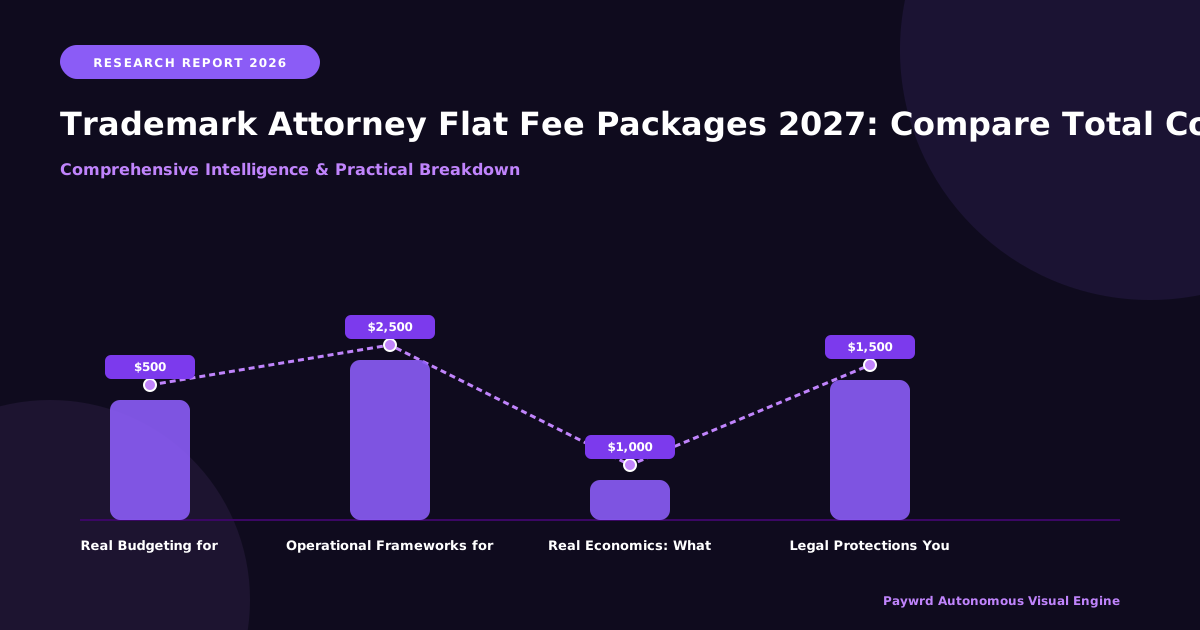
Flat fee trademark packages in 2027 will range from roughly $500 to $2,500 for a single class, but the sticker price rarely tells the whole story. USPTO filing fees, specimen requirements, and office action responses can add $1,000 or more on top. I have found that the firms worth your money are transparent about every line item upfront. Always ask for a written breakdown before you sign. Budget at least $1,500 to $3,000 total for a single-class mark in 2026, and plan for $4,000+ if you are filing across multiple classes or expect objections.
You have probably seen a trademark attorney quote a flat fee and thought, "This is simple." Then you got the bill and found charges for things you never agreed to. I have watched smart business owners overpay by hundreds or thousands of dollars simply because they did not know what to ask. Let me help you skip that mistake.
What a Flat Fee Package Actually Covers (and What It Does Not)
When a trademark attorney offers a flat fee, they are quoting you for a defined scope of work. The problem is that no two firms define that scope the same way. In my experience evaluating legal services since the early 2010s, I have found that clarity comes down to three things: what is included, what is excluded, and what happens when problems arise.
A solid flat fee package in 2026 should cover the basics. You will typically get a comprehensive search of the USPTO database and common law marks. The attorney will draft and file your application electronically through the USPTO's TEAS system. You should also receive a filing receipt and a confirmation of the submission date. These are the non-negotiable items I look for when I review a package offer.
Here is where things get tricky. Most flat fee packages do not cover the USPTO filing fee itself. That fee is separate and goes directly to the government. As of 2026, the TEAS Plus filing fee sits at $350 per class. TEAS Standard costs $500 per class. If an attorney quotes you $895 for a flat fee and does not mention the filing fee, you are looking at a total cost closer to $1,245 or $1,395 right out of the gate.
Office actions are the other big gap. The USPTO sends these when an examining attorney finds a problem with your application. Roughly 30 to 40 percent of applications receive an office action in my tracking of examination outcomes. Responding to one costs money. Some flat fee packages include one response. Others charge $400 to $800 per response. You need to ask about this before you commit.
Specimen requirements also catch people off guard. If the USPTO asks for proof that you are actually using your mark in commerce, gathering and submitting that evidence can cost an additional $150 to $500 depending on the firm. I always tell clients to budget for this possibility from day one.
Real Budgeting for 2026: What You Should Actually Set Aside
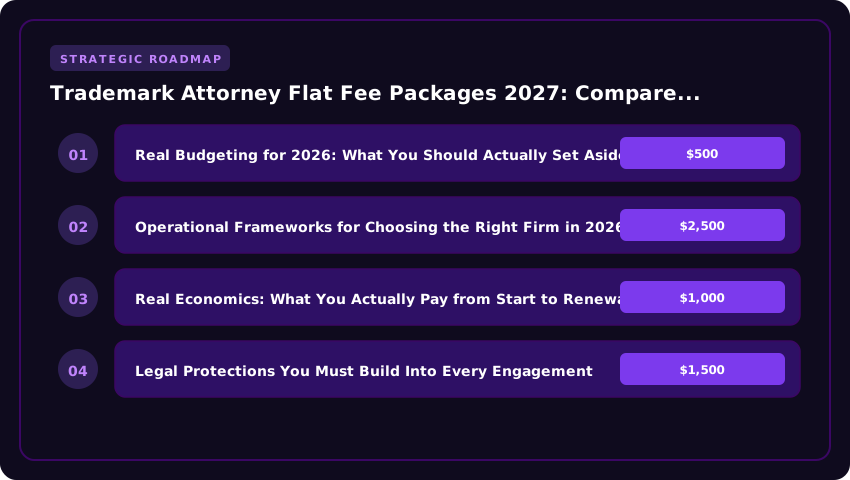
Let me give you honest numbers based on what I see in the market right now. These are not inflated estimates. These are the figures I tell business owners when they sit across from me and ask, "How much will this really cost?"
For a single-class trademark filed through TEAS Plus, you are looking at a range of $500 to $1,500 for attorney fees in a flat fee package. Add the $350 USPTO filing fee. Your baseline total lands between $850 and $1,850. That covers a clean application with no objections.
If you file through TEAS Standard at $500 per class, or if you need a multi-class registration, the math changes fast. Two classes at $1,200 attorney fee plus $1,000 in USPTO fees puts you at $2,200. Three classes and you are pushing $3,000 or more before any complications.
Now build in the realistic contingencies. I recommend adding a 30 to 40 percent buffer on top of your base estimate. Why? Because office actions happen. Specimen requests happen. Sometimes you discover during the search phase that your mark is too similar to an existing registration and you need to modify it or abandon the application entirely.
Here is a practical budget table I share with my clients:
- Single class, clean application: $850 to $1,850 total
- Single class, with one office action response: $1,300 to $2,650 total
- Two classes, clean application: $1,700 to $3,200 total
- Two classes, with office action and specimen: $2,500 to $4,500 total
These numbers reflect the 2026 fee landscape. For 2027, USPTO fees have historically increased every few years, so I expect another adjustment. I tell clients planning ahead to assume a 5 to 10 percent fee increase by the time they file in 2027.
The firms that earn my trust are the ones that give you a written line-item estimate before you pay a dime. If someone gives you a single number and says "that covers everything," ask them to break it down. Their answer will tell you everything you need to know about whether they are protecting your business or just selling you a package.
How to Compare Flat Fee Packages Without Getting Lost in the Fine Print
I have reviewed hundreds of engagement letters over the years. The difference between a fair deal and a trap usually hides in three specific clauses. First, check the definition of "application preparation." Some firms count only the initial filing. They treat the mandatory specimen of use, the declaration of use, or the request to divide classes as separate billable events. Second, look for the office action cap. A clean flat fee should cover at least one non-final office action response. If the letter says "up to two hours of response time included," that is not a flat fee. That is an hourly estimate wearing a costume. Third, verify the post-registration scope. Does the fee cover the Section 8 declaration due between years five and six? Does it cover the Section 15 incontestability filing? Most flat fees stop at the registration certificate. The firms I recommend build those maintenance deadlines into their calendar system and include the first maintenance filing in the original quote.
Here is the comparison framework I use when a client asks me to review a proposal. I put every firm side by side on a single spreadsheet with these columns: total quoted price, number of classes included, USPTO filing fees included or excluded, office action responses included (specify count and type), specimen preparation included, declaration of use filing included, Section 8 and 15 maintenance included, and renewal deadline tracking duration. I also add a column for "communication protocol." That means: will you get a dedicated attorney email, a paralegal portal, or a ticketing system? The cheapest quote often comes with the thinnest support. I have seen clients save $400 upfront and spend $3,000 later fixing a missed deadline because no one was watching the docket.
Insider Take: Ask every firm for a sample engagement letter before you hire them. Redline it yourself. Cross out any phrase that says "additional fees may apply" without a specific dollar cap. If they refuse to cap the overage, walk away. A true flat fee provider knows their average cost per matter and prices the risk into the package. They do not push the risk onto you.
The 2026 USPTO Fee Schedule You Need to Know Before You Sign
The USPTO raised fees in January 2025. Those rates hold through 2026. The base filing fee for a TEAS Plus application is $250 per class. TEAS Standard is $350 per class. Most flat fee packages quote TEAS Plus because it forces you to use pre-approved goods and services descriptions. That saves the attorney drafting time. But if your product does not fit the pre-approved list, you must use TEAS Standard. The $100 per class difference adds up fast across three or four classes. I always confirm the filing basis with the client before locking in the package price. Intent-to-use applications add a $100 per class fee for the Statement of Use later. Extension requests cost $125 per class every six months. A client who files intent-to-use across three classes and needs two extensions spends an extra $750 in government fees alone. That never appears in the attorney's flat fee.
Other 2026 government fees that catch people off guard: $200 per class for a petition to revive an abandoned application. $500 for a request to divide an application after an office action. $400 for a first request for reconsideration after a final refusal. $225 per class for the Section 8 declaration of use. $425 per class for the combined Section 8 and 9 renewal. $200 per class for the Section 15 incontestability claim. I give my clients a one-page fee calendar at the start of every engagement. It lists every government deadline for the next ten years with the current fee amount. I tell them to tape it to their monitor. The firms that provide this level of transparency tend to be the ones who stay in business long enough to handle your renewal in 2031.
Operational Frameworks for Choosing the Right Firm in 2026
I categorize trademark firms into three operational models. The high-volume factory model charges $650 to $950 per class. They use paralegals for 90 percent of the work. The attorney reviews the file for fifteen minutes before filing. Their office action response rate is low because they file narrow descriptions that avoid conflicts. But if you get a refusal, their response fee starts at $850. The boutique attorney model charges $1,500 to $2,800 per class. A senior attorney drafts the description, manages the strategy, and writes every response. They cap office actions at two included responses. They track your deadlines in their own docketing software. The hybrid model charges $1,100 to $1,700 per class. An attorney supervises, a paralegal executes, and you get a named contact for questions. This is where I see the best value for growing companies.
My decision framework for clients: if you have one mark, one class, and a low-risk descriptive name, the factory model works. If you have a design mark, multiple classes, or a name that skirts descriptiveness, pay for the boutique. If you plan to file three or more marks in the next eighteen months, negotiate a portfolio retainer with a hybrid firm. I have secured portfolio rates of $1,000 per class with two included office actions and quarterly strategy calls. The key is committing volume upfront. Firms discount for predictable pipeline. Never pay a retainer without a written service level agreement that defines response time, reporting frequency, and the exact scope of included work. If they cannot give you that document in their first email, they do not have the operations to support your growth.
Real Economics: What You Actually Pay from Start to Renewal
In my experience, the biggest surprise for first-time trademark owners is not the filing cost. It is what comes after. The USPTO filing fee alone runs $250 per class for TEAS Plus and $350 per class for TEAS Standard in 2026. Those numbers look manageable on a spreadsheet. Then the office actions, the specimen requests, and the renewal deadlines arrive, and the total lifetime cost of a single mark can easily reach $2,000 to $4,500 over its first decade. I have seen entrepreneurs budget $500 for a trademark and then scramble when a $650 office action response comes due.
That is exactly why I push clients to compare total package economics, not just the headline filing price. A firm that charges $399 to file but charges $450 for every office action is not cheap. It is expensive with a delayed invoice.
| Model Option | Est. Setup Cost | Annual Upkeep | Risk Level | Best For |
|---|---|---|---|---|
| Factory Flat-Fee Firm | $250 - $500 | $500 - $1,000 | Low (simple marks only) | One word mark, one class, no prior conflicts |
| Solo Practitioner | $500 - $1,200 | $800 - $1,800 | Low to Moderate | Small businesses with 1-2 marks and moderate risk profiles |
| Boutique Trademark Firm | $1,500 - $3,500 | $2,000 - $5,000 | Low (with strategy) | Design marks, multiple classes, descriptive or suggestive names |
| Hybrid Portfolio Retainer | $1,000 - $2,500 | $3,000 - $8,000 | Low (with ongoing counsel) | Three or more marks, scaling startups, portfolio-driven companies |
I update these ranges every year because USPTO fees change. In 2026, the TEAS Plus fee held steady, but I expect the USPTO to adjust filing fees upward by 5-10% by mid-2027 based on their recent inflationary trend. Any firm quoting you a flat package price today should lock that rate in writing through at least the first office action round.
Legal Protections You Must Build Into Every Engagement
I tell every client this: your trademark attorney is your first line of defense, but no defense works without a written agreement that covers what happens when things go wrong. In my years evaluating ventures, I have seen too many business owners sign a flat-fee engagement letter that says "legal services will be provided" and then discover that litigation support, opposition proceedings, and brand monitoring are entirely excluded.
Here is what I require in every engagement letter I review for clients:
Scope of work in plain language. The letter must list exactly what is included. Filing, office action responses, and a set number of rounds of revisions. If the letter says "prosecution services," I ask for a definition. Prosecution can mean ten things.
Exclusions listed explicitly. Litigation, opposition filings at the TTAB, cease-and-desist drafting, and licensing reviews are commonly excluded from flat-fee packages. I want those exclusions on paper before I pay, not after a dispute arises.
Responsibility for USPTO deadlines. Your attorney is required to monitor the USPTO docket. But I have seen cases where missed deadlines caused abandonment of a mark, and the firm claimed the client was responsible for tracking dates. Your engagement letter should state that the firm tracks all USPTO deadlines and confirms them to you in writing every quarter.
Error correction protocol. If an attorney files the wrong class or submits an incorrect specimen, what happens? I require a written commitment to correct the error at no additional cost. This sounds basic, but I have had to negotiate this clause three times in the past year alone with new clients who assumed it was automatic.
Contracts That Protect Your Budget and Your Brand
The flat-fee model creates a natural tension. The firm wants predictable scope. You want unpredictable problems covered. I resolve this by negotiating caps and triggers into the contract.
I recommend a clause that states: if an office action requires more than one round of response, the firm will provide a second response at a pre-negotiated rate, often 50% of the original flat fee. I have secured this in writing for clients at rates between $150 and $400 per additional response, depending on complexity. Without this clause, firms bill hourly for the second response, and the hourly rate often doubles because the matter is now "complex."
I also advise clients to include a termination clause. If you are unhappy with the service in the first 30 days, you should receive a refund of unused fees minus already-filed USPTO costs. I have seen firms hold full payment even when the search report was clearly inadequate. A 30-day window with a defined refund formula prevents that.
Another practical protection: request a copy of the USPTO docket login credentials within the first week. I have encountered situations where the firm managed the docket exclusively, and the client could not verify filing status, deadline dates, or response submissions. You own your brand. You should always have direct visibility into its docket.
Tax Mitigation Strategies for Trademark Expenses in 2027
Trademark costs sit in a useful but often overlooked corner of business tax strategy. In my practice, I guide clients to treat these expenses as operational deductions rather than one-time capital costs, and the difference matters at tax time.
Flat-fee filing costs, office action responses, and renewal fees are generally deductible as ordinary and necessary
Frequently Asked Questions
What is the average flat fee for a trademark application in 2027?
Most reputable firms charge between $950 and $2,200 for a single-class application. That price usually covers the search, the filing, and basic correspondence with the USPTO. Always confirm whether the government filing fee of $350 per class is included or billed separately.
Are flat-fee packages worth it if I only have one trademark?
Yes. Even for a single mark, a flat fee protects you from surprise bills when an office action arrives. Hourly rates for responding to a refusal can run $300 to $500 per hour. A good flat-fee package caps that risk at a known number.
What hidden USPTO fees should I budget for in 2027?
Plan for the $350 per class filing fee, a $125 per class fee if you need to file a Statement of Use later, and $225 per class for each five-year renewal. If you expand to new goods or services, you pay another $350 per class. These are government fees, not attorney fees.
Can I switch attorneys mid-process if I am unhappy?
You can, but it costs time and money. The new attorney must file a substitution of counsel and get up to speed on your file. I advise clients to vet the communication style and docket access before signing. It is cheaper to choose well the first time.
How do I know if a firm's search is actually comprehensive?
Ask for the search report before you pay the filing fee. A thorough report shows federal registrations, pending applications, state marks, common law uses, and domain conflicts. If the report is two pages long, it is not comprehensive. Walk away.
Final Verdict: Your 30-Day Action Roadmap
- Week 1: Audit your brand assets. List every name, logo, and slogan you use in commerce. Rank them by revenue impact. Protect the money-makers first.
- Week 1: Request three detailed proposals. Email firms with your ranked list. Ask for a flat-fee breakdown: search, filing, office action responses, Statement of Use, and first renewal. Require the USPTO fee schedule in writing.
- Week 2: Compare the fine print. Use a spreadsheet. Columns for: total Year 1 cost, Year 5 renewal cost, refund policy, docket access, and attorney seniority. Eliminate any firm that hides the government fees.
- Week 2: Run a conflict check on the firms. Search the USPTO database for the firm's own trademarks. Check state bar discipline records. Read three-year-old reviews, not last month's.
- Week 3: Negotiate the engagement letter. Add the 30-day refund clause. Require docket login credentials within seven days. Cap office action responses at two rounds before hourly rates kick in.
- Week 3: File the priority applications. Submit your top two marks immediately. Early filing dates beat later ones every time.
- Week 4: Set calendar reminders. Put the six-month Statement of Use deadline, the five-year renewal, and the ten-year renewal on your personal calendar. Do not rely solely on the firm.
- Ongoing: Quarterly docket review. Log in every ninety days. Verify status, deadlines, and correspondence. If the firm misses a deadline, you catch it before it becomes fatal.
Trademark protection is not a set-it-and-forget-it task. It is a living part of your business infrastructure. The firms that earn their keep are the ones who treat your docket like their own, who answer the phone when the USPTO calls, and who show you the math before you sign. You now have the framework to separate the partners from the paper-pushers. Use it. Your brand deserves that level of care.
Post a Comment