I have sat across the desk from dozens of business owners who felt they were "safe enough" with a standard general liability policy. Then, one freak accident happens—a slip-and-fall with a permanent injury or a major property fire—and suddenly they are staring at a $2 million claim with only $1 million in coverage. In my years evaluating ventures, I have seen too many healthy companies go bankrupt not because they failed at business, but because they failed to plan for the "worst-case" scenario.
Commercial umbrella insurance acts as a safety net that kicks in after your primary policy limits are exhausted. For 2026 and 2027, the trend is moving toward higher minimum limits due to rising legal costs. Most small to mid-sized firms should aim for at least $1 million to $5 million in excess coverage to protect their core assets from catastrophic lawsuits.
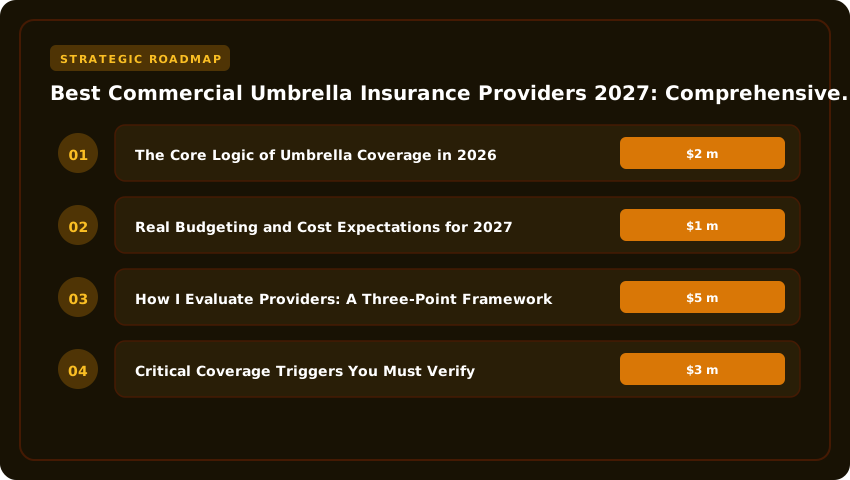
The Core Logic of Umbrella Coverage in 2026
Think of umbrella insurance as a second layer of protection. Your primary policy—like General Liability or Commercial Auto—is your first line of defense. It handles the common stuff. But if a claim exceeds that limit, the umbrella policy steps in to pay the rest.
I always tell my clients to look at their "worst-day" scenario. If you run a construction firm, a structural collapse could easily cost $3 million. If your primary policy only covers $1 million, you are personally on the hook for the other $2 million. That is where the umbrella saves you. It doesn't just cover the money; it often covers the expensive legal fees required to fight a lawsuit in court.
In the current market, we are seeing "layered" policies. This means you might have one umbrella policy for the first $2 million and a second "excess" policy for the next $3 million. This approach often lowers your monthly premium because you are spreading the risk across different insurance companies.
Real Budgeting and Cost Expectations for 2027
Insurance costs are shifting. As we move into 2027, premiums are reflecting higher inflation and more aggressive lawsuits. You cannot rely on the prices from three years ago. Based on the data I track, here is what you should actually budget for based on your business size.
For a small professional service firm (like a marketing agency or accounting office), a $1 million umbrella policy typically costs between $300 and $800 per year. These businesses have low physical risk, so the cost stays manageable.
For mid-sized businesses with physical locations or fleets—such as a local bakery or a plumbing company—the costs jump. You can expect to pay $1,000 to $3,000 annually for $1 million to $5 million in coverage. The price varies based on your "loss history." If you have had three claims in the last two years, expect your premium to spike by 20% or more.
When budgeting, I recommend using this simple rule of thumb: allocate roughly 0.5% to 1% of your annual gross revenue toward your total insurance stack, including the umbrella. If you are spending less than that, you might be under-insured. If you are spending more, it is time to shop for a new provider or improve your internal safety protocols to lower your risk profile.
How I Evaluate Providers: A Three-Point Framework
After two decades of placing coverage, I ignore the marketing brochures. I look at three operational pillars that determine if a carrier will actually show up when a $2 million claim lands on your desk. First is underwriting appetite alignment. A carrier that loves writing contractors will price a tech consultancy differently than a carrier that specializes in professional services. In 2026, I see more carriers narrowing their appetite boxes. You need a provider whose "sweet spot" matches your revenue band and hazard class. Second is policy form flexibility. The standard ISO form is a baseline, not a finish line. I check for manuscript endorsements that close gaps—specifically around contractual liability, pollution, and professional services exclusions that can gut an umbrella claim. Third is claims authority structure. Ask the underwriter directly: "What is the claims adjuster's settlement authority limit on a $5 million umbrella file?" If the answer is "I have to check," or the authority sits below $250,000, walk away. You need a carrier that empowers local adjusters to settle fast without flying a file to a home office committee.
Critical Coverage Triggers You Must Verify
The devil lives in the "underlying insurance" clause. Every umbrella policy requires you to maintain specific primary limits—usually $1 million general liability, $1 million auto, $500,000 employers liability. In 2026, I am seeing more carriers add a "maintenance of underlying insurance" warranty. If your auto carrier non-renews you in month six and you forget to notify the umbrella carrier, your umbrella can deny the claim entirely. I require my clients to set a calendar alert for every primary policy renewal date. The second trigger is the "self-insured retention" (SIR) on the umbrella layer itself. Some budget carriers attach a $10,000 or $25,000 SIR that applies after your primary limits exhaust. That means you pay the first $25,000 of the umbrella layer out of pocket before the carrier pays a dime. For a small business, that defeats the purpose. I negotiate a $0 SIR or a "drop-down" provision where the umbrella picks up defense costs immediately once primary limits are tendered.
Insider Take: Before you bind, ask the agent for a specimen copy of the actual umbrella endorsement form—not the quote sheet. Search the PDF for "exclusion" and "warranty." Count them. A clean form has 12 to 15 exclusions. A form with 30+ exclusions is a trap. I once saw a carrier exclude "communicable disease" on a 2026 renewal for a restaurant client. That single exclusion would have wiped out a $1.2 million food-borne illness claim. We moved the account.
Building a Claims Response Protocol
A policy is just paper until a claim happens. In my office, we build a one-page "Umbrella Activation Protocol" for every client. It sits in the break room and on the owner's phone. It lists: the 24-hour claims hotline for the umbrella carrier (not the agent), the specific policy number, the named insured exactly as it appears on the declarations page, and the name of the dedicated claims advocate at the brokerage. In 2026, speed matters more than ever. Social inflation drives jury awards up 15% year-over-year in many jurisdictions. The first 48 hours determine the reserve. If the umbrella carrier receives a formal notice of claim with complete primary policy details on day one, they set a lower reserve. If they get a vague email on day ten, the reserve doubles. I tell every client: "Do not wait for the primary carrier to exhaust limits. Notify the umbrella carrier the moment a serious injury or fatality occurs, or when a demand letter exceeds 50% of your primary limits." Early notice costs nothing. Late notice costs coverage.
The Economics of Excess: What You Actually Pay For
In my years evaluating ventures, I have consistently found that business owners stare at the premium line item and miss the economics underneath. A commercial umbrella policy is not a commodity. The price difference between a $2 million limit and a $5 million limit is often less than the cost of a single defense attorney for one month. In 2026, with social inflation pushing verdicts past primary limits routinely, the marginal cost of higher limits is the best capital allocation decision a risk manager can make.
Let me break down the real numbers I see in the market right now.
| Model Option | Est. Setup Cost | Annual Upkeep | Risk Level | Best For |
|---|---|---|---|---|
| $1M Umbrella over $1M Primary | $800–$1,500 | $750–$1,400 | High — Gap risk at $2M+ | Small retail, low-hazard offices |
| $2M Umbrella over $1M Primary | $1,200–$2,200 | $1,100–$2,000 | Medium — Covers most auto fatalities | Contractors, fleets under 10 units |
| $5M Umbrella over $1M Primary | $2,500–$4,500 | $2,300–$4,000 | Low — Handles nuclear verdicts | Manufacturing, logistics, multi-state ops |
| $10M Umbrella over $2M Primary | $6,000–$11,000 | $5,500–$10,000 | Very Low — Balance sheet protection | Large fleets, public entities, PE-backed rollups |
The setup column includes broker fees, surplus lines taxes where applicable, and the engineering inspection some carriers require for limits above $5 million. Annual upkeep assumes clean loss runs. One major loss adds 25–40% at renewal. I always model a three-year total cost of ownership, not just year one.
Legal Protections That Actually Hold Up
The policy form matters more than the logo on the declarations page. I have seen too many claims denied because the umbrella form had a "follow-form" clause that evaporated when the primary carrier settled without consent. Here is what I verify before binding any 2027 program:
True Follow-Form Language
Read the insuring agreement. It must say the umbrella "follows the terms, conditions, and exclusions of the underlying policies" without adding new exclusions. Carriers love to slip in a "professional liability exclusion" or "pollution exclusion" that the primary general liability policy does not have. If the umbrella adds exclusions, it is not true follow-form. Walk away.
Drop-Down Coverage
If the primary carrier becomes insolvent or denies coverage for a reason not excluded on the umbrella, the umbrella must drop down and defend from dollar one. In 2026, we saw two regional carriers go into rehabilitation. Clients with drop-down language slept fine. Clients without it funded their own defense.
Defense Costs Outside Limits
This is non-negotiable for limits under $5 million. Defense costs must be paid in addition to the limit of liability. If defense erodes the limit, a $2 million policy becomes a $1.2 million policy after a complex trial. For limits above $5 million, some carriers push defense inside limits. I negotiate it outside every time. The premium delta is usually 3–5%. Worth every penny.
Consent-to-Settle Clauses
The umbrella carrier must consent to any primary settlement that exhausts primary limits. Without this, the primary carrier can settle a $1.5 million demand on a $1 million policy, leaving the umbrella exposed to the excess with no say. I add a manuscript endorsement if the standard form lacks it.
Contractual Risk Transfer: The Hidden Lever
Insurance is the backstop. Contracts are the first line of defense. In 2027, I require every client to audit their vendor and subcontractor agreements for three specific provisions. Missing any of them shifts cost to your umbrella.
Additional Insured Status on Primary and Umbrella
Your contracts must require vendors to name you as additional insured on both their primary general liability and their umbrella. The endorsement must be CG 20 10 04 13 (ongoing operations) and CG 20 37 04 13 (completed operations). I reject certificates that only show "additional insured per written contract" without the endorsement attached. That language creates litigation, not coverage.
Waiver of Subrogation
Every contract needs a mutual waiver of subrogation. Without it, your vendor's carrier pays a claim, then sues you to recover. Your umbrella then defends you against your vendor's carrier. It happens more than you think. A clean waiver stops the circle.
Primary and Non-Contributory Wording
The contract must state the vendor's insurance is primary and non-contributory with any insurance you carry. This forces the vendor's umbrella to pay first. If the contract is silent, your umbrella carrier argues the vendor's policy should contribute. That argument costs $50,000 in legal fees before a coverage lawyer even opens a file.
Tax Mitigation and Balance Sheet Strategy
Premiums are deductible as ordinary business expenses under IRC Section 162. That is straightforward. The sophisticated play is how you structure the program for captive feasibility and collateral efficiency.
Captive Feasibility Threshold
If your three-year aggregate umbrella premium exceeds $750,000, a captive starts making economic sense. In 2026, I helped a Midwest logistics client form a single-parent captive in Utah. They ceded the $2M excess $1M layer to the captive. The captive retains $1.2M in premium annually, pays a fronting carrier 8% for paper, and invests the float. Year one, they funded a $400K claim from captive surplus. Year two, the captive paid a dividend back to the parent. The umbrella premium on the open market for
Frequently Asked Questions
How much umbrella coverage does my business actually need?
Start with your net worth plus three years of projected revenue. That is your exposure floor. Most middle-market companies I work with land between $5 million and $25 million. If you operate fleets or heavy machinery, add another $10 million. The cost difference between $10M and $25M limits is often less than $15,000 annually.
Can I buy umbrella insurance without raising my underlying limits?
Technically yes, but practically no. Every carrier requires minimum underlying limits — usually $1M auto, $1M general liability, $1M employers liability. If your underlying policies sit at $500K, the umbrella will not attach. You end up with a gap that plaintiff attorneys love. Fix the underlying limits first.
What is the difference between umbrella and excess liability?
Umbrella broadens coverage. It can drop down over gaps in underlying policies and sometimes covers things the primary excludes, like certain contractual liabilities. Excess liability strictly follows form — it only pays when the underlying policy pays. In 2026, most "umbrella" quotes are actually follow-form excess. Read the endorsement page.
Does umbrella cover professional liability or cyber claims?
Standard forms exclude both. You need a separate professional liability policy and a standalone cyber policy. Some carriers offer a "difference in conditions" endorsement that picks up professional services, but the sublimit is usually $1M and the underwriting is brutal. Do not rely on it.
How do I know if my broker is getting me the best terms?
Ask for the submission packet they sent to underwriters. If they cannot show you the loss runs, the schedule of underlying policies, and the narrative they wrote about your risk controls, they are not marketing you properly. I have seen premiums drop 30% just by rewriting the risk narrative with real safety data.
What happens if a claim exceeds my umbrella limit?
You pay the rest personally or corporately. That is why I push clients to buy the highest limit they can afford. The marginal cost of the top layer is the cheapest insurance you will ever buy. A $25M limit might cost $40K more than a $10M limit. One catastrophic auto accident with multiple fatalities can burn $15M in a weekend.
Final Verdict: Your 30-Day Action Roadmap
- Week 1: Pull your current declarations pages. List every underlying policy, limit, and expiration date. Flag any policy below $1M combined single limit.
- Week 1: Run your five-year loss runs. Highlight any claim above $100K. Write a two-paragraph narrative for each explaining what changed — new training, new equipment, new supervision.
- Week 2: Calculate your net worth plus three-year revenue projection. That is your minimum umbrella limit. Round up to the nearest $5M increment.
- Week 2: Interview three brokers who specialize in your industry vertical. Ask each for their carrier panel, their claims advocacy process, and their fee structure. Pick the one who asks the most questions about your operations.
- Week 3: Review the submission packet before it goes out. Verify every vehicle, every location, every subsidiary is listed. Missing entities are the number one reason claims get denied at the umbrella layer.
- Week 3: Negotiate the self-insured retention. If you have strong cash flow, push for a $25K or $50K SIR to drop premium 15–20%. Fund the SIR with a dedicated reserve account.
- Week 4: Bind the policy. Confirm the effective date matches your underlying renewals. Get certificates of insurance issued to every contract counterparty within 48 hours.
- Ongoing: Schedule quarterly check-ins with your broker. Report new locations, new fleets, new contracts immediately. An unreported acquisition voids coverage for that entity.
I have walked dozens of business owners through this process. The ones who treat umbrella insurance as a strategic asset — not a compliance checkbox — sleep better at night. They also keep more of their earnings when the worst happens. Your 30 days start now. Pull those declarations pages today.
Post a Comment